

TL;DR:
- Most Amazon sellers believe increasing their PPC budget is the fastest way to boost sales, but marketing success depends on listing optimization and channel integration. Effective ecommerce marketing entails leveraging SEO, PPC, email, and social channels to create a cycle of visibility, conversion, and retention that drives organic growth. Fixing listings, managing PPC intelligently, and measuring off-Amazon channels with Amazon Attribution are crucial for sustainable, scalable growth.
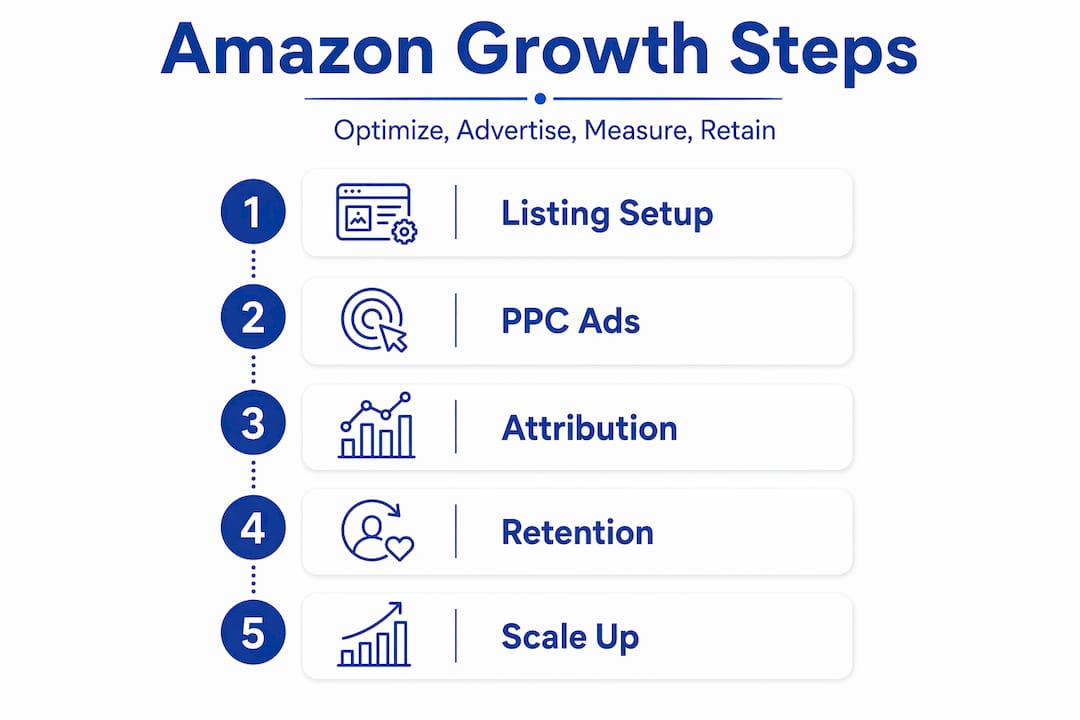
Most Amazon sellers believe that turning up their PPC budget is the fastest path to more sales. It feels logical. Spend more, get more visibility, capture more buyers. But ecommerce marketing is more than a dial you turn up. Sellers who rely entirely on paid ads without fixing their listings or connecting their marketing channels often watch their advertising cost of sale (ACoS) climb while conversions stay flat. This guide breaks down how to apply ecommerce marketing strategies across listing optimization, PPC, external attribution, and lifecycle marketing so every dollar you spend works harder.
Table of Contents
- What is ecommerce marketing and why it matters for Amazon sellers
- Amazon listing optimization: the foundation for ecommerce marketing success
- Smart Amazon PPC management: reducing waste and supporting your listing flywheel
- Using Amazon Attribution to measure and optimize off-Amazon marketing channels
- Maximizing customer retention with ecommerce lifecycle marketing strategies
- Why most Amazon sellers get ecommerce marketing wrong (and what truly drives growth)
- Optimize your Amazon listings and marketing with Searchoneers
- Frequently asked questions
What is ecommerce marketing and why it matters for Amazon sellers
Ecommerce marketing is the full set of digital channels and tactics used to attract, convert, and retain online customers. The core flow is simple: visibility drives traffic, traffic enables conversion, and strong conversion builds retention. As Salesforce explains, ecommerce marketing emphasizes that exact sequence: visibility → conversion → retention. Miss any stage and the whole engine stalls.
For Amazon sellers, the channels at play include:
- Amazon SEO (organic ranking through listing relevance and keyword signals)
- PPC advertising (Sponsored Products, Sponsored Brands, Sponsored Display)
- Email marketing (post-purchase sequences, re-engagement, and promotions)
- Social commerce (driving external traffic from Instagram, TikTok, and Facebook)
- Website personalization (product recommendations and dynamic content for off-Amazon assets)
The real power comes when these channels reinforce each other. A well-optimized listing converts paid traffic more efficiently, which lowers ACoS and boosts organic rank. Better organic rank generates sales without ad spend. Those sales feed review velocity, which raises conversion again. It is a flywheel. Sellers who treat each channel as a separate silo miss the compounding effect entirely.
Amazon-specific relevance matters here too. Your high-converting listing guide is the anchor point for every other marketing activity. Without it, no channel performs at its best.
Amazon listing optimization: the foundation for ecommerce marketing success
Think of your listing as the landing page for every marketing effort you run. Send traffic to a weak listing and you are filling a leaky bucket. Fix the listing first and every subsequent investment pays better returns.
Amazon’s A10 algorithm ranks products based on three primary signals: listing relevance, conversion rate on a given search query, and the quality of external traffic flowing to the detail page. According to current listing optimization best practices, keyword stuffing and keyword density tactics no longer move the needle. Amazon’s algorithm has matured far beyond counting keyword repetitions.
What actually works:
- Title: Front-load your primary keyword naturally. Write for readability, not robots.
- Bullet points: Lead with benefits before features. Each bullet should answer a specific buyer objection.
- Product description and A+ content: Tell the brand story, expand on use cases, and include secondary keywords naturally.
- Backend keywords: Use this space for synonyms, alternate spellings, and terms that do not fit naturally in visible copy.
- Images: High-quality lifestyle images, infographics, and comparison charts all contribute to conversion rate, which directly feeds ranking.
The relationship between listings and ads is direct. Strong ad performance begins with a well-optimized, high-converting listing because ads feed into the organic flywheel, not around it.
Pro Tip: Schedule listing audits every two to four weeks. Algorithm updates, seasonal trends, and competitor movements can shift what converts. Small, iterative updates maintain momentum far better than one big annual overhaul.

Building a repeatable process matters here. A documented listing optimization workflow keeps your updates consistent and traceable. Use your listing enhancement guide as the playbook and test changes against conversion data. When you increase product conversions even modestly, the compounding effect on organic rank is significant.
Smart Amazon PPC management: reducing waste and supporting your listing flywheel
PPC is fuel for the flywheel, not the engine itself. Without a strong listing underneath, ads burn money without building any lasting momentum.
The most common PPC mistake is passivity: set up campaigns, let them run, and check results monthly. Weekly search term analysis is where real savings live. Reviewing search term reports weekly and converting non-converting queries into negative keywords can cut wasted spend by 15 to 25 percent. That is real budget you can redirect toward high-performing targets.
Here is a simple weekly process to manage negative keywords efficiently:
- Pull your search term report from Seller Central every Monday.
- Sort by spend descending. Flag any term with meaningful spend but zero or very low conversions.
- Cross-reference against your listing. If the term is genuinely irrelevant, add it as a negative exact in the relevant campaigns.
- For high-converting search terms you have not yet targeted explicitly, create dedicated exact match campaigns to control bidding precisely.
- Document every change in a running log so you can track the effect on ACoS over time.
Pro Tip: Your PPC search term data is also a goldmine for listing updates. If a term converts well in ads but is absent from your listing copy, add it. Closing that gap strengthens both organic relevance and paid performance simultaneously.
Your negative keywords guide walks through the full approach with more depth, including campaign-level vs. ad group-level negatives and how to structure your campaign architecture to minimize cannibalization.
Using Amazon Attribution to measure and optimize off-Amazon marketing channels
Driving external traffic to your Amazon listings can accelerate ranking significantly. But without measurement, you are spending blind. Amazon Attribution is the tool that changes that.
Attribution works by generating unique tracking tags for each external campaign. You place those tags in your URLs, and Amazon records what happens after the click: did the customer view your detail page, add to cart, and ultimately buy? Amazon Attribution assigns credit using a 14-day last-touch model, meaning the most recent external channel click before purchase gets the revenue credit.
The key metrics to watch:
| Metric | What it measures | Why it matters |
|---|---|---|
| Detail page views | Visits to your listing from external traffic | Signals whether your ad creative drives curiosity |
| Add-to-cart rate | Share of visitors who add the product to cart | Reveals listing-level friction for external audiences |
| Purchase rate | Percentage who complete a buy | Shows true conversion from off-Amazon sources |
| New-to-brand purchases | First-time buyers of your brand on Amazon | Measures your audience expansion from external spend |
| Return on ad spend (ROAS) | Revenue generated per dollar spent externally | The core profitability signal for each channel |
Understanding these numbers tells you which external channels, whether Facebook ads, Google Shopping, influencer links, or email campaigns, are genuinely moving product versus just generating clicks. Without this data from your Amazon analytics, external marketing becomes guesswork. With it, you can confidently scale what works and cut what does not.
Maximizing customer retention with ecommerce lifecycle marketing strategies
Acquiring a new customer costs significantly more than retaining an existing one. Yet most Amazon sellers invest almost everything in acquisition and almost nothing in retention. That is a leaky bucket problem at the business model level.
Lifecycle marketing treats your ecommerce business as a funnel with four stages:
- Awareness: Customers discover your brand through ads, search, or social media.
- Consideration: They evaluate your product, read reviews, and compare options.
- Conversion: They purchase.
- Retention: You bring them back for repeat purchases and build long-term loyalty.
Email is the workhorse of the retention stage. Automated email sequences for welcome, abandoned cart, and re-engagement events are among the most powerful retention tools available to ecommerce businesses. For Amazon sellers, this requires capturing customer emails through off-Amazon channels such as brand website traffic, social media lead magnets, or insert card campaigns that drive buyers to register for warranties or exclusive content.
Once you own that email relationship, you are no longer entirely dependent on Amazon’s ecosystem. You can drive traffic back to your listings on demand, announce new product launches, recover lapsed customers, and test offers with a known audience.
Pro Tip: Personalization dramatically outperforms generic blasts. Segment your email list by purchase history, product category, or engagement level. A customer who bought hiking gear should not get the same email as someone who bought kitchen accessories. The more relevant your message, the higher your open and click rates. Your conversion rate checklist can guide you on what behaviors to trigger emails around.
Why most Amazon sellers get ecommerce marketing wrong (and what truly drives growth)
Here is the uncomfortable truth: most Amazon sellers treat their marketing channels like separate experiments rather than a connected system. PPC is “the ads team.” Listing copy is “the SEO task.” Email is “something we should probably do someday.” That fragmented thinking is exactly why growth stalls.
The sellers who consistently scale are the ones who understand that every channel feeds every other channel. PPC data informs listing copy. Listing conversion rate determines whether PPC is profitable. External traffic quality shows up in organic ranking signals. Email retention reduces the cost of growth by making every acquired customer worth more over time. These are not separate levers. They are one machine.
The other major mistake is scaling too early. We have seen sellers pour thousands into Sponsored Products campaigns on listings that convert at two percent. The math never works. Fix the listing and get conversion above eight to ten percent for your category before you scale ad spend. It is counterintuitive because increasing budget feels like taking action, but it is often the most expensive form of inaction available.
Measurement is the third gap. Sellers who drive social media traffic to their listings without using Amazon Attribution are essentially running campaigns in the dark. They cannot tell which channel drove the sale, which means they cannot invest more in what worked. Scaling off-Amazon traffic without proper attribution data often produces inflated ROI assumptions that collapse when properly tracked.
The truth about digital marketing for ecommerce on Amazon is this: relevance, conversion, and external traffic quality are the three signals Amazon weights most. Build your strategy around improving all three simultaneously, use your product listing guide and negative keywords strategy as your foundational tools, and the growth compounds. Ignore any one of them and you are working against yourself.
Optimize your Amazon listings and marketing with Searchoneers
You now have the framework. The next step is applying it without losing weeks to trial and error or making costly missteps on live campaigns.

At Searchoneers, we specialize in exactly this kind of work. Our listing enhancement guide reflects the same data-driven principles covered here, and our team applies them through expert audits, conversion-focused rewrites, and backend keyword refinement aligned with Amazon’s current ranking signals. We also offer a documented optimization workflow built for scaling across multiple SKUs without data drift. For sellers ready to cut wasted ad spend and grow organically, our data-driven SEO optimization service translates the insights in your search term reports and analytics into real listing and campaign improvements. Every service is built around measurable outcomes, not guesswork.
Frequently asked questions
What is the primary goal of ecommerce marketing for Amazon sellers?
The main goal is to increase product visibility, improve conversion rates, and retain customers using channels like SEO, PPC, email, and personalization. As Salesforce notes, the core flow moves from visibility to conversion to retention, and each stage must be actively managed.
How does Amazon Attribution help sellers measure off-Amazon marketing effectiveness?
Amazon Attribution tracks clicks from external campaigns and assigns sales credit using a 14-day last-touch model, revealing which off-Amazon channels drive actual Amazon purchases and new-to-brand customers.
Why should Amazon sellers focus on listing optimization before scaling PPC ads?
Because ads perform only as well as the listing they send traffic to. Scaling PPC on a weak listing wastes budget and produces poor ACoS; fixing conversion first makes every ad dollar more effective.
What is the best way to reduce wasted spend in Amazon PPC campaigns?
Review your search term reports weekly and add non-converting, high-spend queries as negative keywords. This process can reduce wasted spend by 15 to 25 percent and free up budget for better-performing targets.
How important is email marketing for ecommerce lifecycle management?
Email is one of the highest-ROI tools available for customer retention. Automated sequences for welcome, abandoned cart, and re-engagement events keep customers engaged and reduce dependence on costly paid acquisition.

Comments
4 responses to “Ecommerce marketing strategies that drive Amazon growth”
[…] in categories where a pure-play retailer would need higher margins to survive. You can explore ecommerce marketing strategies that align with this ecosystem to see how sellers can position themselves within it […]
[…] Ecommerce marketing strategies that drive Amazon growth – Searchoneers […]
[…] can explore ecommerce growth tactics that connect these platform-level behaviors to specific listing and advertising improvements. The […]
[…] your PIM efforts with ecommerce growth strategies that account for how enriched product data feeds into search visibility and conversion rates across […]