More than 60 percent of American shoppers start their search on Amazon, but only a fraction of sellers achieve standout conversions. If you are an American seller with a year or two of experience, you likely sense the challenge of competing against seasoned rivals. Knowing exactly how to analyze and enhance your product listings can help you capture the attention of buyers who are constantly bombarded by options.
Table of Contents
- Step 1: Assess Current Listing Performance Data
- Step 2: Enhance Titles and Bullet Points with Keywords
- Step 3: Refine Product Images and A+ Content
- Step 4: Implement Targeted Backend Keywords
- Step 5: Monitor Analytics and Optimize Continuously
Quick Summary
| Key Insight | Explanation |
|---|---|
| 1. Assess Your Current Listing Metrics | Regularly evaluate key performance indicators like conversion rate and click-through rate to identify improvement areas. |
| 2. Optimize Titles and Bullet Points | Use strategic keyword placement in your title and bullet points to enhance visibility and attract customers. |
| 3. Enhance Product Images and A+ Content | Create high-quality images and informative A+ Content to engage customers and increase conversion rates. |
| 4. Implement Targeted Backend Keywords | Use backend keywords effectively to capture more search queries without cluttering your primary listing. |
| 5. Continuously Monitor Analytics | Regularly review performance data and adapt your strategies based on customer interactions and trends. |
Step 1: Assess current listing performance data
To optimize your Amazon product conversions, you need a precise snapshot of your current listing performance. This means diving deep into key metrics that reveal how your product is actually performing in the marketplace. Amazon provides sellers with robust analytics that can unlock critical insights about your product’s visibility, engagement, and sales potential.
Start by accessing your Amazon Seller Central dashboard and examining core performance indicators. Evaluate Amazon product metrics using key performance indicators like conversion rate, click through rate, and search ranking position. Look specifically at your product’s sessions versus your actual sales numbers. A low conversion rate might signal issues with pricing, product images, description quality, or competitive positioning. Track these metrics consistently to understand performance trends and identify areas requiring strategic improvement.
Understanding these baseline metrics sets the foundation for targeted optimization. By analyzing your current performance data systematically, you can develop precise strategies to enhance your product listing and increase conversions.
Pro tip: Create a performance tracking spreadsheet to monitor your key metrics weekly, allowing you to quickly spot trends and make data driven adjustments to your Amazon strategy.
Here is a summary of key Amazon product listing metrics and their business impact:
| Metric | What It Measures | Common Issue Indicated | Business Impact |
|---|---|---|---|
| Conversion Rate | Percentage of buyers from total visitors | Low sales relative to traffic | Signals effectiveness of listing |
| Click Through Rate | Percentage of shoppers clicking listing from search | Weak title or main image | Impacts traffic and exposure |
| Sessions | Number of unique visits to listing | Declining interest or poor ranking | Affects visibility and growth |
| Search Ranking | Position in Amazon search results | Poor keyword targeting | Limits discoverability and sales |
Step 2: Enhance titles and bullet points with keywords
Optimizing your Amazon product listing requires strategic keyword placement that attracts both search algorithms and potential buyers. Your title and bullet points are critical real estate for improving product visibility and driving conversions. These sections serve as your primary communication channels with shoppers and Amazon’s ranking system.
Start by developing targeted keyword strategies that balance search volume, relevance, and buyer intent. For your product title, prioritize placing the most important keywords at the beginning while maintaining natural readability. Aim to include primary product attributes like brand name, key features, size, color, or quantity. Bullet points should expand on your title by highlighting specific benefits and unique selling propositions using additional relevant keywords. Avoid keyword stuffing and focus on creating clear, compelling language that speaks directly to customer needs and search patterns.
Remember that keyword optimization is an ongoing process. Continuously monitor your listing’s performance and be prepared to refine your approach based on changing market dynamics and customer search behaviors.
Pro tip: Use Amazon’s search term reports to identify emerging keywords and regularly update your listing to stay competitive and maintain strong search rankings.
Step 3: Refine product images and A+ Content
Creating compelling visual content is crucial for transforming Amazon product listings from ordinary to extraordinary. Your product images and A+ Content are powerful tools that can dramatically increase customer engagement and conversion rates by providing rich visual storytelling about your product.

Amazon A+ Content strategies can increase sales by up to 20% while significantly improving customer understanding and reducing return rates. Focus on creating high resolution images that showcase your product from multiple angles and demonstrate its real world use. Include lifestyle images that help potential buyers visualize how the product fits into their daily lives. For A+ Content, develop clear infographics that highlight key product features, technical specifications, and unique benefits using professional design and easy to understand visual layouts.
Successful visual content requires continuous refinement. Regularly analyze your image and A+ Content performance using Amazon’s analytics tools to understand which visuals resonate most with your target audience and drive the highest conversion rates.
Pro tip: Create a consistent visual brand narrative across all product images by using similar backgrounds, color schemes, and design elements that make your listings instantly recognizable.
Step 4: Implement targeted backend keywords
Backend keywords represent a strategic opportunity to expand your Amazon product’s search visibility without cluttering your visible listing content. These hidden search terms allow you to capture additional relevant search queries that potential customers might use when looking for products like yours.
Backend keyword strategies require careful planning to maximize your product’s discoverability. Focus on using the full available character space (approximately 250 to 500 bytes) while avoiding repetition of keywords already present in your title or bullet points. Include alternative spellings, common misspellings, related terms, and synonyms that customers might use. Prioritize long tail keywords that reflect specific customer search behaviors and exclude brand names to maintain compliance with Amazon’s guidelines.
Successful backend keyword implementation is an ongoing process. Regularly review your keyword performance using Amazon’s search term reports and be prepared to refine your strategy based on actual search data and emerging customer search trends.
Pro tip: Create a spreadsheet to track your backend keyword variations and performance metrics, allowing you to systematically test and optimize your search term strategy.
Below is a comparison of visible and backend keyword strategies on Amazon:
| Keyword Type | Where Used | Main Advantage | Key Best Practice |
|---|---|---|---|
| Visible (Title/Bullets) | Shown to shoppers | Boosts relevance and rankings | Use high-volume, relevant terms |
| Backend Keywords | Hidden from shoppers | Expands visibility for extra queries | Include synonyms and long-tail phrases |
Step 5: Monitor analytics and optimize continuously
Successful Amazon selling requires a dynamic approach where continuous monitoring and strategic optimization become your core competitive advantage. Your product listings are living assets that demand regular attention and refinement based on real performance data.
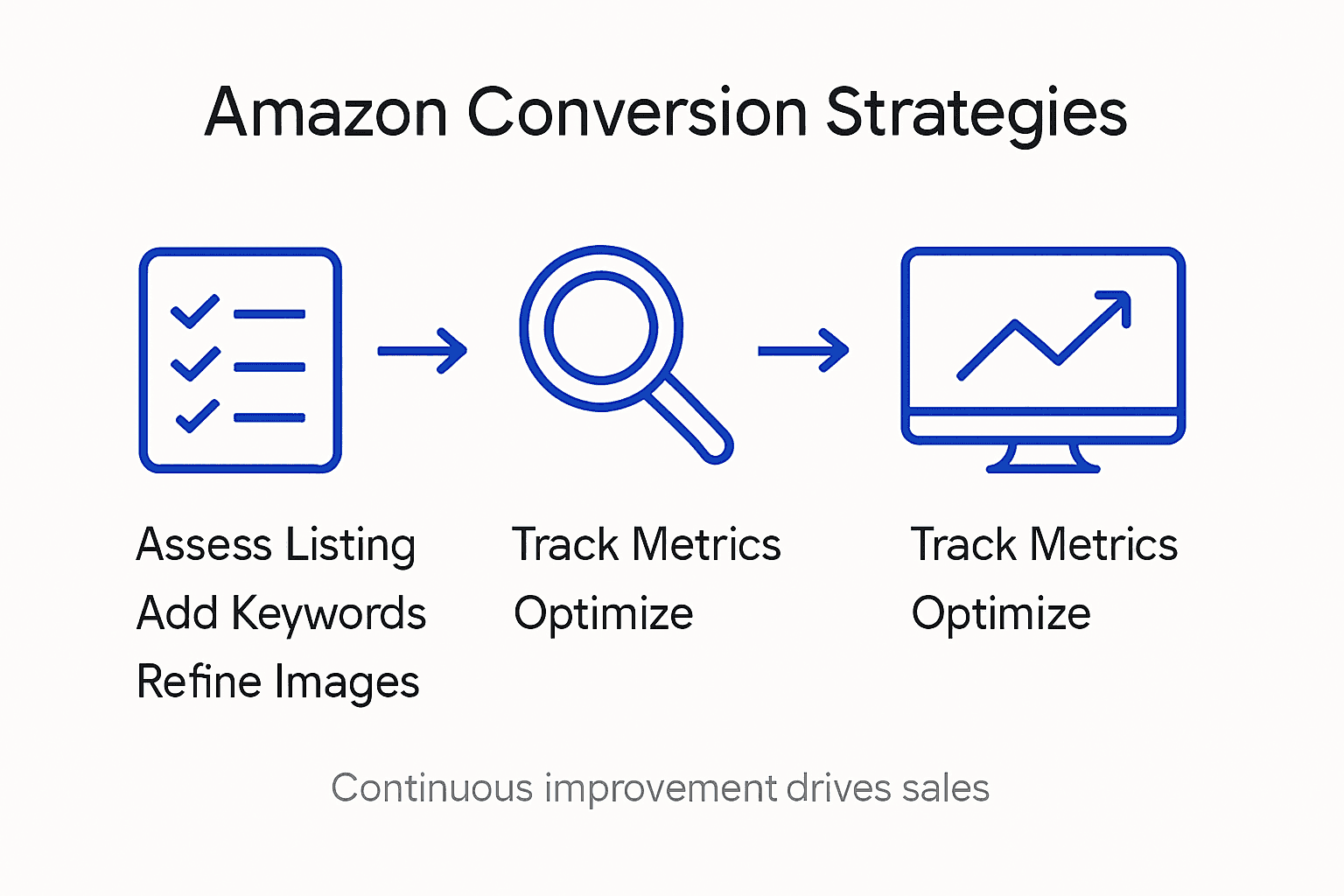
Advanced optimization strategies leverage machine learning techniques and comprehensive performance tracking to help sellers adapt quickly to market changes. Focus on key metrics such as click through rates, conversion rates, customer feedback, and search ranking positions. Pay special attention to user engagement data that reveals how potential buyers interact with your product listing. Identify patterns in customer behavior such as which images generate the most interest, which descriptions trigger clicks, and what search terms are driving traffic to your listing.
Remember that optimization is an iterative process. What works today might not work tomorrow, so maintaining flexibility and a data driven mindset is crucial. Regularly review your analytics dashboard, compare your performance against competitors, and be prepared to make swift adjustments to your listing strategy.
Pro tip: Set up automated reporting and schedule monthly deep dive analytics review sessions to ensure you are capturing and acting on critical performance insights.
Unlock Higher Amazon Product Conversions with Expert Guidance
Struggling to improve your Amazon listing performance despite careful efforts with titles, bullet points, and backend keywords The challenge lies in converting traffic into loyal customers by leveraging precise data and strategic SEO. This article highlights the importance of metrics like conversion rates and search rankings to uncover hidden barriers in your listing.
Enhance your approach by exploring advanced techniques and personalized support at E-commerce Tips & Strategies to Grow Your Online Business.
Don’t let your product get lost in the competition Elevate your Amazon sales through smart listing optimization and ongoing analytics backed by real marketplace insights. Start optimizing today with Search Oneers for tailored Amazon SEO & Analytics solutions designed to grow your visibility and conversions. Discover practical steps and expert strategies that keep your listings relevant and compelling.
Frequently Asked Questions
How can I evaluate my current Amazon product listing performance?
To assess your current Amazon product listing performance, access your Amazon Seller Central dashboard and focus on key metrics such as conversion rate, click-through rate, sessions, and search ranking. Regularly track these metrics to identify trends and areas needing improvement within 30 days.
What are effective strategies for optimizing product titles and bullet points on Amazon?
To optimize product titles and bullet points, prioritize important keywords at the beginning of your title while maintaining readability. Incorporate clear descriptions of key features and benefits, and ensure your content speaks directly to customer needs by regularly updating it based on search behavior.
How do I enhance my product images and A+ Content to increase conversions?
Enhancing your product images and A+ Content involves using high-resolution images that showcase your product from various angles and include lifestyle images. Invest time in creating professional infographics that clearly display key product features and benefits, aiming for a visual style that resonates with your target audience.
What should I include in my backend keywords to improve visibility?
To improve visibility using backend keywords, fill the available character space with relevant synonyms, alternative spellings, and long-tail phrases without repeating visible keywords. Focus on capturing a variety of search queries that potential customers might use, adjusting your keywords based on performance every few weeks.
How can I ensure continuous optimization of my Amazon listings?
To ensure continuous optimization, regularly monitor key metrics such as click-through rates, conversion rates, and customer feedback. Set up a schedule for monthly analytics reviews to identify which strategies are working and make timely adjustments based on real-time data.
What metrics should I focus on to measure the success of my Amazon product listings?
Focus on metrics like conversion rate, click-through rate, sessions, and search ranking to measure success. Analyze these figures consistently, looking for significant trends over 30 to 60 days, to identify strengths and weaknesses within your listings.