

TL;DR:
- Effective Amazon success in 2026 hinges on integrating advertising, operational excellence, and listing optimization as a unified system rather than separate efforts.
- Sellers who continuously review campaign metrics, maintain inventory levels, and refresh listings outperform those relying solely on automation or sporadic updates.
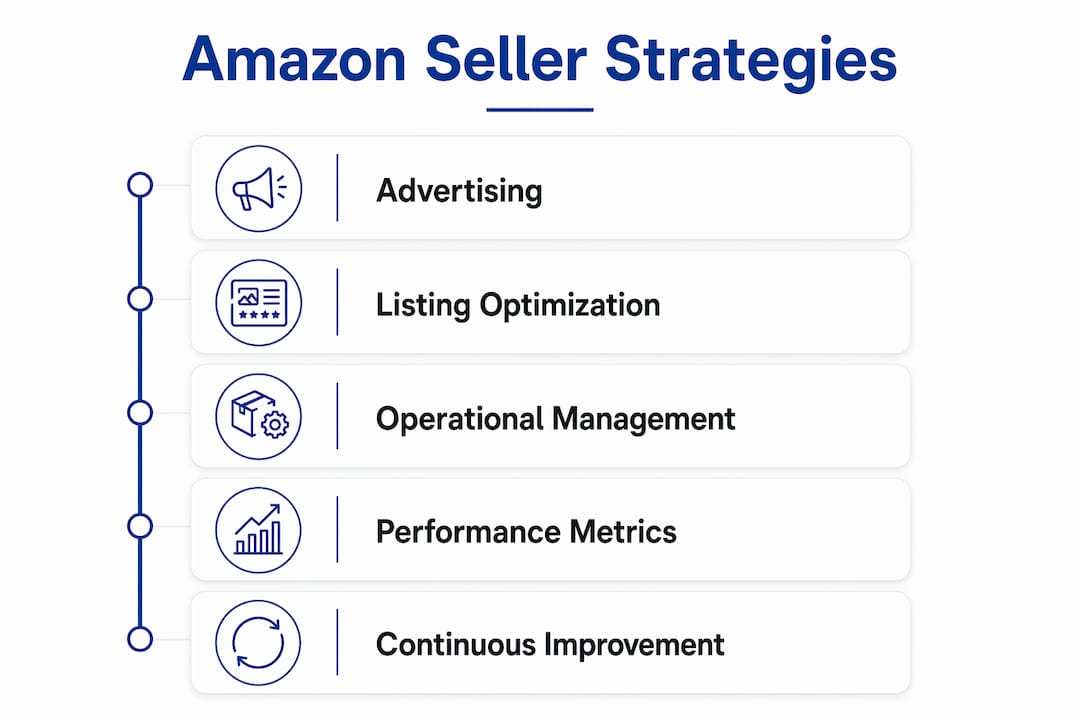
Amazon strategies are the coordinated combination of advertising campaigns, listing optimization, and operational management that determine whether a seller grows or stagnates on the marketplace. In 2026, the stakes are higher than ever. New AI-powered ad formats like Sponsored Brands collections and Sponsored Products prompts have reshaped how sellers capture demand. Meanwhile, Buy Box eligibility thresholds and inventory fee structures punish sellers who treat operations as an afterthought. Whether you sell ten SKUs or ten thousand, the sellers winning right now are the ones treating advertising, listings, and operations as one connected system rather than three separate tasks.
What are the most effective Amazon advertising strategies in 2026?
Amazon advertising, formally called Amazon Ads, is the primary paid growth engine for marketplace sellers. The platform runs on a cost-per-click model where bidding and ad relevance together determine whether your ad appears and where it ranks. You only pay when a shopper clicks, which makes budget control straightforward once you understand the mechanics.
The three ad products every serious seller should know are Sponsored Products, Sponsored Brands, and Amazon DSP. Here is how each one works and where it fits your growth plan:
- Sponsored Products are the most widely used format. They appear in search results and on product detail pages, driving direct purchase intent traffic to individual ASINs. They are the right starting point for any seller building sales velocity.
- Sponsored Brands display your brand logo, a custom headline, and multiple products at the top of search results. The format builds brand recognition while capturing high-intent shoppers browsing a category.
- Sponsored Brands collections take this further. AI-powered collections automatically curate product groupings based on live shopping signals, so the ad unit dynamically surfaces the most relevant products from your catalog without manual intervention.
- Sponsored Products prompts, which became generally available in March 2026, automatically engage shoppers with contextually relevant information at key decision moments during their browsing session.
The performance numbers validate the investment. Advertisers using Sponsored Products see 34% more sales growth after four weeks compared to non-advertisers. That is not a marginal lift. It reflects how deeply Amazon’s algorithm rewards products with strong sales velocity signals, which paid ads directly generate.
For campaign performance, track ACOS and ROAS as your primary metrics. ACOS benchmarks for high-performing campaigns run 15 to 25% on branded terms and 25 to 40% on non-branded terms. ROAS is simply the inverse: the dollars of sales generated per dollar of ad spend. Knowing your target ACOS before you launch a campaign prevents the common mistake of pausing ads too early because the numbers look unfamiliar.

Pro Tip: Give new campaigns at least four weeks before making major bid adjustments. Amazon’s algorithm needs time to gather click and conversion data before it can optimize delivery effectively. Cutting campaigns short during the learning window is one of the most expensive mistakes sellers make.
How do operational Amazon strategies influence Buy Box eligibility?
The Buy Box is the “Add to Cart” button on a product detail page, and winning it is the single most important operational goal for most sellers. Buy Box eligibility requires hitting three hard performance thresholds: Order Defect Rate below 1%, Late Shipment Rate below 4%, and Pre-Fulfillment Cancellation Rate below 2.5%. Missing any one of these removes you from Buy Box rotation entirely, regardless of your price.
Here is a practical framework for maintaining eligibility and maximizing your Buy Box share:
- Monitor your Order Defect Rate weekly. ODR includes negative feedback, A-to-Z claims, and chargebacks. A single spike can take weeks to recover from, so catching issues early matters.
- Use FBA where margins allow. FBA sellers gain structural advantages in Buy Box scoring that offset slight price differences versus FBM competitors. Amazon trusts its own fulfillment network to meet shipping promises.
- Solicit feedback proactively. Use Amazon’s Request a Review button or an approved third-party tool to ask buyers for feedback after confirmed delivery. A higher feedback score directly supports your seller metrics.
- Set up a repricer with Buy Box targeting, not lowest-price targeting. A repricer chasing the lowest price erodes your margin without guaranteeing the Buy Box. Configure it to target the Buy Box price range instead.
- Maintain 30 to 45 days of safety stock to avoid Amazon’s low-inventory fees and aged-inventory surcharges. Calculate your reorder point as daily sales velocity multiplied by lead time, then add your safety stock buffer on top.
Stockouts are a silent killer for seller rankings. When a product goes out of stock, Amazon removes it from search results and resets its sales velocity data. Rebuilding that momentum after a stockout takes weeks of advertising spend and organic traffic recovery. Preventing stockouts through disciplined inventory management is far cheaper than recovering from them.
Pro Tip: Recalculate your reorder points weekly, not monthly. Lead times from suppliers shift, and SKU velocity changes with seasonality and promotions. A static reorder point calculated in January will fail you in Q4.
How to optimize Amazon product listings to complement advertising
Paid ads drive traffic. Your listing converts it. If your listing is weak, every dollar you spend on Sponsored Products is partially wasted. Listing optimization is the conversion layer that determines whether ad clicks turn into sales.
The core elements of a well-optimized listing work together as a system:
- Title: Include your primary keyword, brand name, key product attributes, and size or quantity. Keep it under 200 characters and front-load the most important terms. Amazon’s A10 algorithm reads titles heavily for relevance scoring.
- Bullet points: Address the top five customer questions or objections. Lead each bullet with a benefit, not a feature. “Stays cold for 24 hours” outperforms “Double-wall insulation” every time.
- Backend keywords: These are invisible to shoppers but indexed by Amazon. Use this space for spelling variants, synonyms, and long-tail phrases that do not fit naturally in your visible copy.
- Images: Use all nine image slots. Include a lifestyle image, an infographic showing key specs, and a comparison chart if you have multiple variants. High-resolution images above 1000 pixels on the longest side enable zoom, which increases conversion rates.
- Video: A product video in the media gallery reduces return rates and increases time-on-page, both of which signal quality to Amazon’s algorithm.
- Enhanced Brand Content (A+ Content): Available to brand-registered sellers, A+ Content replaces the standard product description with rich modules including comparison tables, feature callouts, and brand story sections.
Audit your listings every 90 days. Competitor listings evolve, search trends shift, and customer language changes. A listing that ranked and converted well six months ago may be losing ground to a competitor who refreshed their copy and images last month.
What advanced strategies and common pitfalls should Amazon sellers know?
The sellers who scale consistently treat Amazon as a flywheel, not a funnel. Ads generate sales velocity. Sales velocity improves organic rank. Better organic rank reduces your cost-per-acquisition over time. But this flywheel only spins when advertising, listings, and operations are all working together. Neglecting any one of the three stalls the entire system.
Here are the advanced tactics and warnings that separate experienced sellers from those stuck at a plateau:
- Set exclusion lists before launching AI-powered ad formats. AI-supported ad formats require a strict exclusions mindset. If you let automation run across your full catalog without excluding weak ASINs, you will spend budget amplifying products with poor reviews or thin margins. Audit your catalog first and exclude anything with fewer than 15 reviews or a rating below 3.8 stars.
- Pause underperforming prompts regularly. Sponsored Products prompts give you individual performance metrics in Campaign Manager. Review them weekly and pause any prompt with high spend and low conversion. Automation is only as good as your oversight of it.
- Watch for margin erosion from misconfigured repricers. A repricer set to “always match the lowest price” can spiral your price down to unprofitable levels within hours during a competitive pricing event. Set a hard floor price that protects your minimum margin before activating any repricing rule.
- Segment campaigns by match type. Running broad, phrase, and exact match keywords in the same campaign makes it impossible to control bids by intent level. Separate them so you can bid aggressively on exact match terms with proven conversion history while keeping broad match bids conservative for discovery.
- Protect account health across all ASINs. One ASIN with a high return rate or safety complaint can trigger account-level reviews. Monitor your Account Health Dashboard in Seller Central weekly, not just when you receive a notification.
Pro Tip: Use your Sponsored Products search term reports monthly to mine for new exact match keywords. The terms shoppers actually use to find and buy your product are often different from the terms you assumed they would use. These real-world terms belong in your titles, bullets, and backend fields.
Key takeaways
Winning on Amazon in 2026 requires coordinating advertising, listing quality, and operational metrics as a single integrated system rather than managing each in isolation.
| Point | Details |
|---|---|
| Advertising drives velocity | Sponsored Products users see 34% more sales growth after four weeks, making paid ads the fastest path to ranking. |
| Buy Box requires clean metrics | ODR below 1%, Late Shipment Rate below 4%, and Pre-Fulfillment Cancellation Rate below 2.5% are non-negotiable thresholds. |
| Listings convert ad traffic | Optimized titles, bullets, backend keywords, and A+ Content determine whether clicks become purchases. |
| AI ads need active oversight | Exclude weak ASINs and pause underperforming prompts to prevent automation from wasting your budget. |
| Inventory protects rank | Maintaining 30 to 45 days of safety stock prevents stockouts that reset sales velocity and organic ranking. |
What I have learned from watching sellers win and lose on Amazon
After working with Amazon sellers across dozens of categories, the pattern is consistent. The sellers who struggle are not losing because they lack knowledge. They are losing because they treat their Amazon business as a series of one-time fixes rather than a continuous management practice.
I have seen sellers launch a well-optimized listing, run a strong ad campaign for the first month, and then go quiet. They check in three months later wondering why their rank dropped. The answer is always the same: a competitor kept optimizing while they stopped. Amazon’s A10 algorithm rewards recency and consistency, not past effort.
The other mistake I see constantly is over-relying on automation without building the judgment to supervise it. AI-powered Sponsored Brands collections and Sponsored Products prompts are genuinely powerful tools. But they amplify whatever is in your catalog. If your catalog has weak products, automation amplifies weakness at scale. The sellers who use these tools well spend time upfront curating which ASINs enter the system and reviewing performance data every week.
My honest recommendation: build a weekly rhythm. Review your Account Health Dashboard, check your ACOS and ROAS by campaign, recalculate reorder points for your top SKUs, and scan your listing audit checklist. Thirty minutes a week of disciplined review prevents the expensive recoveries that come from months of neglect. Amazon rewards sellers who behave like operators, not passive catalog owners.
— Goga
Take your Amazon listings to the next level with Searchoneers
Your advertising spend is only as effective as the listing it sends traffic to. Searchoneers specializes in Amazon listing optimization and SEO, helping sellers build the conversion foundation that makes every ad dollar work harder.

Whether you need a full listing overhaul or a structured process to maintain quality at scale, Searchoneers has the tools to get you there. The Amazon listing enhancement guide walks you through title construction, bullet point frameworks, backend keyword strategy, and A+ Content best practices with step-by-step clarity. For sellers who want a repeatable process, the listing optimization workflow gives you a structured checklist built specifically for Amazon sellers managing multiple ASINs. Start with your listings. Everything else compounds from there.
FAQ
What are Amazon strategies for sellers?
Amazon strategies are the coordinated set of advertising, listing optimization, and operational tactics sellers use to increase sales, improve organic rank, and win the Buy Box. Effective execution requires managing all three areas together rather than in isolation.
How do Sponsored Products ads work on Amazon?
Sponsored Products operate on a cost-per-click model where your bid and ad relevance to the shopper’s query determine placement. You pay only when a shopper clicks your ad, making budget control predictable once you set target ACOS thresholds.
What ACOS should I target for Amazon PPC campaigns?
High-performing campaigns typically target ACOS of 15 to 25% on branded terms and 25 to 40% on non-branded terms. Your break-even ACOS depends on your product margin, so calculate that number before setting bids.
How do I win the Amazon Buy Box?
Buy Box eligibility requires an Order Defect Rate below 1%, Late Shipment Rate below 4%, and Pre-Fulfillment Cancellation Rate below 2.5%. FBA sellers hold a structural scoring advantage, and a properly configured repricer targeting the Buy Box price range maximizes win rate without sacrificing margin.
How often should I optimize my Amazon listings?
Audit and refresh your listings every 90 days at minimum. Search trends shift, competitor listings evolve, and customer language changes. Sellers who treat listings as a one-time task consistently lose ground to those who treat optimization as an ongoing practice.

Comments
2 responses to “Amazon Strategies for Sellers: 2026 Growth Guide”
[…] Amazon Strategies for Sellers: 2026 Growth Guide – Searchoneers […]
[…] Amazon Strategies for Sellers: 2026 Growth Guide – Searchoneers […]