TL;DR:
- In 2026, effective keyword tracking combines Google Search Console, dedicated rank trackers, and pixel visibility tools to capture true search performance. Understanding the limitations of average position, privacy filters, and SERP features is essential for accurate interpretation and actionable insights. Regular calibration, layered data sources, and strategic thresholds help optimize SEO efforts amidst evolving search engine behaviors.
Keyword rank tracking is the practice of monitoring your website’s search engine positions for target keywords to measure SEO health, diagnose visibility gaps, and guide optimization decisions. Every SEO professional who wants to improve organic performance needs a system to track keyword rankings that goes beyond checking positions manually. In 2026, that system must account for Google Search Console data, dedicated trackers like Semrush, Ahrefs, and AccuRanker, and emerging pixel-based visibility metrics that reveal where users actually see your content on the page. Ordinal rank alone no longer tells the full story, and the professionals who understand that distinction are the ones pulling ahead.
What tools should you use to track keyword rankings?
Choosing the right tools is the first real decision in any keyword tracking setup. No single platform covers every angle, which is why the most effective SEO teams combine at least two data sources.
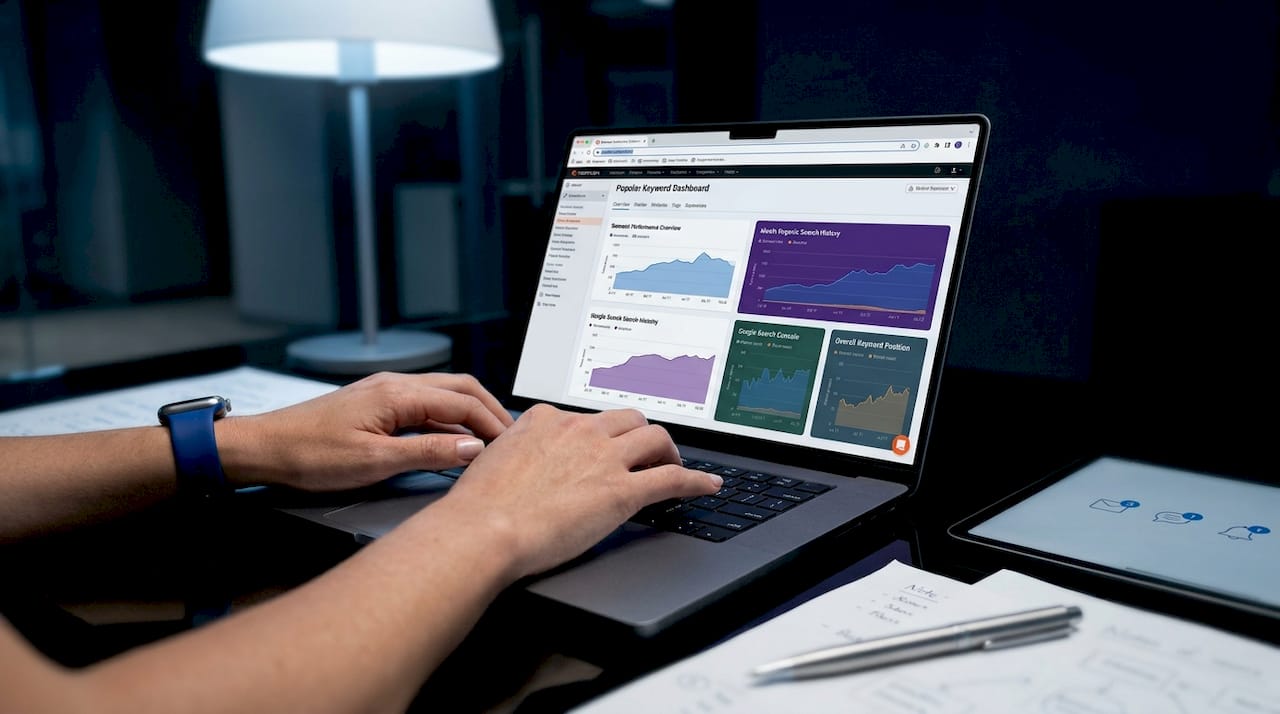
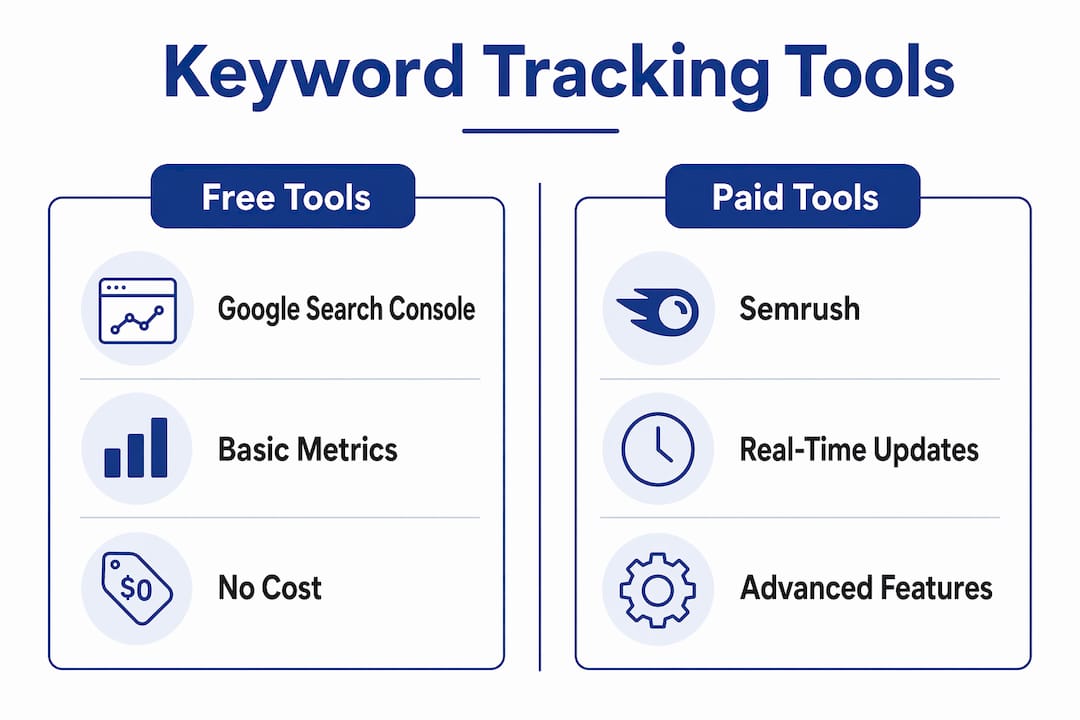
Google Search Console (GSC) is the authoritative free baseline. It provides clicks, impressions, CTR, and average position directly from Google’s index. The catch: GSC data is capped at a rolling 16-month window, so any trend analysis beyond that requires you to export data monthly or quarterly before it disappears. GSC is best used for validating performance and understanding how Google sees your pages, not for real-time rank diagnostics.
Dedicated rank tracking tools fill the gaps GSC leaves open. Platforms like Semrush, Ahrefs, AccuRanker, and SERPWatcher deliver daily position checks with granularity by device, location, and SERP feature presence. Rank tracking tools also support automated alerts when positions shift significantly, which GSC does not offer natively. For teams managing large keyword sets, tools like Serpwatch expose fields including initial position, current position, best position, and next update timestamp for precise monitoring workflows.
The third layer is emerging visibility measurement. Traditional ranking signals are decoupling from actual user visibility because AI Overviews, featured snippets, carousels, and ads now dominate the top of many SERPs. Tools that measure pixel rank and AI citation frequency are becoming standard in 2026 reporting stacks.
| Tool | Update frequency | Key strength | Cost | Best use case |
|---|---|---|---|---|
| Google Search Console | Daily (delayed ~3 days) | Authoritative click/impression data | Free | Performance validation |
| Semrush | Daily | SERP feature tracking, competitor data | Paid | Full-funnel rank analysis |
| Ahrefs | Daily to weekly | Backlink + rank correlation | Paid | Authority-driven tracking |
| AccuRanker | Daily | Speed and location granularity | Paid | Agency-scale monitoring |
| SEO Clarity | Daily | Pixel rank measurement | Paid | True visibility reporting |
Pro Tip: Combine GSC for performance validation with a dedicated tracker for real-time position diagnostics. GSC tells you what happened; your rank tracker tells you why and where.
How do you interpret ranking metrics without being misled?
Raw rank numbers are easy to misread. Understanding what the data actually represents is what separates reactive SEOs from strategic ones.
GSC’s average position is not a live rank. It is an impression-weighted average that blends positions across devices, geographies, and query variations into a single number. A keyword showing “position 8” in GSC might rank position 3 on mobile in Chicago and position 14 on desktop in New York. That smoothing effect masks volatility and makes the metric useful only as a directional signal, not a precise measurement.
Privacy filtering compounds the problem. About 75% of impressions and 38% of clicks can be filtered out of GSC query reports due to low-volume privacy thresholds. Those queries still count toward aggregate metrics, which means your total impression count looks healthy while your query-level data has significant blind spots. Long-tail keyword analysis is the most affected area.
Then there is the pixel rank problem. AI Overviews can push the #1 organic result more than 1,100 pixels below the top of the SERP, placing it below the fold on most devices. A keyword where you rank position 1 organically may deliver far less visibility than a position 4 result on a clean SERP with no features above it. Ordinal rank does not capture this reality.
Here is what to watch alongside position data:
- Impressions trend: Rising impressions with flat clicks signals a CTR problem, not a ranking problem.
- CTR by position: A CTR drop at the same rank position often means a new SERP feature has appeared above your result.
- Click volume vs. position: If rank improves but clicks fall, check whether an AI Overview or featured snippet now answers the query directly.
- Device and location splits: Segment your data before aggregating. Slicing by query groups or page subsets before averaging reveals patterns that disappear in blended numbers.
“Average position should never be used alone. Pairing it with impressions and CTR uncovers the true ranking impact on traffic and conversions.” — freeseoservice.net
How to set up a systematic keyword rank monitoring process
A monitoring system that works is built once and runs consistently. Here is a practical setup that scales from solo practitioners to agency teams.
Build a prioritized keyword list. Group keywords by business goal and search intent: transactional, informational, and navigational. Commercial keywords tied directly to revenue get daily tracking. Informational keywords can be monitored weekly or monthly without losing meaningful signal.
Set baseline positions before making changes. Record current rankings before any SEO work begins. Without a baseline, you cannot measure whether your changes caused a ranking shift or whether it was an algorithm update.
Define monitoring frequency by keyword category. Daily tracking for high-value commercial terms. Weekly for supporting content keywords. Monthly for brand and navigational terms that rarely fluctuate.
Configure automated alerts for significant shifts. Set thresholds for meaningful movements, not daily noise. Multi-day confirmed position changes correlated with your SEO change log provide far more actionable alerts than single-day spikes. A keyword dropping 5 positions for one day is noise. The same drop confirmed over three consecutive days warrants investigation.
Export GSC data on a monthly schedule. Because GSC’s rolling data limit cuts off at 16 months, a monthly export routine preserves your historical trend data for year-over-year analysis.
Build a monthly ranking report. Summarize gains, losses, near-miss opportunities (positions 8 to 15), and SERP feature appearances. Near-miss keywords are often the fastest wins available since they need a modest push to reach page one.
Pro Tip: Use query grouping and segmentation in GSC or your rank tracker to analyze theme-level performance. Individual keyword ranks fluctuate daily; topic cluster trends reveal whether your content strategy is actually working.
The Search Console API supports programmatic retrieval of clicks, impressions, CTR, and average position at scale, which makes it the right choice for teams managing thousands of keywords across multiple properties. Pair API exports with a dedicated tracker for a complete picture.
| Keyword category | Monitoring frequency | Alert threshold | Primary tool |
|---|---|---|---|
| High-value commercial | Daily | 3+ position drop, confirmed 3 days | Semrush or AccuRanker |
| Supporting content | Weekly | 5+ position drop | Ahrefs or SERPWatcher |
| Brand and navigational | Monthly | Any significant movement | Google Search Console |
| Long-tail informational | Monthly | Traffic drop correlated with rank | GSC + API export |
How to troubleshoot and sharpen your tracking accuracy
Even a well-built monitoring setup produces misleading data without regular calibration. These are the most common accuracy problems and how to fix them.
GSC and rank tracker discrepancies: GSC reports the position at which an impression occurred, averaged across all times the URL appeared. Dedicated trackers check rank at a specific time from a specific location. Expect differences of 2 to 5 positions on competitive keywords. Use GSC for trend direction and your tracker for diagnostic precision.
Privacy filter gaps: When GSC query data looks thin relative to your impression totals, you are seeing the effect of privacy filtering on long-tail queries. Supplement with a dedicated tracker that checks specific keywords directly, bypassing the filter problem entirely.
Local and device-specific rankings: If your business serves specific geographies, configure your rank tracker to check positions from those locations. A national average rank is meaningless for a business competing in a single metro area. The same logic applies to mobile versus desktop splits.
AI-generated content impacts: AI Overviews and LLM-powered answer boxes are now appearing for a growing share of informational queries. If your AI visibility in these features is not measured, you are missing a significant portion of your brand’s actual search presence.
Alert fatigue from daily SERP noise: Set your alert thresholds high enough to filter out natural daily fluctuations. Single-day movements of 1 to 3 positions on competitive keywords are normal. Alerts should fire only when a change is large enough and sustained enough to justify a content or technical SEO response.
Connecting rank data to action: Rank tracking data has no value unless it feeds decisions. Map ranking drops to specific pages, then check for technical issues, content gaps, or lost backlinks before assuming an algorithm update is the cause. Pair your ecommerce keyword research insights with rank data to identify where new content investments will have the highest return.
Keyword tracking in 2026: what I’ve learned the hard way
Ordinal rank tracking made complete sense when a Google SERP was ten blue links. That world is gone. I have watched teams celebrate a position 1 ranking while their organic CTR collapsed because an AI Overview answered the query before any user scrolled to their result. The number looked great. The traffic told a different story.
The professionals I respect most in 2026 treat rank as one input in a broader visibility model, not the output. They track pixel rank alongside ordinal position. They monitor whether their brand appears in AI-generated answers. They segment GSC data by device and query cluster before drawing any conclusions from average position. And they correlate every significant ranking change with their own SEO change log before attributing it to an algorithm update.
My practical recommendation: build your stack in three layers. Use GSC as your performance record. Use a dedicated tracker like Semrush or AccuRanker for daily diagnostics. Add a pixel rank or AI visibility tool for any keyword category where SERP features are common. That combination gives you a defensible, complete picture of search visibility rather than a single number that may be hiding more than it reveals.
Scaling this process does not require a large team. It requires clear thresholds, automated alerts, and a monthly review cadence that connects rank data to content and technical decisions. Start simple, export your GSC data consistently, and add measurement layers as your keyword portfolio grows.
— Goga
Take your SEO further with Searchoneers
Tracking keyword rankings on Google is only half the equation if you also sell on Amazon. The same principles of monitoring, segmentation, and data-driven optimization apply directly to Amazon product listings, where keyword position determines whether buyers find your product or your competitor’s.

At Searchoneers, we apply these exact strategies to Amazon SEO, from backend keyword selection to listing copy that captures search intent at every stage of the buyer journey. If you are ready to put rank tracking insights to work in your listings, start with our Amazon listing enhancement guide for a step-by-step framework that connects keyword data to real sales outcomes. You can also explore our listing optimization workflow to build a repeatable process that scales with your catalog.
FAQ
What is keyword rank tracking?
Keyword rank tracking is the process of monitoring where your web pages appear in search engine results for specific target keywords. It measures SEO progress and identifies opportunities to improve organic visibility.
How often should you check keyword rankings?
High-value commercial keywords warrant daily monitoring, while supporting content and informational keywords can be tracked weekly or monthly. Monitoring frequency should match the business impact of each keyword category.
Why does Google Search Console show different rankings than other tools?
GSC reports an impression-weighted average position across all devices, locations, and query variations, while dedicated trackers check rank at a specific time and location. Differences of 2 to 5 positions are normal and expected.
What is pixel rank and why does it matter?
Pixel rank measures the actual distance in pixels between the top of a SERP and your organic result. AI Overviews can push a position 1 result more than 1,100 pixels below the fold, making pixel rank a more accurate measure of true user visibility than ordinal position.
How do you handle missing keyword data in Google Search Console?
GSC privacy filters can exclude up to 75% of impressions from query-level reports for low-volume searches. Supplement GSC with a dedicated rank tracker that checks specific keywords directly to recover visibility into long-tail query performance.
Key takeaways
Effective keyword rank tracking in 2026 requires combining Google Search Console, dedicated rank trackers, and pixel visibility tools to build a complete and accurate picture of search performance.
| Point | Details |
|---|---|
| Use layered tools | Combine GSC, a dedicated tracker, and a pixel rank tool for complete visibility measurement. |
| Interpret GSC carefully | Average position is an impression-weighted average that masks device and location differences. |
| Account for privacy filters | Up to 75% of GSC impressions can be filtered, leaving long-tail keyword data incomplete. |
| Set smart alert thresholds | Confirm ranking changes over multiple days before acting to avoid reacting to daily SERP noise. |
| Connect rank data to action | Map every significant ranking shift to a specific page, then investigate technical or content causes. |