

Standing out in the crowded Amazon marketplace can feel like an uphill climb for sellers across the United States and Canada. Every American brand owner knows how crucial it is to get products seen by the right shoppers before competitors do. This guide takes the mystery out of Amazon Sponsored Products, showing how these targeted pay-per-click ads blend seamlessly with organic search results and offer practical ways to drive sales, fine-tune campaigns, and improve return on investment.
Table of Contents
- Defining Amazon Sponsored Products For Sellers
- Types Of Sponsored Product Campaigns Explained
- How Sponsored Products Ads Function On Amazon
- Targeting Methods And Optimization Strategies
- Costs, Risks, And Common Seller Mistakes
Key Takeaways
| Point | Details |
|---|---|
| Product Visibility | Amazon Sponsored Products enhance product exposure via PPC ads in search results and product pages, increasing the chances of sales. |
| Campaign Types | Sellers can choose from automatic, manual, or product targeting campaigns based on their experience and marketing objectives. |
| Performance Monitoring | Regularly analyze key performance metrics like ACoS, ROAS, and CTR to optimize ad spend and campaign effectiveness. |
| Budget Management | Start with a modest budget and gradually increase it based on campaign performance to avoid unnecessary costs. |
Defining Amazon Sponsored Products for Sellers
Amazon Sponsored Products represent a powerful advertising strategy designed to help sellers increase product visibility and drive sales within the Amazon marketplace. These pay-per-click (PPC) advertisements allow sellers to promote individual product listings directly in Amazon search results and product detail pages, giving them a strategic advantage in a competitive e-commerce environment.
At their core, Sponsored Products function as targeted advertising tools that enable sellers to bid on specific keywords relevant to their products. When a shopper searches for terms matching those keywords, the sponsored item appears alongside organic search results, typically marked with a “Sponsored” label. This placement provides enhanced exposure beyond traditional product rankings, giving sellers an opportunity to reach potential customers who might not otherwise discover their offerings.
Key characteristics of Amazon Sponsored Products include:
- Appear in search results and product pages
- Operate on a pay-per-click model
- Allow precise keyword targeting
- Provide detailed performance analytics
- Can be customized for different campaign objectives
The mechanism behind Sponsored Products is relatively straightforward. Sellers select products they want to promote, choose relevant keywords, set a daily budget, and determine their maximum bid per click. Amazon’s algorithm then determines ad placement based on factors like bid amount, product relevance, and historical performance. Amazon Marketplace terms provide additional context for understanding these intricate advertising dynamics.
Sellers can leverage these ads across multiple product categories, making them a versatile marketing tool for businesses of all sizes. Whether you’re launching a new product or seeking to increase visibility for an existing listing, Sponsored Products offer a flexible and measurable approach to Amazon advertising.
Pro tip: Start with a modest budget and gradually increase spending as you learn which keywords and products generate the most effective return on investment.
Types of Sponsored Product Campaigns Explained
Amazon offers sellers multiple approaches to advertising through Sponsored Product campaigns, each designed to meet different marketing objectives and target specific customer segments. Product listing strategies can significantly impact the effectiveness of these advertising methods, making it crucial to understand the nuanced options available.
The three primary types of Amazon Sponsored Product campaigns include:
- Automatic Targeting Campaigns
- Amazon’s algorithm selects keywords automatically
- Lower management effort required
- Ideal for initial product discovery
- Helps identify potential search terms
- Manual Targeting Campaigns
- Sellers directly choose specific keywords
- Provides more precise control
- Allows strategic bid adjustments
- Better for experienced sellers
- Product Targeting Campaigns
- Target specific product listings or categories
- Enables competitive positioning
- Allows placement near similar products
- Useful for capturing competitor’s audience
Automatic targeting campaigns represent an excellent starting point for sellers new to Amazon advertising. In these campaigns, Amazon’s algorithm automatically matches your product with relevant customer searches based on your product’s details. This approach requires minimal setup and can provide valuable insights into potential keywords and customer search behaviors.

Manual targeting campaigns offer more sophisticated control, allowing sellers to handpick specific keywords and set individual bids. Experienced sellers often prefer this method because it enables precise optimization and more strategic advertising spend. By carefully selecting keywords and monitoring performance, sellers can incrementally improve their campaign efficiency.
Here’s a comparison of the three main Sponsored Product campaign types to help guide your strategy:
| Campaign Type | Control Level | Ideal Use Case | Data Learning Potential |
|---|---|---|---|
| Automatic Targeting | Minimal management | Product launch and discovery | Identifies new keyword opportunities |
| Manual Targeting | High customization | Experienced seller optimization | Refines keyword and bid strategies |
| Product Targeting | Competitive positioning | Targeting specific products/categories | Gains insights on competitor placement |
Pro tip: Start with automatic targeting campaigns to gather initial keyword data, then transition to manual campaigns for more refined, cost-effective advertising strategies.
How Sponsored Products Ads Function on Amazon
Amazon Sponsored Products operate through a complex auction-based advertising mechanism that allows sellers to promote individual products directly within Amazon’s search results and product pages. Amazon advertising strategies play a crucial role in understanding how these dynamic ad placements work and generate visibility for sellers.
The core functioning of Sponsored Products revolves around several key mechanisms:
- Keyword Bidding
- Sellers select relevant keywords
- Set maximum cost-per-click (CPC) bids
- Compete against other sellers for ad placement
- Higher bids increase potential visibility
- Ad Placement Algorithm
- Amazon evaluates multiple factors
- Considers bid amount
- Assesses product relevance
- Calculates conversion likelihood
- Determines final ad positioning
- Payment Structure
- Cost-per-click (CPC) model
- Sellers pay only when customers click ads
- No charge for ad impressions
- Transparent and performance-driven approach
The advertising process begins when sellers choose specific products to promote and select targeting options. Sellers can opt for automatic targeting, where Amazon’s algorithm identifies relevant keywords, or manual targeting, which allows precise keyword selection. The platform’s sophisticated algorithm then evaluates multiple parameters to determine ad placement, including historical performance, keyword relevance, and competitive bidding strategies.
Unique to Amazon’s approach, Sponsored Products now extend beyond traditional search results. Recent developments include ad placements on external publisher sites like Pinterest and BuzzFeed, dramatically expanding potential customer reach. This expansion allows sellers to engage potential customers across multiple digital platforms, creating more comprehensive marketing opportunities.
Pro tip: Monitor your ad performance weekly and adjust keyword bids incrementally to optimize your return on advertising spend.
Targeting Methods and Optimization Strategies
Successful Amazon Sponsored Products campaigns rely on sophisticated targeting methods that enable sellers to reach their most relevant customer segments. Amazon listing optimization plays a critical role in maximizing the effectiveness of these advanced targeting approaches.
The primary targeting methods for Sponsored Products include:
- Automatic Targeting
- Amazon’s algorithm selects keywords
- Minimal seller intervention required
- Ideal for initial campaign discovery
- Generates initial performance data
- Manual Targeting
- Sellers directly control keyword selection
- Precise targeting capabilities
- Allows granular bid adjustments
- Requires ongoing keyword management
- Negative Targeting
- Exclude irrelevant keywords
- Improve campaign efficiency
- Reduce wasted ad spend
- Refine audience targeting
Optimization strategies demand a systematic approach to campaign management. Sellers should begin with automatic targeting to gather initial keyword insights, then transition to manual targeting for more precise control. This approach allows sellers to identify high-performing keywords and gradually refine their advertising strategy.
Key performance indicators are crucial for measuring campaign effectiveness. Metrics like Advertising Cost of Sales (ACoS), Return on Ad Spend (ROAS), and Click-Through Rate (CTR) provide critical insights into campaign performance. Sophisticated sellers utilize both Amazon’s native analytics and third-party tools to track and optimize their advertising efforts continuously.
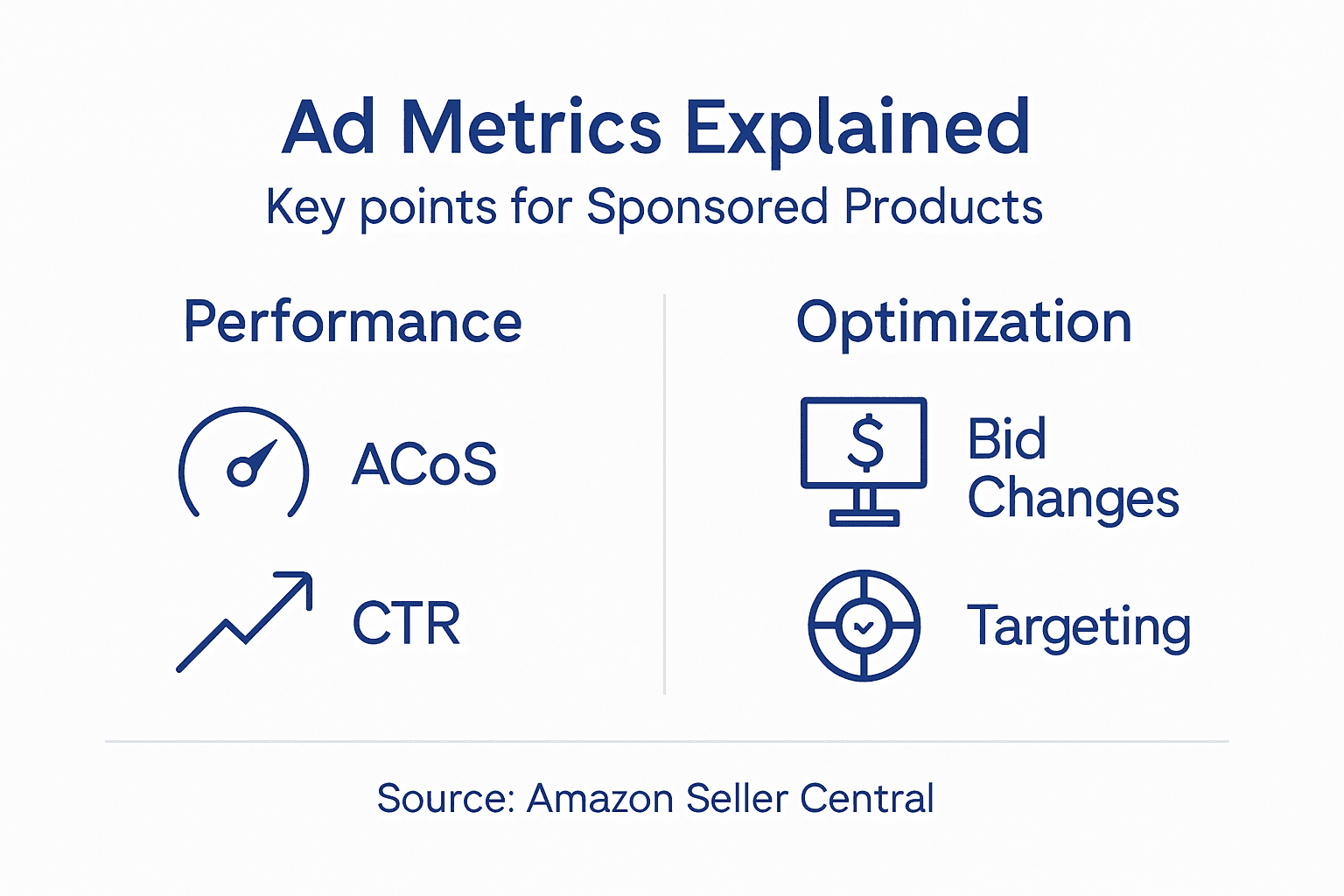
Consider these key performance metrics and their advertising impact:
| Metric | What It Measures | Why It Matters |
|---|---|---|
| ACoS (Advertising Cost of Sales) | Ad spend as % of revenue | Optimizes campaign profitability |
| ROAS (Return on Ad Spend) | Revenue per advertising dollar | Evaluates advertising efficiency |
| CTR (Click-Through Rate) | Clicks per 1000 ad impressions | Indicates ad appeal and relevance |
Pro tip: Create separate campaigns for different product types and regularly review performance data to incrementally adjust your targeting and bidding strategies.
Costs, Risks, and Common Seller Mistakes
Sponsored Products advertising on Amazon involves significant financial and strategic considerations that can make or break a seller’s marketing efforts. Amazon seller red flags highlight the importance of understanding potential pitfalls in these advertising campaigns.
The primary financial risks and costs associated with Sponsored Products include:
- Direct Advertising Expenses
- Pay-per-click (PPC) model
- Variable cost per keyword
- Budget can quickly escalate
- Requires continuous monitoring
- Potential Campaign Inefficiencies
- Wasted spend on irrelevant keywords
- Poor targeting leading to low conversion rates
- High advertising cost of sales (ACoS)
- Reduced profit margins
- Common Strategic Mistakes
- Neglecting keyword research
- Insufficient campaign optimization
- Ignoring performance metrics
- Inconsistent bid management
Sellers often underestimate the complexity of managing Sponsored Products campaigns. Many fall into the trap of setting up campaigns and then abandoning them, which leads to continuous unnecessary spending. Successful advertising requires ongoing attention, regular performance analysis, and willingness to make data-driven adjustments to targeting and bidding strategies.
The financial risks extend beyond direct advertising costs. Poorly managed campaigns can damage a product’s organic ranking, reduce overall visibility, and consume marketing budgets without delivering proportional returns. Sellers must approach Sponsored Products as a strategic investment, carefully tracking key performance indicators and maintaining a disciplined approach to campaign management.
Pro tip: Allocate no more than 10-15% of your product’s total revenue to advertising and regularly audit campaign performance to minimize unnecessary spending.
Take Control of Your Amazon Sponsored Products Success Today
Struggling to maximize your Amazon Sponsored Products campaigns because of complex keyword bidding and inconsistent campaign optimization Loss of visibility and wasted ad spend can be frustrating but you are not alone Many sellers face these challenges including mastering manual targeting and interpreting key metrics like ACoS and ROAS Our solutions at E-commerce Tips & Strategies to Grow Your Online Business are designed to help you conquer these common hurdles with expert Amazon Listing Optimization and data-driven Amazon SEO & Analytics
Don’t let ineffective campaigns drain your budget or limit your sales potential Visit https://searchoneers.com now and discover how our proven strategies can boost your product visibility and increase sales With targeted keyword optimization and continuous performance analysis you can transform your Sponsored Products campaigns into reliable growth engines Start optimizing today and watch your Amazon business soar
Frequently Asked Questions
What are Amazon Sponsored Products?
Amazon Sponsored Products are pay-per-click (PPC) advertisements that allow sellers to promote individual product listings directly in Amazon search results and product pages. They help increase product visibility and drive sales.
How do I set up a Sponsored Products campaign?
To set up a Sponsored Products campaign, select the products you want to promote, choose relevant keywords, set a daily budget, and determine your maximum bid per click. You can choose either automatic or manual targeting options.
What are the different types of Sponsored Product campaigns?
There are three primary types of Sponsored Product campaigns: Automatic Targeting (where Amazon selects keywords), Manual Targeting (where sellers choose specific keywords), and Product Targeting (which focuses on specific product listings or categories).
How can I optimize my Sponsored Products campaigns?
To optimize your Sponsored Products campaigns, regularly monitor key performance metrics such as ACoS, ROAS, and CTR. Start with automatic campaigns for insights, then transition to manual targeting to refine your strategy with more precise controls.

Comments
4 responses to “Amazon Sponsored Products: Boosting Sales and Visibility”
[…] Amazon sellers understand that Amazon Sponsored Products require precise targeting and creative strategies during holiday shopping windows. The right […]
[…] CPCs due to intense competition, while niche home goods may cost considerably less. Review our Sponsored Products ad guide for format-specific optimization strategies, or check the official Amazon ad fee details for […]
[…] Amazon keywords, maximizes reach while controlling costs effectively. Understanding these Sponsored Products essentials separates profitable campaigns from budget […]
[…] curve is manageable, and results are measurable. To explore foundational strategies, check out amazon sponsored products essentials and amazon sponsored product 2026 […]