

Over 75% of Amazon’s ad revenue comes from Sponsored Products, yet many sellers struggle to understand how these ads actually work. This confusion leads to wasted budgets and missed sales opportunities. This guide clarifies Sponsored Products’ mechanics, targeting strategies, and optimization tactics to help you maximize visibility and drive measurable growth on Amazon’s competitive marketplace.
Table of Contents
- What Are Amazon Sponsored Products?
- How Amazon Sponsored Products Work: The PPC Auction And Bidding Model
- Targeting And Bidding Strategies For Amazon Sponsored Products
- Common Misconceptions About Amazon Sponsored Products
- Comparison With Other Amazon Advertising Types
- Effectiveness And Sales Impact Of Sponsored Products
- Optimization Strategies For Sponsored Products Ads
- Conceptual Framework And Strategic Approach To Amazon Sponsored Products
- Boost Your Amazon Sales With Expert Listing Optimization
- Frequently Asked Questions
Key takeaways
| Point | Details |
|---|---|
| Sponsored Products are PPC ads | You pay only when shoppers click your ads, with costs ranging from $0.10 to $3.00 per click depending on category competition. |
| Ad placement depends on three factors | Bid size, keyword relevance, and expected click-through rate all determine where your ads appear in search results. |
| Targeting options include keywords and products | Choose from exact, phrase, broad, or negative keyword matches, plus product targeting on competitor listings. |
| Optimization requires time and data | Campaigns need 2 to 4 weeks of active management before showing peak performance and sales impact. |
| Strategic campaigns boost sales significantly | Properly optimized Sponsored Products can increase sales by 20 to 25% when combined with negative keywords and data-driven bidding. |
What are Amazon sponsored products?
Sponsored Products are pay-per-click advertisements that appear directly within Amazon’s shopping environment. These ads show up in search results and on product detail pages, positioning your items exactly where shoppers are actively making purchasing decisions.
These ads dominate Amazon’s advertising ecosystem because they deliver results at critical moments in the buying journey. Sponsored Products appear within shopping results and product detail pages, triggered by keyword matches or product targeting rules you set. When shoppers search for terms related to your products, your ads can appear alongside organic listings, marked with a subtle “Sponsored” label.
The platform’s effectiveness explains its market dominance. Sponsored Products generate massive revenue for Amazon precisely because they work for sellers of all sizes. Small businesses and enterprise brands alike use these ads to compete for visibility in crowded categories.
Sponsored Products work through two primary targeting methods:
- Keyword targeting matches your ads to specific search terms shoppers use, letting you capture demand for relevant queries.
- Product targeting places your ads on competitor or complementary product pages, intercepting shoppers who are already interested in similar items.
- Automatic targeting lets Amazon’s algorithm choose relevant placements based on your product listing data.
- Manual targeting gives you complete control over which keywords or products trigger your ads.
This dual approach provides flexibility to reach shoppers through multiple discovery paths. Whether customers search directly for what you sell or browse related products, Sponsored Products put your items in front of qualified buyers ready to purchase.
How Amazon sponsored products work: the PPC auction and bidding model
Every time a shopper searches on Amazon, an instant auction determines which ads appear and in what order. This pay-per-click model means sellers only pay when someone actually clicks their ad, not for impressions or views.
The auction considers three critical factors simultaneously. Your bid amount signals how much you’re willing to pay per click. Ad relevance measures how well your product matches the shopper’s query. Expected click-through rate predicts how likely shoppers are to engage with your ad based on historical performance data.

Higher bids don’t automatically guarantee top placement. Amazon prioritizes ads that deliver good shopper experiences, meaning a highly relevant ad with a moderate bid can outrank an irrelevant ad with a massive bid. This system protects shoppers from poor matches while rewarding sellers who target appropriately.
Cost per click varies dramatically across categories and competitive landscapes:
- Electronics and tech accessories often see CPCs between $1.50 and $3.00 due to intense competition.
- Home goods and kitchen items typically range from $0.40 to $1.20 per click.
- Books and media products frequently cost $0.10 to $0.50 per click in lower competition niches.
- Beauty and personal care products average $0.80 to $2.00 depending on brand saturation.
Pro Tip: Start with conservative bids 20% below Amazon’s suggested amounts, then gradually increase based on conversion data rather than impressions alone. This approach prevents overspending while you gather performance insights.
Understanding auction dynamics helps you balance visibility against profitability. You’re not just buying clicks; you’re investing in qualified traffic that converts into sales. The auction rewards sellers who match shopper intent accurately, making relevance optimization just as important as budget allocation.
Targeting and bidding strategies for Amazon sponsored products
Effective Sponsored Products campaigns start with precise targeting that connects your products to shoppers actively seeking what you sell. The platform offers multiple match types and targeting approaches, each serving distinct strategic purposes.
Keyword targeting forms the foundation of most campaigns. Exact match shows your ads only for the specific keyword you target, delivering highly qualified traffic with minimal waste. Phrase match triggers ads when shoppers’ queries contain your keyword phrase in order, offering moderate reach with good relevance. Broad match casts the widest net, showing ads for related variations and synonyms that Amazon’s algorithm deems relevant.
Negative keywords prevent your ads from appearing for irrelevant searches, protecting your budget from wasted clicks. If you sell premium leather wallets, adding “cheap” and “free” as negative keywords stops your ads from showing to bargain hunters unlikely to convert. This simple tactic can improve campaign efficiency by 15 to 20% immediately.
Product targeting takes a different approach by placing your ads directly on competitor or complementary product detail pages. When shoppers view a rival’s listing, your product appears as an alternative in the sponsored section. This strategy works exceptionally well for items with better reviews, lower prices, or unique features compared to established competitors.
Bidding strategy determines how aggressively you compete for ad placements:
- Fixed bids maintain consistent CPC limits, offering predictable costs but potentially missing high-value placements.
- Dynamic bids down only lets Amazon reduce your bid when conversion is less likely, protecting profitability.
- Dynamic bids up and down allows Amazon to increase bids up to 100% for top-of-search placements and decrease for less valuable positions.
Pro Tip: Use exact match campaigns to identify your highest-converting keywords, then create separate broad match campaigns with those terms as negative keywords to discover new variations without cannibalizing proven winners.
Successful targeting combines multiple approaches. Start with automatic campaigns to gather data, then create manual campaigns focusing on your best-performing keywords. Layer in product targeting to capture competitor traffic. Finally, use your search term reports to continuously refine negative keywords and eliminate underperformers. This comprehensive approach, detailed in our guide on optimizing Amazon keywords, maximizes reach while controlling costs effectively. Understanding these Sponsored Products essentials separates profitable campaigns from budget drains.
Common misconceptions about Amazon sponsored products
Many sellers enter Sponsored Products advertising with flawed assumptions that undermine their campaign performance. Correcting these misconceptions early prevents costly mistakes and sets realistic expectations for results.
The biggest myth is that higher bids automatically secure top ad placements. While bid amount matters, Amazon’s algorithm weighs relevance and expected engagement just as heavily. A seller bidding $3.00 on an irrelevant keyword loses to a competitor bidding $1.50 on a highly relevant match. The system rewards shopper satisfaction over raw spending power.
Another common error is expecting immediate sales spikes. Sponsored Products require data accumulation before algorithms optimize delivery. Most campaigns need 2 to 4 weeks of active management before performance stabilizes and improves. Sellers who judge campaigns after three days miss the optimization curve entirely.
Misusing keyword targeting wastes enormous budgets across the platform:
- Running only broad match campaigns without negative keywords generates irrelevant clicks that rarely convert.
- Ignoring search term reports means you keep paying for queries that will never drive sales.
- Failing to separate branded and generic keywords makes it impossible to measure true acquisition costs.
- Treating all match types identically prevents strategic budget allocation based on intent signals.
Some sellers believe Sponsored Products replace the need for listing optimization. In reality, ads drive traffic to your product page, but poor listings fail to convert that traffic. A weak title, unclear images, or missing bullet points sabotage even perfectly targeted campaigns. Your ad spend amplifies your listing quality, whether excellent or terrible.
The final misconception involves treating campaigns as set-and-forget investments. Successful Sponsored Products advertising requires continuous monitoring, bid adjustments, and keyword refinement. Competition shifts, seasonal trends emerge, and consumer behavior evolves. Static campaigns decay in performance while managed campaigns compound their effectiveness over time.
Comparison with other Amazon advertising types
Amazon offers three primary ad formats, each serving distinct marketing objectives within your overall strategy. Understanding these differences helps you allocate budget effectively across promotional channels.
| Feature | Sponsored Products | Sponsored Brands | Sponsored Display |
|---|---|---|---|
| Primary goal | Drive individual product sales through keyword and product targeting | Build brand awareness with custom headlines and multiple products | Retarget shoppers and expand reach beyond keyword searches |
| Ad format | Single product listing appearing in search results and detail pages | Brand logo, custom headline, and up to three products | Banner ads on and off Amazon with lifestyle imagery |
| Targeting options | Keyword match types and product targeting | Keywords only, with brand store integration | Audience segments, product views, and category interests |
| Pricing model | Pay per click with variable CPC based on competition | Pay per click with typically higher CPC than Products | Pay per click or per thousand impressions (CPM) |
| Best for | Direct response sales and product-level conversions | Brand building and launching new product lines | Remarketing to cart abandoners and awareness campaigns |
Sponsored Products excel at converting shoppers already searching for what you sell. These ads capture high-intent traffic at the moment of purchase consideration, making them ideal for driving immediate sales and testing new product market fit.
Sponsored Brands support top-of-funnel awareness by showcasing your brand identity and product range simultaneously. The prominent placement above search results with custom messaging builds recognition among shoppers who may not yet know your brand exists. This format works best for established sellers with multiple related products and a brand store.
Sponsored Display extends your reach beyond Amazon’s marketplace to external websites and apps where shoppers browse. These ads reconnect with people who viewed your products but didn’t purchase, keeping your brand visible during their consideration phase. Display ads also target relevant audiences based on shopping behavior and interests rather than keyword searches alone.
Most successful sellers combine all three formats strategically. Sponsored Products drive the bulk of sales from active shoppers. Sponsored Brands build awareness and capture broader category traffic. Sponsored Display recovers lost sales through retargeting and expands reach to new audiences. This integrated approach maximizes visibility across the entire customer journey from discovery through purchase.
Effectiveness and sales impact of sponsored products
When managed properly, Sponsored Products deliver measurable sales growth that justifies their cost. Real-world data from thousands of campaigns reveals consistent performance patterns across categories and seller sizes.
Optimized campaigns typically increase product sales by 20 to 25% compared to organic performance alone. This lift comes from capturing additional search visibility and appearing on competitor product pages where you wouldn’t otherwise rank. The incremental traffic converts because targeting matches shopper intent precisely.
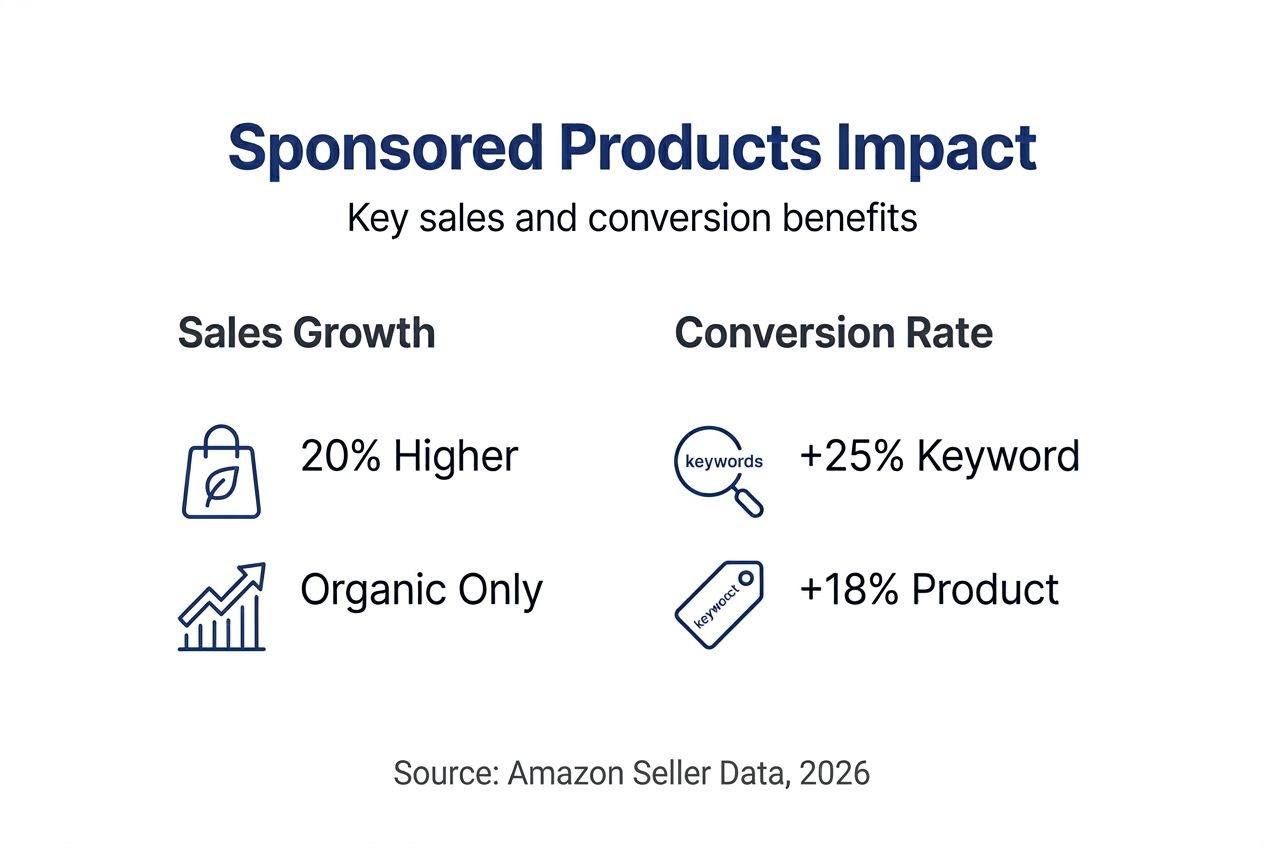
Negative keyword optimization specifically improves conversion rates by up to 25% by eliminating irrelevant clicks. When you stop paying for searches like “how to make” or “free alternatives,” your remaining clicks come from shoppers with genuine purchase intent. This concentrated traffic converts at higher rates while reducing your total ad spend.
Product targeting campaigns deliver approximately 18% higher conversion rates than keyword campaigns on average. Shoppers viewing competitor products are already interested in that category and actively comparing options. Your ad presents an alternative at the perfect moment, capturing sales you’d otherwise lose to rivals.
| Performance Metric | Average Improvement | Optimization Timeframe |
|---|---|---|
| Overall sales lift | 20 to 25% increase | 4 to 6 weeks |
| Conversion rate gain from negative keywords | Up to 25% improvement | 2 to 3 weeks |
| Product targeting conversion boost | 18% above keyword campaigns | 3 to 4 weeks |
| Cost per sale reduction | 15 to 30% decrease | 6 to 8 weeks |
| Return on ad spend (ROAS) | 3:1 to 5:1 ratio for optimized campaigns | 8 to 12 weeks |
These metrics demonstrate that Sponsored Products profitability depends on systematic optimization rather than simply activating campaigns. The difference between break-even advertising and highly profitable campaigns lies in continuous refinement of targeting, bidding, and keyword selection. Our analysis of Sponsored Products sales impact shows that sellers who actively manage campaigns weekly outperform those who check monthly by a factor of two to three.
The compound effect of small improvements matters enormously. A 5% increase in conversion rate combined with a 10% reduction in CPC through better targeting can double your campaign profitability. These incremental gains accumulate over months, separating thriving sellers from those who abandon advertising as unprofitable.
Optimization strategies for sponsored products ads
Transforming average Sponsored Products campaigns into profit engines requires systematic optimization across multiple dimensions. Follow these evidence-based strategies to maximize return on ad spend.
- Establish clear campaign objectives that align with your business goals, whether maximizing sales volume, hitting specific profit margins, or launching new products with aggressive market penetration.
- Conduct comprehensive keyword research including competitor analysis and search term mining to identify both opportunity keywords and terms requiring negative blocking.
- Select appropriate targeting types based on your product’s competitive position, using exact match for proven converters and product targeting against weaker competitors.
- Set initial bids conservatively at 20 to 30% below Amazon’s suggestions, then increase based on actual conversion data rather than impression volume.
- Implement negative keywords aggressively from day one, blocking obvious mismatches like informational queries, competitor brand names, and price-focused searches incompatible with your positioning.
- Analyze performance data weekly for the first month, then biweekly once campaigns stabilize, focusing on metrics that directly impact profitability.
- Make incremental bid adjustments of 10 to 15% rather than dramatic changes, allowing time to measure impact before further modifications.
Within your optimization process, prioritize actions by impact potential:
- Adding negative keywords from search term reports eliminates waste immediately with zero downside risk.
- Increasing bids on keywords with high conversion rates but low impression share captures additional profitable sales.
- Pausing keywords with high spend but zero sales after 30 clicks redirects budget to better performers.
- Creating separate campaigns for top-performing keywords enables granular bid control and budget allocation.
Pro Tip: Run an automatic campaign continuously at low bids to harvest new keyword opportunities that manual campaigns miss. Mine its search term report monthly to find hidden gems for your manual campaigns.
Successful optimization requires patience and data discipline. Resist the urge to react to single-day fluctuations or make multiple changes simultaneously. When you adjust bids, targeting, and creative elements all at once, you can’t identify which change drove results. Isolate variables, measure outcomes, then proceed with the next optimization. This methodical approach, covered thoroughly in our Sponsored Products essentials and Amazon search optimization strategies, compounds small wins into substantial performance gains.
The optimization cycle never truly ends. As competition shifts, seasons change, and new products launch, your campaigns require ongoing refinement. Sellers who embrace this reality build advertising systems that scale profitably. Those seeking one-time setup solutions struggle indefinitely with inconsistent results. The difference isn’t skill or budget; it’s commitment to systematic improvement reflected in our listing optimization workflow.
Conceptual framework and strategic approach to Amazon sponsored products
Behind successful Sponsored Products campaigns lies a unifying framework that explains why certain strategies work while others fail. Understanding this model transforms advertising from guesswork into strategic execution.
The Auction and Relevance Model describes how three interdependent factors determine your ad performance. Bid amount represents your financial commitment to visibility. Keyword relevance measures how well your product matches shopper intent. Expected click-through rate predicts engagement based on your listing quality and past performance.
These elements interact multiplicatively rather than additively:
- High bids with poor relevance generate impressions but waste money on unqualified clicks that rarely convert.
- Perfect relevance with minimal bids results in few impressions, leaving sales opportunity untapped despite efficiency.
- Strong bids and relevance but weak listing quality produce clicks without conversions, making campaigns unprofitable.
- Optimizing all three dimensions simultaneously creates compound effects where small improvements in each area multiply total impact.
“Success in Sponsored Products advertising comes not from maximizing any single factor, but from systematically balancing bid competitiveness, targeting precision, and listing conversion power to achieve profitable visibility at scale.”
This framework explains why experienced sellers focus on listing optimization before increasing ad budgets. A product with a 2% conversion rate needs five times the traffic of one converting at 10% to achieve the same sales. Improving your listing multiplies the value of every ad dollar spent, making optimization the highest leverage activity available.
The model also clarifies why campaign success requires time. Amazon’s algorithm needs data to accurately predict your CTR and relevance scores. New campaigns start with estimated values that refine over hundreds of impressions and dozens of clicks. Premature judgments based on limited data lead to abandoning potentially profitable campaigns or scaling losers.
Applying this framework strategically means:
- Investing in listing quality before campaign launch to maximize conversion potential from the start.
- Targeting keywords where your product genuinely excels rather than chasing high-volume generic terms.
- Allowing sufficient time for data accumulation before making optimization decisions.
- Recognizing that bid increases only help when relevance and listing quality support them.
This conceptual approach, detailed in our Sponsored Products essentials, provides the strategic foundation for all tactical decisions. When you understand how the system works at a fundamental level, individual optimizations make sense as part of a coherent strategy rather than isolated tactics.
Boost your Amazon sales with expert listing optimization
Understanding Sponsored Products mechanics is just the first step toward advertising success. Turning that knowledge into consistent sales growth requires expertly optimized product listings that convert the traffic your ads deliver.

Searchoneers specializes in Amazon listing optimization that transforms underperforming product pages into conversion machines. Our systematic approach enhances titles, bullet points, descriptions, and backend keywords using data-driven strategies proven across thousands of listings. When your product pages convert visitors effectively, every dollar spent on Sponsored Products generates maximum return.
Our comprehensive Amazon listing enhancement guide shows exactly how optimization amplifies advertising performance. We help sellers implement our proven listing optimization workflow that systematically improves conversion rates while strengthening organic search visibility. This dual benefit means your optimized listings drive sales from both paid and organic traffic sources.
Combining strategic Sponsored Products campaigns with expertly crafted listings creates a powerful growth system. Your ads attract qualified shoppers while optimized content converts them into buyers. This integrated approach, supported by our Sponsored Products essentials, delivers sustainable competitive advantage in Amazon’s crowded marketplace.
Frequently asked questions
What is the cost model for Amazon Sponsored Products?
Amazon Sponsored Products use a pay-per-click model where you pay only when a shopper clicks your ad, not for impressions or views. Typical cost per click ranges from $0.10 to $3.00 depending on your product category and competitive intensity. Electronics and beauty products usually cost more per click than books or home goods due to higher competition and profit margins in those categories.
How long does it take to see results from Sponsored Products campaigns?
Sponsored Products campaigns generally require 2 to 4 weeks of active optimization before showing peak performance and consistent results. Immediate sales lifts are uncommon because Amazon’s algorithm needs time to gather performance data and refine ad delivery. Sellers who judge campaigns after just a few days often abandon potentially profitable strategies before optimization takes effect. Patience combined with systematic weekly refinements produces the best long-term outcomes.
What are the main targeting options for Sponsored Products ads?
Sponsored Products offer keyword targeting with exact, phrase, broad, and negative match types that control when your ads appear in search results. Product targeting places your ads directly on competitor or complementary product detail pages, intercepting shoppers already interested in similar items. Most successful campaigns combine both approaches, using keyword targeting for search visibility and product targeting to capture competitor traffic. Automatic targeting lets Amazon choose placements while manual targeting gives you complete control.
How can I improve my Sponsored Products campaign performance?
Regularly adjust bids based on conversion data rather than impressions alone, increasing spend on profitable keywords while reducing or pausing underperformers. Implement negative keywords aggressively to block irrelevant searches that waste budget without generating sales. Monitor your search term reports weekly to identify new opportunities and eliminate poor matches. Most importantly, optimize your Sponsored Products systematically over multiple weeks rather than making dramatic changes based on short-term fluctuations. Consistent refinement compounds small improvements into substantial performance gains.
Recommended
- Amazon Sponsored Products: Boosting Sales and Visibility – Searchoneers
- Amazon seller competitor analysis guide for 2026 success – Searchoneers
- Amazon SEO Workflow 2025: Complete Step-by-Step Guide – Searchoneers
- Amazon Seller Tips 2025: Essential Strategies for Success
- Social Selling Explained: Strategies, Tools, and Benefits – Jarrod Harman

Comments
One response to “What is an Amazon sponsored product? A 2026 seller’s guide”
[…] placement in high-traffic areas where shoppers are actively browsing and making purchase decisions. Sponsored Products ads appear within Amazon search results and on product detail pages, targeting sh…, making them one of the most direct ways to capture […]