

Amazon controls nearly 37% of all U.S. ecommerce sales, making competition fiercer than ever. Many sellers fall into the trap of simply copying successful competitors, expecting the same results. That rarely works. Real success comes from understanding what makes competitors tick, analyzing their strategies with precision, and using those insights to build your own unique advantage. This guide shows you how to conduct data-driven competitor analysis that leads to sustainable growth in 2026.
Table of Contents
- Understanding Amazon Competitor Analysis
- Market Context And Competitive Landscape
- Identifying And Categorizing Competitors
- Analyzing Competitor Listings And Metrics
- Tools And Technologies For Competitor Analysis
- Common Misconceptions In Competitor Analysis
- Best Practices And Continuous Monitoring
- From Insight To Action: Applying Competitor Analysis
- Elevate Your Amazon Listings With Expert Optimization
- Frequently Asked Questions About Amazon Seller Competitor Analysis
Key takeaways
| Point | Details |
|---|---|
| Competitor analysis drives optimization | Effective listing improvements and pricing strategies depend on understanding what your competitors do well and where they fall short. |
| Categorize for targeted action | Group competitors into primary, secondary, and tertiary segments to focus your research efforts where they matter most. |
| Automation scales your research | Real-time monitoring tools eliminate manual work and surface competitive insights faster than humanly possible. |
| Continuous adaptation wins | The marketplace shifts constantly, so one-time analysis fails while regular updates keep you ahead of competitor moves. |
| Avoid common myths | Success requires differentiation and ongoing research, not copying listings or relying solely on review mining. |
Understanding Amazon competitor analysis
Competitor analysis involves systematically studying product listings, pricing, keywords, reviews, and advertising to understand how rival sellers attract buyers and rank in search results. This intelligence helps you identify gaps in your own strategy and opportunities to stand out.
The process covers multiple dimensions of the marketplace. You examine how competitors structure their product titles and bullet points, what backend keywords they target, how they price their items, and what advertising tactics they deploy. You also mine their customer reviews to spot weaknesses you can address and strengths you need to match.
In 2026, this research matters more than ever. Market complexity has grown alongside seller numbers, and buyers expect highly optimized listings that answer their questions immediately. A strong competitor analysis workflow gives you the edge needed to capture attention in crowded categories.
Key elements analyzed include:
- Product listing content and structure
- Pricing patterns and promotional tactics
- Keyword targeting and search rankings
- Customer review sentiment and pain points
- Sponsored ad campaigns and placement strategies
- Sales velocity and Best Seller Rank trends
Market context and competitive landscape
The U.S. Amazon marketplace represents the largest and most competitive ecommerce environment globally. With approximately 37% of U.S. ecommerce sales and 9+ million active sellers, the platform creates intense pressure on every listing to perform.
This scale means you compete against sophisticated operations that use advanced software, dynamic pricing algorithms, and aggressive advertising budgets. Casual approaches to competitor research leave money on the table because you miss critical shifts in pricing, keyword trends, or promotional strategies.
Current trends shaping the landscape include:
- Widespread adoption of AI-powered repricing and listing optimization tools
- Increased investment in Sponsored Products and Sponsored Brands campaigns
- Growing importance of A+ Content and Enhanced Brand Content for conversions
- Rising buyer expectations for fast shipping and detailed product information
- Greater emphasis on review quality and seller reputation
Notable statistic: Over 300 million active customer accounts shop on Amazon, creating enormous opportunity but also fierce competition for visibility in search results and the Buy Box.
Identifying and categorizing competitors
Not all competitors deserve equal attention. Categorizing them into primary, secondary, and tertiary groups helps you allocate research time strategically and respond to the threats that matter most.
Primary competitors sell nearly identical products in your exact niche, target the same keywords, and compete directly for your customers. A primary competitor for organic dog treats might be another seller offering grain-free, USA-made treats in similar packaging and price ranges.

Secondary competitors offer related products that solve the same customer problem differently. For organic dog treats, this could be sellers of premium kibble or natural dental chews. They pull from your buyer pool but with a different angle.
Tertiary competitors operate in adjacent categories with minimal overlap. They might sell pet accessories or toys that share some keywords but rarely compete head-to-head for the same purchase decision.
Keyword research drives competitor identification. Run your target keywords through search and note which sellers consistently appear in top positions. These are your primary rivals. Look at related search terms to find secondary competitors expanding into your space.
Pro Tip: Track 5 to 10 primary competitors closely with weekly monitoring, but scan secondary competitors monthly to catch category shifts before they impact your sales.
Analyzing competitor listings and metrics
Deep analysis of competitor product pages reveals what drives their success and where vulnerabilities exist. Start with listing elements that directly influence conversions and search rankings.
Examine product titles for keyword placement, specificity, and readability. Note how many characters competitors use and whether they front-load important terms. Review bullet points for benefit-focused language, technical specifications, and formatting choices that improve scannability.
Pricing analysis uncovers strategic patterns. Track how competitors adjust prices around promotions, seasonal events, or inventory levels. Some sellers use dynamic repricing to stay competitive in real time, while others hold steady to maintain margins. Understanding these approaches helps you position your own pricing intelligently.
Customer reviews provide a goldmine of insight. Sort competitor reviews by lowest ratings first to identify common complaints about quality, shipping, or product accuracy. These pain points become your differentiation opportunities. High-rated reviews reveal what customers value most, guiding your own product improvements and messaging.
Advertising tactics matter too. Check if competitors run Sponsored Products ads on your target keywords and at what positions they typically appear. Learning from competitor advertising strategies can boost conversion rates by 15 to 25%. Note their ad copy, placement consistency, and whether they use video or A+ Content in campaigns.
Key metrics to track:
- Search ranking positions for shared keywords
- Best Seller Rank and category rankings
- Number and velocity of customer reviews
- Pricing history and promotional frequency
- Sponsored ad visibility and estimated spend
- A+ Content and Enhanced Brand Content usage
| Analysis Area | What to Track | Strategic Value |
|---|---|---|
| Listing Content | Title structure, bullet formatting, keyword density | Improve your own SEO and readability |
| Pricing | Base price, discounts, Lightning Deals | Position competitively without racing to bottom |
| Reviews | Sentiment, complaint themes, response rate | Fix common pain points before launch |
| Advertising | Ad positions, keyword targets, estimated budget | Optimize PPC spend and bidding strategy |
Apply these insights through Amazon SEO best practices and refine your approach using a systematic competitor analysis workflow. When ready to implement changes, follow an SEO optimization checklist for Amazon listings to ensure nothing gets overlooked.
Pro Tip: Screenshot competitor listings monthly to track changes over time and identify what adjustments coincide with ranking or sales improvements.
Tools and technologies for competitor analysis
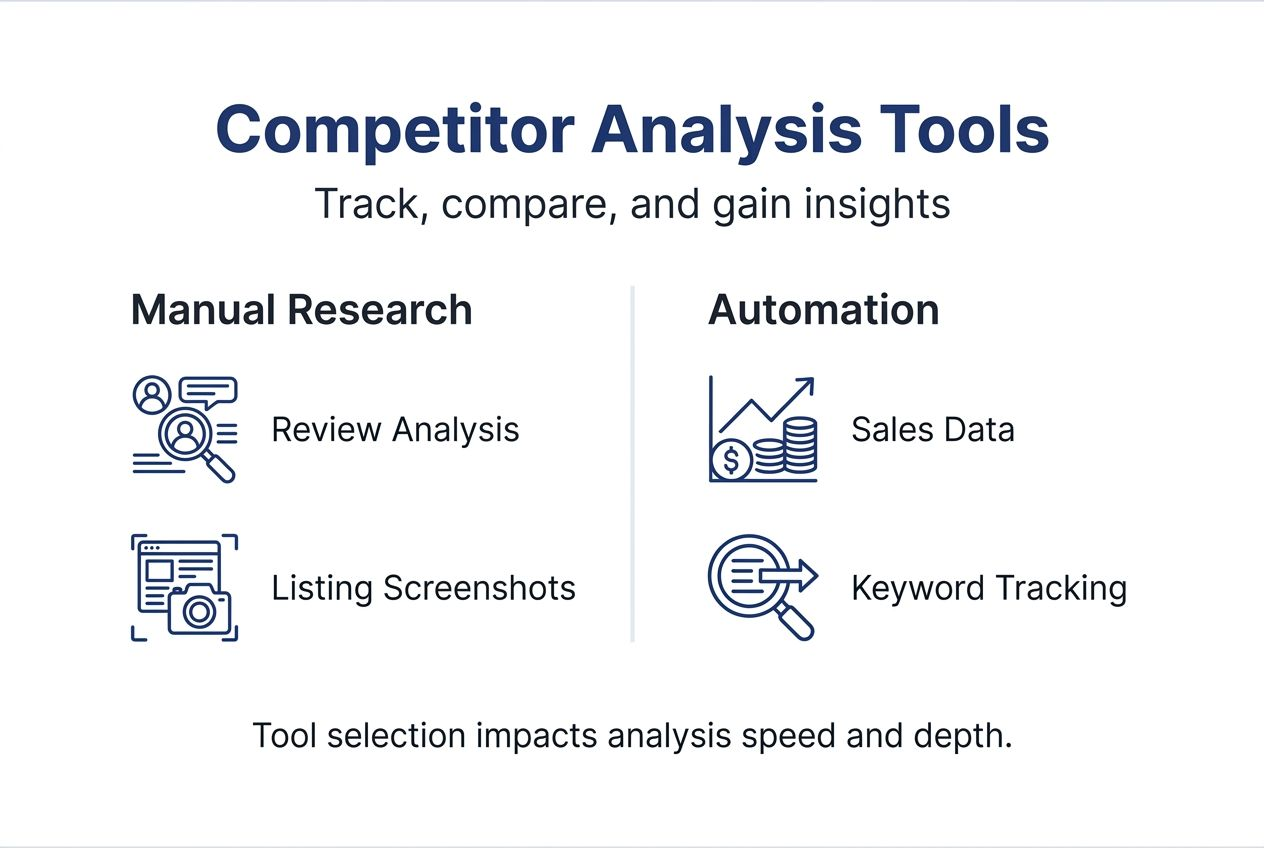
Manual research only scales so far. Automated tools track sales estimates, keyword rankings, and ads in real-time, critical capabilities when monitoring the 9+ million seller landscape.
Top competitor analysis tools in 2026 include:
| Tool | Key Features | Best For |
|---|---|---|
| Jungle Scout | Sales estimates, keyword tracking, product database | New sellers needing comprehensive data |
| Helium 10 | Listing optimizer, PPC analyzer, keyword research | Advanced users running ad campaigns |
| Viral Launch | Market intelligence, keyword manager, listing builder | Sellers focused on launch strategies |
| AMZScout | Product tracker, niche finder, sales estimator | Budget-conscious solo sellers |
| Keepa | Price history tracking, deal alerts, API access | Repricing and inventory planning |
Automation delivers speed and consistency impossible through manual checks. Tools refresh data hourly or daily, alerting you to competitor price drops, ranking changes, or new product launches immediately. This speed lets you respond before losing significant market share.
Manual research still has a place for qualitative analysis. Reading through customer reviews, evaluating listing copy quality, and assessing brand positioning requires human judgment that software cannot replicate. The winning approach combines automated data collection with manual interpretation.
For detailed comparisons of features and pricing, review our Amazon competitor analysis tools comparison to find the right fit for your business size and goals.
Common misconceptions in competitor analysis
Sellers often stumble into traps that waste time and produce misleading conclusions. Recognizing these myths helps you focus on strategies that actually move the needle.
Copying competitor listings guarantees nothing. What works for an established seller with thousands of reviews and brand recognition fails for newcomers without that trust. Buyers respond to differentiation, not duplication. Instead of mimicking, identify what competitors miss and fill that gap with better imagery, clearer benefits, or superior customer service.
Relying solely on customer reviews for product research creates blind spots. Reviews reflect existing products, not unmet needs or emerging trends. Combine review mining with keyword research, search volume data, and category growth metrics for a complete picture.
One-time competitor analysis becomes obsolete fast. The marketplace shifts weekly with new sellers launching, prices changing, and algorithms updating. Sellers who analyzed competitors once six months ago operate on stale intelligence that leads to poor decisions.
Ignoring regular updates costs sales. When a competitor drops prices by 15% and you remain unaware for weeks, your conversions plummet. When a rival launches a superior A+ Content layout and you do not adapt, buyers choose their listing over yours.
Key misconceptions to avoid:
- Assuming review count alone determines sales success
- Thinking keyword stuffing still works for ranking
- Believing competitors never change their strategies
- Expecting one analysis session to provide lasting advantage
- Focusing only on direct competitors while ignoring category trends
“Success on Amazon comes from understanding competitors deeply enough to outmaneuver them, not from creating pale imitations of their listings.”
Best practices and continuous monitoring
Building sustainable competitive advantage requires establishing routines for frequent analysis and rapid response. Regular competitor analysis updates and integrating findings lead to sustained marketplace success.
Set a monitoring cadence based on category velocity. Fast-moving categories with frequent price changes and new launches demand weekly reviews. Slower niches allow biweekly or monthly checks without missing critical shifts. Use calendar reminders or tool alerts to maintain consistency.
Feed insights directly into operational decisions:
- Pricing adjustments: When competitors cut prices, evaluate whether matching maintains margin or if emphasizing quality justifies your premium.
- Keyword optimization: If rivals rank for valuable terms you miss, add those keywords to your backend and consider updating titles or bullets.
- Ad campaign refinement: Competitors bidding aggressively on specific keywords signal high-value search terms worth testing in your own campaigns.
- Content improvements: When competitor A+ Content drives conversions, develop your own enhanced layouts highlighting different benefits.
- Inventory planning: Competitor stockouts create temporary opportunities to capture extra market share with increased ad spend.
Avoid common pitfalls that undermine monitoring efforts. Stale data from infrequent updates leads to reactive rather than proactive strategies. Tracking too many competitors dilutes focus and creates information overload. Ignoring secondary competitors allows category disruption to blindside you.
Pro Tip: Create a simple spreadsheet tracking your top 5 competitors’ prices, rankings, and review counts weekly. After 8 to 12 weeks, patterns emerge showing seasonal trends and strategic shifts you can anticipate.
From insight to action: applying competitor analysis
Data without execution changes nothing. Transform competitor intelligence into concrete improvements that increase sales, conversions, and market presence through systematic application.
Optimize listings based on competitive gaps. If competitor bullet points focus heavily on features while ignoring customer benefits, emphasize how your product solves specific problems. When rivals use low-quality images, invest in professional photography showing your product in use. Where competitors neglect backend keywords, expand your targeting to capture overlooked search traffic.
Adjust pricing dynamically without racing to unsustainable lows. When competitors temporarily discount for promotions, maintain your price if reviews and content justify a premium. If rivals consistently undercut you by 20%, evaluate whether cost reductions or bundling strategies can close the gap while preserving margin.
Refine advertising campaigns using competitor keyword data. Bid on terms where competitors rank organically but not through ads, capturing clicks they miss. Test ad copy variations emphasizing different benefits than competitor messaging. Allocate more budget to keywords where competitors recently reduced spending.
Real examples show measurable impact:
- A kitchen gadget seller increased conversions 23% by adding lifestyle images after noting competitor listings lacked usage context.
- An electronics brand boosted organic rankings 5 positions by targeting 12 backend keywords competitors overlooked in title optimization.
- A supplement seller grew sales 18% by addressing safety concerns mentioned in competitor reviews but absent from their own content.
Apply these strategies through a structured listing optimization workflow for Amazon sellers and follow comprehensive Amazon SEO step-by-step guidance to boost product visibility.
Pro Tip: After implementing competitor-informed changes, wait 2 to 3 weeks before evaluating results. Amazon’s algorithm needs time to process updates and adjust rankings accordingly.
Elevate your Amazon listings with expert optimization
Competitor analysis reveals opportunities, but execution determines results. Turning insights into optimized listings, strategic pricing, and effective advertising requires expertise and systematic workflows many sellers lack time to develop.

Our specialized services help Amazon sellers transform competitive intelligence into measurable sales growth. We enhance product titles, bullet points, descriptions, and backend keywords using data-driven strategies that align with current marketplace dynamics. Our analytics tools track competitor movements and surface actionable recommendations weekly.
Whether you need comprehensive listing enhancement guidance for sales growth, a proven listing optimization workflow, or advanced Amazon analytics for sustained sales growth, we provide the frameworks and support to outperform competitors consistently. Stop reacting to marketplace changes and start anticipating them with professional optimization that delivers results.
Frequently asked questions about Amazon seller competitor analysis
How often should I update my competitor analysis data?
Update weekly for fast-moving categories with frequent price changes and new product launches. Slower niches allow biweekly or monthly reviews without missing critical competitive shifts that impact your sales.
What are the best tools for Amazon competitor analysis in 2026?
Jungle Scout, Helium 10, Viral Launch, AMZScout, and Keepa lead the market with comprehensive features for tracking sales estimates, keyword rankings, pricing history, and advertising data. Choose based on your budget and whether you prioritize product research, PPC management, or repricing capabilities.
How can I avoid just copying competitor listings?
Focus on differentiation by identifying gaps in competitor content, addressing pain points mentioned in their reviews, and emphasizing unique product benefits. Use competitor analysis to understand market standards, then exceed them rather than duplicate them.
What key metrics should I focus on for pricing adjustments?
Track competitor base prices, promotional frequency, Buy Box win rates, and sales velocity indicators like Best Seller Rank. Monitor how price changes correlate with ranking shifts to understand elasticity in your category before making adjustments.
Can competitor analysis help with Amazon advertising strategy?
Absolutely. Analyzing competitor ad placements, keyword targets, and estimated budgets reveals high-value search terms and optimal bidding strategies. Learning from their advertising approach can boost your conversion rates significantly while reducing wasted ad spend.
Should I analyze international competitors or focus only on U.S. sellers?
Prioritize U.S. competitors who directly impact your marketplace performance. International sellers only matter if they actively compete in your categories and ship to American buyers. Focus analysis where competition directly affects your sales and rankings.
Recommended
- Amazon Competitor Analysis Workflow: Complete Guide – Searchoneers
- Amazon Seller Tips 2025: Essential Strategies for Success
- 8 Best Amazon Competitor Analysis Tools – Expert Comparison 2025 – Searchoneers
- Amazon SEO Workflow 2025: Complete Step-by-Step Guide – Searchoneers
- Track eCommerce Metrics in 2026: Boost Growth by 30%

Leave a Reply