TL;DR:
- Keyword cannibalization occurs when multiple pages target the same search intent, dividing ranking signals and reducing SEO effectiveness. Detection involves analyzing performance data and site search results to confirm competition, with fixing strategies including merging, reoptimization, or canonical tags. Not all keyword overlaps are harmful; clear intent distinction allows pages to coexist, emphasizing the importance of ongoing content coordination.
You publish two blog posts on the same topic, both optimized carefully, and neither ranks where you expect. Your traffic plateaus. You check rankings and see two of your own URLs trading positions on page two. This is keyword cannibalization at work, and it is one of the most misunderstood problems in SEO. Understanding what it is, why it happens, and how to fix it can unlock ranking potential that is already sitting on your website, waiting to be released.
Table of Contents
- Key Takeaways
- What keyword cannibalization actually means
- The real impact on your SEO performance
- How to detect keyword cannibalization on your site
- Strategies for fixing and preventing it
- When keyword overlap is not actually harmful
- My take: why this problem is almost always a people problem
- Take your SEO further with Searchoneers
- FAQ
Key Takeaways
| Point | Details |
|---|---|
| Definition matters | Keyword cannibalization is about intent overlap, not just keyword matching across multiple pages. |
| Real ranking cost | Competing pages split ranking signals, leaving all of them weaker instead of one ranking strongly. |
| Detection is step one | Use Google Search Console and site search operators to pinpoint which URLs are competing for the same query. |
| Merging beats deleting | A 301 redirect preserves link equity and ranking history better than simply removing a page. |
| Prevention requires process | A keyword map and editorial coordination stop cannibalization before it starts. |
What keyword cannibalization actually means
Keyword cannibalization is the technical term for what happens when multiple pages on your website target the same keyword with similar search intent, causing search engines to compete your own pages against each other. The result is that ranking signals get split rather than consolidated, and all competing pages perform below their potential.
The word “cannibalization” is precise here. Your pages are not competing with rival sites. They are eating each other’s authority.
Here is where most site owners get this wrong. They think keyword cannibalization is simply about using the same keyword phrase on more than one page. It is not. It is about intent overlap. Two pages can share a keyword and coexist without any problem, as long as they serve clearly different search intents. The real issue arises when intent ownership is unclear, meaning Google cannot tell which URL best answers the searcher’s question.
Consider the difference between content cannibalization and keyword cannibalization. They often overlap, but they are not the same thing. Content cannibalization is broader, covering thematic duplication and overlapping value across pages even when exact keywords differ. Keyword cannibalization is narrower and more structural. It specifically involves two or more URLs competing for the same query and intent combination.
Here are the three conditions that create genuine keyword cannibalization:
- Multiple pages target the same primary keyword or very close variants
- Those pages serve the same or highly similar searcher intent
- Google has no clear signal identifying one URL as the definitive answer
When all three conditions are met, you have a problem worth fixing.
The real impact on your SEO performance
The damage from keyword cannibalization goes further than most people realize. It is not just about rankings. It touches your link equity, your crawl budget, and your overall content strategy.
Start with rankings. When two pages compete for the same query, ranking fluctuations increase and SERP placement drops. Instead of one page holding a strong position in the top five, you end up with two pages hovering in positions nine through fifteen, swapping spots depending on Google’s most recent crawl. Neither converts well. Both cost you traffic you should have had.

Link equity takes a hit too. When other sites link to your content about a given topic, those links may spread across two or three competing pages instead of reinforcing one authoritative URL. The effect compounds over time.
Crawl efficiency suffers as well. Search engine bots have finite crawl budgets, especially on larger sites. When they spend time re-crawling multiple pages covering the same ground, they crawl fewer of your truly unique pages. Large e-commerce sites face this acutely, where product pages, category pages, and blog content can all target the same commercial keyword without any single team realizing it.
The resource cost is easy to overlook too. Every hour your team spends creating a new page that overlaps an existing one is an hour not spent building genuinely differentiated content that could rank for something new.
Stat to know: Multiple competing URLs fragment your ranking signals, causing pages to hover in mid-tier SERP positions rather than capturing the top spots where clicks are concentrated.
How to detect keyword cannibalization on your site
Detection is where most site owners either skip steps or get overwhelmed. Here is a repeatable process that actually works.
Start in Google Search Console. Open the Performance report and filter by a query you suspect is causing issues. Look at which URLs are generating impressions and clicks for that same query. Filtering by query to view multiple URLs with overlapping performance data is your fastest first signal of cannibalization.
Run a site search. Type "site:yourdomain.com “your keyword phrase”` into Google. If you see three or more pages returned that all appear to address the same topic and intent, that is your confirmation that you have a structural problem to address.
Use a dedicated SEO tool. Platforms like Ahrefs or Semrush let you track keyword rankings at the URL level. Pull a position history report for your target keyword and look for cases where multiple URLs from your domain have ranked for it at different times. That rotation pattern is a classic cannibalization signature.
Look for the warning signs. You do not always need tools to spot trouble. Watch for: two of your own pages appearing side by side in search results, ranking stalls on a page that should be climbing, or a strong older page losing ground shortly after a newer page on a similar topic is published.
Pro Tip: Do not rush to fix every perceived overlap. Confirm actual competition through performance data before consolidating pages. Fixing something that is not broken can create new problems.
Strategies for fixing and preventing it
Once you have confirmed cannibalization, you have several paths forward. The right fix depends on what the competing pages are and how their content differs.
Merge and redirect. This is the preferred solution for most situations. A 301 redirect from the weaker page to the stronger one consolidates all link equity, ranking signals, and authority behind a single URL. Do not simply delete the weaker page. Deletion without a redirect wastes every inbound link pointing to that URL.
Use canonical tags. When two pages need to exist for technical or business reasons but serve the same intent, a canonical tag tells Google which version to treat as authoritative. This is common in e-commerce, where the same product appears under multiple category paths.
Apply noindex selectively. For thin or transitional pages that overlap a stronger piece of content, a noindex tag removes them from search engine consideration without deleting them entirely. Use this sparingly and only where the page adds no standalone ranking value.
Reoptimize for distinct intents. Sometimes you do not need to eliminate a page. You need to redirect its focus. If two pages are targeting “best running shoes” and one actually covers beginner recommendations while the other focuses on marathon training, reoptimizing each for its specific sub-intent transforms a cannibalization problem into a content cluster strength.
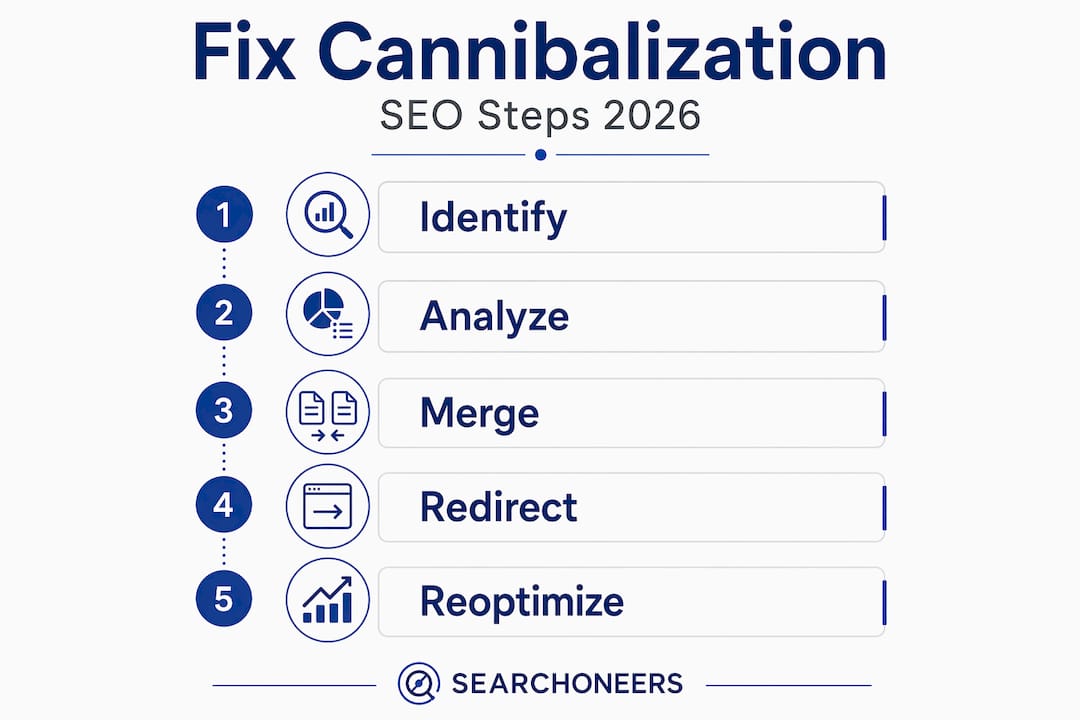
Here is a quick comparison to guide your decision:
| Situation | Recommended fix |
|---|---|
| Two pages cover identical topic and intent | Merge with 301 redirect to stronger page |
| Pages share keyword but serve different intents | Reoptimize each for its distinct intent |
| Duplicate needed for technical reasons | Add canonical tag to preferred URL |
| Thin page overlaps a stronger one | Apply noindex to the weaker page |
Pro Tip: Build a keyword map before publishing any new content. Assign one primary keyword and intent to each URL in a shared spreadsheet. This single habit prevents the majority of cannibalization cases before they happen.
Consistent e-commerce SEO practices make prevention much easier, especially when multiple team members are creating content across product and editorial pages.
When keyword overlap is not actually harmful
Not every instance of keyword overlap on your site is a problem. This distinction matters more in 2026 than it did three years ago, because Google’s semantic understanding has improved significantly.
Google’s ability to distinguish intent means that two pages sharing a keyword phrase can coexist peacefully when they clearly serve different purposes. A product page and an educational guide both mentioning “protein powder” are not cannibalizing each other. One answers a purchase intent. The other answers an informational query. Google understands that distinction now better than ever.
Similarly, Google sometimes shows multiple results from the same domain for branded queries or when different intents genuinely warrant separate pages. That is not cannibalization. That is topical authority working in your favor.
“Cannibalization is problematic only where overlapping intent causes signal dilution. Not all keyword overlap is created equal.” — Morrison SEO
The key question to ask about any suspected case: does each page have clear, distinct intent ownership? If yes, leave them alone. If no, fix them. Focusing your energy on genuine conflicts rather than chasing every keyword overlap keeps your SEO work efficient and your content strategy intact.
My take: why this problem is almost always a people problem
I have audited dozens of websites where keyword cannibalization was not a technical failure. It was a coordination failure. One team member published a blog post on topic A. Six months later, a different team member published another post on topic A without checking what already existed. Neither was wrong in isolation. Together, they were quietly sinking each other.
What I have found works is deceptively simple: a shared keyword ownership document. Not a complex SEO platform, just a spreadsheet where each URL has an assigned primary keyword and nobody publishes without checking it first. I have seen sites recover significant ranking ground within sixty days of implementing this one process.
The other thing I push back on is the idea that cannibalization is a one-time fix. It is not. New content gets published. Old pages get updated. The conditions that create conflict regenerate constantly. The sites that stay clean are the ones that build ongoing monitoring into their workflow, checking Search Console quarterly at minimum and auditing their top commercial terms twice a year.
Fixing cannibalization is not about perfection. It is about consolidating ranking signals behind pages that genuinely deserve to rank, and building the habits that keep your content working together instead of against itself.
— Goga
Take your SEO further with Searchoneers
Keyword cannibalization is just one piece of your overall visibility puzzle. If you are managing an Amazon presence alongside your website, the same principle applies: competing product pages, overlapping backend keywords, and uncoordinated listings all fragment your ranking potential.

At Searchoneers, we build data-driven strategies that assign clear intent and authority to every product page so your listings work together, not against each other. Whether you need a full audit or targeted improvements, our Amazon listing optimization resources give you a practical path to stronger rankings and more sales. Explore our Amazon SEO guide to see how the same intent-first thinking that fixes cannibalization can transform your product visibility.
FAQ
What is keyword cannibalization in SEO?
Keyword cannibalization happens when multiple pages on the same website target the same keyword with similar intent, causing search engines to split ranking signals across those pages instead of ranking one page strongly.
Is keyword cannibalization always harmful?
No. Keyword overlap is only harmful when pages share the same searcher intent. Pages that target the same keyword but serve clearly different search intents can coexist without negatively affecting rankings.
How do I detect keyword cannibalization on my site?
Filter the Google Search Console Performance report by a target query to see which URLs are receiving impressions and clicks for the same search term. Multiple URLs appearing for one query is a strong indicator of cannibalization.
What is the best way to fix keyword cannibalization?
Merging the weaker page into the stronger one with a 301 redirect is typically the most effective fix. It consolidates link equity and ranking signals behind a single authoritative URL without wasting existing inbound links.
How is keyword cannibalization different from duplicate content?
Duplicate content involves substantially identical text across pages. Keyword cannibalization is about intent and ranking competition, not identical copy. Two pages with completely different text can still cannibalize each other if they target the same query intent.