

Branded keywords deliver conversion rates exceeding 20% while generic terms struggle to break 10%. This gap represents the difference between profitable campaigns and wasted ad spend. Understanding branded keywords transforms how you approach Amazon listings, advertising strategy, and competitive positioning in 2026’s crowded marketplace.
Table of Contents
- Understanding Branded Keywords And Their Importance On Amazon
- Benefits And Cost Advantages Of Using Branded Keywords
- Crafting And Prioritizing Branded Keywords For Your Amazon Listings
- Optimizing Your Amazon Listings Using Branded Keywords For Maximum Visibility And Sales
- Unlock Your Amazon Success With Expert Listing Optimization Guides
Key takeaways
| Point | Details |
|---|---|
| Definition clarity | Branded keywords incorporate your brand name or closely related terms that shoppers associate with your products |
| Conversion advantage | These keywords convert at rates exceeding 20% compared to generic alternatives |
| Cost efficiency | CPCs run 20-50% lower than generic keywords while delivering superior results |
| Strategic priority | Integration across titles, backend fields, and PPC campaigns maximizes visibility and protects brand equity |
Understanding branded keywords and their importance on Amazon
Branded keywords contain your brand name or terms shoppers strongly associate with your company. When someone searches “Nike running shoes” instead of “running shoes,” they’re using a branded keyword. This distinction matters because it signals purchase intent and brand preference.
Generic keywords describe products without brand association. “Wireless headphones” is generic, while “Sony wireless headphones” is branded. The fundamental difference lies in shopper behavior. Branded searches indicate familiarity, trust, and often immediate purchase readiness. Generic searches represent exploration and comparison.
Amazon’s search ecosystem rewards relevance. When shoppers search branded terms, they expect to find that specific brand. Branded keywords often yield high conversion rates due to this familiarity. You’re not convincing strangers to trust you. You’re connecting with shoppers already seeking your products.
Consider how different keyword types serve distinct purposes. Branded keywords capture existing demand while generic keywords build awareness. Both matter, but branded terms deliver immediate ROI with less friction.
Branded keyword characteristics include:
- Direct brand name inclusion in search queries
- Product line names specific to your catalog
- Misspellings and variations of your brand
- Combinations of brand plus product category
- Competitor brand terms for defensive positioning
Usage scenarios extend beyond obvious applications. New product launches benefit from branded keyword campaigns targeting existing customers. Seasonal promotions gain traction when branded terms highlight limited editions. Defensive campaigns prevent competitors from stealing traffic on your brand name searches.
Benefits and cost advantages of using branded keywords
The financial case for branded keywords becomes clear through performance data. Conversion rates exceeding 20% aren’t outliers for established brands. Shoppers searching your brand name already trust you. They’re deciding between your products, not between you and competitors.

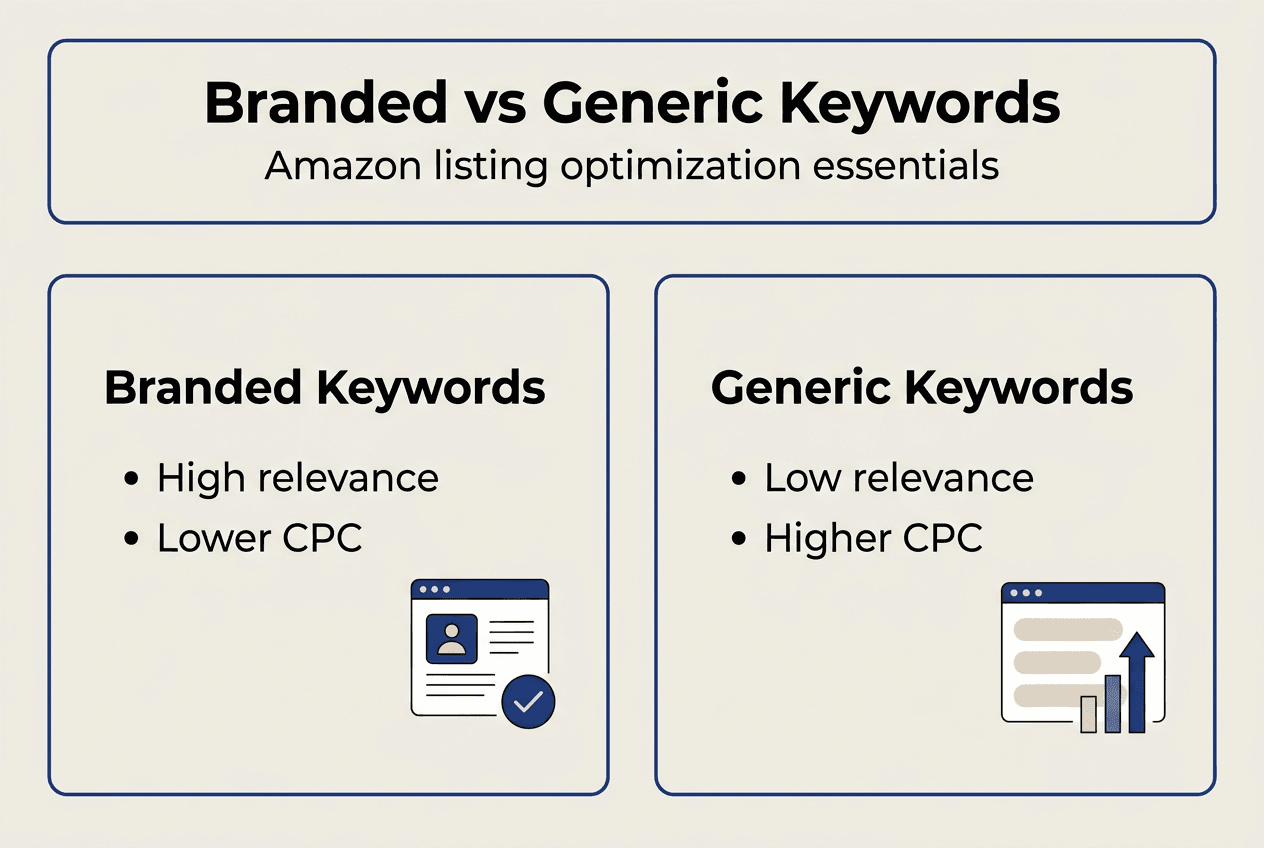
Cost efficiency compounds these conversion advantages. CPCs running 20-50% lower than generic alternatives mean your ad budget stretches further. Lower costs per click combined with higher conversion rates create explosive ROAS improvements.
| Metric | Branded Keywords | Generic Keywords |
|---|---|---|
| Average Conversion Rate | 20-25% | 8-12% |
| Typical CPC Range | $0.30-$0.80 | $0.60-$1.50 |
| Customer Intent Level | High (ready to buy) | Medium (researching) |
| Competition Intensity | Lower | Higher |
Beyond raw numbers, branded keywords protect your market position. When competitors bid on your brand terms, you need defensive campaigns to maintain visibility. Optimizing these keywords ensures you don’t lose customers at the finish line.
The competitive edge extends to organic rankings too. Amazon’s algorithm recognizes when shoppers search your brand and click your listings. This behavior signals relevance, boosting your overall keyword performance across the board.
Key benefits summarized:
- Reduced customer acquisition costs through lower CPCs
- Higher profit margins from improved conversion efficiency
- Brand protection against competitor encroachment
- Enhanced organic rankings through relevance signals
- Improved quality scores in PPC campaigns
- Better customer lifetime value from brand loyal shoppers
Pro Tip: Monitor your branded keyword CPCs weekly during peak seasons. Competitors often increase bids on your brand terms during high-traffic periods. Adjust your bids proactively to maintain top-of-search placement without overpaying during slower periods.
Crafting and prioritizing branded keywords for your Amazon listings
Effective branded keyword strategy starts with comprehensive discovery. Don’t limit yourself to exact brand name matches. Shoppers use variations, misspellings, and combinations you might not expect.
- Audit your current brand search terms through Amazon Brand Analytics if you’re Brand Registered
- Research competitor branded keywords to identify defensive opportunities
- Analyze customer reviews and questions for natural language brand references
- Test variations including abbreviations, common misspellings, and product line names
- Prioritize keywords by search volume data and conversion potential
- Integrate top performers into listing titles, bullet points, and backend search terms
- Launch separate PPC campaigns for branded versus generic keyword strategies
- Monitor performance weekly and reallocate budget toward highest ROAS terms
Prioritization matters because not all branded keywords perform equally. Your exact brand name likely converts best, but long-tail branded phrases like “[brand] waterproof hiking boots” capture specific intent. Choosing the right mix balances volume with relevance.
Search volume indicates opportunity size but conversion rate determines profitability. A branded keyword with 100 monthly searches converting at 30% outperforms a 1,000 search term converting at 5%. Calculate potential revenue, not just traffic.
Integration across your listing ecosystem amplifies results. Place primary branded keywords in titles for maximum algorithmic weight. Use variations in bullet points to capture different search patterns. Fill backend search term fields with misspellings and abbreviations shoppers actually use.
PPC campaigns deserve separate branded keyword ad groups. This isolation lets you set appropriate bids reflecting lower competition and higher conversion rates. Mixing branded and generic keywords in single campaigns wastes budget on inflated bids for branded terms.
Pro Tip: Create negative keyword lists excluding irrelevant search terms that trigger your branded campaigns. If you sell “Alpha Brand Protein Powder,” add “Alpha Brand Yoga Mats” as a negative to prevent wasted clicks from shoppers seeking different product categories.
Amazon’s ad business hit a $69 billion annual run rate in Q1 2025, proving smart keyword strategies aren’t optional. They’re survival skills in an increasingly competitive marketplace where every click costs money and every conversion counts.
Your branded keyword list should evolve with your catalog. New product launches require new branded long-tail combinations. Seasonal offerings need temporary branded keyword additions. Regular keyword analysis keeps your strategy current.
Optimizing your Amazon listings using branded keywords for maximum visibility and sales
Implementation separates knowledge from results. Branded keywords deliver value only when properly integrated across your entire Amazon presence.
| Aspect | Branded Keywords Approach | Generic Keywords Approach |
|---|---|---|
| Title Placement | Front-load exact brand name | Lead with primary product benefit |
| Bid Strategy | Lower bids, higher budgets | Higher bids, careful budget limits |
| Match Types | Exact and phrase match priority | Broad match for discovery |
| Landing Pages | Direct to brand storefront | Product detail pages |
Search ranking improvements come from consistent branded keyword usage. Amazon’s algorithm weighs title keywords heavily. Placing your brand name early in titles signals relevance for branded searches. This doesn’t mean keyword stuffing. Natural, readable titles that include your brand convert better than awkward keyword strings.
Buyer confidence increases when listings clearly display brand identity. Shoppers searching “[your brand] wireless charger” expect prominent brand mentions in titles, images, and descriptions. Meeting these expectations reduces bounce rates and improves conversion, which further boosts rankings.
Common pitfalls include overusing branded keywords where they don’t fit naturally. Backend search terms should include variations and misspellings, but customer-facing content needs readability. Conversion rates remain high only when listings feel professional, not spammy.
Irrelevant keyword usage damages performance. Adding competitor brand names to your backend fields violates Amazon’s terms and risks suppression. Focus on your own brand variations instead. Defensive PPC campaigns handle competitor brand protection legally through advertising, not listing manipulation.
Best practices for integration:
- Place exact brand name within first 80 characters of title
- Use branded long-tail keywords in bullet points naturally
- Fill backend search terms with misspellings and abbreviations
- Create brand-specific A+ content highlighting your story
- Launch Sponsored Brand campaigns showcasing full catalog
- Monitor brand analytics for emerging search patterns
- Update listings quarterly based on performance data
PPC integration requires strategic thinking. Exact match campaigns on your brand name prevent competitor hijacking. Phrase match campaigns capture long-tail branded searches. Broad match rarely makes sense for branded keywords since you want precision, not discovery.
Pro Tip: Analyze your keyword performance data monthly using Amazon’s Search Term Report. Identify which branded variations drive sales versus clicks. Shift budget toward converters and add non-converters as negative keywords to eliminate waste.
The complete optimization process extends beyond keywords alone. Images, pricing, reviews, and fulfillment method all impact conversion rates. Branded keywords bring qualified traffic, but your listing must close the sale. Test different combinations to find what resonates with your specific audience.
Unlock your Amazon success with expert listing optimization guides
Mastering branded keywords represents just one component of comprehensive Amazon success. Searchoneers specializes in helping sellers like you transform listings into revenue engines through proven optimization frameworks.
Our listing enhancement guide walks you through advanced techniques for maximizing every element of your product pages. From title optimization to backend keyword strategies, you’ll discover how top sellers consistently outrank competitors.

The optimization workflow we’ve developed streamlines the entire process. You’ll learn exactly which changes to prioritize, how to test variations, and when to scale successful approaches across your catalog.
For sellers ready to dominate search results, our step-by-step SEO guide reveals the complete system. Branded keywords become exponentially more powerful when combined with smart SEO tactics that amplify visibility and drive sustainable growth.
FAQ
What is the difference between branded keywords and generic keywords?
Branded keywords include your brand name or closely associated terms, while generic keywords describe products without brand specificity. Branded searches like “Anker power bank” indicate purchase intent and familiarity, whereas generic searches like “portable charger” represent exploration. This distinction drives dramatically different conversion rates, with branded terms often converting two to three times higher than generic alternatives.
How can I find the best branded keywords for my Amazon products?
Start by analyzing your Brand Analytics dashboard if you’re registered, which reveals actual customer search terms. Research competitor listings to identify defensive opportunities and examine customer reviews for natural language patterns. Use Amazon’s autocomplete suggestions by typing your brand name followed by product categories. Our keyword selection guide provides detailed methods for discovering high-value branded terms specific to your catalog.
Do branded keywords always have a lower cost-per-click on Amazon?
Branded keywords typically cost 20-50% less than generic alternatives, but competition and brand strength affect actual CPCs. Established brands with strong recognition enjoy the lowest costs, while newer brands may see smaller differentials. Monitor your specific branded keyword CPCs weekly because competitors bidding on your brand terms can temporarily inflate costs. Adjust your bid strategy based on performance data rather than assumptions about branded keyword pricing.
Should I bid on competitor brand names in my PPC campaigns?
Bidding on competitor brand names through PPC is legal and common, but adding them to your listing content violates Amazon’s terms. Defensive campaigns targeting competitor brands can capture comparison shoppers, though conversion rates typically run lower than your own branded terms. Focus primarily on protecting and maximizing your own brand keywords before investing heavily in competitor targeting. The ROI usually favors brand defense over brand conquest strategies.
How often should I update my branded keyword strategy?
Review branded keyword performance monthly at minimum, with weekly checks during peak seasons or product launches. Add new branded long-tail combinations whenever you introduce products or identify emerging search patterns in your analytics. Quarterly deep audits help identify declining terms to pause and rising opportunities to prioritize. Your branded keyword list should evolve continuously as your catalog grows and customer search behavior shifts over time.

Comments
One response to “What is branded keywords: A 2026 Amazon sellers guide”
[…] Branded keywords increase conversions for loyal customers, while non-branded ones attract new buyers. This distinction matters enormously for your ad spend allocation and organic strategy. […]