TL;DR:
- Keyword stuffing involves overloading website content with keywords in an unnatural way to manipulate search rankings, ultimately harming readability and user experience. Search engines detect this through unnatural patterns, leading to penalties, reduced visibility, or search removal. Using keywords naturally, employing synonyms, and focusing on quality content help ensure both compliance and effective SEO.
Keyword stuffing is one of those tactics that seems logical on the surface. More keywords should mean better rankings, right? Wrong. What is keyword stuffing, exactly? It’s the practice of overloading a webpage with keywords in an unnatural way to manipulate search rankings rather than serve the reader. The result is content that reads like a robot wrote it, and search engines have gotten very good at recognizing exactly that. This guide breaks down the patterns, the consequences, and what you should do instead.
Table of Contents
- Key takeaways
- What keyword stuffing actually looks like
- Why keyword stuffing is bad for your SEO
- How to detect keyword stuffing in your content
- Best practices for natural keyword optimization
- Keyword stuffing in ecommerce and Amazon listings
- My honest take on keyword stuffing
- Optimize your listings the right way with Searchoneers
- FAQ
Key takeaways
| Point | Details |
|---|---|
| Keyword stuffing defined | Forcing keywords unnaturally into content signals spam to search engines and alienates real readers. |
| Pattern, not just percentage | Google detects stuffing through unnatural phrasing and repetition, not by hitting a keyword density threshold. |
| Real penalties follow | Stuffed content can trigger manual or algorithmic penalties that tank your search visibility. |
| Detection requires human judgment | Reading your content aloud reveals keyword loops that automated density tools routinely miss. |
| Natural variation wins | Using synonyms, related terms, and contextual placement satisfies both users and modern search algorithms. |
What keyword stuffing actually looks like
Let’s get specific. Keyword stuffing is excessive keyword repetition that makes content feel written for a search engine instead of a person. The definition is simple. The patterns are more varied than most marketers realize.
Here are the most common keyword stuffing examples you’ll encounter in the wild:
- Repetitive phrasing in body copy: A paragraph that uses “best running shoes” six times in four sentences. Each sentence technically makes sense alone, but read together, the whole thing feels awkward and forced.
- Keyword blocks and lists: Pages that include a wall of city names, product types, or service categories with zero surrounding context. Think “plumber Denver, plumber Aurora, plumber Lakewood, plumber Boulder.” No sentence. No value.
- Stuffed metadata: Title tags that read “Buy Shoes | Cheap Shoes | Best Shoes | Running Shoes | Shoes Online.” Every slot filled with the target keyword and its variants.
- Hidden keyword injection: This is the most aggressive form. Invisible text on webpages, like white text on a white background, is placed to feed crawlers keywords while showing users nothing. Search engines categorize this alongside cloaking because it deliberately deceives.
The critical nuance here is that keyword stuffing is about forcing keywords unnaturally into your content, not simply about reaching some keyword count. A 3,000-word article on protein supplements will naturally mention “protein” dozens of times. That’s not stuffing. A 400-word article that opens with “protein supplement protein powder best protein” is.
Pro Tip: Run a simple test. Copy your content into a word processor and use “Find and Replace” to highlight your target keyword. If it lights up every other sentence like a Christmas tree, you have a stuffing problem.
| Content type | Natural keyword use | Keyword stuffing |
|---|---|---|
| Product title | “Lightweight Trail Running Shoes for Men” | “Running Shoes Men Trail Running Shoes Best Running Shoes” |
| Meta description | “Shop durable trail shoes built for long-distance runs.” | “Buy running shoes, best running shoes, cheap running shoes online.” |
| Body paragraph | “These shoes handle rocky terrain without sacrificing comfort.” | “These running shoes are running shoes designed for running shoe lovers who want the best running shoes.” |
Why keyword stuffing is bad for your SEO
Here’s the straightforward answer to “is keyword stuffing bad?”: yes, and the reasons stack up fast.
Excessive keyword use harms readability and user experience, which sends negative quality signals to search engines. Google’s systems do not simply count keywords. They assess how users interact with your content. High bounce rates, low time-on-page, and poor engagement all tell the algorithm that your page is not delivering value.
Beyond user signals, there are direct penalties to consider:
- Algorithmic filtering: Google’s spam systems actively identify keyword-stuffed content and reduce its ranking eligibility. Your page may be indexed but buried where no one will find it.
- Manual penalties: Google spam policies treat keyword stuffing as a direct violation. A manual review can result in your pages being removed from search results entirely until you file a reconsideration request.
- Trust erosion: Users who land on stuffed content leave fast. They remember the bad experience and won’t return or share your content. Brand credibility takes a real hit.
“Keyword density is no longer a reliable ranking factor. Search systems now prioritize quality and user signals, making stuffing not just ineffective but actively harmful to your rankings.” — Shopify
The impact of keyword stuffing on SEO is not a future risk. It is a current reality. Brands that built traffic on keyword-heavy tactics in the early 2010s lost that traffic when Google’s Panda and subsequent algorithm updates re-prioritized content quality. Recovering from those penalties took months, sometimes years.
How to detect keyword stuffing in your content
Knowing what keyword stuffing is and knowing whether your own content is guilty of it are two different skills. Here’s a practical audit process you can run today.
- Read your content aloud. This is the most underrated technique in SEO. Reading content aloud reveals keyword loops that automated tools completely miss. If you stumble, repeat yourself, or feel like you’re reciting a list, the content has a stuffing problem.
- Check keyword distribution, not just density. What is keyword density? It’s the percentage of times a keyword appears relative to total word count. A useful reference point, but not a verdict. Instead, look at where keywords cluster. If your primary keyword appears seven times in the opening three paragraphs and nowhere else, that’s a red flag regardless of the overall percentage.
- Scan headings and subheadings independently. Stuffing frequently concentrates in headers because marketers assume that’s where ranking signal lives. Pull out just your H1, H2, and H3 tags and read them as a sequence. Do they sound natural, or do they read like a keyword inventory?
- Use SEO tools for a baseline, then apply human judgment. Tools like Screaming Frog or Semrush can flag high-frequency terms. But judging stuffing requires assessing context, not just percentages. Use tools to find suspects, then review each instance manually.
- Check alt text and metadata. SEO placement in metadata is acceptable if natural. The moment your image alt text reads “red shoes buy red shoes cheap red shoes,” you’ve crossed into stuffing territory.
Pro Tip: Create a simple spreadsheet listing every instance of your target keyword by section. Paragraphs, headers, meta, alt text. Pattern recognition becomes much easier when you see the full distribution visually.
Best practices for natural keyword optimization
The goal is not to avoid keywords. The goal is to use them the way a knowledgeable human would write, naturally, contextually, and for the reader first.
Here’s what that looks like in practice:
- Write the first draft without thinking about keywords. Get your ideas down clearly. Then review for opportunities to include your target term where it fits without forcing it. This order matters because writing backwards around a keyword almost always produces stuffed content.
- Use synonyms and semantic variations. If you’re writing about “email marketing campaigns,” you can also use “email newsletters,” “automated email sequences,” “subscriber outreach,” and “promotional emails.” Search engines understand topical relevance beyond exact keywords, so varied phrasing actually helps your rankings rather than diluting them.
- Place your primary keyword strategically, not repeatedly. Target placement in your H1, the first 100 words, one or two subheadings, and the conclusion. That’s sufficient signal. Every additional forced instance after that adds risk, not reward.
- Write alt text that describes the image. “A runner wearing lightweight trail shoes on a mountain path” is both descriptive and keyword-relevant. It serves visually impaired users and passes SEO value without becoming a keyword dump.
- Keep meta descriptions readable. Your meta description should convince a human to click. If it convinces a human, it will satisfy the algorithm. One clear mention of your primary keyword is enough.
For deeper research into how ecommerce keyword strategy affects visibility, the principles above scale directly to product pages and category listings.
Keyword stuffing in ecommerce and Amazon listings
Ecommerce is where SEO keyword stuffing causes some of its most visible damage. Product listings are high-stakes, short-format content, which makes marketers more likely to cram keywords into every available field.

Keyword stuffing appears frequently in product listings through repetitive titles, keyword-jammed bullet points, and metadata that reads like a tag cloud rather than a product description.
Here’s what stuffed versus optimized looks like on an Amazon listing:
| Listing element | Stuffed version | Optimized version |
|---|---|---|
| Product title | “Yoga Mat Non Slip Yoga Mat Thick Yoga Mat Exercise Mat Yoga” | “Premium Non-Slip Yoga Mat, 6mm Thick, for Home and Studio Use” |
| Bullet point | “Best yoga mat yoga mat for beginners yoga mat non slip yoga exercise” | “Extra-grip surface keeps the mat firmly in place during hot yoga and HIIT sessions.” |
| Product description | “This yoga mat is a yoga mat that all yoga mat users love for yoga mat workouts.” | “Designed for daily use, this mat cushions joints during floor exercises while staying firmly in position.” |
Amazon’s A10 algorithm, like Google, prioritizes keywords used in Amazon listings based on relevance and conversion signals, not raw repetition. A title stuffed with the same keyword four times will not outrank a clean, benefit-driven title that converts shoppers into buyers.
The practical fix for ecommerce is straightforward:
- Use your primary keyword once in the product title, naturally integrated with the product’s actual benefits.
- Distribute secondary and long-tail keywords across bullet points and the description without repeating any single term more than twice.
- Place additional keyword variations in back-end search terms fields, where they serve the algorithm without disrupting the reader’s experience.
- Review competitor listings that are converting, not just ranking. High-converting listings almost always read naturally.
For a detailed breakdown of how to optimize Amazon product pages without the stuffing risk, Searchoneers has built out practical frameworks you can apply directly to your catalog.
My honest take on keyword stuffing
Over years of working through SEO audits and listing optimizations, I’ve come to one conclusion most practitioners resist: keyword stuffing is rarely an intentional spam decision. It’s usually a measurement problem.
Marketers see keyword density as a lever. They assume that if one mention of a keyword sends a signal, five mentions send a stronger signal. What I’ve found is that this logic made partial sense before 2012. After a decade of algorithm evolution, it’s simply wrong.
The more interesting shift is this: Google doesn’t penalize frequency. It penalizes unnatural patterns. I’ve seen content with a keyword density of 4% that ranked brilliantly because every instance read naturally. I’ve also seen content at 1.5% density that triggered quality filters because every keyword appeared at the start of a sentence in the same paragraph. It’s the pattern, not the percentage.
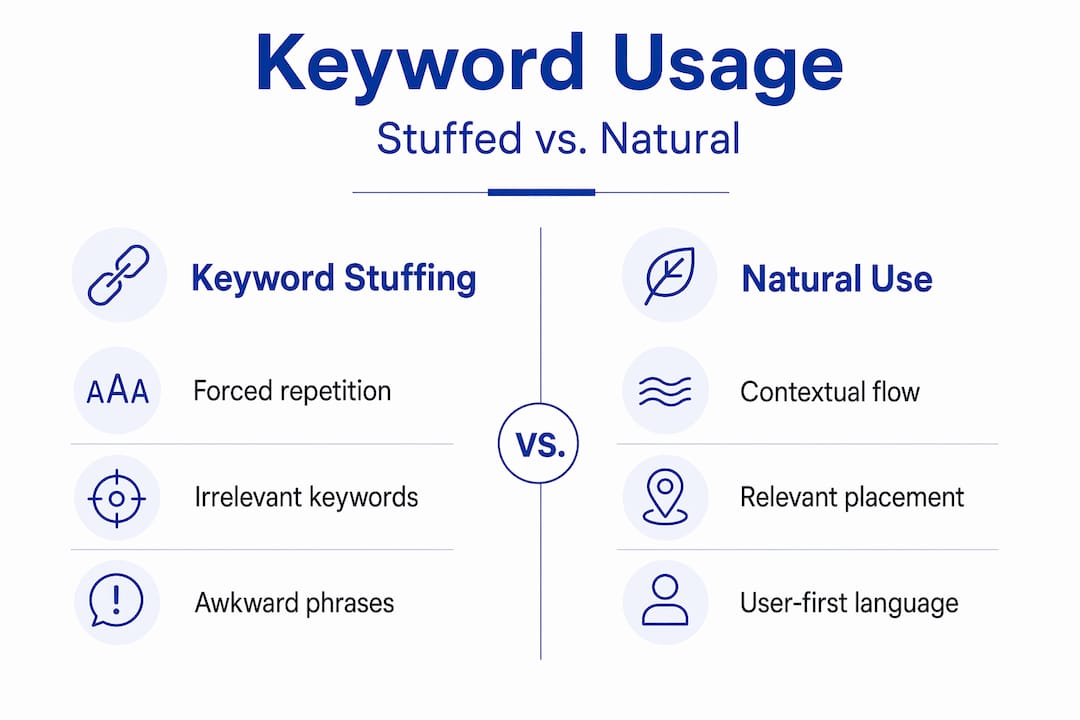
What I keep telling teams is to understand keyword density as a diagnostic, not a target. If your density is high and your content reads well, you’re fine. If your density is moderate but the content feels repetitive, you have a problem the numbers aren’t showing you.
The practitioners who consistently rank well are the ones writing for humans and trusting that relevance will follow. That’s not idealism. It’s just how modern search works.
— Goga
Optimize your listings the right way with Searchoneers
If any of this resonates and you’re looking at your current product listings wondering whether they’ve crossed the line, you’re already ahead of most sellers.

At Searchoneers, we specialize in Amazon listing optimization that puts your keywords to work without the stuffing risk. Our Amazon listing enhancement guide walks you through exactly how to structure titles, bullet points, and descriptions for maximum visibility and conversions. If you want a faster starting point, the listing optimization checklist gives you a step-by-step framework for auditing and fixing your entire catalog. Clean listings convert better and rank higher. Let’s build yours the right way.
FAQ
What is keyword stuffing in SEO?
Keyword stuffing is the practice of overloading a webpage with keywords in an unnatural way to manipulate search rankings. It prioritizes search engine signals over user readability, which modern algorithms actively penalize.
Is keyword stuffing bad for rankings?
Yes. Keyword stuffing violates Google’s spam policies and can trigger both algorithmic filtering and manual penalties, reducing or removing your page from search results.
What is a safe keyword density to avoid stuffing?
There is no universal safe percentage. Keyword stuffing is detected as an unnatural pattern, not a fixed density threshold. Focus on readability and natural placement rather than hitting or staying under a specific number.
How do I find keyword stuffing in my content?
Read your content aloud and listen for awkward repetition. You can also map every keyword instance by section in a spreadsheet to spot clusters that density tools won’t flag automatically.
Does keyword stuffing apply to Amazon listings?
Absolutely. Amazon’s algorithm penalizes unnatural keyword repetition in titles, bullet points, and descriptions. Stuffed listings underperform because they fail to convert shoppers, which reduces the conversion signals the A10 algorithm rewards.