TL;DR:
- Brand content builds genuine relationships by expressing a brand’s identity, values, and voice, not solely aiming for sales. Its strategic focus on trust and authenticity enhances audience loyalty, organic reach, and long-term authority, unlike traditional advertising. Effective brand content relies on transparency, community co-creation, and quality over quantity to foster sustainable growth and organic discovery.
Most marketers treat brand content as a fancy label for advertising. It isn’t. What is brand content, really? It’s the body of stories, formats, and experiences a brand produces to build genuine relationships with its audience — not to push a product, but to earn trust over time. The distinction is subtle but strategically massive. Get it right, and you compound audience loyalty, organic reach, and brand authority simultaneously. Get it wrong, and you’re just producing expensive noise. This article breaks down the definition, types, and practical creation of brand content so you can use it with precision.
Table of Contents
- Key takeaways
- What is brand content: a clear definition
- Why brand content matters right now
- How to create brand content that actually works
- Measuring and scaling brand content
- My take on brand content’s real role
- Take your brand content further with Searchoneers
- FAQ
Key takeaways
| Point | Details |
|---|---|
| Brand content builds relationships | It prioritizes trust and affinity over immediate sales or conversions. |
| It differs from content marketing | Brand content focuses on identity and storytelling; content marketing drives demand and conversion. |
| Quality outranks frequency in 2026 | Over 70% of marketers now prioritize relevance and quality over publishing volume. |
| Transparency is a growth strategy | Radical transparency in brand content, like unfiltered reviews, generates billions of impressions. |
| Governance matters at scale | Effective scaling requires AI oversight, human review, and brand integrity policies from the start. |
What is brand content: a clear definition
Let’s clear up the confusion right away. The definition of brand content is content that a brand creates and owns, designed primarily to express its identity, values, and voice rather than to sell a product directly. Think of it as your brand’s personality made visible through articles, videos, podcasts, social posts, and experiences.
This is where the terminology gets slippery. Many marketers use “brand content,” “branded content,” and “content marketing” interchangeably. They aren’t the same thing.
Brand content builds affinity and trust through subtle, integrated storytelling, while content marketing primarily drives demand and conversions. Branded content, on the other hand, often refers to co-created or sponsored content produced in partnership with media companies or creators. Your brand is featured, but you don’t fully control the narrative.
Here’s a quick comparison to anchor those differences:
| Type | Primary goal | Brand presence | Creator | Typical format |
|---|---|---|---|---|
| Brand content | Build identity and trust | Central and overt | The brand itself | Blog, video series, podcast |
| Branded content | Build affinity via association | Subtle, story-integrated | Brand + media partner | Sponsored editorial, film |
| Content marketing | Drive demand and conversion | Moderate | The brand itself | How-to guides, lead magnets |
The most common formats in brand content include:
- Owned media such as brand blogs, YouTube channels, and email newsletters
- Visual storytelling through documentary-style videos or brand films
- Thought leadership articles written under the brand’s voice
- Community content like brand-moderated forums and curated social content
- Experiential content such as live events documented and published online
What unifies all of these is intent. Brand content is never primarily transactional. The moment it starts feeling like a sales pitch, it stops functioning as brand content and starts functioning as advertising.
Why brand content matters right now
The case for brand content isn’t theoretical anymore. It’s measurable, urgent, and tied directly to how your audience discovers and trusts you.

Over 70% of marketers now prioritize content quality and audience relevance over publishing frequency. That’s a hard shift away from the “publish more, rank more” era. The reason? Audiences have grown intolerant of low-value content, and search engines are catching up to that intolerance.
Search algorithms now weigh brand trust and authority signals more heavily, making consistent, on-brand content critical for sustainable organic visibility. If your content doesn’t clearly express who you are and why you matter, it won’t earn the authority signals that drive long-term search growth.
The importance of brand content becomes even clearer when you look at real campaigns:
- Coach ran a purpose-led content strategy co-created with Gen Z that produced 15M+ organic engagements and 450,000 user-generated posts, with a 60% increase in top-of-mind awareness. No paid media buy delivers that kind of brand recall.
- Dove’s use of unfiltered Reddit reviews generated over 1 billion impressions and significant sales lift, proving that honesty, not polish, builds brand trust at scale.
“Brand content is not a top-of-funnel tactic. It’s the foundation your entire funnel rests on. Without it, every campaign you run is starting from zero trust.”
The benefits of brand content compound over time in ways that paid advertising simply cannot. Each story you tell, each value you express, each relationship you build through content reduces your reliance on paid acquisition and increases the organic gravity your brand generates naturally.
How to create brand content that actually works
Creating effective brand content in 2026 means you’re optimizing for two very different audiences simultaneously: real humans who want to feel something, and AI systems that want to retrieve and cite structured information. Content must be optimized for either emotional human consumption or AI citation, because middle-ground content underperforms across both channels.
Here’s a practical brand content strategy you can build on:
Define your brand voice in writing. Not bullet points on a slide deck. A documented voice guide that covers tone, vocabulary, taboo phrases, and example sentences. This becomes your quality filter for every piece of content you produce.
Choose your formats based on audience behavior, not trend. If your audience reads long-form analysis, invest in editorial content. If they watch short video, build there. Chasing formats your audience isn’t using wastes your production budget.
Embrace radical transparency. Dove’s Reddit campaign worked because it published what real customers actually said, not what the brand wished they said. Publishing unfiltered consumer reviews is a trust-building strategy most brands are too cautious to try. That caution is your competitive opportunity.
Co-create with your community. Brands that co-create with communities rather than controlling narratives see far greater organic engagement. KFC Arabia’s viral approach demonstrated this clearly — invite your audience into the story instead of broadcasting at them.
Shift from gated to modular formats. AI search engines favor modular, data-rich, question-driven content over traditional gated content. Structure your articles and videos so specific sections can be cited independently.
Build governance before you scale. Every piece of AI-assisted content needs a human review checkpoint. Define who approves what, and keep that process tight.
Pro Tip: Before you brief your creative team on any brand content piece, write a single sentence that completes this: “This content will make our audience feel ___.” If you can’t complete that sentence with a specific emotion, your brief isn’t ready.
The most common pitfall in how to create brand content is confusing volume with presence. Producing 30 mediocre blog posts is not the same as producing 5 stories your audience actually remembers and shares. Scale the right things, not everything.
Measuring and scaling brand content
Knowing your brand content strategy is working requires more than tracking page views. The metrics that matter for brand content are different from those used for performance marketing.
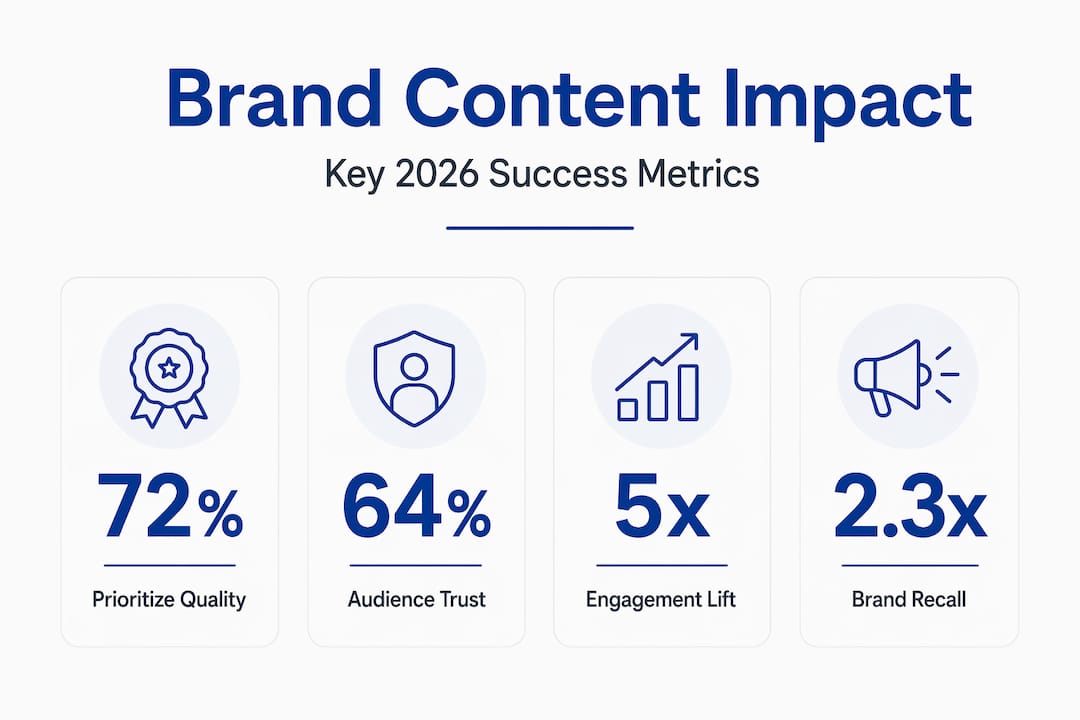
| Metric | What it measures | Why it matters |
|---|---|---|
| Brand recall lift | Audience memory of your brand after content exposure | Tracks affinity and top-of-mind presence |
| Engagement depth | Time on page, scroll depth, video completion rate | Indicates genuine content resonance |
| Organic share rate | How often content is shared without promotion | Signals authentic audience endorsement |
| Trust survey scores | Periodic audience surveys on brand trust | Quantifies relationship-building progress |
| AI citation frequency | How often AI tools surface your content | Measures authority in AI-driven discovery |
Scaling brand content introduces a specific risk: dilution. When you produce more, you often produce less consistently. Effective scaling in the AI era requires governance on provenance, human review, and AI transparency from the start to maintain brand integrity. The brands that scale poorly are the ones that handed content production to AI tools without establishing brand-specific guardrails first.
Scaling quality also means training AI tools on your own brand’s IP rather than relying on generic outputs. Bespoke AI models trained on your existing content library, with human creative input at key stages, maintain the nuance and distinctiveness that make brand content worth creating in the first place.
Pro Tip: Set a quarterly brand content audit. Pull your five highest-performing pieces and five lowest-performing ones. The patterns in what resonated vs. what didn’t will tell you more about your brand voice than any strategy session can.
You can also explore Amazon content strategy workflows to see how brand content principles apply specifically to e-commerce environments where trust drives purchase decisions at scale.
My take on brand content’s real role
I’ve spent years watching brands treat brand content as something you do after the “real work” of performance marketing. In my experience, that’s exactly backwards.
Brand content is not a luxury layer on top of your marketing. It’s the infrastructure. Every time a customer encounters your brand through a paid ad, they make a subconscious check: “Do I recognize this? Do I trust it?” If your brand content has been doing its job, the answer is yes before the ad even loads.
What I’ve learned is that the brands most intimidated by brand content are the ones that haven’t defined what they actually believe. When you know your values and your voice, content creation becomes a filtering process, not a creative crisis. The hard part isn’t writing the article or producing the video. The hard part is having something genuine to say.
I’m also convinced that most brands are dramatically under-investing in radical transparency. The instinct to control the narrative is understandable, but audiences in 2026 have a finely tuned radar for brand polish that hides inconvenient truths. Dove didn’t become more trusted by publishing better photography. They became more trusted by publishing what real customers actually said. That’s the model worth copying.
One more thing: don’t let AI be an excuse for sameness. The AI shopping surge of 4,700% year-over-year means the discovery environment is changing fast, but distinctiveness still wins. Use AI to scale what makes you different, not to produce what makes you indistinguishable.
— Goga
Take your brand content further with Searchoneers
If you’re selling on Amazon, brand content isn’t just a marketing concern. It directly affects your listing performance, conversion rate, and brand perception at the exact moment buyers are ready to purchase.

At Searchoneers, we specialize in translating brand content strategy into optimized Amazon listings that perform. Our Amazon listing enhancement guide shows you how to use storytelling, structured content, and brand voice to drive real sales results. You can also explore our work on Amazon Enhanced Brand Content to see how brand storytelling tools like A+ Content and Brand Story modules can reinforce your identity directly on product pages. When your brand content and your Amazon presence speak the same language, trust compounds and conversion follows.
FAQ
What is brand content in simple terms?
Brand content is any content a brand creates to express its identity and values rather than to directly sell a product. Its primary purpose is building trust and long-term relationships with the audience.
How does brand content differ from content marketing?
Brand content focuses on identity, storytelling, and affinity. Content marketing is primarily designed to drive demand and convert prospects into customers, often using educational or problem-solving formats.
What are the main types of brand content?
The main types include owned media like blogs and podcasts, brand films, thought leadership articles, community content, and experiential content documented for digital channels. Each format serves the same core purpose: expressing the brand’s authentic voice.
Why is brand content important for SEO?
Search engines now weigh brand trust and authority signals more heavily, meaning consistent, high-quality brand content contributes directly to organic search visibility and sustainable rankings over time.
How do you measure brand content success?
Key metrics include brand recall lift, engagement depth, organic share rate, trust survey scores, and AI citation frequency. Unlike performance marketing metrics, these indicators reflect relationship quality and long-term brand equity rather than short-term conversions.