

TL;DR:
- Pricing strategy shapes how a business conveys its market position and builds customer trust before sales occur.
- Choosing the right model involves understanding costs, customer value, and market conditions to ensure profitability and growth.
Your price is not just a number on a tag. Pricing strategy, the structured approach business owners use to set prices that achieve specific financial and market goals, is one of the most powerful signals your business sends before a customer ever buys from you. Yet most entrepreneurs set prices by guessing or copying competitors without a plan. Pricing signals brand positioning and customer identity long before the purchase decision is made. Get your pricing right, and you unlock better margins, stronger positioning, and customers who trust you.
Table of Contents
- Key takeaways
- What is pricing strategy and why it matters
- Types of pricing strategies explained
- How to set prices strategically
- Pitfalls and advanced pricing considerations
- Pricing strategy examples in practice
- My take on pricing as a mindset shift
- Grow your Amazon sales with smarter pricing and listing power
- FAQ
Key takeaways
| Point | Details |
|---|---|
| Pricing is strategic, not reactive | A structured pricing plan tied to your goals drives revenue and market share better than cost-guessing. |
| Multiple strategies exist | From cost-plus to value-based pricing, each model suits different products, markets, and growth stages. |
| Discounting erodes value | Frequent discounts damage perceived worth; adjusting scope or features protects price integrity. |
| Transparency builds trust | Clear, consistent pricing communication reduces purchase hesitation and builds lasting customer loyalty. |
| Test and refine regularly | Pricing is not set-and-forget. Regular review keeps your prices aligned with market conditions and profitability goals. |
What is pricing strategy and why it matters
A pricing strategy is a long-term plan for setting prices in a way that supports your business objectives, whether that is maximizing revenue, growing market share, or building a premium brand. It is not a one-time decision. It is a living framework you revisit as your costs, competition, and customers change.
The importance of pricing strategy goes well beyond covering your costs. Your price shapes how customers perceive your product’s quality, who they think the product is for, and whether they trust your brand. A $12 candle and a $90 candle made with identical wax send completely different messages. That gap is pricing strategy at work.
“Pricing or cost issues are among the top cited reasons startups fail.” — Stripe
That finding should get your attention. Entrepreneurs who treat pricing as an afterthought often discover the hard way that strong product-market fit does not save a business with broken unit economics. Pricing in marketing functions as a communication tool. It tells your market whether you are a budget option, a specialist, or a premium provider. Every price point you publish is a positioning statement.
The benefits of effective pricing compound over time. You attract the right customers, protect your margins, and reduce the pressure to compete purely on cost. When your pricing matches what the market values, you stop defending your price and start closing more deals.
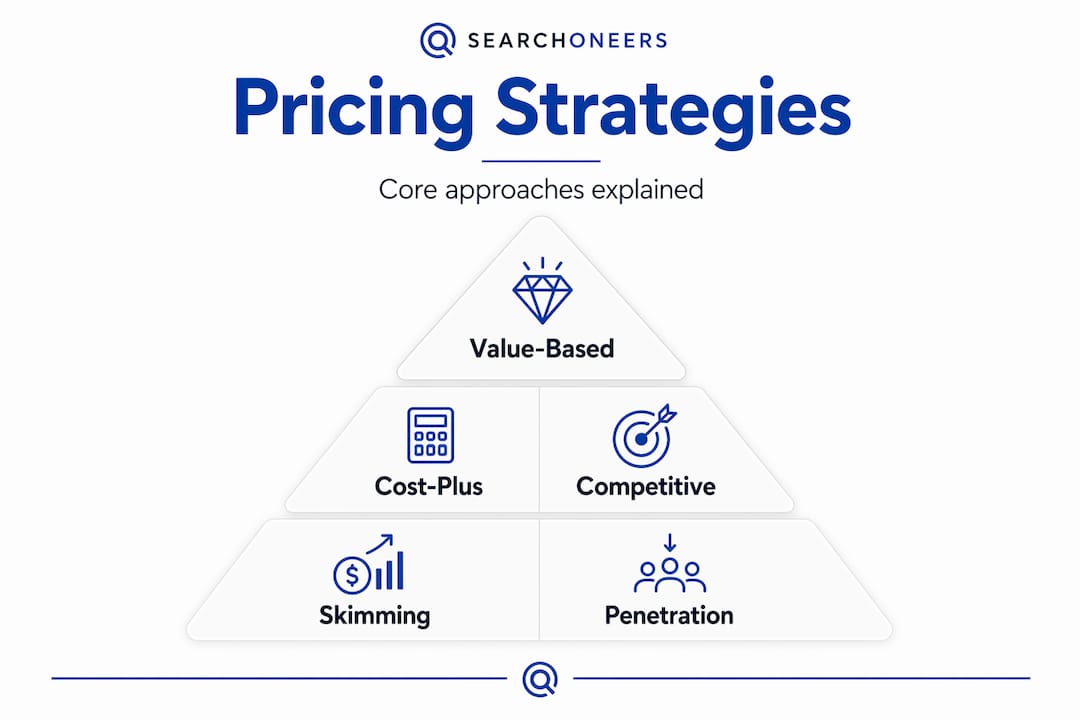
Types of pricing strategies explained
Understanding what pricing models are available is step one. Each approach has its place, and choosing the wrong one for your product or market will cost you either customers or margins.
| Strategy | Best for | Key benefit | Key risk |
|---|---|---|---|
| Cost-plus pricing | Physical products, manufacturing | Simple to calculate | Ignores customer value and competition |
| Competitive pricing | Commoditized markets | Stays market-relevant | Encourages race to bottom |
| Price skimming | Tech launches, innovations | Maximizes early revenue | Alienates price-sensitive buyers |
| Penetration pricing | New market entrants | Fast market share growth | Margin pressure, hard to raise later |
| Value-based pricing | SaaS, services, premium goods | Aligns price with customer ROI | Requires deep customer research |
| Tiered pricing | SaaS, subscriptions, retail bundles | Captures multiple segments | Complexity in messaging |
Cost-plus pricing
This is the most common starting point. You calculate your total unit cost, then add your desired margin on top. The formula is: Price = Total Cost divided by (1 minus Target Margin). So if your product costs $20 to make and you want a 20% margin, your price is $25. It is clean, predictable, and simple.

The downside is that cost-plus pricing completely ignores what your customer is actually willing to pay. You may be leaving serious money on the table or, worse, pricing below what your market considers credible.
Value-based pricing
This is where serious margin lives. Instead of asking “what did this cost me,” you ask “what is this worth to the buyer.” A consultant who saves a client $200,000 per year can charge $40,000 for their service, even if it took 80 hours of work. The cost of delivery is almost irrelevant. What matters is the outcome the client receives.
Value-based pricing requires real customer research, but the payoff is significant. You stop competing on price and start competing on results.
Penetration and skimming pricing
Penetration pricing wins initial market share by launching low, but you must plan your path to higher prices or cost reduction from day one. Price skimming does the opposite: you launch high to capture early adopters willing to pay a premium, then lower prices over time as competition increases. Apple’s iPhone launch pricing is the textbook example of skimming.
- Skimming works when your product is genuinely new or differentiated
- Penetration works when the market is price-sensitive and volume drives profitability
- Both require a clear exit plan to avoid being trapped at the wrong price point
How to set prices strategically
Knowing the theory is one thing. Here is how to actually set prices that hold up under pressure.
Calculate your true unit cost. Include not just materials and labor, but also overhead, packaging, shipping, returns, and a share of fixed costs. Most founders under-count here. If your spreadsheet only shows direct costs, you are already working with bad data.
Set your minimum acceptable price. Use the cost-plus formula to find your floor. This is the lowest you can sell without losing money. Never price below this without a deliberate, time-limited strategic reason.
Research your market. Look at what competitors charge for comparable products. Do not copy them blindly, but understand the pricing range customers are accustomed to seeing. If you plan to charge significantly more, you need a clear reason why.
Assess customer willingness to pay. Talk to real prospects. Ask them what they currently spend on solving this problem and what a solution like yours would be worth. You will often find they value it more than you assumed.
Choose your pricing model. Match your model to your product type and customer behavior. Subscriptions work for recurring value. One-time fees work for tools or physical goods. Tiered options work when customers have different needs and budgets.
Test, then refine. Launch with a price you believe in, then watch your conversion rate, average order value, and customer feedback. Price testing is not a sign of weakness. It is smart business.
Pro Tip: Tiered pricing shifts customer focus from “can I afford this” to “which option is right for me.” Offering an Essentials, Standard, and Premium tier typically increases average transaction value because buyers anchor to the middle option.
Pitfalls and advanced pricing considerations
Even entrepreneurs with solid pricing plans fall into a few predictable traps. Knowing them in advance saves you months of margin erosion.
- Over-relying on internal costs. Your costs are only one input. A price that covers your costs but feels too low to your market damages your brand credibility. Price perception matters.
- Discounting too often. Frequent ad-hoc discounting erodes perceived value and trains customers to wait for sales. If a customer’s budget is short, adjust the scope of work or the features included. Do not slash your price.
- Ignoring capacity alignment. Pricing too low when you are near capacity means you are turning away higher-value business to serve lower-value customers. Your pricing should reflect your operational reality.
- Hiding prices. Clear, transparent pricing with visible explanations reduces buyer hesitation. Concealing prices to “force a conversation” often breeds mistrust, especially online.
“Adjusting product scope or features is preferable to discounting when meeting budget constraints.” — Moore Kingston Smith
One advanced topic worth understanding is dynamic pricing. Dynamic and individualized pricing improves market efficiency by matching price to demand in real time, but it raises fairness concerns with consumers. Airlines and ride-sharing apps use it effectively. For most product businesses, the better application is seasonal pricing adjustments or demand-based tiers rather than real-time fluctuation.
Pro Tip: Know when to walk away from a customer who will not pay your price. One unprofitable client who consumes disproportionate resources can cost you the margin from three profitable ones. Price integrity is a business discipline.
Pricing strategy examples in practice
Theory becomes real when you see how these pricing approaches play out across different business types.
- A physical goods manufacturer uses cost-plus pricing to cover materials, labor, and overhead, then checks competitive pricing to confirm the market will support that price. If the market rate is higher, they capture the extra margin. If it is lower, they look for cost efficiencies.
- A SaaS startup launching into a crowded market uses penetration pricing to undercut established players. They know margins will be thin for 12 to 18 months but project that volume and retention will create a profitable base before they raise prices.
- A premium consultancy charges three times the market rate using value-based pricing because they target clients for whom the outcome is worth multiples of the fee. Their price is part of the positioning. A lower price would actually lose them clients who associate cost with quality.
- A DTC brand offers three product bundles: Starter, Growth, and Pro. Modern customers respond to tiered options that let them choose based on their needs rather than be forced into a single price point. The brand’s average order value increases by 30% compared to a single-SKU pricing model.
- A tech hardware company launches a new smart device at $299 to capture early adopters. Six months later, as competition arrives, they drop to $199 and accelerate volume. The skimming approach funded their marketing spend for the broader rollout.
For eCommerce sellers, getting your Amazon product strategy aligned with your pricing decisions is what separates sellers who compete on price from those who compete on value.
My take on pricing as a mindset shift
I have seen pricing debates sink more businesses than bad products. Founders agonize over whether to charge $47 or $49, while the real problem is that they have no idea what outcome they are actually selling or who their customer truly is.
In my experience, the most common pricing failure is not charging too much. It is charging too little out of fear. Entrepreneurs who underprice their work signal to the market that they do not believe in their own value. Customers pick up on that. A confident, clearly communicated price with a strong reason behind it closes faster than an apologetic discount.
What I have found is that pricing is storytelling. Your price tells the customer who you are, who this is for, and what to expect before a single word of your sales pitch lands. When I have watched businesses shift from cost-based to value-based pricing, the transformation is not just financial. The entire client relationship changes. You attract more decisive buyers and fewer time-wasters.
The discomfort of holding your price when a prospect pushes back is real. But long-term brand value requires resisting short-term pressure. The businesses I have seen thrive over years are the ones that treat price integrity the same way they treat product quality. It is non-negotiable.
— Goga
Grow your Amazon sales with smarter pricing and listing power
Your pricing strategy determines your profitability, but on Amazon, it also determines your visibility. The right price means nothing if your listing is not pulling in the right traffic and converting it.

At Searchoneers, we help Amazon sellers build listing optimization workflows that amplify the competitive advantage your pricing strategy creates. From keyword-rich titles and bullet points to backend SEO that drives discovery, our data-backed approach ensures your product gets seen by buyers who are ready to pay your price. Pair strong pricing with a fully optimized Amazon listing and you stop competing on price alone. You compete on value, visibility, and conversion.
FAQ
What is pricing strategy in simple terms?
A pricing strategy is a structured plan for setting your prices in a way that supports your business goals, such as maximizing profit, growing market share, or positioning your brand. It goes beyond covering costs to include market conditions, customer value, and competitive context.
What are the most common types of pricing strategies?
The most common types include cost-plus pricing, value-based pricing, competitive pricing, price skimming, penetration pricing, and tiered pricing. Each suits different products, markets, and business stages.
How do I set prices for my product?
Start by calculating your full unit cost, set a minimum price using your target margin, research what competitors charge, assess what customers are willing to pay, and then choose a pricing model that fits your product and market. Test and adjust from there.
Why is pricing strategy important for entrepreneurs?
Pricing directly impacts revenue, brand perception, and customer quality. Pricing or cost issues are among the top reasons startups fail, making a clear pricing plan one of the most critical decisions you will make as a business owner.
What is the difference between pricing strategy and pricing model?
A pricing strategy is the overall approach and goals behind your price-setting, such as value-based or competitive positioning. A pricing model is the mechanism you use to charge customers, such as subscriptions, one-time fees, or tiered bundles. The two work together but serve different purposes.

Comments
3 responses to “What Is Pricing Strategy? A Guide for Entrepreneurs”
[…] What Is Pricing Strategy? A Guide for Entrepreneurs – Searchoneers […]
[…] What Is Pricing Strategy? A Guide for Entrepreneurs – Searchoneers […]
[…] What Is Pricing Strategy? A Guide for Entrepreneurs – Searchoneers […]