TL;DR:
- Product positioning shapes how customers perceive your product relative to competitors, focusing on target audience, problem-solving, and differentiation. It is a strategic internal foundation guiding messaging, sales, and launches, emphasizing clear, evidence-backed claims in customer language. Consistent, emotional, and specific positioning drives customer trust, separates brands in crowded markets, and should be regularly refined across all touchpoints, including Amazon listings.
Product positioning is defined as the strategic process of shaping how customers perceive your product relative to competitors, answering who it’s for, what problem it solves, and why it beats the alternatives. According to Atlassian, effective positioning answers all four of those questions simultaneously. For marketers and business owners competing in crowded markets, understanding what is product positioning means understanding the single most powerful lever you have over buyer perception. Get it right, and customers choose you without needing a price war. Get it wrong, and you compete on features and discounts indefinitely.
What is product positioning and why does it matter?
Product positioning, also called market positioning, is the internal, market-driven decision about how your product creates value for a specific customer persona. The Pragmatic Institute defines it as the process of clarifying the problem, the persona, and the rationale using the customer’s own language. That last part matters more than most marketers realize. Positioning is not a tagline or a headline. It is the strategic foundation that every piece of messaging, every sales conversation, and every product launch is built on.

Al Ries and Jack Trout, who wrote the book on this topic, emphasized that positioning changes perception in the prospect’s mind rather than changing the product itself. That insight reframes the entire discipline. You are not redesigning your product. You are redesigning how your market thinks about it. That shift in perspective is what separates brands that command premium prices from those that constantly justify their existence.
The importance of product positioning becomes obvious the moment you enter a competitive market. When customers face many similar options, clear positioning cuts through the noise and gives buyers a reason to choose you that goes beyond price. Without it, you are invisible or interchangeable.
What are the core components of effective product positioning?
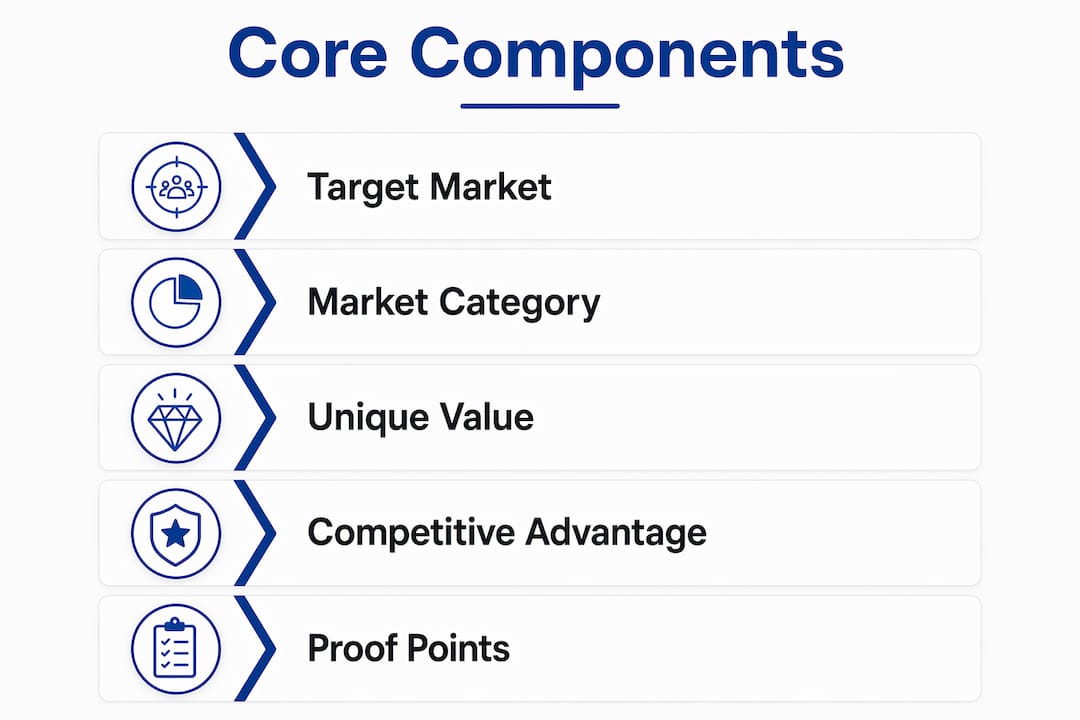
Strong positioning is built from five specific building blocks. According to Miro’s positioning framework, those five components are: target market, category, unique value, proof points, and competitive alternatives. Each one does a specific job, and skipping any one of them leaves your positioning incomplete.
Here is what each component contributes:
- Target market: The specific persona or segment you are solving for. Not “small businesses” but “e-commerce founders with under $1M in annual revenue who sell on Amazon.”
- Market category: The space your product belongs in. This tells customers how to evaluate you and what mental shelf to put you on.
- Unique value proposition: The single most compelling reason your product wins for this persona. One reason, stated clearly, beats a list of features every time.
- Proof points: The evidence that your claim is true. Testimonials, data, case studies, and third-party validation all qualify.
- Competitive alternatives: Every realistic option your buyer might choose instead, including doing nothing at all.
| Component | What it does |
|---|---|
| Target market | Defines who the positioning speaks to |
| Market category | Sets the competitive context |
| Unique value | States the core differentiator |
| Proof points | Validates the claim with evidence |
| Competitive alternatives | Anchors differentiation to real buyer choices |
These five components interact to produce a positioning statement: a single internal document that guides every external communication your team produces. The statement is not for customers to read. It is for your team to align around before anyone writes a single word of copy.
Pro Tip: Write your positioning statement before you write any marketing copy. Teams that skip this step end up with messaging that sounds good but says nothing specific enough to drive a decision.
How does product positioning influence customer perception?
Positioning works by claiming mental real estate. Atlassian describes this as the need to explain where you belong and why you are different in outcome terms. If you cannot do that clearly, customers will not consider your product when they are evaluating solutions. They will simply not think of you.
“Positioning is not what you do to a product. It is what you do to the mind of the prospect.” — Al Ries and Jack Trout, Positioning: The Battle for Your Mind
The mechanism works in four stages:
- Awareness: The customer encounters your product in a category they already recognize or one you define for them.
- Categorization: They place your product on a mental shelf next to alternatives they already know.
- Differentiation: Your positioning claim gives them a specific reason to evaluate you differently from those alternatives.
- Decision: Strong positioning speeds up the decision by removing ambiguity. Weak positioning forces the buyer to default to price or surface-level feature comparison.
Weak positioning causes customers to default to price or superficial feature comparison. That is the direct cost of vague or generic positioning. You end up in a race to the bottom that no one wins. Strong positioning, by contrast, connects your product to specific customer needs, benefits, and outcomes. It builds trust before the sales conversation even starts.
Emotional connection amplifies this effect. ProductPlan notes that successful positioning often leverages emotional triggers that competitors overlook. Milk Duds, for example, did not compete on taste or ingredients. They positioned around the experience of a candy that lasts longer, giving budget-conscious moviegoers more value per dollar. That emotional angle carved out a durable place in consumers’ minds that a purely feature-based claim never could have.
What strategies and frameworks help you position a product?
The most widely used framework for how to position a product comes from Geoffrey Moore’s work in Crossing the Chasm. His positioning statement template follows this structure: “For [target customer] who [has this problem], [product name] is a [category] that [delivers this value]. Unlike [competitive alternative], our product [key differentiator].” It forces clarity on every component and prevents the vague, committee-written positioning that plagues most companies.
Here is a practical process for building your positioning strategy:
- Identify your best-fit customer. Start with the persona who gets the most value from your product today, not the broadest possible audience.
- Map the competitive alternatives. List every realistic option your buyer might choose, including spreadsheets, manual processes, or doing nothing. Anchoring on actual alternatives creates realistic differentiation rather than positioning against a competitor you invented.
- Define your unique value in outcome terms. Translate features into results. “Saves 3 hours per week” beats “has an automated workflow.”
- Gather proof points. Pull customer quotes, usage data, and case study results that validate your value claim.
- Draft and test your positioning statement. Share it with customers and ask if it resonates. Revise based on their language, not yours.
The most common mistake in this process is confusing positioning with messaging. Positioning is the internal strategy. Messaging is the external execution. Teams that skip positioning and jump straight to copywriting end up with polished words that communicate nothing specific. The copy sounds good in a meeting but fails to convert because it never answered the buyer’s core question: “What’s in it for me?”
Pro Tip: Use your customers’ exact words when writing your positioning statement. If they say “I waste hours chasing invoices,” your positioning should reference that specific pain, not a sanitized version of it.
Iterative refinement matters here. Your first positioning statement will be wrong in at least one dimension. Test it with sales conversations, landing page experiments, and customer interviews. Treat positioning as a living document that sharpens over time, not a one-time deliverable.
What do real-world product positioning examples teach us?
The best product positioning examples share one trait: they make a specific claim for a specific person in a specific context. Vague positioning fails because it tries to speak to everyone and ends up resonating with no one.
Consider how positioning works across different market segments:
- Premium segment: Apple positions the MacBook Pro not as a laptop but as a professional creative tool. The target persona is a designer or developer who bills by the hour. The value claim is reliability and performance that pays for itself.
- Value segment: Amazon Basics positions on price parity with name brands at lower cost. The emotional trigger is “smart shopping,” not cheapness.
- Niche segment: Milk Duds, as noted by ProductPlan, positioned around duration of enjoyment rather than taste or ingredients. That single emotional angle created lasting differentiation in a crowded candy category.
| Brand | Positioning angle | Core emotional trigger |
|---|---|---|
| Apple MacBook Pro | Professional creative tool | Reliability and status |
| Amazon Basics | Smart value alternative | Confidence in frugality |
| Milk Duds | Longer-lasting candy experience | Value per dollar |
Effective positioning also guides sales conversations. When your team knows the positioning statement, they stop pitching features and start asking questions that surface the buyer’s specific problem. That shift alone can improve conversion rates without changing the product at all. For Amazon sellers, this principle applies directly to listing copy. Your title, bullet points, and product description are your positioning statement made public. They either claim a specific place in the buyer’s mind or they blend into the search results.
Proof points deserve special attention in competitive markets. Testimonials, verified ratings, and outcome-based case studies all serve as positioning reinforcement. A claim without proof is just an assertion. A claim backed by a customer quote or a measurable result becomes a reason to believe. You can read more about retail display positioning to see how these principles extend beyond digital channels into physical retail environments.
Key takeaways
Effective product positioning requires a clear target persona, a defined competitive context, and a value claim backed by proof. Without all three, positioning collapses into generic messaging that fails to drive decisions.
| Point | Details |
|---|---|
| Positioning shapes perception | It defines how customers categorize and evaluate your product before they ever talk to sales. |
| Five components are non-negotiable | Target market, category, value, proof points, and competitive alternatives must all be present. |
| Positioning precedes messaging | Write your positioning statement before any copy, or your marketing will lack strategic direction. |
| Emotional triggers drive differentiation | Positioning that connects to specific feelings and outcomes outlasts feature-based claims. |
| Iteration is built into the process | Test your positioning with real customers and refine it based on their language, not internal assumptions. |
Why most positioning fails before it reaches the customer
Most positioning problems I see are not strategic failures. They are alignment failures. A product team writes a positioning statement, marketing interprets it one way, sales interprets it another, and the customer hears three different stories depending on which touchpoint they hit first. That inconsistency destroys trust faster than bad positioning ever could.
The fix is not a better framework. It is internal commitment. Positioning decisions should align cross-functional teams and guide messaging, sales, and launch strategies from a single source of truth. That means the positioning statement needs to be a shared document, not a slide in a deck that gets forgotten after the launch meeting.
The other pattern I see constantly is positioning that sounds great internally but uses language customers never actually use. I have watched teams spend weeks perfecting a positioning statement filled with industry jargon, then wonder why their landing page conversion rate is flat. The answer is always the same: they wrote for themselves, not for the buyer. The Pragmatic Institute’s guidance on answering “What’s in it for me?” in the customer’s own language is the most practical test I know. If your positioning statement would confuse a smart customer who has never heard of your product, rewrite it.
For Amazon sellers specifically, positioning is not abstract. It lives in your title, your bullet points, and your first product image. Every word either earns attention or loses it. A solid Amazon product strategy starts with positioning clarity, not keyword research.
— Goga
How Searchoneers turns positioning strategy into Amazon sales
Understanding your product positioning strategy is step one. Translating it into an Amazon listing that actually converts is where most sellers get stuck.

Searchoneers specializes in exactly that translation. The team at Searchoneers takes your positioning statement and builds it into every element of your Amazon listing: titles that claim your category, bullet points that speak to your buyer’s specific problem, and backend keywords that capture the search terms your best customers actually use. The result is a listing that ranks higher and converts better because it speaks to one specific buyer with one specific reason to choose you. If you are ready to turn positioning clarity into real sales growth, the Amazon listing enhancement guide is the place to start.
FAQ
What is product positioning in simple terms?
Product positioning is the process of defining how you want customers to think about your product relative to competitors. It answers who the product is for, what problem it solves, and why it is the better choice.
How is product positioning different from messaging?
Positioning is the internal strategy that defines your product’s place in the market. Messaging is the external execution of that strategy in ads, copy, and sales conversations. Confusing the two leads to polished copy with no strategic foundation.
What are the steps for product positioning?
The core steps are: identify your best-fit customer persona, map competitive alternatives including doing nothing, define your unique value in outcome terms, gather proof points, and draft a positioning statement. Refine it based on real customer feedback.
Why does product positioning matter for Amazon sellers?
On Amazon, your listing title, bullet points, and description function as your public positioning statement. Clear positioning helps your listing rank for the right searches and convert the right buyers, reducing wasted ad spend and improving your conversion rate.
How often should you revisit your product positioning?
Revisit your positioning whenever you enter a new market segment, launch a major product update, or notice that competitors are closing the gap on your differentiation. Treat it as a living strategy, not a one-time exercise.