

Over ninety percent of American online shoppers have purchased from Amazon at least once, making it a core platform in the nation’s digital buying habits. Understanding Amazon’s marketing strategy is essential because it shapes how products are discovered, recommended, and ultimately chosen in a crowded marketplace. Dive into what drives Amazon’s success and uncover tactics that help both buyers and sellers navigate this ever-evolving American e-commerce giant.
Table of Contents
- Defining Amazon Marketing Strategy Fundamentals
- Types of Amazon Marketing: PPC, SEO, DSP
- Core Components: Listings, Keywords, Analytics
- Impact of Data-Driven Optimization Methods
- Common Mistakes and How to Avoid Them
Key Takeaways
| Point | Details |
|---|---|
| Customer-Centric Approach | Amazon’s marketing strategy focuses on understanding consumer needs and personalizing experiences to exceed expectations. |
| Data-Driven Decision Making | Utilizing analytics and predictive modeling helps sellers optimize their strategies and respond effectively to market trends. |
| Diverse Marketing Methods | Amazon offers various marketing strategies, including PPC, SEO, and DSP, which sellers can leverage to enhance visibility and drive sales. |
| Common Pitfalls | Sellers should be aware of frequent mistakes like neglecting keyword research and product optimization to maintain a competitive edge. |
Defining Amazon Marketing Strategy Fundamentals
Amazon’s marketing strategy represents a sophisticated approach to digital commerce that prioritizes customer experience and technological innovation. By leveraging advanced digital marketing techniques, Amazon has transformed how businesses engage with online consumers and create sustainable growth models.
The core of Amazon’s marketing strategy revolves around three fundamental pillars: customer-centricity, data-driven decision making, and continuous technological adaptation. Customer-Centric Approach means understanding consumer needs at a granular level and designing experiences that anticipate and exceed expectations. This strategy involves using extensive consumer data to personalize recommendations, optimize search results, and create seamless purchasing journeys.
Key components of Amazon’s marketing strategy include:
- Personalized product recommendations
- Dynamic pricing algorithms
- Advanced search and filtering capabilities
- Comprehensive customer review systems
- Integrated logistics and fulfillment networks
Technological innovation drives Amazon’s competitive edge, enabling them to constantly refine their marketing approaches. By integrating artificial intelligence, machine learning, and predictive analytics, Amazon creates marketing strategies that are not just reactive but proactively anticipate market trends and consumer preferences. This approach allows sellers to optimize their presence and performance within the Amazon ecosystem.
Types of Amazon Marketing: PPC, SEO, DSP
Amazon offers three primary marketing strategies that enable sellers to maximize visibility and drive sales: Pay-Per-Click (PPC) advertising, Search Engine Optimization (SEO), and Demand-Side Platform (DSP) marketing. Sponsored search results significantly impact marketplace dynamics, creating complex interactions between advertising strategies and product discoverability.
Pay-Per-Click (PPC) Advertising represents a direct method for sellers to increase product visibility by bidding on specific keywords. This approach allows sellers to place sponsored product listings at the top of search results, paying only when potential customers click on their advertisements. Key PPC strategies include:
- Sponsored Product Ads
- Sponsored Brand Ads
- Product Display Ads
Search Engine Optimization (SEO) focuses on optimizing product listings to improve organic search rankings within Amazon’s ecosystem. This involves strategically selecting keywords, crafting compelling product titles, creating detailed descriptions, and maintaining competitive pricing and positive customer reviews. Sellers aim to improve their product’s natural visibility without direct advertising expenditure.
Advanced prediction networks are transforming advertiser strategies through Demand-Side Platform (DSP) marketing. DSP enables sellers to reach customers across Amazon’s network and external websites, utilizing sophisticated targeting mechanisms. Unlike traditional PPC, DSP allows for programmatic advertising that extends beyond Amazon’s immediate marketplace, providing broader audience reach and more nuanced targeting capabilities based on customer behavior and demographics.
Core Components: Listings, Keywords, Analytics
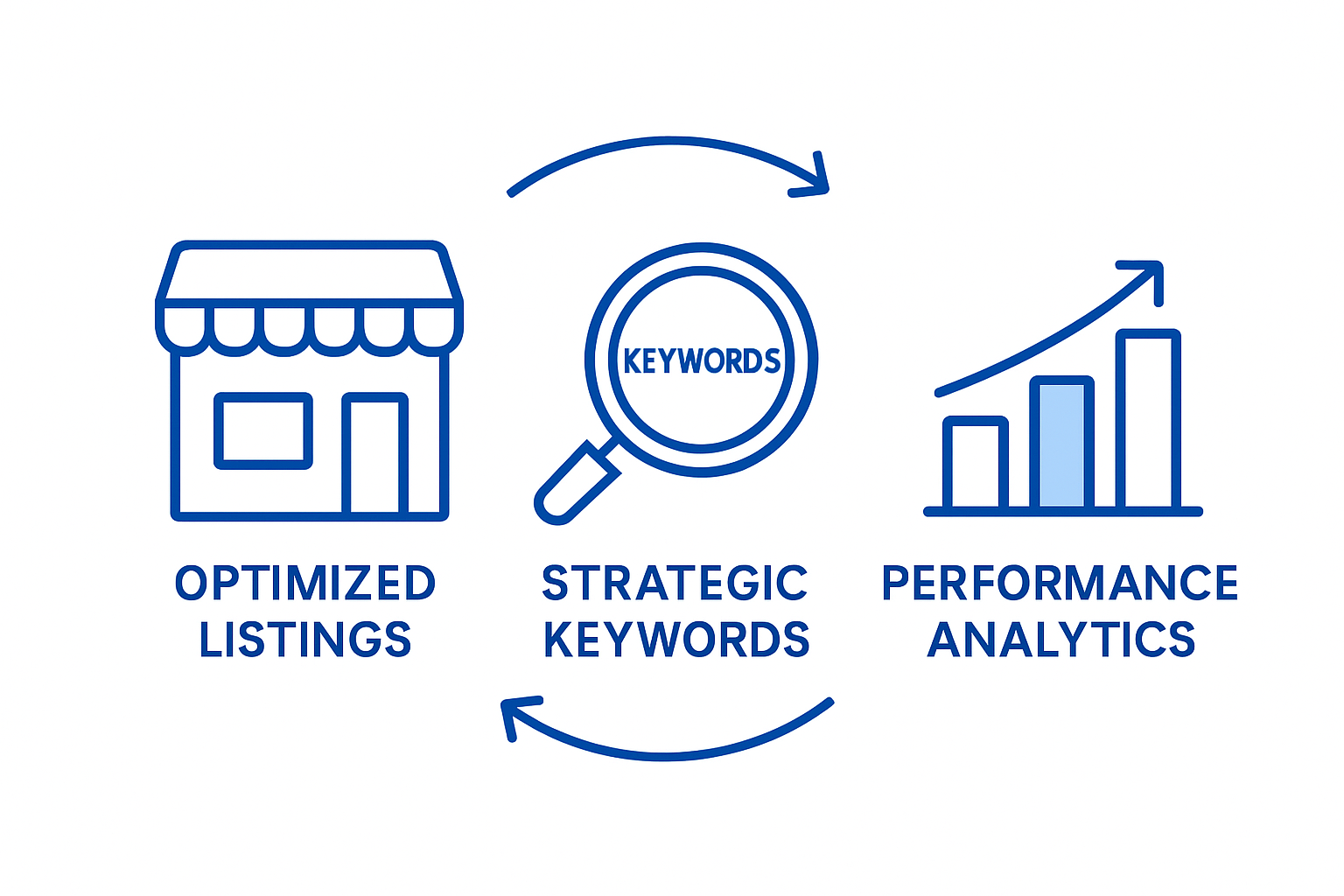
Comprehensive product lifecycle modeling reveals critical insights into Amazon’s marketing ecosystem, highlighting the intricate relationship between product listings, strategic keyword deployment, and performance analytics. These core components form the foundation of successful seller strategies, driving visibility, engagement, and ultimately, sales performance.
Product Listings represent the primary interface between sellers and potential customers. A high-performing listing requires meticulous attention to detail, including:
- Clear, compelling product titles
- High-quality images
- Detailed product descriptions
- Accurate product specifications
- Competitive pricing information
Keywords serve as the critical connective tissue between product listings and customer search behaviors. Advanced recommendation systems analyze complex keyword interactions, enabling sellers to understand and predict customer search patterns. Effective keyword strategies involve:
- Thorough market research
- Understanding customer search intent
- Incorporating long-tail and specific keywords
- Balancing high-volume and niche search terms
- Continuous keyword performance tracking
Performance Analytics transform raw data into actionable insights, allowing sellers to make data-driven decisions. These analytics encompass multiple dimensions, including conversion rates, click-through rates, customer engagement metrics, and competitive positioning. Successful Amazon sellers leverage these insights to continuously refine their marketing approaches, optimize product positioning, and stay ahead of market trends.

Impact of Data-Driven Optimization Methods
Advanced prediction networks are revolutionizing how Amazon sellers approach marketing optimization, transforming raw data into strategic insights that drive competitive advantage. These sophisticated methodologies enable sellers to move beyond intuitive decision-making, leveraging comprehensive analytical frameworks that decode complex marketplace dynamics.
The core principles of data-driven optimization encompass several critical strategies:
- Predictive performance modeling
- Real-time market trend analysis
- Customer behavior pattern recognition
- Dynamic pricing optimization
- Targeted advertising allocation
Temporal Sales Dynamics play a crucial role in understanding market performance. Research exploring product sales and trust modeling reveals that successful sellers must continuously adapt their strategies based on nuanced data interpretations. This approach goes beyond simple metrics, diving deep into understanding the underlying factors that influence product visibility, customer engagement, and revenue generation.
Successful data-driven optimization requires sellers to embrace a holistic approach. This means integrating multiple data sources, utilizing advanced analytical tools, and developing a flexible strategy that can rapidly respond to marketplace shifts. By transforming complex data points into actionable insights, Amazon sellers can create more precise marketing strategies, optimize product positioning, and ultimately drive sustainable growth in an increasingly competitive digital marketplace.
Common Mistakes and How to Avoid Them
Sponsored result strategies reveal critical insights into the most frequent pitfalls Amazon sellers encounter, highlighting the importance of understanding and mitigating potential marketing errors. Navigating the complex Amazon marketplace requires strategic awareness and proactive problem prevention.
Top mistakes Amazon sellers consistently make include:
- Neglecting keyword research
- Underestimating product listing optimization
- Ignoring customer feedback
- Inconsistent pricing strategies
- Poor inventory management
- Inadequate competitor analysis
Recommendation System Challenges demand sophisticated approaches. Advanced recommendation networks demonstrate that sellers often misunderstand personalization techniques, leading to ineffective marketing strategies. Common errors typically stem from:
- Generic product descriptions
- Misaligned target audience understanding
- Ineffective use of customer data
- Lack of adaptive marketing approaches
- Overlooking performance metrics
Successful Amazon sellers distinguish themselves by developing a comprehensive understanding of marketplace dynamics. This means continuously learning, adapting strategies, and maintaining a data-driven approach that goes beyond surface-level tactics. By proactively addressing potential mistakes and maintaining flexibility, sellers can create more resilient and effective marketing strategies that withstand competitive pressures and evolving consumer preferences.
Unlock Your Amazon Success with Proven Marketing Strategies
Struggling to navigate Amazon’s complex marketing landscape and optimize your product listings effectively The case study highlights challenges like mastering keyword research improving product visibility and leveraging data-driven analytics. If your goal is to boost sales through tailored Amazon SEO and standout listings you must adopt strategies that evolve with this fast-changing marketplace. Our expertise in Amazon Listing Optimization ensures enhanced titles bullet points descriptions and backend keywords crafted to maximize your product’s presence. Coupled with smart Amazon SEO & Analytics our methods focus on continuous optimization based on performance data and market trends.

Ready to elevate your Amazon sales and leave common pitfalls behind Visit SearchOneers today to discover practical solutions designed to turn insights from this case study into real growth. Don’t wait to gain the competitive edge by applying expert-driven strategies that deliver measurable results.
Frequently Asked Questions
What are the fundamental pillars of Amazon’s marketing strategy?
Amazon’s marketing strategy is built on three core pillars: customer-centricity, data-driven decision making, and continuous technological adaptation. This approach emphasizes understanding consumer needs and utilizing data to optimize marketing efforts.
How can sellers improve their product visibility on Amazon?
Sellers can enhance product visibility by using effective Pay-Per-Click (PPC) advertising, optimizing product listings with strategic keywords, and leveraging search engine optimization (SEO) techniques to improve organic search rankings.
What role do customer reviews play in Amazon’s marketing strategy?
Customer reviews are a vital component of Amazon’s marketing strategy. They help build product credibility, influence purchasing decisions, and can significantly impact a product’s organic search ranking, making it essential for sellers to maintain high-quality customer feedback.
How do data-driven optimization methods impact sellers’ marketing strategies?
Data-driven optimization methods allow sellers to make informed decisions based on predictive modeling, real-time analysis of market trends, and customer behavior recognition. This holistic approach helps sellers refine their marketing tactics to better respond to marketplace dynamics.

Comments
3 responses to “Amazon Marketing Strategy Case Study: Boosting Seller Success”
[…] Amazon Marketing Strategy Case Study: Boosting Seller Success – Searchoneers […]
[…] to navigate a series of strategic prerequisites that have become increasingly sophisticated. Amazon Marketing Strategy Case Study: Boosting Seller Success highlights the critical importance of understanding these foundational requirements before […]
[…] Amazon Marketing Strategy Case Study: Boosting Seller Success – Searchoneers […]