TL;DR:
- Amazon SEO focuses on optimizing product listings through relevance and performance signals to improve organic rankings. Effective strategies include keyword placement, compelling imagery, A+ Content, and aligning PPC campaigns to validate keywords, while avoiding common mistakes like stockouts and keyword stuffing. Sustained success depends on continuous testing, operational stability, and integrating paid and organic efforts for maximum growth.
Amazon SEO is the process of optimizing product listings to rank higher in Amazon’s search results and convert shoppers into buyers, making it the single most important lever for organic sales growth on the platform. Unlike Google SEO, which rewards backlinks and domain authority, Amazon ranking is driven by listing relevance and performance metrics like click-through rate (CTR) and conversion rate (CVR). Amazon’s algorithm has evolved from the keyword-centric A9 model to the performance-weighted A10, and now incorporates COSMO, a context-aware ranking model, alongside Rufus, Amazon’s AI shopping assistant that interprets buyer intent conversationally. Sellers who treat Amazon SEO as conversion rate optimization for targeted search queries, rather than keyword stuffing, consistently outperform competitors who don’t.
What are the main Amazon ranking signals in 2026?
Amazon product ranking depends on two categories of signals: relevance and performance. Relevance signals tell the algorithm what your product is. Performance signals tell it how well your product satisfies buyers. Both must be strong for sustained visibility.
Relevance signals include:
- Keyword presence in the product title, bullet points, backend search terms, and product attributes
- Category and subcategory accuracy
- Brand name and product type alignment with search queries
- COSMO’s contextual mapping of your listing to buyer intent, not just literal keyword matches
Performance signals include:
- Click-through rate (CTR): how often shoppers click your listing after seeing it in results
- Conversion rate (CVR): how often clicks turn into purchases
- Sales velocity: the rate and consistency of units sold over time
- Review velocity and volume: listings with many recent, trusted reviews rank higher even when their star rating is slightly lower than a competitor’s
Operational factors also carry significant weight:
- Buy Box ownership: losing the Buy Box tanks both paid and organic visibility
- Inventory stability: stockouts cause ranking drops lasting 30 to 60 days, making consistent stock levels non-negotiable
- Competitive pricing: pricing above the category median reduces Buy Box eligibility and suppresses rank
Rufus, Amazon’s conversational AI assistant, adds another layer. It surfaces products based on intent-driven queries like “best protein powder for beginners,” which means your listing must answer buyer questions directly, not just match keywords mechanically.
Pro Tip: Run Sponsored Products campaigns on your top keywords for two to three weeks before making major listing changes. The CTR and CVR data from those campaigns tells you exactly which keywords convert, so you optimize around real buyer behavior, not assumptions.

How to optimize every listing component for rank and conversion
Amazon listing optimization is best understood as a term-to-merchandising mapping exercise: every element of your listing must align with a specific search query and prove to the algorithm that your product satisfies it. Here is how to approach each component systematically.
Product title. Front-load your brand name and primary keyword within the first 80 characters. Optimal title length sits between 100 and 150 characters. Avoid repeating keywords or stacking synonyms back-to-back. Mobile displays truncate titles aggressively, so the most critical information must appear first. A title like “BrandName Stainless Steel Water Bottle 32oz, Insulated, Leak-Proof, BPA-Free” outperforms “Water Bottle Stainless Steel Insulated BPA Free Leak Proof 32 oz Bottle” because it reads naturally and front-loads the brand.
Bullet points. Lead each bullet with a benefit, not a feature. Address a specific buyer concern in every bullet and work in one keyword variant per point. “STAYS COLD 24 HOURS: Double-wall vacuum insulation keeps drinks cold all day, perfect for gym, hiking, and office use” serves both the buyer and the algorithm. Five bullets is the standard; use all five.
Backend search terms. Backend keywords must be unique from your visible copy, free of punctuation, and capped at 249 bytes. Use this space for synonyms, common misspellings, and alternate phrasings that don’t fit naturally in your title or bullets. Never repeat terms already in your listing. This is invisible gold that expands your indexing footprint without cluttering your copy.
Images. Your main image drives CTR. It must be on a pure white background with the product filling at least 85% of the frame. Lifestyle images and detail shots drive CVR by helping buyers visualize the product in use. Use honest text callouts on infographic images to highlight key specs. Amazon’s algorithm reads image engagement as a conversion signal.
A+ Content. A+ content improves conversion through brand storytelling, comparison modules, and FAQ sections. Rufus indexes A+ content to answer shopper questions, so writing clear, benefit-focused copy here directly supports AI-driven discovery. Listings with strong A+ content consistently achieve higher CVR and sustained sales velocity.
| Listing element | Primary SEO function | Primary conversion function |
|---|---|---|
| Title | Keyword indexing and CTR | First impression for relevance |
| Bullet points | Secondary keyword indexing | Addresses buyer objections |
| Backend keywords | Expanded indexing coverage | None (invisible to buyers) |
| Images | Engagement signal | Visual proof and trust |
| A+ Content | Rufus and intent matching | Brand trust and comparison |
Pro Tip: Treat your A+ Content FAQ module as a direct feed to Rufus. Write questions exactly as shoppers phrase them (“Is this bottle dishwasher safe?”) and answer them in one clear sentence. Rufus pulls these answers when shoppers ask conversational questions.
How can Amazon PPC support your organic SEO efforts?
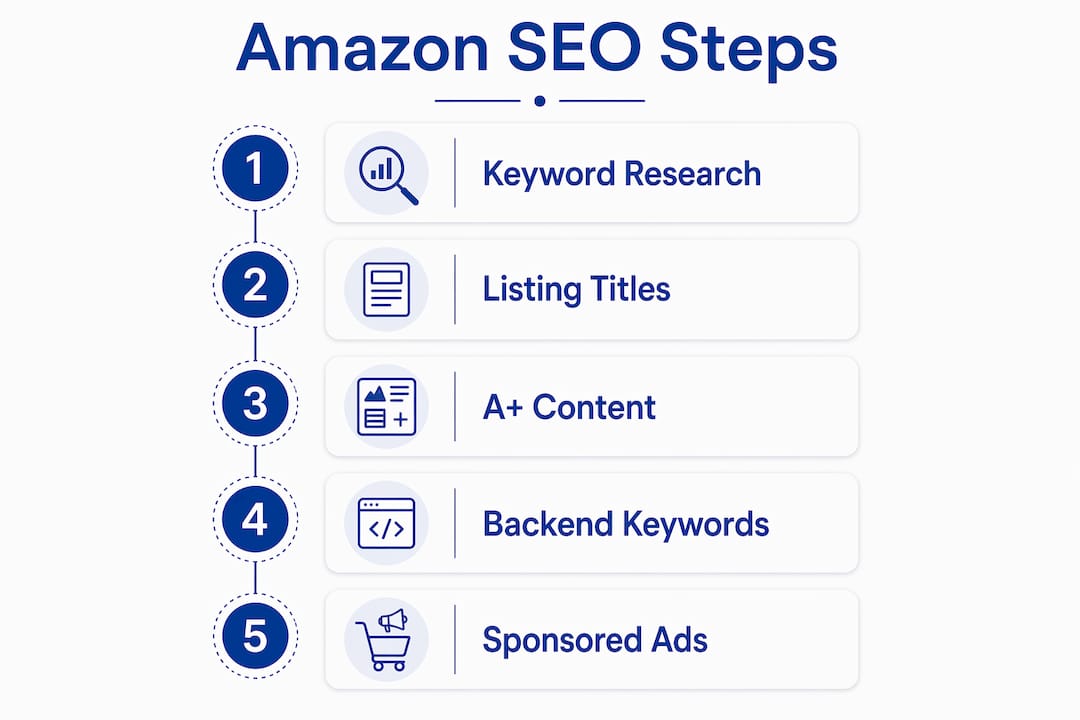
Paid advertising and organic SEO on Amazon are not separate strategies. They are two sides of the same growth engine. Sponsored ads contribute conversion data that feeds directly into organic ranking velocity, meaning ad-driven sales on a specific keyword push that keyword’s organic rank upward over time.
Here is how to align PPC with your SEO strategy for compounding results:
- Keyword validation. Run broad and phrase match Sponsored Products campaigns to discover which keywords actually convert. Move high-converting terms into your title and bullets. Kill spend on terms that generate clicks but no sales.
- Sales velocity injection. When launching a new listing, use PPC to generate early sales velocity. The A10 algorithm rewards performance-weighted signals, and early conversion momentum accelerates organic indexing.
- Brand query protection. Sponsored Brand campaigns on your own brand name prevent competitors from capturing shoppers who already know you. This protects CVR and keeps your brand’s conversion signals clean.
- Sponsored Display for retargeting. Shoppers who viewed your listing but didn’t buy are warm leads. Sponsored Display campaigns bring them back, improving overall CVR for the listing.
- External traffic. Traffic from Google Search, Meta ads, email lists, and TikTok Shop can boost organic rank if it converts. Amazon’s Brand Referral Bonus program rewards sellers who drive external traffic, crediting back a percentage of ad fees. Non-converting external traffic, however, hurts your CVR ratio, so align your ads with SEO and send traffic only to listings that are fully optimized and ready to convert.
The sellers who waste the most ad spend are those chasing impressions on broad keywords without filtering for actual converting terms. PPC data is the fastest and most reliable source of keyword intelligence available to Amazon sellers. Use it before you finalize any listing copy.
Common Amazon SEO mistakes that kill your ranking
Most ranking problems trace back to a small set of repeatable errors. Knowing what to avoid is as valuable as knowing what to do.
- Keyword stuffing. Packing your title with every possible synonym destroys readability and CTR. Lower CTR signals poor relevance to the algorithm, which drops your rank. Keyword stuffing and poor data architecture decrease both visibility and click performance simultaneously.
- Stockouts. Running out of inventory is one of the most damaging events for an Amazon listing. Recovery from a stockout takes weeks, not days, because the algorithm must rebuild confidence in your sales velocity. Use FBA restock alerts or a third-party inventory tool to stay ahead of demand spikes.
- Duplicating backend keywords. Repeating terms already in your title or bullets in the backend wastes your 249-byte limit. Every byte should introduce a new indexing opportunity, not reinforce what the algorithm already sees.
- Pricing above the category median. Amazon’s algorithm factors in pricing competitiveness when awarding the Buy Box. Losing the Buy Box means losing the default purchase path for most shoppers, which collapses both CVR and organic rank.
- Manipulative review tactics. Incentivized reviews, review trading groups, and fake review services violate Amazon’s terms of service and trigger suppression penalties. The review velocity and volume model rewards authentic, recent feedback. Sustainable review acquisition comes from post-purchase email sequences and the Amazon Vine program for new listings.
Pro Tip: Set a calendar reminder to audit your backend keywords every 90 days. Search trends shift, and terms that drove traffic six months ago may now be low-volume or superseded by new buyer language. Tools like Helium 10 and Jungle Scout surface emerging keyword opportunities before your competitors find them.
Key takeaways
Amazon SEO requires simultaneous optimization of listing relevance, conversion performance, and operational stability to achieve and sustain high organic rankings.
| Point | Details |
|---|---|
| Relevance plus performance | Rank higher by matching keywords AND converting clicks into sales consistently. |
| Title and backend work together | Front-load primary keywords in titles; use backend for synonyms and misspellings only. |
| PPC validates SEO | Run Sponsored Products first to identify converting keywords before finalizing listing copy. |
| Stockouts destroy momentum | Inventory gaps cause ranking drops lasting 30 to 60 days; treat stock stability as an SEO task. |
| A+ Content feeds Rufus | FAQ modules in A+ Content are indexed by Amazon’s AI assistant for conversational queries. |
Why I think most sellers are optimizing for the wrong thing
Here is something I’ve seen consistently across hundreds of Amazon listings: sellers obsess over keyword rank position while ignoring the CVR data sitting right in their Seller Central dashboard. A listing ranking on page one for a high-volume keyword but converting at 4% will eventually lose ground to a competitor ranking on page two converting at 12%. The A10 algorithm is not fooled by keyword density. It watches what shoppers actually do.
The sellers who sustain top rankings are the ones who treat every listing as a living document. They test a new main image, measure CTR change over two weeks, keep it or revert, then move to the bullet points. They treat listing optimization as an ongoing discipline, not a one-time setup task. Ranking shifts can occur within 24 hours, but sustained improvement requires continued CTR, CVR, and sales velocity growth. One-time tweaks almost always fade.
The other pattern I’d warn against is treating PPC and SEO as separate budgets owned by separate people. When your ads team and your listing team don’t share data, you end up with ad spend on keywords your listing can’t convert, and listing copy optimized for terms your ads aren’t testing. That misalignment is expensive. Bring those two functions together around a shared keyword performance report, and the compounding effect is real and measurable.
— Goga
Ready to turn your listings into ranking machines?
At Searchoneers, we work with Amazon sellers who are done guessing and ready to grow with data. Whether you’re starting from scratch or auditing an existing catalog, our listing enhancement strategies cover every component from title architecture to A+ Content to backend keyword structure.

Our listing optimization workflow gives you a repeatable, step-by-step process built around the ranking signals that matter most in 2026. We align PPC data with organic SEO so your ad spend validates your copy and your copy converts your clicks. If you want a faster path from listing to ranking, Searchoneers is built for exactly that.
FAQ
What is Amazon SEO and why does it matter?
Amazon SEO is the practice of optimizing product listings to rank higher in Amazon search results and convert more shoppers into buyers. It matters because the majority of Amazon purchases begin with a search, and listings that don’t rank on page one capture very little organic traffic.
How long does it take to rank on Amazon?
Ranking shifts can appear within 24 hours of listing changes, but sustained improvement requires consistent CTR, CVR, and sales velocity growth over weeks. New listings typically need two to four weeks of PPC-supported sales velocity before organic rank stabilizes.
What is the difference between A9 and A10 on Amazon?
A9 was Amazon’s earlier keyword-centric ranking model. A10 shifted the emphasis to performance-weighted signals like buyer behavior, sales velocity, and conversion data, making listing quality and ad alignment more critical than keyword density alone.
How many backend keywords should I use?
Amazon allows up to 249 bytes for backend search terms. Fill the entire limit with unique synonyms, alternate spellings, and phrases not already present in your visible listing copy. Never repeat terms from your title or bullets.
Does A+ Content help with Amazon SEO?
Yes. A+ Content improves CVR through brand storytelling and comparison modules, and its FAQ sections are indexed by Rufus, Amazon’s AI assistant, for conversational search queries. Higher CVR from A+ Content feeds directly into improved organic ranking signals.