TL;DR:
- Product differentiation involves creating meaningful distinctions that captivate customers and build competitive advantages. Effective strategies layer various differentiation types, focus on real customer needs, and require continuous refinement across all organizational functions. Prioritizing customer experience and ongoing assessment ensures sustainable market positioning and long-term success.
Product differentiation is defined as the strategic process of distinguishing a product from competitors on dimensions that target customers genuinely value, creating competitive advantages that go beyond price alone. Every market has a ceiling on how low prices can go, and most companies cannot win a race to the bottom based solely on cost. The brands that endure, Apple in hardware, Amazon in logistics, Grammarly in writing software, build their moats through unique selling propositions (USPs), superior customer experience, and capabilities competitors cannot easily copy. Understanding product differentiation strategies is not optional for marketers and business professionals. It is the foundation of every durable competitive position.
What is product differentiation and what are its core types?
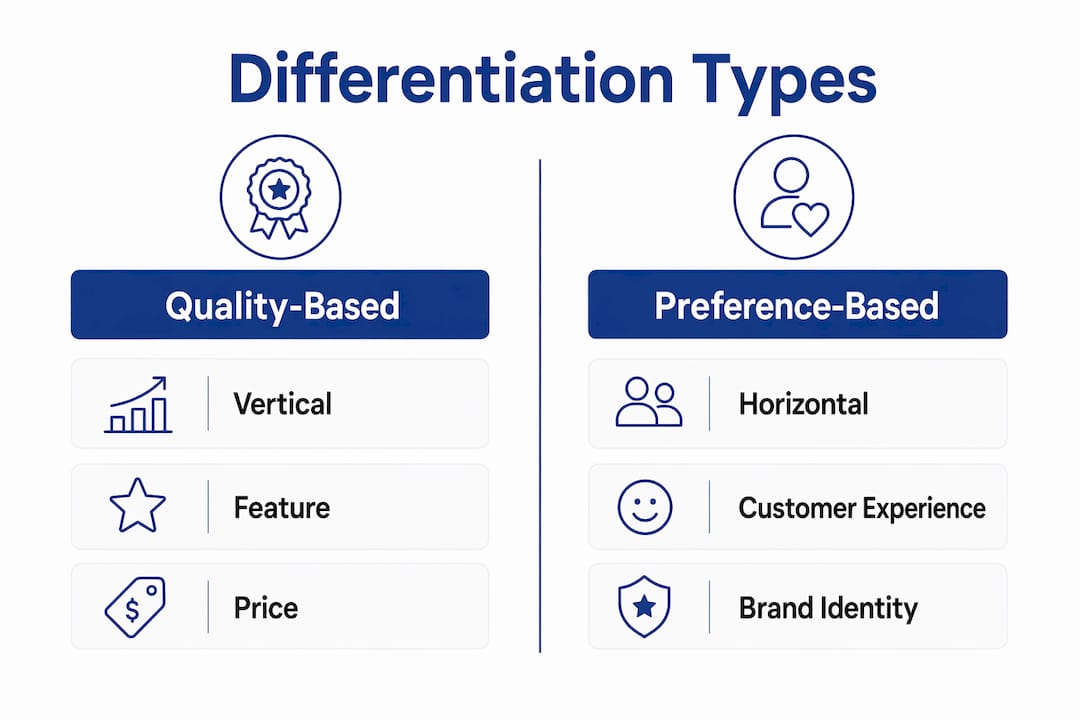
Product differentiation is the practice of making your product meaningfully distinct from alternatives in ways that matter to buyers. The four core types are horizontal, vertical, price-based, and feature-based differentiation. Combining these types rather than relying on just one produces the strongest competitive position.

| Type | Definition | Example | Strength |
|---|---|---|---|
| Horizontal | Different but not objectively better | Pepsi vs. Coca-Cola flavor preference | Appeals to personal taste |
| Vertical | Objectively higher or lower quality | iPhone vs. budget Android phones | Justifies premium pricing |
| Price-based | Competing on cost or value tier | Amazon Basics vs. branded goods | Captures price-sensitive buyers |
| Feature-based | Unique capabilities or functions | Grammarly’s AI tone detection | Hard to replicate quickly |
Horizontal differentiation is subjective. Two products occupy the same quality tier but appeal to different preferences, like choosing between a red or blue version of the same sneaker. Vertical differentiation is objective. A product is measurably better or worse than its rivals, which is why luxury brands can charge premiums without justification beyond quality. Price-based differentiation targets buyers who prioritize cost over features, while feature-based differentiation targets buyers who need specific capabilities no competitor offers.
The smartest brands layer these types. Apple uses vertical differentiation (premium hardware quality), feature-based differentiation (the Apple Silicon chip), and horizontal differentiation (color and design options) simultaneously. That combination makes displacement extremely difficult for any single competitor.
Why product differentiation matters for competitive positioning
Without differentiation, products compete purely on price. Price wars erode margins, commoditize categories, and ultimately destroy value for everyone in the market. The importance of product differentiation becomes clear the moment you watch two undifferentiated brands cut prices until neither is profitable.
Differentiation delivers three concrete business outcomes:
- Premium pricing power. Customers pay more for products they perceive as uniquely suited to their needs. Apple’s gross margin consistently exceeds 40%, a direct result of product uniqueness explained through design and ecosystem lock-in.
- Customer retention. Buyers who chose your product for a specific reason are less likely to switch when a cheaper alternative appears. Loyalty is built on perceived irreplaceability.
- Defensibility. Durable differentiation requires capabilities that demand years of investment or proprietary assets, making it costly for competitors to close the gap.
83% of consumers pay as much attention to how a brand treats them as to the product’s actual features. That statistic reframes the entire differentiation conversation. Your product’s specs are only half the story. The experience surrounding the product, onboarding, support, returns, and communication, is equally decisive in purchase decisions.
Pro Tip: Collect customer feedback at every touchpoint and map it directly to your differentiation claims. If customers consistently mention a benefit you never marketed, you have found an undiscovered USP worth amplifying.
How to develop an effective product differentiation strategy
A differentiation strategy built on guesswork fails fast. The process that works follows a clear, repeatable sequence. Here is the seven-step framework that monday.com’s product differentiation research and practitioners at Atlassian both validate:
- Analyze competitors. Map every rival’s positioning, pricing, features, and customer reviews. Identify where they are strong and, more importantly, where they are silent.
- Identify customer priorities. Survey buyers, read reviews, and conduct interviews. Understand what problems they are actually trying to solve, not what you assume they want.
- Map opportunities. Cross-reference competitor gaps with customer priorities. The overlap is your differentiation opportunity zone.
- Define your USP. Translate the opportunity into a single, clear statement of what you do that no one else does as well. Specificity beats vagueness every time.
- Align cross-functional teams. Marketing, product, and customer service must all deliver the same differentiated promise. Misalignment between teams is one of the most common failure points in differentiation execution.
- Implement and communicate. Build the differentiator into the product and communicate it clearly in every channel, from your Amazon listing title to your homepage headline.
- Measure and refine. Track conversion rates, customer satisfaction scores, and competitive win/loss data. Adjust based on what the numbers tell you.
One principle worth embedding into step four is the MAYA principle, which stands for Most Advanced, Yet Acceptable. The MAYA principle advises balancing innovation with accessibility so customers embrace the differentiation rather than find it confusing. Ignoring MAYA produces products that are technically impressive but commercially ignored.
Pro Tip: Before finalizing your USP, run it through a “so what?” test with five real customers. If they cannot explain why it matters to them in one sentence, the USP needs sharper focus.
What are common pitfalls in product differentiation?
The most expensive mistake in differentiation is building features that impress internally but mean nothing to customers. This is called vanity differentiation, and it wastes R&D budgets while delivering zero competitive advantage. A product team that adds a proprietary file format no customer asked for is a classic example. The feature is unique. It is also useless.
Beyond vanity differentiation, watch for these traps:
- Temporary advantages. The durability test is straightforward: can a competitor close your differentiation gap within 12 to 18 months? If yes, the advantage is temporary, not strategic. Patents, proprietary data, and network effects create durable moats. A slightly better UI does not.
- Siloed execution. When the marketing team promises a differentiated experience that the product team never built and the support team cannot deliver, customers feel the gap immediately. Cross-functional alignment is not a soft requirement. It is the operational backbone of differentiation.
- Set-and-forget thinking. Markets shift. Competitors copy. Customer expectations rise. Product differentiation is a living strategy, not a one-time project. Brands that defined their USP in 2020 and never revisited it are already losing ground.
Pro Tip: Schedule a quarterly differentiation audit. Review competitor launches, customer feedback, and your own conversion data together. Treat your USP like a product that needs regular updates, not a tagline carved in stone.
How companies differentiate through customer experience
Features get customers in the door. Experience keeps them there. Customer support, onboarding, and success programs can differentiate B2B products as much as core capabilities, and in crowded markets they often matter more.
Amazon’s differentiation is a masterclass in experience over features. Prime’s two-day shipping was not a product feature. It was a service promise that reshaped buyer expectations across all of e-commerce. Apple’s Genius Bar turned hardware support into a brand touchpoint that reinforced premium positioning. Neither example is about the product alone.
Deep integration with customer workflows creates switching costs that pure feature competition cannot match. When your product becomes embedded in how a customer runs their business, replacing it requires effort that goes far beyond evaluating a competitor’s spec sheet. Salesforce built a $30 billion business on this principle. So did Slack before Microsoft Teams forced a rethink.
The data below shows how experience dimensions affect buyer decisions:
| Experience dimension | Impact on buyer decision |
|---|---|
| Onboarding quality | Reduces churn in first 90 days |
| Support responsiveness | Increases renewal rates in B2B |
| Workflow integration | Creates measurable switching costs |
| Brand values alignment | Drives word-of-mouth referrals |
For Amazon sellers, this translates directly. Your listing is the first experience touchpoint. Titles, images, bullet points, and A+ content either communicate a differentiated value or blend into the noise. Sellers who treat their Amazon customer experience as a differentiator, not just a compliance exercise, consistently outperform those who do not.
AI is also reshaping experience-based differentiation. Personalized AI-driven experiences are becoming a decisive differentiator in e-commerce, allowing brands to tailor recommendations, messaging, and support at a scale that was impossible five years ago.
Key takeaways
Product differentiation succeeds only when it solves real customer problems, is operationalized across every team, and is continuously refined as markets evolve.
| Point | Details |
|---|---|
| Define your USP precisely | A vague USP is invisible to buyers; specificity drives purchase decisions. |
| Combine differentiation types | Layering horizontal, vertical, and feature-based approaches creates harder-to-copy positions. |
| Avoid vanity differentiation | Features unrelated to customer needs waste resources and fail commercially. |
| Align all teams | Marketing, product, and support must deliver the same differentiated promise consistently. |
| Treat it as ongoing work | Quarterly audits and continuous measurement keep your advantage relevant as competitors evolve. |
Why I think most brands get differentiation backwards
From where I sit, the biggest mistake I see brands make is starting with the product and working backward to the customer. They build something genuinely novel, then go looking for a customer who wants it. Real differentiation runs in the opposite direction. You start with an underserved need, a frustration competitors are ignoring, and you build toward that gap.
The MAYA principle resonates with me precisely because it captures the tension every product team faces. You want to be different enough to matter but not so different that customers need a tutorial to understand the value. I have watched technically superior products lose to simpler ones repeatedly, not because the market was wrong, but because the team never asked whether customers were ready for that level of advancement.
Cross-functional alignment is the piece I emphasize most when advising marketers. You can have the sharpest USP in your category and still lose if your support team is delivering a generic experience. Differentiation is a promise. Every team in your organization is either keeping that promise or breaking it. There is no neutral.
The brands that sustain competitive advantage are not the ones with the most features. They are the ones that solve specific problems competitors ignore, communicate that clearly, and never stop measuring whether they are still doing it.
— Goga
How Searchoneers helps you differentiate on Amazon
Your differentiation strategy is only as strong as how well it shows up in your product listing. Searchoneers specializes in translating your USP into Amazon listings that capture attention, communicate value, and convert browsers into buyers.

From enhanced titles and bullet points to backend keyword architecture, Searchoneers’ listing enhancement guide gives you a practical, step-by-step framework for making your differentiation visible where it counts most. If you want a structured process, the listing optimization workflow walks you through every stage from competitor analysis to live performance tracking. Your product is already different. Now make sure Amazon shoppers can see it.
FAQ
What is product differentiation in simple terms?
Product differentiation is the process of making your product stand out from competitors in ways that matter to buyers, whether through features, quality, price, or customer experience. The goal is to give customers a clear reason to choose your product over alternatives.
What are the main types of product differentiation?
The four core types are horizontal (preference-based), vertical (quality-based), price-based, and feature-based differentiation. Combining multiple types creates a stronger and more durable competitive position than relying on any single approach.
Why is product differentiation important for business?
Without differentiation, products compete on price alone, which erodes margins and commoditizes the category. Effective differentiation enables premium pricing, builds customer loyalty, and creates defensible market positions that are harder for competitors to displace.
What is vanity differentiation and why does it fail?
Vanity differentiation refers to unique features or attributes that do not address real customer needs. It fails because customers do not value the difference, meaning the investment in building it produces no competitive advantage or commercial return.
How often should you revisit your differentiation strategy?
A quarterly review is the recommended cadence. Markets shift, competitors copy successful features, and customer expectations rise continuously, so differentiation must be treated as an ongoing process rather than a fixed positioning statement.