

TL;DR:
- Dynamic pricing automatically adjusts product prices in real time based on demand, competition, and inventory levels. It enhances margins, inventory management, and market responsiveness but requires careful data quality and transparent communication with customers. Successful implementation depends on clear rules, guardrails, and ongoing calibration to optimize revenue and maintain customer trust.
Dynamic pricing is defined as a flexible, real-time pricing strategy that automatically adjusts product prices based on demand, competitor activity, and inventory levels. Unlike a fixed price tag that sits unchanged for months, dynamic pricing lets your store respond to market signals within minutes or hours. Platforms like Salesforce and Stripe have documented how this approach drives higher gross margins and sharper inventory control for online retailers. Tools powered by machine learning now make real-time price adjustments accessible to stores of every size, not just enterprise giants. If you sell on Amazon or run an e-commerce store, understanding dynamic pricing is one of the fastest ways to stop leaving revenue on the table.
How does dynamic pricing work in practice?
Dynamic pricing works by using algorithms and software to monitor market data continuously, then applying preset rules to change prices automatically. According to Stripe, the four most common dynamic pricing models are time-based, inventory-based, competition-based, and segment-based pricing. Each model targets a different lever.
Here is what each model does in practice:
- Time-based pricing raises or lowers prices based on the time of day, week, or season. Think of airline tickets that spike on Friday afternoons.
- Inventory-based pricing drops prices when stock is high and raises them when supply runs low. This keeps warehouses from overflowing and margins from collapsing.
- Competition-based pricing tracks rival listings and adjusts your price to stay competitive without manually checking every hour.
- Segment-based pricing charges different customer groups different prices based on purchase history, geography, or loyalty status.
Most sophisticated e-commerce operations combine two or more of these models. A retailer might use competition-based pricing as the baseline, then layer inventory-based rules on top to protect margins when stock drops below a threshold. The result is a pricing engine that balances demand surges, margin protection, and inventory flow simultaneously.
Pro Tip: Set explicit price floors and ceilings before you activate any algorithm. Without hard limits, automated systems can race prices to zero or spike them to levels that destroy conversion rates overnight.

What are the benefits and challenges of dynamic pricing?
Dynamic pricing delivers real, measurable advantages for online stores. Businesses that implement it correctly report higher gross margins and faster inventory turnover compared to static pricing. That is not a coincidence. The strategy works because prices match what the market will actually pay at any given moment.
The core benefits include:
- Margin protection: You capture full price during peak demand instead of leaving money on the table.
- Inventory health: Prices drop automatically during slow periods, stimulating demand early and eliminating the need for end-of-season clearance events.
- Market responsiveness: Your store reacts to competitor moves in real time, not after a weekly pricing review.
- Revenue optimization: You earn more per unit when demand is high and move more units when demand is low.
The challenges are just as real, though. The biggest risk is customer perception. Shoppers who notice prices fluctuating may feel manipulated, which erodes trust faster than any competitor can. Research from Wharton Knowledge shows that framing price changes as “dynamic discounting” rather than surges significantly improves customer acceptance and loyalty. The framing matters as much as the math.
A second challenge is the risk of price wars. When two competitors both run automated competition-based pricing, they can trigger a spiral that crushes both margins. Wharton’s research confirms that dynamic pricing works best when customers perceive it as fair and transparent.
Pro Tip: Communicate price drops as limited-time deals and price increases as “demand-based availability.” Customers accept both far more readily when the framing feels like an opportunity rather than a penalty.
Dynamic pricing vs. fixed pricing: which strategy wins?
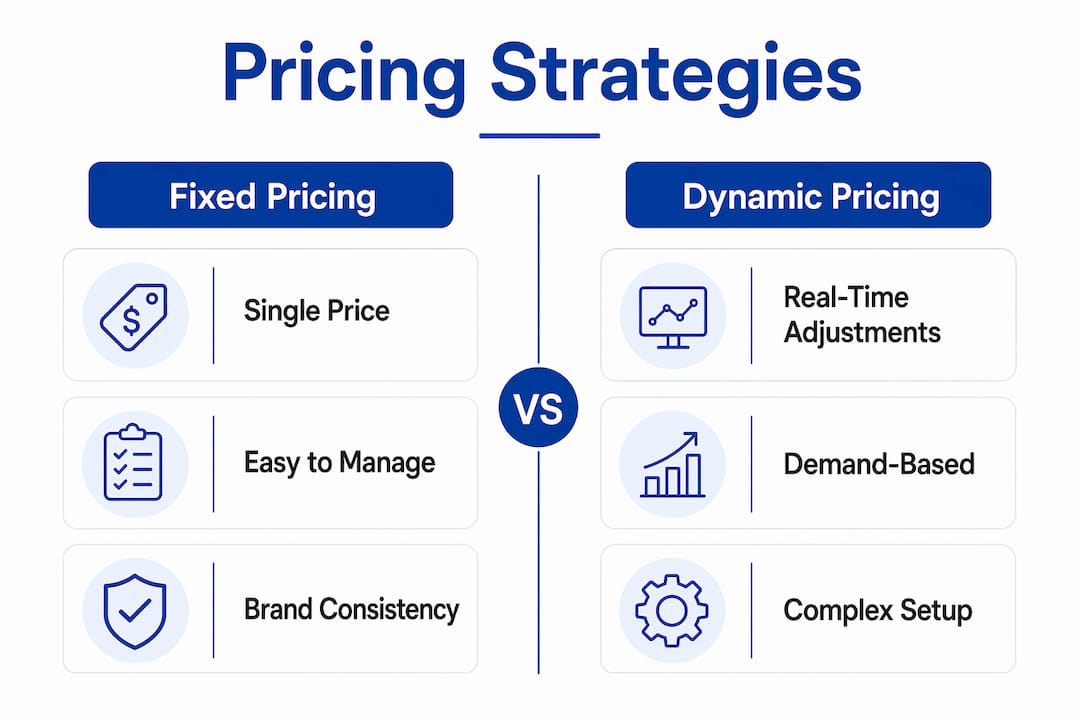
Fixed pricing sets one price and holds it regardless of market conditions. It is simple to manage and easy for customers to understand. Dynamic pricing, by contrast, treats price as a variable that should earn its keep every day.
The table below compares the most common pricing approaches for e-commerce stores:
| Pricing Strategy | Core Logic | Key Advantage | Key Risk |
|---|---|---|---|
| Fixed / Static | One price, set manually | Simple, predictable | Misses demand peaks and valleys |
| Cost-Plus | Cost + markup percentage | Protects margins on every unit | Ignores what competitors charge |
| Promotional | Temporary discounts on schedule | Drives traffic and clears stock | Trains customers to wait for sales |
| Value-Based | Price reflects perceived customer value | Captures maximum willingness to pay | Requires deep customer data |
| Dynamic | Algorithm-driven, real-time adjustments | Captures revenue across all demand states | Requires data quality and guardrails |
Dynamic pricing outperforms fixed pricing in high-velocity e-commerce environments where demand shifts daily. If you sell seasonal products, consumables, or anything with a short shelf life, static pricing is costing you margin every single week. The pricing strategies available to e-commerce sellers have expanded dramatically, and dynamic pricing sits at the top of the performance curve when implemented correctly.
Fixed pricing still makes sense for brand-building scenarios where consistency signals premium quality. Luxury goods and subscription products often benefit from price stability. The key is knowing which category your products fall into before you commit to a model.
How to implement dynamic pricing in your e-commerce store
Getting dynamic pricing right requires more than flipping a switch in your software dashboard. The setup process determines whether the system protects your margins or destroys them. Follow these steps to build a pricing engine that actually works.
Collect and clean your data. Sales velocity, competitor prices, inventory counts, and customer segments are the raw inputs. Salesforce’s research is direct: poor data quality leads to margin erosion faster than manual pricing ever would. Audit your data sources before you write a single pricing rule.
Define your pricing rules. Decide what triggers a price change and by how much. Rules might include “raise price by 8% when inventory drops below 50 units” or “match the lowest competitor price, but never go below $14.99.” These guardrails are non-negotiable.
Choose your software tools. Repricers built for Amazon, such as those reviewed in Searchoneers’ advertising optimization tools comparison, automate the execution layer. You can also explore free calculators and reseller tools at DealFlipAI to model pricing scenarios before committing to a paid platform.
Integrate with your inventory system. Your pricing engine needs live inventory data to function correctly. A price drop triggered by a stock count that is two days old is a recipe for selling out at the wrong price.
Monitor results weekly and calibrate. Dynamic pricing is not “set and forget.” WithOrb’s analysis confirms that continuous algorithm tuning is required to prevent price wars and protect unit economics. Review your price floors, conversion rates, and margin reports on a fixed schedule.
Communicate transparently with customers. Display original prices alongside current prices. Use language like “limited-time price” or “price drop” to frame changes positively. Transparency converts skeptics into repeat buyers.
Pro Tip: Run a two-week parallel test before going fully live. Keep your old pricing on half your listings and apply dynamic rules to the other half. The data from that test will tell you exactly where to set your floors and ceilings.
Key takeaways
Dynamic pricing is the most effective revenue tool available to e-commerce sellers when it is built on clean data, clear rules, and transparent customer communication.
| Point | Details |
|---|---|
| Definition is clear | Dynamic pricing adjusts prices automatically based on demand, competition, and inventory in real time. |
| Four core models exist | Time-based, inventory-based, competition-based, and segment-based pricing are the primary frameworks to combine. |
| Data quality is the foundation | Stale or inaccurate inputs cause margin erosion faster than any manual pricing mistake. |
| Framing drives acceptance | Calling price drops “dynamic discounts” builds customer trust and loyalty instead of triggering backlash. |
| Guardrails are non-negotiable | Price floors, ceilings, and weekly monitoring prevent automated systems from triggering destructive price wars. |
What i have learned after years of watching sellers get this wrong
Most sellers who struggle with dynamic pricing share one mistake: they treat it as a technology problem instead of a strategy problem. They install a repricer, connect it to their catalog, and expect the algorithm to figure out the rest. It does not work that way.
The sellers I have seen succeed with dynamic pricing spend most of their setup time on the rules layer, not the software layer. They know their cost per unit, their minimum acceptable margin, and their top three competitors before they write a single pricing rule. The algorithm is just the execution engine. The strategy has to come from you.
The other pattern I keep seeing is neglect of customer perception. Sellers obsess over margin optimization and forget that a shopper who notices a price jumped $6 between visits may never come back. The Wharton research on dynamic discounting is not just academic. It reflects real buyer psychology. When you frame a lower price as a deal, you create a positive emotional response. When a buyer discovers a higher price with no explanation, you create distrust.
My honest advice: start conservative. Set tight price floors and ceilings, run the system for 30 days, and review what the algorithm actually did. You will almost always find at least one rule that needs tightening. Dynamic pricing rewards patience and precision, not speed. The stores that win long-term are the ones that treat pricing as an ongoing discipline, not a one-time setup.
— Goga
How Searchoneers helps you turn pricing strategy into sales
Smart pricing is only half the equation. If your Amazon listings are not optimized to convert the traffic your pricing strategy attracts, you are leaving sales on the table at every price point.

Searchoneers specializes in Amazon listing enhancement that pairs directly with dynamic pricing strategies. From title and bullet point optimization to backend keyword architecture, the team builds listings that rank higher and convert better regardless of where your price sits on any given day. For sellers ready to go deeper, the listing optimization workflow guide walks you through every step of building a listing that works as hard as your pricing engine does. Pricing gets buyers to click. Optimized listings get them to buy.
FAQ
What is dynamic pricing in simple terms?
Dynamic pricing is a strategy where product prices change automatically based on real-time factors like demand, competitor prices, and inventory levels. Prices can update every few minutes or hours without manual input.
Is dynamic pricing effective for small e-commerce stores?
Dynamic pricing is effective for stores of any size when built on clean data and clear pricing rules. Small stores benefit most from inventory-based and competition-based models that protect margins without requiring large data teams.
What are the biggest risks of dynamic pricing?
The two biggest risks are triggering price wars with competitors and damaging customer trust through unexplained price increases. Both risks are manageable with price floor guardrails and transparent communication.
How is dynamic pricing different from promotional pricing?
Promotional pricing uses scheduled, temporary discounts to drive traffic. Dynamic pricing adjusts prices continuously based on live market data, making it more responsive and less predictable for competitors to exploit.
What data does dynamic pricing require to work correctly?
Dynamic pricing requires sales velocity data, real-time competitor prices, and current inventory counts. Salesforce confirms that stale or inaccurate data leads to poor pricing decisions and margin erosion faster than manual methods.

Comments
One response to “What Is Dynamic Pricing? A 2026 Guide for Sellers”
[…] What Is Dynamic Pricing? A 2026 Guide for Sellers – Searchoneers […]