Amazon sellers often assume listing fees are simple and predictable, but the reality is far more complex. Referral fees, fulfillment charges, storage costs, and category-specific rates all combine to significantly impact your bottom line. Understanding these fee structures and how they interact with your product catalog is essential for maintaining healthy profit margins. This guide breaks down each fee type, explains how fulfillment choices affect costs, and provides actionable strategies to optimize your listings and boost profitability on the platform.
Table of Contents
- Key takeaways
- Understanding the different types of Amazon listing fees
- How fulfillment methods affect listing fees and margins
- Strategies to minimize Amazon listing fees and boost profitability
- Understanding fee reporting and reconciliation in Seller Central
- Optimize your Amazon listings for higher profits
- FAQ
Key Takeaways
| Point | Details |
|---|---|
| Fee types and ranges | Sellers face multiple fee types including referral fees fulfillment charges storage costs and category based rates that vary by product and fulfillment method. |
| Fulfillment choice impact | Choosing FBA or FBM changes cost structure and margins with FBA often delivering higher conversions but higher fees. |
| Storage costs and long term | Monthly storage fees and long term storage charges for inventory older than a year can erode profits if not managed. |
| Use modeling and verification | Model costs in spreadsheets and verify calculations against Seller Central reports to ensure accuracy. |
Understanding the different types of Amazon listing fees
Amazon charges sellers multiple fee types that vary based on product characteristics, category, and fulfillment method. Referral fees represent the largest cost for most sellers, calculated as a percentage of the total sale price including shipping. These percentages range from 8% to 45% depending on product category, with most common categories falling between 12% and 15%. Electronics typically carry 8% referral fees, while Amazon device accessories can reach 45%.
Fulfillment by Amazon fees include both pick-and-pack charges and storage costs. FBA fulfillment fees depend on product size tier and weight, with small standard items under 10 ounces costing around $3.22 per unit and large bulky items exceeding $89 for oversized products. Monthly storage fees charge $0.87 per cubic foot from January through September and $2.40 per cubic foot during the peak October-December period. Long-term storage fees apply to inventory aged beyond 365 days, adding $6.90 per cubic foot or $0.15 per unit, whichever is greater.
Other fees include closing fees for media categories, high-volume listing fees for sellers with over 100,000 active listings, and rental book service fees. Modeling fees in spreadsheets using triggers based on category, size tier, and inventory turnover helps predict costs accurately. You can verify these calculations against Seller Central payment reports to ensure accuracy and identify discrepancies.
Key fee categories to track include:
- Referral fees based on category percentages and total sale price
- FBA fulfillment fees determined by size tier and weight
- Monthly storage fees calculated by cubic foot and season
- Long-term storage fees for inventory exceeding 365 days
- Closing fees for books, music, video, and software categories
Understanding Amazon pro seller fees requires tracking each component separately. The professional selling plan costs $39.99 monthly but eliminates the $0.99 per-item fee charged to individual sellers. For sellers moving more than 40 units monthly, the professional plan becomes cost effective. Beyond the subscription, all sellers pay the same referral and fulfillment fees based on their product specifications and category placement.
How fulfillment methods affect listing fees and margins
Choosing between Fulfillment by Amazon and Fulfillment by Merchant fundamentally changes your cost structure and profit margins. FBA offers Prime eligibility and can boost conversion rates by 20-40%, but the convenience comes with fees that consume 30-45% of product revenue for many items. The higher conversion rates often justify these costs for fast-moving, lightweight products with strong demand and healthy margins.

FBM typically saves 18-30% on fulfillment costs compared to FBA, giving you more control over packaging, shipping speed, and customer communication. However, this approach increases operational complexity significantly. You must manage inventory storage, process orders quickly, handle customer service inquiries, and maintain shipping performance metrics that meet Amazon’s standards. Missing delivery windows or failing to respond to messages promptly can result in account suspensions.
Hybrid fulfillment strategies combine both methods to optimize costs across your catalog. Use FBA for lightweight, fast-selling items where Prime eligibility drives substantial sales increases. Reserve FBM for heavy products, slow movers, or items with thin margins where FBA fees would eliminate profitability. This approach requires careful inventory management and clear systems to prevent stockouts on either channel.
| Fulfillment Method | Typical Fee Range | Best For | Key Advantage |
|---|---|---|---|
| FBA | 30-45% of revenue | Fast sellers, light items | Prime badge, high conversion |
| FBM | 12-20% of revenue | Heavy items, slow movers | Lower costs, margin control |
| Hybrid | Varies by product | Mixed catalog | Optimized cost structure |
Pro Tip: Calculate your breakeven point for each product by modeling FBA fees against your estimated FBM costs including labor, packaging, and shipping. Switch fulfillment methods when a product’s velocity or size makes the alternative more profitable.
The Amazon listing fee guide provides detailed breakdowns of how fulfillment choices impact total costs. Products weighing over 3 pounds often benefit from FBM unless their sales velocity is exceptionally high. Conversely, small items under 1 pound with strong demand almost always perform better with FBA due to the Prime conversion advantage outweighing the incremental fees.
Strategies to minimize Amazon listing fees and boost profitability
Reducing fees while maintaining sales performance requires strategic planning across inventory, fulfillment, and listing optimization. Building a spreadsheet model that calculates fees based on product attributes lets you forecast costs before committing to inventory purchases. Include columns for category, size tier, weight, expected monthly sales, and storage duration to generate accurate fee projections.
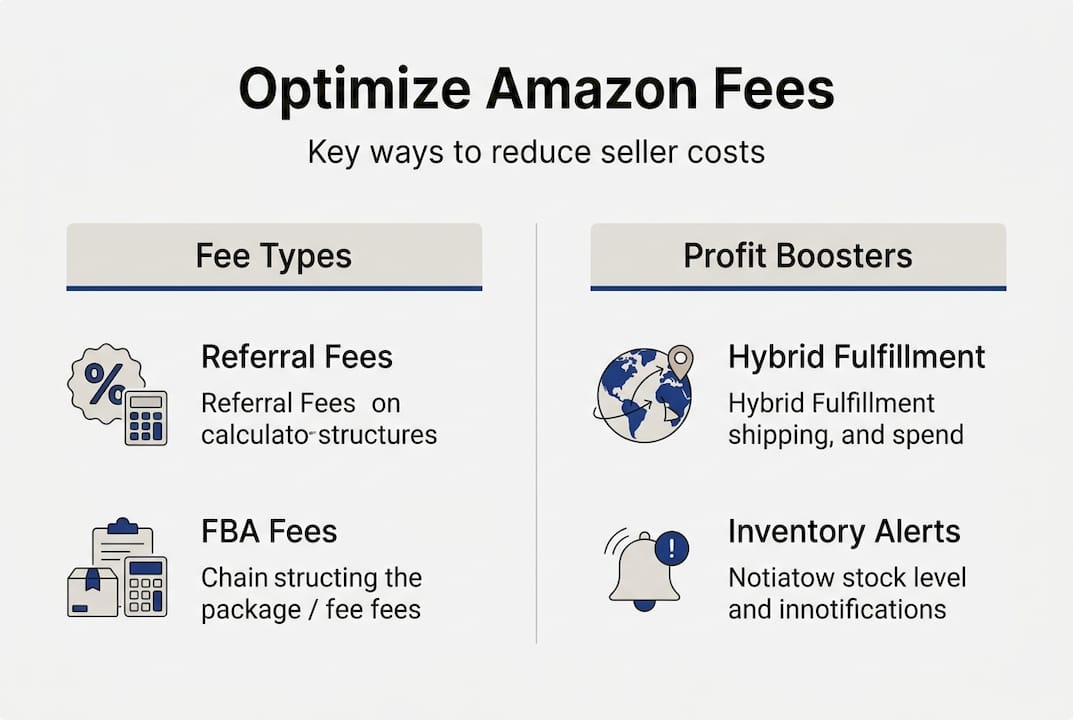
Avoiding long-term storage fees demands active inventory management and sales velocity tracking. Products sitting in FBA warehouses beyond 365 days trigger substantial charges that quickly erode margins. Monitor your inventory age report weekly and create removal orders or run promotions for slow-moving stock before it reaches the long-term threshold. Some sellers find success using FBM for products with unpredictable demand patterns to avoid storage risks entirely.
Using hybrid FBA and FBM strategically matches each product’s characteristics with the most cost-efficient fulfillment method. Send fast-moving, lightweight, high-demand items to FBA to capture Prime sales. Handle heavy, slow-moving, or low-margin products through FBM to preserve profitability. This requires maintaining separate inventory systems but can dramatically improve overall margins across your catalog.
Optimizing your Amazon inventory listings improves visibility and conversion rates, helping offset fee impacts through increased sales volume. Enhanced titles with relevant keywords, compelling bullet points that address customer pain points, and high-quality images all contribute to better organic rankings and higher click-through rates. When your listings convert more efficiently, the fixed costs of referral and fulfillment fees become a smaller percentage of your total revenue.
Key optimization tactics include:
- Model all fees in spreadsheets before purchasing inventory
- Monitor inventory age reports weekly to prevent long-term storage charges
- Implement hybrid fulfillment based on product velocity and weight
- Optimize listing content to improve organic rankings and conversion
- Review Seller Central payment reports monthly for fee anomalies
Pro Tip: Set up automated alerts in your inventory management system to flag products approaching 330 days in FBA storage. This gives you 35 days to run promotions, create removal orders, or liquidate stock before long-term fees hit.
| Strategy | Implementation | Expected Savings |
|---|---|---|
| Spreadsheet modeling | Build fee calculator with product attributes | Prevents unprofitable purchases |
| Inventory management | Weekly age monitoring, 330-day alerts | Eliminates long-term storage fees |
| Hybrid fulfillment | FBA for fast/light, FBM for slow/heavy | 18-30% on appropriate products |
| Listing optimization | Enhanced content, keyword research | Offsets fees through volume increases |
Regularly reviewing your fee structure against sales performance reveals opportunities for improvement. Products with thin margins may need price increases, cost reductions through better sourcing, or removal from your catalog entirely. High-volume items justify more aggressive listing optimization investments since small conversion improvements generate substantial revenue increases that dwarf the fee costs.
Understanding fee reporting and reconciliation in Seller Central
Seller Central payment reports provide detailed breakdowns of all fees charged against your account, organized by transaction type and time period. Accessing these reports requires navigating to Reports, then Payments, and selecting the date range you want to analyze. The transaction view shows individual orders with associated referral fees, FBA fees, and any other charges, while the summary view aggregates fees by category for easier analysis.
Downloading and interpreting fee reports involves several steps:
- Navigate to Reports > Payments in Seller Central and select your date range
- Download the transaction-level report as a CSV file for detailed analysis
- Import the data into your spreadsheet model with product attributes
- Match fees charged against your calculated estimates to identify discrepancies
- Investigate any significant variances between expected and actual fees
- Adjust your fee models based on actual charges for future accuracy
Modeling fees using triggers based on category, size tier, and inventory turnover creates a proactive system for cost management. Build lookup tables in your spreadsheet that automatically calculate expected fees when you enter product specifications. Compare these projections against actual charges from Seller Central to verify accuracy and catch errors that occasionally occur in Amazon’s fee calculations.
Regular reconciliation prevents unexpected cost overruns that damage profitability. Monthly reviews of fee reports against your projections reveal patterns in where costs exceed expectations. You might discover that certain products consistently generate higher storage fees than anticipated, suggesting slower sales velocity than planned. This insight allows you to adjust pricing, marketing, or inventory levels before losses accumulate.
Integrating fee data with overall business financials provides complete visibility into your Amazon operation’s true profitability. Export fee totals by product or category and combine them with your cost of goods sold, advertising spend, and other expenses. This comprehensive view shows which products genuinely drive profits versus those that appear successful based on revenue alone but generate minimal margins after all fees.
The Seller Central complete guide walks through every reporting feature available to sellers. Beyond payment reports, inventory reports show storage fees accumulating in real time, while advertising reports reveal how sponsored product costs interact with organic sales and fees. Mastering these tools gives you the data foundation needed to make informed decisions about pricing, inventory, and product selection.
Optimize your Amazon listings for higher profits
Understanding fee structures is just the first step toward maximizing Amazon profitability. Implementing proven optimization strategies across your listings, inventory management, and fulfillment choices transforms fee knowledge into tangible margin improvements. Searchoneers specializes in helping sellers navigate these complexities with data-driven approaches that balance visibility, conversion, and cost efficiency.

Our Amazon listing enhancement guide provides detailed workflows for improving every element of your product pages. From keyword research that targets high-intent search terms to bullet point frameworks that address customer objections, these resources help you build listings that convert traffic into sales efficiently. The listing optimization workflow breaks down the enhancement process into manageable steps you can implement systematically across your catalog. Combined with the comprehensive Amazon listing fee guide, you gain complete visibility into how fees impact margins and which optimization tactics deliver the strongest return on investment.
FAQ
What are the main fees Amazon charges sellers?
Amazon charges referral fees as a percentage of sale price varying by category, typically 12-15% for most products. FBA sellers also pay fulfillment fees based on size and weight, plus monthly storage fees calculated per cubic foot. Long-term storage fees apply to inventory exceeding 365 days in warehouses. Professional sellers pay $39.99 monthly while individual sellers pay $0.99 per item sold.
How does choosing FBA or FBM affect my fees?
FBA includes fulfillment and storage fees that typically consume 30-45% of revenue but provides Prime eligibility that can increase conversions by 20-40%. FBM eliminates these fees, saving 18-30% on costs, but requires you to handle shipping, customer service, and maintain performance metrics. The choice depends on your product’s weight, sales velocity, and margin structure.
Can I predict and control my Amazon listing fees?
Building spreadsheet models with fee triggers based on category, size tier, and weight enables accurate cost forecasting before purchasing inventory. Download Seller Central payment reports monthly to compare actual fees against projections and identify discrepancies. This proactive approach lets you adjust pricing, sourcing, or product selection to maintain target margins.
What strategies can reduce long-term storage fees?
Monitor your inventory age report weekly and set alerts for products approaching 330 days in FBA warehouses. Run promotions, create removal orders, or liquidate slow-moving stock before it reaches 365 days and triggers long-term fees. Consider using FBM for products with unpredictable demand to avoid storage risks entirely while maintaining flexibility.
How do referral fees vary across product categories?
Referral fees range from 8% for electronics to 45% for Amazon device accessories, with most categories between 12-15%. The fee applies to the total sale price including item cost and shipping charges. Some categories like jewelry have tiered structures with different percentages for different price ranges, making category selection a strategic decision for margin optimization.