Every experienced American seller knows that choosing the wrong Amazon category can quietly bury even your best product. With thousands of items competing in each niche, strategic categorization has become far more than a checklist item for serious sellers. In fact, over 40 percent of listing visibility issues stem from misclassified or generic category assignments. This guide explores advanced product categorization techniques that help American sellers command higher rankings, stronger search results, and greater marketplace visibility without leaving vital details to chance.
Table of Contents
- Defining Amazon Product Categorization
- Understanding Categories, Subcategories, Browse Nodes
- Optimizing For SEO And Marketplace Visibility
- Product Eligibility And Compliance Requirements
- Common Categorization Errors To Avoid
Key Takeaways
| Point | Details |
|---|---|
| Understanding Categorization | Mastering Amazon’s product categorization enhances visibility and search relevance, significantly impacting sales. |
| SEO Optimization | Conduct regular audits of listings to refine metadata and keywords, boosting product performance. |
| Compliance Awareness | Stay informed of varied compliance requirements across product categories to avoid legal issues. |
| Avoid Misclassification | Regularly review category placements to ensure alignment with Amazon’s taxonomy, preventing visibility reduction. |
Defining Amazon Product Categorization
Amazon Product Categorization represents a strategic system for organizing merchandise into hierarchical classifications that determine product discoverability and searchability. Unlike generic inventory management approaches, this process involves precise placement of items within Amazon’s intricate marketplace taxonomy, enabling sellers to optimize their product visibility and reach targeted consumer segments.
The classification system functions as a sophisticated framework where products are systematically mapped across multiple levels of specificity. Product categorization methodologies rely on complex machine learning algorithms that analyze product attributes, keywords, and metadata to determine the most appropriate category placement. This process goes beyond simple sorting – it involves understanding nuanced relationships between product characteristics and consumer search behaviors.
At its core, Amazon’s categorization structure includes broad parent categories that progressively narrow into increasingly specific subcategories. For advanced Amazon sellers, understanding this hierarchy becomes critical for strategic product positioning. Each category carries unique requirements, search algorithms, and competitive landscapes that directly impact product performance. Sellers who master these classification strategies can significantly enhance their product’s searchability, potentially improving organic ranking and visibility.
Pro Seller Tip: Conduct a comprehensive review of your product’s most granular characteristics and match them precisely with Amazon’s most specific subcategory to maximize search potential and reduce misclassification risks.
Here’s a summary of how Amazon categorization impacts business outcomes:
| Categorization Aspect | Business Impact | Seller Advantage |
|---|---|---|
| Granular subcategory usage | Higher search relevance | Better organic rankings |
| Accurate browse node placement | More targeted customer traffic | Increased conversion rates |
| Regular taxonomy reviews | Reduced misclassification | Improved ongoing visibility |
| Metadata refinement | Enhanced discoverability | Competitive market position |
Understanding Categories, Subcategories, Browse Nodes
Amazon’s product organization system utilizes a complex hierarchical structure known as browse nodes that enable precise product classification and navigation. These nodes function as digital roadmaps, guiding consumers through increasingly specific product segments while providing sellers strategic placement opportunities within the marketplace ecosystem.

Amazon’s browse node architecture represents an intricate taxonomy where each node represents a specific product category or subcategory. These nodes operate on two primary levels: branch nodes, which contain additional subcategories, and leaf nodes, which represent the most granular product classifications. This sophisticated system allows for nuanced product discovery, enabling shoppers to progressively refine their searches from broad categories to highly specific product types.
The browse node hierarchy creates a structured approach to product organization that goes beyond simple categorization. Each node contains metadata, search attributes, and algorithmic parameters that influence product visibility and searchability. Advanced sellers recognize that understanding these node relationships can dramatically impact their product’s discoverability, potentially increasing organic search rankings and consumer engagement by strategically positioning their offerings within the most relevant and specific product classifications.
Pro Seller Tip: Conduct a detailed audit of your product’s precise characteristics and match them meticulously with the most specific browse node possible, as granular category placement can significantly enhance search relevance and competitive positioning.
Optimizing for SEO and Marketplace Visibility
Amazon’s search ecosystem demands a strategic approach to product optimization that goes far beyond simple keyword insertion. Sellers must develop a comprehensive strategy that encompasses multiple dimensions of product discoverability, including precise metadata, strategic keyword placement, and alignment with Amazon’s complex ranking algorithms.
Successful marketplace visibility requires a multifaceted approach, where Amazon SEO optimization becomes a critical lever for driving product performance. This involves carefully crafting product titles, bullet points, and descriptions that not only incorporate relevant search terms but also compellingly communicate product value to potential buyers. The most effective listings balance algorithmic requirements with genuine customer-focused communication, creating a seamless bridge between search mechanics and consumer engagement.
Advanced sellers understand that marketplace visibility extends beyond basic search optimization. It involves a holistic approach that includes maintaining competitive pricing, securing positive customer reviews, managing product inventory levels, and continuously refining listing content. Each element contributes to Amazon’s sophisticated ranking algorithm, which evaluates products based on relevance, conversion potential, and overall customer satisfaction. By treating product optimization as a dynamic, ongoing process, sellers can develop a robust strategy that consistently improves their products’ visibility and competitive positioning.
Pro Seller Tip: Conduct a monthly comprehensive audit of your product listings, analyzing performance metrics, keyword rankings, and conversion rates to systematically identify and implement optimization opportunities that can incrementally improve your marketplace visibility.
Product Eligibility and Compliance Requirements
Amazon’s marketplace operates under a rigorous product compliance framework that demands sellers meet stringent regulatory standards across multiple dimensions. This comprehensive approach ensures consumer safety, maintains marketplace integrity, and protects both buyers and sellers from potential legal and financial risks associated with non-compliant product listings.
Global product compliance guidelines establish a complex set of requirements that sellers must navigate meticulously. These guidelines encompass multiple critical areas including safety certifications, documentation standards, legal requirements, and ongoing product testing. Sellers must provide comprehensive documentation such as safety certificates, test reports, and verified compliance documentation specific to their product category and target markets.
The compliance process extends far beyond simple documentation submission. Advanced sellers recognize that different product categories have unique regulatory requirements, which can vary significantly across international markets. For instance, electronic products might require different safety certifications in the United States compared to European Union markets, while children’s products demand additional rigorous testing and documentation. Successful sellers develop a proactive compliance strategy that anticipates regulatory changes, maintains updated documentation, and ensures continuous alignment with Amazon’s evolving marketplace standards.
Pro Seller Tip: Create a comprehensive compliance tracking system that includes automated document expiration alerts, regular certification renewals, and a centralized repository of all required compliance documentation to streamline your product listing and marketplace approval processes.
Below is a comparison of key Amazon compliance requirements across major product categories:
| Category | Common Certifications Required | Documentation Types |
|---|---|---|
| Electronics | FCC, CE, RoHS | Safety test reports, manuals |
| Children’s items | CPSIA, ASTM | Lab test certificates, labeling |
| Cosmetics | FDA, ISO | Ingredients list, safety data |
| Food products | FDA, HACCP | Supplier proof, shelf life docs |
Common Categorization Errors to Avoid
Product categorization on Amazon represents a nuanced process where seemingly minor errors can dramatically impact product visibility and sales performance. Sellers frequently encounter critical mistakes that can potentially derail their marketplace success, making a strategic and meticulous approach essential for maintaining optimal product positioning.
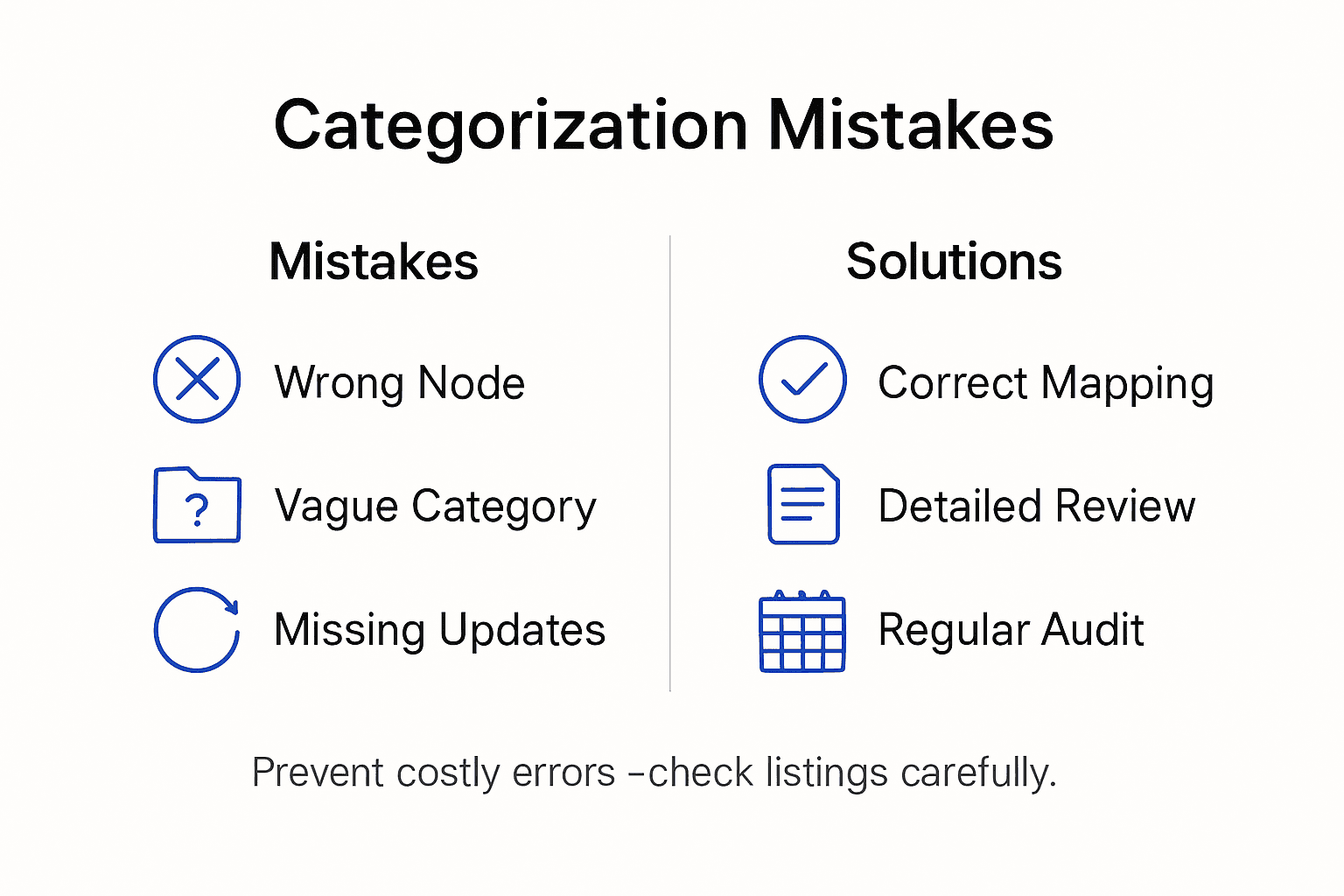
One of the most significant categorization pitfalls involves misalignment with product specificity. Many sellers mistakenly choose broad categories that fail to capture their product’s unique characteristics, resulting in reduced search relevance and diminished visibility. Amazon listing optimization requires understanding that each product has a precise taxonomical location within Amazon’s complex classification system, and selecting an overly generic or inappropriately broad category can significantly undermine discoverability.
Advanced sellers recognize that categorization errors extend beyond initial placement. Common mistakes include failing to update category assignments as product features evolve, neglecting to utilize subcategories that provide more granular search opportunities, and overlooking the importance of matching product attributes precisely with category requirements. These errors can create significant barriers to organic search ranking, reduce conversion potential, and potentially trigger algorithmic penalties that further diminish marketplace performance. Successful sellers develop a proactive approach that involves regular category audits, continuous metadata refinement, and a deep understanding of Amazon’s evolving classification mechanisms.
Pro Seller Tip: Conduct quarterly comprehensive reviews of your product listings, systematically cross-referencing your current category placements against Amazon’s most recent taxonomy updates to ensure ongoing alignment and maximum search optimization.
Maximize Your Amazon Visibility with Expert Categorization and Optimization
Struggling to place your products in the perfect Amazon category can limit your search visibility and sales potential. This article highlights how precise product categorization, understanding browse nodes, and ongoing SEO refinement are key to boosting your organic rankings and driving more targeted traffic. If you want to avoid common pitfalls like misclassification and low discoverability, mastering Amazon listing optimization and data-driven SEO strategies is essential.
Take your Amazon listings to the next level with our specialized solutions at SearchOneers. We focus on Amazon Listing Optimization with enhanced titles, bullet points, descriptions, and backend keywords tailored for superior visibility. Our Amazon SEO & Analytics services deliver smart, evolving strategies that keep your products competitive in a crowded marketplace. Explore actionable insights and E-commerce Tips & Strategies to Grow Your Online Business that can transform your Amazon sales. Don’t wait for the competition to outrank you. Visit us today at SearchOneers and start optimizing your Amazon product categorization and visibility now.
Frequently Asked Questions
What is Amazon Product Categorization?
Amazon Product Categorization is a system used to organize products into hierarchical classifications that enhance discoverability and searchability within the Amazon marketplace.
How can I optimize my product listings for better search visibility on Amazon?
To optimize product listings, focus on crafting compelling titles, bullet points, and descriptions that incorporate relevant keywords while clearly communicating product value. Regular audits and refinement of your listing content are also essential.
What are browse nodes, and why are they important for product categorization?
Browse nodes are the specific categories and subcategories within Amazon’s hierarchical structure that guide consumers through product searches. They are crucial for accurately placing products to enhance discoverability and relevance.
What common mistakes should I avoid in product categorization on Amazon?
Common mistakes include using overly broad categories, failing to match specific product attributes with the correct category, and not updating category assignments as product features evolve. Regular audits can help avoid these pitfalls.