

Over 60 percent of Amazon sellers say that choosing the right product type has a direct impact on their sales. Sellers are constantly challenged by Amazon’s intricate classification system, where a simple misstep can mean lower visibility and lost revenue. Knowing how product types work helps unlock better search rankings and ensures listings land in front of the right customers. This guide breaks down the essentials so you can make smarter, more profitable choices every time you list a product.
Table of Contents
- What Is Amazon Product Type Defined
- Amazon Product Type Categories Explained
- How Product Type Affects Listing Requirements
- Product Type’s Role In Variations
- Risks And Mistakes With Product Type
- Optimizing Product Type For Performance
Key Takeaways
| Point | Details |
|---|---|
| Understanding Product Types | Amazon Product Types are essential for accurate product categorization, directly impacting visibility and sales. Sellers must select the right product type to optimize their listings. |
| Listing Requirements | Each product type has specific mandatory and optional attributes that sellers must include, influencing product compliance and search performance. |
| Variation Management | Effective management of product variations within categories can enhance customer choices and increase sales opportunities. Sellers should strategically plan their variations. |
| Mitigating Risks | Misclassification can lead to visibility loss and account penalties; sellers should meticulously review category requirements to avoid errors. |
What Is Amazon Product Type Defined
Amazon Product Type represents a systematic classification method used by sellers to categorize and list their products within specific marketplace taxonomies. According to the developer-docs, the Product Type Definitions API enables developers to retrieve detailed schemas for precise product listings, ensuring accurate categorization and compliance.
At its core, a product type serves as a digital blueprint that defines the essential characteristics, attributes, and metadata required for a specific category of items. The mimage Product Classification Reference Guide highlights that each product type comes with unique classification codes and specific requirements that sellers must follow.
Key characteristics of Amazon Product Types include:
- Unique identifier for specific product categories
- Standardized set of required and optional product attributes
- Precise guidelines for listing items within that category
- Specific validation rules to ensure data accuracy
Understanding product types is crucial for Amazon sellers because these classifications directly impact product visibility, search rankings, and overall marketplace performance. By accurately selecting and populating the right product type, sellers can optimize their listings, improve customer searchability, and enhance the likelihood of successful sales.
Amazon Product Type Categories Explained
Amazon product type categories represent a comprehensive classification system that strategically organizes products across diverse marketplace segments. According to the mimage Product Classification Reference Guide, these categories provide a structured approach to product listing that enables precise identification and categorization.
The primary Amazon product type categories typically include:
- Electronics
- Home & Kitchen
- Clothing & Accessories
- Books & Media
- Health & Personal Care
- Toys & Games
- Sports & Outdoors
- Beauty & Grooming
- Automotive
- Tools & Home Improvement
Each category comes with unique classification requirements that sellers must meticulously follow. Developer documentation emphasizes that these categories are not just organizational tools, but complex frameworks with specific attribute schemas designed to ensure accurate product representation.
Navigation between these categories requires sellers to understand nuanced distinctions. For instance, a smart watch might fall under multiple categories like Electronics, Sports & Outdoors, or Accessories, demanding careful selection to maximize product visibility and searchability. For sellers looking to optimize their product placement, understanding these categorical subtleties is crucial for marketplace success.
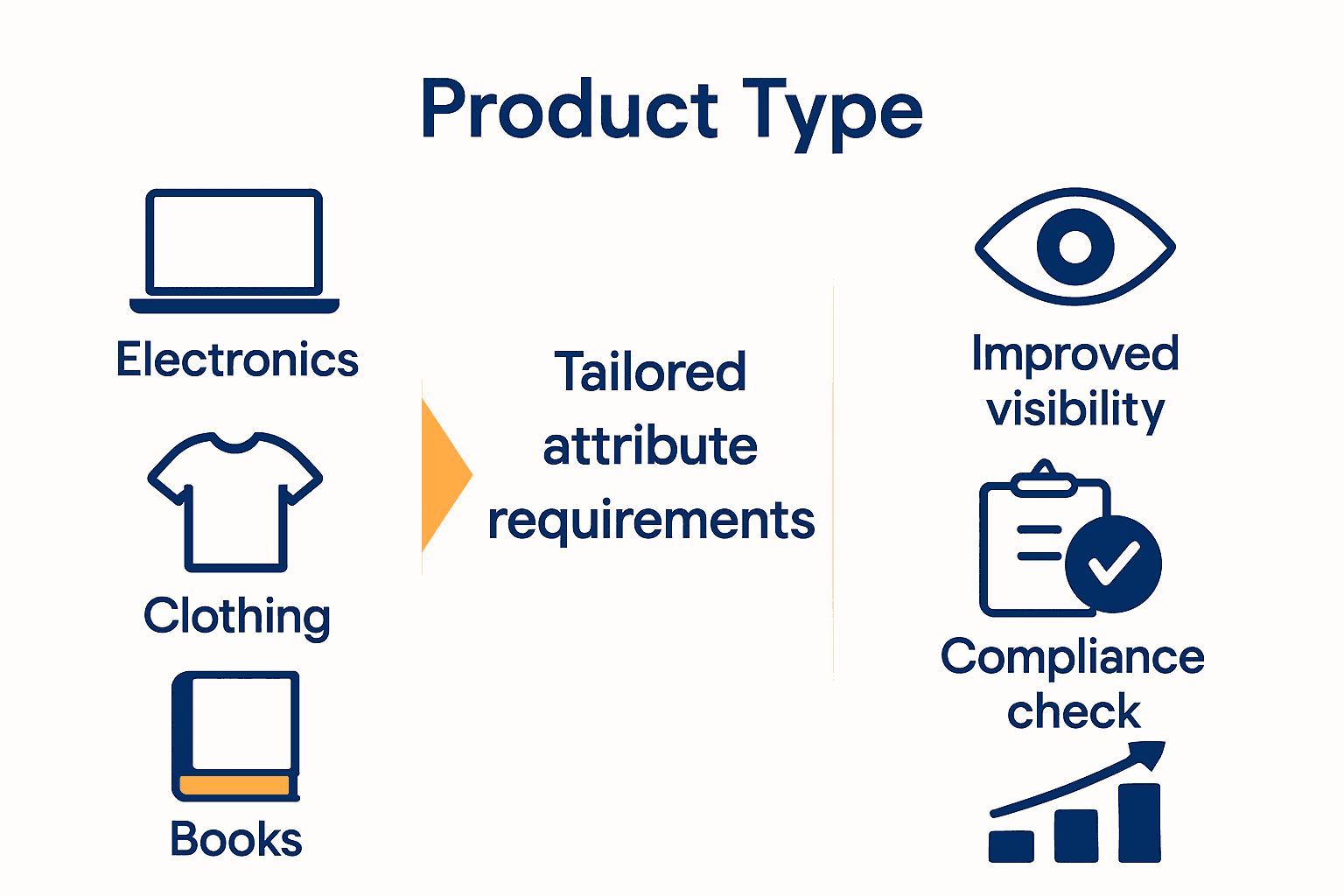 If you want a deeper dive into category selection strategies, check out our guide on Amazon category selection.
How Product Type Affects Listing Requirements
Product type fundamentally shapes the listing requirements on Amazon, creating a complex framework of mandatory and optional attributes for sellers. According to the developer documentation, the Product Type Definitions API provides specific schemas that dictate precise information sellers must include when listing products in different categories.
The listing requirements vary dramatically across product types, encompassing several critical dimensions:
- Mandatory attribute fields
- Specific data formatting requirements
- Minimum and maximum value constraints
- Unique descriptive parameters
- Required product images and specifications
The mimage Product Classification Reference Guide emphasizes that each product type comes with its own intricate set of listing rules. For example, an electronics listing might require technical specifications like voltage and compatibility, while a clothing item demands precise measurements, fabric composition, and care instructions.
Understanding these nuanced requirements is crucial for sellers aiming to optimize their product visibility and compliance. Misclassification or incomplete listings can lead to reduced search rankings, potential account warnings, or even product delisting.
 For sellers seeking a comprehensive approach to navigating these complex listing strategies, our guide to product listing strategies offers in-depth insights into mastering Amazon’s intricate marketplace requirements.
Product Type’s Role In Variations
Product variations represent a critical aspect of Amazon selling, where product types dramatically influence how sellers can create and manage different product options. The complexity of variations depends entirely on the specific product type, with each category offering unique flexibility for sellers to showcase multiple versions of their items.
Typical variation dimensions across different product types include:
- Color variations
- Size options
- Material differences
- Technical specifications
- Pattern or design alternatives
For instance, clothing product types typically allow variations like size and color, while electronics might permit variations in storage capacity, model number, or configuration. These variation strategies directly impact a product’s discoverability, customer choice, and ultimately, sales potential.
Successful variation management requires strategic understanding of each product type’s specific constraints and opportunities. Sellers must carefully map out their variation strategy, ensuring that each option adds genuine value and doesn’t overwhelm potential customers. By mastering these nuanced approaches, sellers can create compelling, comprehensive product listings that provide clear, attractive choices. For sellers looking to dive deeper into advanced listing strategies, our guide to product listing strategies offers comprehensive insights into maximizing product presentation and variations.
Risks And Mistakes With Product Type
Amazon sellers face numerous potential pitfalls when navigating product type classifications, with misclassification representing a significant risk to their marketplace success. Onramp Funds warns that misclassifying product types can lead to serious listing errors and potential policy violations that might compromise a seller’s account standing.
Common risks and mistakes in product type selection include:
- Incorrect category placement
- Incomplete attribute documentation
- Misrepresenting product capabilities
- Using inappropriate variation strategies
- Failing to meet specific category requirements
- Providing inconsistent or inaccurate product information
These errors can result in severe consequences for sellers, ranging from reduced product visibility to potential account suspensions. For instance, listing an item in the wrong product type might trigger automatic suppression, prevent potential customers from finding the product, or trigger Amazon’s automated compliance checks. Each misclassification represents not just a technical error, but a potential loss of sales and marketplace reputation.
Mitigating these risks requires meticulous attention to detail and a comprehensive understanding of Amazon’s complex product taxonomy. Sellers must invest time in thoroughly researching each product type’s specific requirements, carefully reviewing all listing details, and staying updated on Amazon’s evolving classification guidelines. For those seeking deeper insights into navigating these challenges, our guide to product listing strategies provides comprehensive strategies for maintaining listing accuracy and compliance.
Optimizing Product Type For Performance
Optimizing product type selection is a critical strategy for improving visibility and performance on Amazon’s marketplace. Amazon Listings Optimization Guide emphasizes that accurate product type classification directly influences discoverability and conversion rates, making it a pivotal element of successful selling strategies.
Key optimization strategies for product type performance include:
- Conducting thorough keyword research within specific product categories
- Matching product attributes precisely to category requirements
- Utilizing all available attribute fields for comprehensive product description
- Selecting the most specific and relevant product type possible
- Regularly updating product information to maintain accuracy
- Analyzing competitor listings within the same product type
The nuanced approach to product type optimization goes beyond mere categorization. Sellers must strategically align their product’s unique characteristics with the most appropriate category, considering factors like search algorithms, customer search behaviors, and marketplace dynamics. This means sometimes drilling down into subcategories that might seem counterintuitive but offer better visibility and targeting.
To maximize performance, sellers need a dynamic approach that combines meticulous category selection with continuous refinement. By leveraging detailed insights and optimizing Amazon product visibility, sellers can transform their product type strategy from a simple classification exercise into a powerful marketing tool that drives discoverability and sales.
Master Your Amazon Product Types and Boost Your Sales Today
Struggling to navigate the complex maze of Amazon product types can hold back your store’s potential. This article highlights how selecting the right product type impacts your listing’s visibility, search ranking, and customer trust. If you find it overwhelming to perfectly match your products with the correct categories and meet all listing requirements, you are not alone. Understanding terms like mandatory attributes, product variations, and category-specific rules is essential to avoid costly mistakes and unlock strong marketplace performance.

Elevate your Amazon selling game by exploring proven strategies that simplify product type optimization and enhance listing appeal. Check out our E-commerce Tips & Strategies to Grow Your Online Business to gain actionable insights on category selection and optimized product listings. Dive deeper with tailored Amazon Listing Optimization and smart SEO solutions available at SearchOneers. Take control now and transform your Amazon presence by leveraging expert guidance designed for sellers ready to thrive.
Frequently Asked Questions
What is a product type on Amazon?
A product type on Amazon is a classification system used to categorize and list products accurately within different marketplace segments. It defines the essential attributes and requirements for specific categories of items.
How does product type affect my listing requirements on Amazon?
Product type determines the mandatory and optional attributes that sellers must include in their listings. Each product type has specific guidelines for data formatting, required images, and unique descriptive parameters, impacting overall listing compliance and visibility.
What are the main Amazon product type categories?
The primary Amazon product type categories include Electronics, Home & Kitchen, Clothing & Accessories, Books & Media, Health & Personal Care, Toys & Games, Sports & Outdoors, Beauty & Grooming, Automotive, and Tools & Home Improvement.
How can I optimize my product type selection for better performance?
To optimize your product type selection, conduct thorough keyword research, match product attributes accurately to category requirements, utilize all available fields for product descriptions, and regularly update your product information to enhance visibility and conversion rates.

Comments
One response to “What Is Product Type Amazon? Complete Guide”
[…] What Is Product Type Amazon? Complete Guide – Searchoneers […]