

Most American Amazon listings never realize their full sales potential because critical data is often buried or overlooked. For e-commerce entrepreneurs, missing a single insight can mean falling behind competitors and losing valuable market share. By mastering the art of a thorough Amazon listing audit, you gain the tools to uncover profit-driving opportunities, correct costly missteps, and create a listing strategy that wins attention in the crowded online marketplace.
Table of Contents
- Step 1: Gather And Analyze Key Listing Data
- Step 2: Review Titles, Bullets, And Descriptions
- Step 3: Evaluate Backend Keywords And SEO
- Step 4: Compare Listing Against Top Competition
- Step 5: Verify Compliance And Optimize For Conversion
- Step 6: Track Results And Adjust Listings
Quick Summary
| Key Insight | Explanation |
|---|---|
| 1. Gather Key Metrics | Monitor sessions, impressions, and conversion rates. These reveal product performance and customer interaction. |
| 2. Optimize Titles and Descriptions | Use high-intent keywords in titles while addressing customer needs in descriptions to improve visibility and conversion. |
| 3. Conduct Competitor Analysis | Regularly compare your listing with top competitors to identify unique selling points and areas for improvement. |
| 4. Check Compliance and Standards | Ensure your listing adheres to Amazon’s regulations, enhancing both professionalism and customer trust. |
| 5. Track Performance Regularly | Establish a routine to monitor key metrics and tweak listings based on data for continual improvement in sales. |
Step 1: Gather and Analyze Key Listing Data
Auditing your Amazon listings demands a strategic approach to data collection. Your mission is to compile critical performance metrics that reveal your product’s true market positioning and potential opportunities for optimization.
Start by diving into Seller Central metrics and extracting key performance indicators. Focus on three primary data sources: sessions, impressions, and unit session percentage. These numbers tell a detailed story about how customers discover and interact with your product. Look closely at search term reports to understand which keywords are driving traffic and which might be underperforming. Brand analytics provide an additional layer of insight by showing your competitive landscape and potential gaps in your current listing strategy.
To conduct a comprehensive audit, organize your data systematically. Create a spreadsheet that tracks each metric over time identifying trends and anomalies. Pay special attention to fluctuations in click through rates, conversion rates, and search ranking positions. By establishing a clear baseline of your current performance, you can make targeted improvements that directly impact your sales potential.
Here is a summary of key Amazon listing metrics and their business significance:
| Metric | What It Measures | Business Impact |
|---|---|---|
| Sessions | Unique visits to the listing | Reveals overall shopper interest |
| Impressions | Times listing appears in search | Indicates keyword visibility |
| Unit Session Percentage | Orders per visitor | Shows conversion rate effectiveness |
| Click Through Rate | Clicks per impression | Assesses listing title and image appeal |
| Search Ranking | Listing position in results | Drives organic traffic and sales |
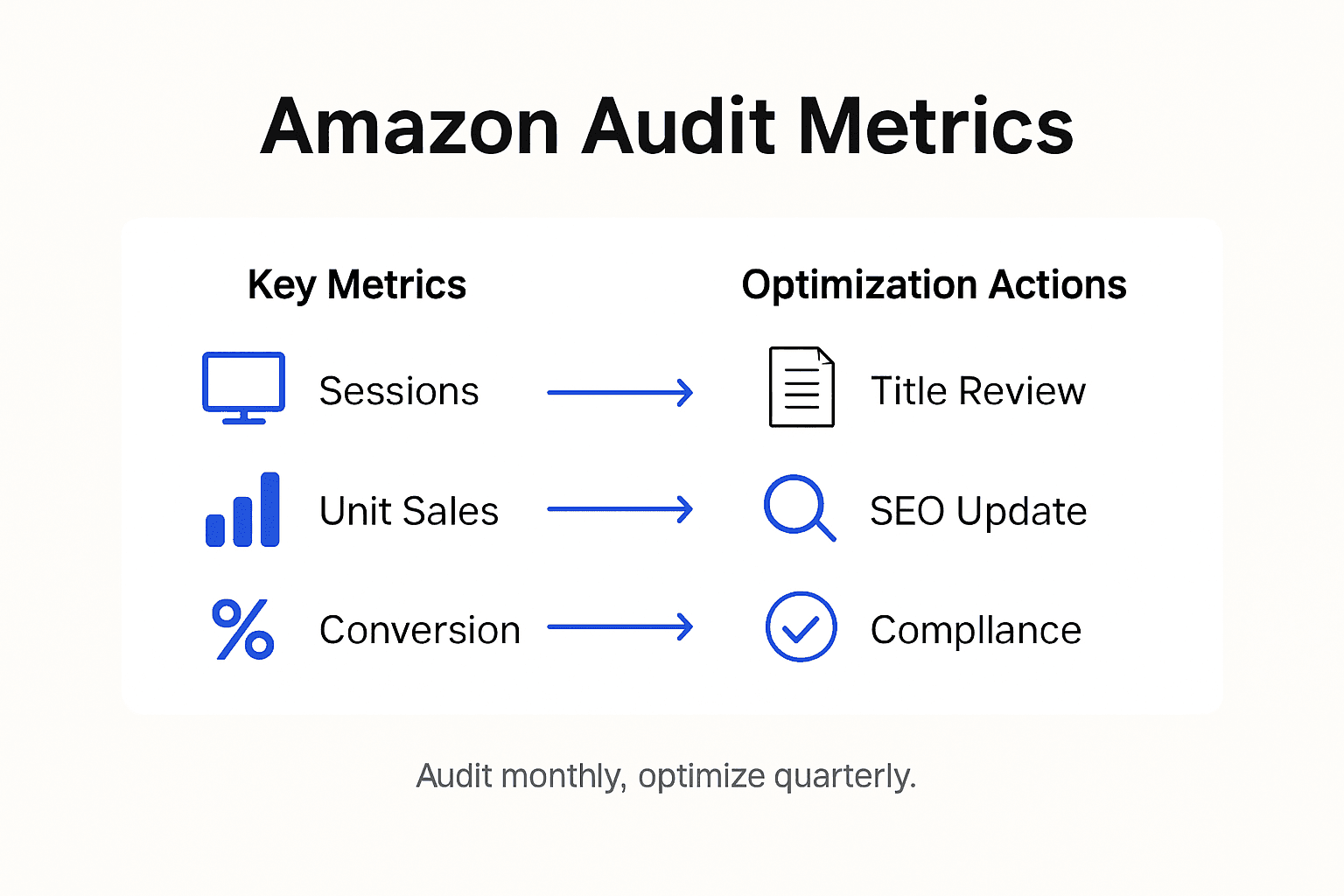
Pro tip: Conduct your data gathering monthly to maintain a consistent pulse on your Amazon listing performance and rapidly adapt to marketplace changes.
Step 2: Review Titles, Bullets, and Descriptions
Your Amazon listing success hinges on crafting compelling titles, bullets, and descriptions that simultaneously attract search algorithms and engage potential buyers. This step transforms your product presentation from basic information to a persuasive marketing tool.

When optimizing your listing, focus first on the product title. High-intent keywords integrated naturally can dramatically improve your search visibility. Construct titles that balance searchability with readability by including primary features, key benefits, and essential product specifications. For bullets, think strategically about communicating value. Each bullet point should highlight a unique benefit or solve a specific customer problem. Prioritize the most critical information first and use clear, concise language that speaks directly to your target audience’s needs.
The product description represents your final opportunity to convert browsers into buyers. Craft a narrative that goes beyond simple specifications by telling a story about how your product improves the customer’s life. Use a mix of technical details and emotional appeal, ensuring that you integrate relevant keywords seamlessly without compromising readability. Remember that Amazon shoppers want solutions, not just products.
Pro tip: Regularly update your listings based on customer feedback and emerging search trends to maintain optimal performance and relevance.
Below is a comparison of common Amazon listing elements and optimization strategies:
| Listing Element | Best Practice Example | Potential Optimization Approach |
|---|---|---|
| Product Title | Includes primary feature, clear wording | Add high-intent keywords, improve clarity |
| Bullet Points | Highlights key benefits, solves problems | Refine order, use concise language |
| Description | Story-driven, detailed specifications | Integrate emotional and technical details |
| Backend Keywords | Hidden, unique search terms | Update quarterly, diversify terms |
Step 3: Evaluate Backend Keywords and SEO
Optimizing your Amazon listing’s backend keywords is a critical strategy for improving product visibility and search ranking. This step focuses on uncovering hidden opportunities to expand your product’s discoverability without violating Amazon’s strict guidelines.
Backend keyword optimization requires careful strategic planning to maximize search potential. Start by identifying unique search terms that are not already present in your product title or bullet points. Focus on relevant keywords that potential customers might use when searching for products like yours, but avoid repetition and ensure each term adds genuine value. Leverage research tools to analyze current search trends and explore variations of your primary keywords. Pay special attention to Amazon’s specific backend fields such as search terms, intended use, and subject matter.
When populating backend keyword fields, think like your target customer. Consider alternative product descriptions, common misspellings, and related terms that might help shoppers find your listing. Aim for clarity and specificity while staying within Amazon’s character limits. Remember that backend keywords work silently behind the scenes to improve your product’s searchability without being visible to customers. Continuously refine and update these keywords based on performance data and emerging market trends.
Pro tip: Conduct quarterly backend keyword audits to ensure your listing remains competitive and aligned with current search behaviors.
Step 4: Compare Listing Against Top Competition
Competitive analysis transforms your Amazon listing from good to exceptional by understanding exactly how your product stacks up against market leaders. This critical step reveals strategic opportunities to differentiate and optimize your product presentation.
Deep competitor analysis goes beyond simple keyword comparisons and requires a holistic examination of market positioning. Systematically review top-ranking competitors by analyzing their content strategy, visual presentation, pricing structure, and customer review approach. Pay close attention to how they structure product titles, craft bullet points, and write descriptions. Look for patterns in keyword usage, unique selling propositions, and areas where your listing can provide more clarity or value. Identify specific market gaps that your product can uniquely fill by understanding what top performers are doing right and where they might be falling short.
Your competitive review should be comprehensive yet strategic. Compare elements like image quality, price point, shipping options, and customer engagement metrics. Seek out subtle differences that can give your listing a competitive edge. Remember that the goal is not to copy competitors but to understand the marketplace and position your product more effectively. Use your insights to refine your listing’s language, highlight distinctive features, and create a more compelling narrative that resonates with potential buyers.
Pro tip: Conduct your competitive analysis quarterly to stay ahead of shifting market dynamics and emerging product trends.
Step 5: Verify Compliance and Optimize for Conversion
The final stage of your Amazon listing audit focuses on ensuring your product meets marketplace standards while maximizing its potential to convert browsers into buyers. This comprehensive review will help you identify and eliminate potential barriers to sale while fine tuning your listing for peak performance.
Conversion optimization requires a meticulous approach to understanding customer expectations and marketplace requirements. Carefully review your listing against Amazon’s current guidelines to confirm compliance with product description rules, image standards, and prohibited content restrictions. Check that all product details are accurate, pricing is competitive, and shipping information is transparent. Examine your listing through the lens of a potential buyer evaluating every visual and textual element for clarity, professionalism, and persuasiveness.
Beyond technical compliance, focus on crafting a compelling narrative that speaks directly to your target customer’s needs and desires. Analyze your product images to ensure they showcase key features from multiple angles, provide context for use, and meet Amazon’s technical specifications. Verify that your pricing strategy aligns with market expectations while communicating the unique value of your product. Pay special attention to customer questions and recent reviews to identify potential areas of improvement in your listing presentation.
Pro tip: Run A/B tests on different listing elements to continuously refine your conversion strategy and stay ahead of marketplace dynamics.
Step 6: Track Results and Adjust Listings
Successful Amazon sellers understand that listing optimization is an ongoing process of measurement, analysis, and strategic refinement. Your goal is to create a dynamic approach that continuously improves your product’s marketplace performance.
Performance tracking requires systematic monitoring of key metrics that reveal your listing’s true effectiveness. Focus on critical indicators like click-through rate, conversion rate, search ranking, and keyword indexing. Establish clear baseline measurements and implement a regular review schedule to assess how changes impact your product’s visibility and sales potential. Utilize Amazon’s built-in analytics tools alongside specialized third-party tracking platforms to gain comprehensive insights into your listing’s performance.
The art of listing optimization lies in making data-driven adjustments. After collecting performance data, experiment with targeted modifications to your title, bullet points, images, or backend keywords. Test one element at a time to clearly understand its impact. Pay attention to seasonal trends, competitor movements, and shifts in customer search behavior. Remember that successful optimization is an iterative process where continuous learning and adaptation are key to maintaining a competitive edge in the Amazon marketplace.
Pro tip: Create a tracking spreadsheet to document each listing change and its corresponding performance metrics for systematic improvement.
Unlock Your Amazon Listing’s True Potential Today
Auditing your Amazon listings to boost sales results can feel overwhelming when you face challenges like low conversion rates and hidden backend keyword gaps. This article highlights the critical need to analyze key metrics such as sessions, impressions, and click-through rates while fine-tuning titles, bullets, and backend SEO to rise above the competition. If you are struggling to keep pace with evolving marketplace trends or unsure how to translate audit insights into real growth, you are not alone.
Discover how our expertise in Amazon Listing Optimization and smart, data-driven Amazon SEO & Analytics can help you craft compelling product presentations designed to captivate both customers and Amazon’s search algorithms. Don’t let complex data hold your sales back. Explore actionable E-commerce Tips & Strategies to Grow Your Online Business that empower you to transform audit findings into successful listing improvements. Act now and turn your Amazon store into a powerful sales engine by visiting us at SearchOneers. Your next level of Amazon success starts with a single click.
Frequently Asked Questions
How can I gather and analyze key listing data for my Amazon products?
To gather and analyze key listing data, start by extracting performance metrics from Seller Central, focusing on sessions, impressions, and unit session percentage. Create a spreadsheet to track these metrics over time and identify trends, aiming for monthly updates to maintain visibility on your listings’ performance.
What elements should I review when optimizing my Amazon listing titles, bullets, and descriptions?
Review your product title to ensure it includes high-intent keywords and clearly conveys the product’s primary features. When optimizing bullets and descriptions, focus on communicating unique benefits and telling a story about how your product solves customer problems, updating regularly based on feedback and trends.
How do I evaluate and optimize backend keywords for my Amazon listing?
Evaluate backend keywords by identifying relevant search terms that are not included in your product title or bullets. Populate backend keyword fields thoughtfully, using alternative descriptions and common misspellings, and conduct audits every quarter to keep your keywords aligned with current search trends.
What is the best way to compare my listing against top competitors on Amazon?
To compare your listing to top competitors, conduct a thorough analysis of their content strategy, pricing, and customer engagement metrics. Identify areas where your listing can provide more value or clarity, and update your presentation to differentiate your product effectively from competitors.
How can I verify compliance and optimize my listing for better conversion rates?
Verify compliance by reviewing your listing against Amazon’s guidelines to ensure all information is accurate and meets marketplace standards. Focus on creating a persuasive narrative that addresses customer needs, and run A/B tests to fine-tune specific elements for increased conversion rates.
What metrics should I track after optimizing my Amazon listing to measure its performance?
Track key metrics such as click-through rate, conversion rate, and search ranking to measure your listing’s performance. Establish baseline measurements and review them regularly, ideally monthly, to assess how any changes impact your visibility and sales results.

Comments
2 responses to “How to Audit Amazon Listings for Better Sales Results”
[…] How to Audit Amazon Listings for Better Sales Results – Searchoneers […]
[…] real-time Amazon product data testing to quickly identify and address potential listing issues. Monitor key performance indicators like […]