TL;DR:
- Amazon’s primary market includes convenience-driven consumers aged 25 to 44, with middle-income households dominating purchases. Prime members, who make up a significant portion of shoppers, tend to spend more and prioritize fast delivery over price. Sellers should tailor listings and marketing strategies to these demographics while leveraging international and B2B opportunities.
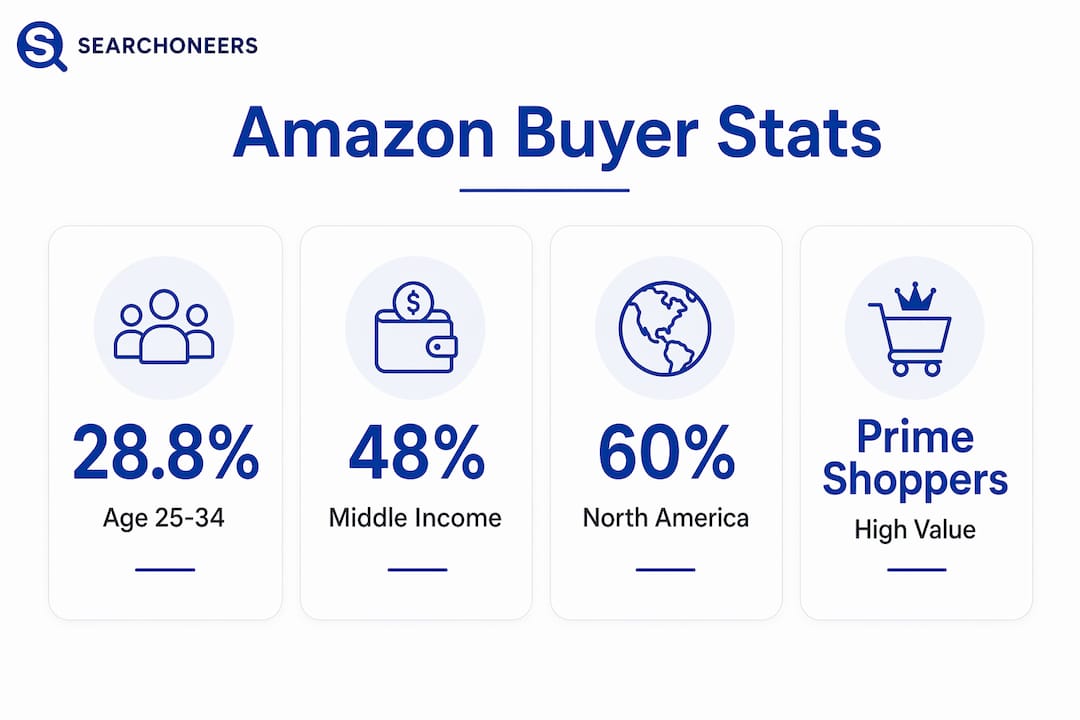
Amazon’s target market is defined as the broad, convenience-driven consumer base spanning multiple age groups, income levels, and geographies, unified by a preference for fast delivery and integrated digital services. The 25–34 age group leads sales contribution at 28.81%, followed by 35–44-year-olds at 19.57%. Middle-income households earning $40,000–$125,000 make up 48% of Amazon’s shoppers. With 200 million+ global Prime members and 230 million US users, Amazon’s reach is unmatched in retail. For e-commerce sellers, understanding this customer base is not optional. It is the foundation of every positioning, pricing, and listing decision you make.
What are the primary demographic segments in Amazon’s target market?
Amazon’s customer base is not one audience. It is a layered set of buyer personas defined by age, income, gender, and education, each with distinct shopping behavior.

Age distribution
The largest age segment in Amazon’s customer base is 25–34, contributing 28.81% of sales. The 35–44 group follows at 19.57%, and the 18–24 cohort accounts for 16.18%. These three groups together represent the majority of Amazon’s purchasing volume. Sellers targeting apparel, tech accessories, or home goods should build their listings and ad copy around the priorities of 25–44-year-olds: speed, reviews, and clear product value.
Income and spending power
Middle-income households earning $40,000–$125,000 make up 48% of Amazon’s customers. Low-income shoppers under $40,000 represent 23%, and high-income households above $125,000 account for 9%. This distribution tells you something critical: Amazon is not a luxury platform. It is a value-and-convenience platform that serves the broad middle of the American income spectrum. Sellers who price and position products for that middle band capture the widest possible audience.
Gender and education
Women slightly lead in purchases across essentials, apparel, and household categories. Men index higher in electronics and tools. Both groups skew toward college-educated buyers, and urban and suburban residents make up the dominant geographic profile. This matters because educated, urban shoppers respond well to detailed product descriptions, comparison-ready bullet points, and verified reviews. Thin or vague listings lose them fast.
Pro Tip: Use Amazon’s demographic data to write listings that speak directly to the 25–44 buyer. Lead with the benefit, back it with a specific feature, and close with a trust signal like a rating count or certification.
How does Amazon segment its market geographically and behaviorally?
Amazon’s segmentation strategy uses demographic, geographic, behavioral, and psychographic frameworks simultaneously. No single lens explains who buys on Amazon. You need all four.
Geographic reach
North America generates roughly 60% of Amazon’s total revenue. The United Kingdom, Germany, and Japan are the next largest markets. India is the fastest-growing international market, expanding at approximately 18% year-over-year, backed by over $15 billion in Amazon investment. The Middle East is also growing, with Amazon adapting logistics and payment systems to local conditions. For sellers, this means the opportunity to reach international buyers is real, but it requires localization. Listings, pricing, and fulfillment must match the expectations of each market.
Behavioral profiles
Amazon shoppers split into two broad behavioral groups. Budget shoppers prioritize price and use tools like price-tracking alerts and Subscribe & Save to minimize spend. High-frequency Prime users prioritize speed and convenience over lowest price. 62% of Prime members ranked delivery speed as more important than lowest price in 2025 surveys. That is a defining insight. It means competing on price alone is a losing strategy for sellers targeting Prime users.
| Behavioral segment | Key priority | Seller implication |
|---|---|---|
| Budget shoppers | Lowest price | Competitive pricing, coupons, Subscribe & Save |
| Prime loyalists | Fast delivery, convenience | FBA enrollment, Prime badge, strong listing quality |
| Subscription users | Recurring value | Subscribe & Save eligibility, bundle offers |
| Tech-savvy early adopters | Innovation, AI tools | Enhanced content, A+ pages, video listings |
Pro Tip: Enroll in Fulfillment by Amazon (FBA) to earn the Prime badge. Prime-eligible listings consistently outperform non-Prime listings in both click-through rate (CTR) and conversion rate (CVR) for the high-frequency buyer segment.
Understanding ad segmentation strategies helps you apply these behavioral profiles directly to your Amazon Sponsored Products campaigns.
Who are Amazon’s Prime members and why do they matter?
Prime members are the most valuable segment in Amazon’s buyer profile. They shop more often, spend more per order, and stay loyal longer than non-Prime shoppers.
Prime members spend roughly 2.5 times more than non-members annually. There were approximately 180 million US Prime members by late 2025. These buyers are concentrated in urban and suburban households with incomes often above $80,000. That income profile explains why Prime members respond to premium positioning, not just discount pricing.
Key characteristics of the Prime buyer segment:
- Delivery speed over price: 62% prioritize fast shipping above the lowest cost
- Tech adoption: Prime members are early adopters of AI-driven shopping tools, voice search via Alexa, and Amazon’s personalized recommendation engine
- Category breadth: Prime members buy across more categories than non-members, from groceries to electronics to apparel
- Subscription use: High adoption of Subscribe & Save, Prime Video, and Amazon Music creates deep platform integration
Amazon has shifted from a convenience store to household infrastructure, embedding itself into daily routines through subscriptions and smart devices. That shift changes the competitive dynamic for sellers. You are no longer just competing for a sale. You are competing for a spot in someone’s daily routine.
Pro Tip: Target Prime members by combining FBA fulfillment with A+ Content and high-quality product images. Prime buyers read listings carefully and reward sellers who invest in content quality with higher CVR.
For a deeper look at how Prime behavior shapes seller strategy, the Amazon segments and strategies guide from Searchoneers breaks down each cohort with practical targeting advice.
How do Amazon’s B2B segments shape the overall market?
Amazon operates a dual-engine model: a high-volume B2C retail engine and a high-margin B2B technology engine. Both matter to sellers who want a complete picture of Amazon’s market.
Amazon Business reached a $40 billion annual run rate by 2025, serving procurement teams in healthcare, education, and government sectors. These buyers purchase in bulk, require invoicing and tax-exempt purchasing, and value reliability over novelty. AWS holds approximately 31% of global cloud infrastructure market share in early 2026 and serves 80% of Fortune 500 companies. AWS is not a retail play, but it funds Amazon’s ability to invest in logistics, AI, and international expansion.
For e-commerce sellers, the B2B opportunity is concrete:
- Amazon Business listings allow sellers to offer quantity discounts and business-only pricing
- Healthcare and education buyers purchase consumables, office supplies, and equipment at scale
- Government procurement favors sellers with verified credentials and consistent stock
- B2B buyers have longer purchase cycles but higher average order values
Sellers who ignore Amazon Business leave a significant revenue channel untapped. Adding business pricing to existing listings costs little and can open access to institutional buyers who reorder consistently.
What strategies help sellers reach Amazon’s target market effectively?
Knowing who buys on Amazon is only useful if you translate that knowledge into listing and advertising decisions. Here is how to apply demographic and behavioral insights directly.
Align your listing with the 25–44 buyer. Write titles and bullet points that address the specific needs of this age group. Lead with the primary benefit, not the product name. Use language that matches how this cohort searches, not how manufacturers describe products.
Position for convenience, not just price. Amazon-primary shoppers are highly tech-savvy and prioritize convenience. They adopt AI-driven shopping tools early and respond to service quality over brand loyalty. Highlight fast shipping, easy returns, and subscription options in your listing copy.
Use behavioral data to time promotions. Budget shoppers respond to Lightning Deals and coupons. Prime loyalists respond to exclusive Prime Day offers. Segment your promotional calendar to match each group’s trigger.
Localize for international growth. Amazon’s international expansion strategy depends on adapting logistics, payment, and content to local markets. If you sell in Germany, the UK, or India, translate listings fully and adapt pricing to local purchasing power.
Target business buyers with quantity pricing. If your product fits a B2B use case, activate Amazon Business pricing and add bulk discount tiers. Healthcare and education buyers search differently than consumers. Use category-specific keywords in your backend search terms.
Pro Tip: Use personalized content principles to write product descriptions that speak to specific buyer motivations. A listing written for a 28-year-old urban professional converts better than one written for “everyone.”
Key Takeaways
Amazon’s target market is defined by convenience-driven shoppers aged 25–44, middle-income households, and high-spending Prime members who together reward sellers who invest in listing quality, fast fulfillment, and behavioral targeting.
| Point | Details |
|---|---|
| Age concentration | The 25–34 group drives 28.81% of sales; build listings for this cohort first. |
| Income sweet spot | Middle-income households ($40K–$125K) make up 48% of buyers; price accordingly. |
| Prime member value | Prime members spend 2.5x more than non-members; FBA enrollment is non-negotiable. |
| Convenience beats price | 62% of Prime members rank delivery speed above lowest price; compete on service. |
| B2B is a real channel | Amazon Business hit a $40B run rate; add business pricing to eligible listings. |
What I’ve learned from watching sellers ignore their own buyer data
Most sellers I work with know Amazon is big. Few of them actually know who is buying their product. They write listings for a generic “customer” and wonder why their CTR is flat.
The shift that changes everything is treating Amazon as infrastructure, not a marketplace. When you realize that Prime members have embedded Amazon into their daily lives, the entire game changes. You stop competing on price and start competing on trust, speed, and content quality. That is where the margin lives.
The sellers who win consistently are the ones who study their buyer personas the way a product manager would. They look at which age group converts, which income tier returns products most, and which behavioral segment responds to their ad creative. Then they rewrite their listings accordingly.
Emerging markets are the next frontier, and most sellers are sleeping on them. India’s 18% year-over-year growth is not a footnote. It is a signal. The sellers who localize early, before the market matures, capture the best positions at the lowest cost.
My honest advice: stop treating demographic data as background reading. Treat it as your product brief. Every listing decision, every ad bid, every pricing choice should trace back to a specific buyer segment. That discipline separates sellers who grow from sellers who plateau.
— Goga
How Searchoneers helps sellers reach the right buyers
Knowing Amazon’s buyer segments is step one. Translating that knowledge into listings that rank and convert is where most sellers get stuck.

Searchoneers specializes in Amazon listing enhancement that connects your product to the right buyer at the right moment. From title structure and bullet point sequencing to backend keyword architecture, every element is built around the demographic and behavioral data that defines Amazon’s actual shoppers. The listing optimization workflow walks you through each step with clear, data-backed guidance. If you are ready to stop guessing and start selling to the buyers who are already on Amazon looking for your product, Searchoneers has the tools to get you there.
FAQ
Who is the primary buyer on Amazon?
The largest buyer segment on Amazon is adults aged 25–34, who contribute 28.81% of sales, followed by the 35–44 group at 19.57%.
What income group shops most on Amazon?
Middle-income households earning $40,000–$125,000 make up 48% of Amazon’s customer base, making them the dominant income segment.
Why do Prime members matter for sellers?
Prime members spend approximately 2.5 times more annually than non-members and prioritize delivery speed over lowest price, making them the highest-value segment for sellers enrolled in FBA.
Does Amazon serve business buyers?
Amazon Business reached a $40 billion annual run rate by 2025, serving procurement teams in healthcare, education, and government, giving sellers access to high-volume institutional buyers.
How should sellers use Amazon’s demographic data?
Sellers should align listing copy, pricing, and ad targeting with the 25–44 age group and middle-income buyer profile, then layer in behavioral signals like Prime membership and purchase frequency to refine positioning.