Finding your products stuck on the lower pages can feel frustrating after months of effort. For experienced Amazon sellers, discovering the hidden flaws that keep listings from ranking and converting is a turning point. A thorough Amazon listing audit shines a light on overlooked opportunities, like backend keyword gaps and copy errors, leading directly to visibility and sales improvements you never expected.
Table of Contents
- Amazon Listing Audit Essentials Explained
- Key Steps In The Listing Audit Process
- Types Of Amazon Listing Audits
- Common Audit Mistakes And How To Avoid Them
- Essential Tools For Effective Listing Audits
Key Takeaways
| Point | Details |
|---|---|
| Importance of Audits | Regular Amazon listing audits enhance visibility and conversion rates by identifying and fixing critical elements. |
| Focus Areas | Prioritize optimizing the title and backend keywords for immediate ranking improvements. |
| Competitive Analysis | Conduct competitor audits to uncover gaps in your own listings and improve overall performance. |
| Common Pitfalls | Avoid neglecting backend keywords and customer feedback, as they drastically affect visibility and sales. |
Amazon Listing Audit Essentials Explained
An Amazon listing audit is a systematic review of every element that affects how your product ranks and converts. Think of it as an X-ray of your listing’s health, revealing what works, what’s broken, and where quick wins hide.
Unlike a quick glance at your product page, a proper audit examines the complete picture. It covers everything from backend keywords to review sentiment, from title optimization to competitor positioning. Most sellers skip this step and wonder why their visibility plateaus.
Here’s why audits matter for your bottom line:
- Visibility boost: Fixed search algorithm issues unlock category visibility you didn’t know was possible
- Conversion improvement: Mismatched copy or weak benefits tank conversion even with good traffic
- Competitive gaps: Your competitor’s optimizations reveal opportunities in your listing
- Cost efficiency: Better-optimized listings reduce your advertising spend per sale
A thorough listing audit identifies the specific gaps preventing your products from ranking higher and converting at their potential.
The audit process typically covers five core areas. Understanding why Amazon listings fail helps you avoid common mistakes during your assessment. Each area demands attention, but they’re not equally important for every product.
Title and search algorithm fit comes first. Your title must match actual search queries while staying within Amazon’s character limits. Sellers often include brand name three times or add irrelevant keywords that actually hurt ranking.
Backend keywords are where most sellers leave money on the table. You have 249 bytes to capture search intent that doesn’t fit in your title. Many sellers never fill this field or repeat what’s already visible in the title.
Bullet points and description determine whether browsers become buyers. These need to address specific pain points, not just list features. A competitor might mention durability while you focus on aesthetics, and that difference means sales.
Images and A+ content directly impact conversion rates. Blurry photos, missing lifestyle shots, or cluttered A+ content cost you conversions even when traffic is strong.
Reviews and rating velocity influence both ranking and purchase decisions. The audit should track whether you’re losing market share to competitors or if something in your listing is depressing your review rate.
Pro tip: Focus your initial audit on the title and backend keywords first, since fixing these high-impact elements takes less time than content rewrites but delivers faster ranking improvements and immediate traffic gains.
Below is a summary of critical Amazon listing elements and their direct impact on business performance:
| Listing Element | Main Role | If Optimized | If Neglected |
|---|---|---|---|
| Title and Keywords | Drives search relevance | Higher ranking, more traffic | Fewer impressions |
| Bullet Points/Description | Converts views to sales | Clear value, higher conversion | Lost buyers, weak messaging |
| Images/A+ Content | Visual persuasion | Increased buyer confidence | Lower conversion, returns |
| Reviews/Velocity | Social proof and ranking | Strong trust, better ranking | Missed market share |
Key Steps in the Listing Audit Process
A listing audit follows a logical sequence, but the order matters. Start with foundational elements before moving to refinements. Skipping steps leaves critical issues hidden.
Your first move is understanding how Amazon’s search algorithm actually works. The A10 algorithm prioritizes relevance, conversion history, and customer satisfaction signals. Without knowing this, your optimization efforts might push the wrong elements.
Here’s the sequence most successful sellers follow:
- Analyze your current keyword performance and search ranking positions
- Review your title for relevance and character optimization
- Audit backend keywords for gaps and redundancy
- Assess bullet point clarity and benefit messaging
- Check images and A+ content for conversion impact
- Track review velocity and customer feedback patterns
Start by pulling your search term report from Seller Central. Identify which keywords are driving traffic and which ones have zero impressions. This reveals whether your listing matches actual customer searches or if you’re chasing ghost keywords no one uses.
Next, evaluate your title’s relevance to top-performing keywords. Many sellers cram keywords without checking if they actually match search volume. A title stuffed with low-volume keywords ranks for nothing while pushing out high-intent terms.
Backend keywords deserve serious attention here. Understanding keyword optimization for primary and long-tail terms reveals whether you’re capturing the full search intent universe. Most sellers leave 40 percent of available keyword real estate blank.
Your bullet points and description should address specific customer pain points, not just recite features. Does your competitor mention “no tools required” while you focus on color options? That gap costs conversions.
Your audit should identify indexing issues, poorly optimized copy, and content gaps affecting both discoverability and conversion rates.
Images tell the conversion story visually. Blurry photos, missing lifestyle shots, or cluttered lifestyle images depress conversion rates. A+ content should enhance, not duplicate, what’s already in your bullets.

Review velocity tracks how fast you’re accumulating reviews relative to competitors. A stalled review rate despite traffic suggests something in your listing or product experience is problematic.
Pro tip: Audit your top three competing listings first to spot their keyword strategy, then use gaps you find to rewrite your backend keywords before touching anything else.
Types of Amazon Listing Audits
Not all audits are created equal. Different audit types answer different questions and reveal different problems. Choosing the right type depends on your situation and what you’re trying to fix.
Think of audits as specialized tools. A hammer works great for nails but fails at screwing bolts. Similarly, a compliance audit won’t identify keyword gaps, and a competitive audit won’t catch policy violations.
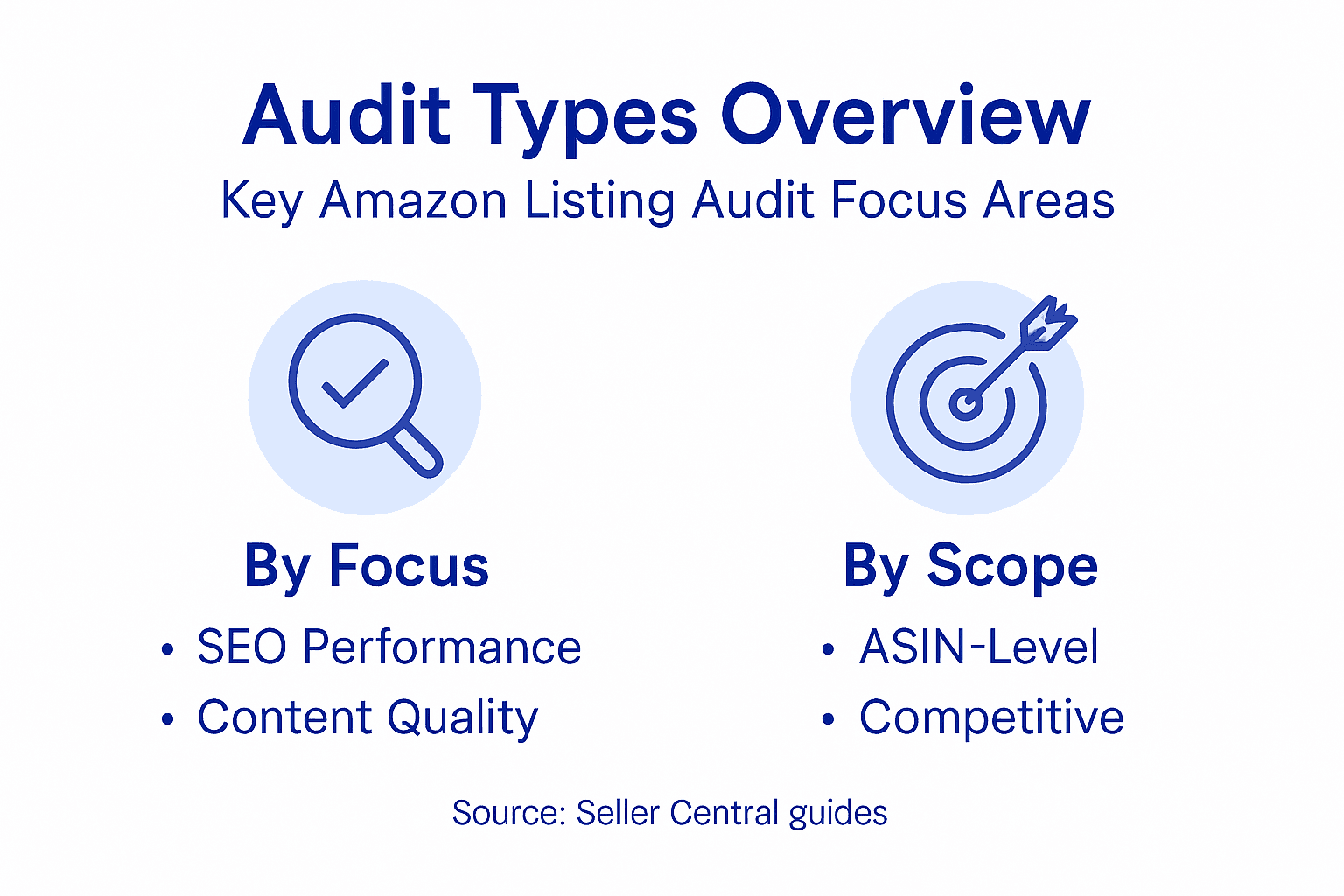
Here are the main audit types you’ll encounter:
ASIN-level audits focus on individual product listings. These examine keyword optimization, title relevance, backend keyword coverage, and conversion factors. This is where most sellers start because it directly impacts visibility and sales.
Content audits evaluate your copywriting effectiveness and image quality. Weak bullet points, confusing descriptions, or blurry photos tank conversion even when traffic is strong. These audits ask: would you buy from your own listing?
Compliance audits verify you’re following Amazon’s policies and guidelines. Policy violations don’t just hurt sales, they risk account suspension. These audits check for prohibited claims, restricted content, or policy-breaking product images.
Competitive audits benchmark your listing against top three competitors. Understanding competitive listing benchmarking strategies reveals what’s working in your category and where you have gaps. Most sellers never look at competitor backend keywords, which is a huge miss.
The audit type you choose should match the specific problem you’re solving or the goal you’re pursuing.
Timing also matters. Initial audits work best for new or struggling listings that need foundational fixes. Quarterly or ongoing audits maintain listing health as algorithms change and seasons shift. Event-driven audits address specific situations like negative review spikes, algorithm updates, or seasonal preparation.
Some audits focus narrowly on SEO performance and search visibility metrics, while others dig into customer feedback and review analysis. The best audit strategy combines multiple types on different schedules.
You might run an ASIN-level audit quarterly, a competitive audit twice yearly, and event-driven compliance audits after policy changes. New sellers should start with an ASIN-level audit, then move to competitive analysis.
Here’s a quick comparison of the main Amazon listing audit types to help you choose the right approach:
| Audit Type | Primary Focus | Typical Use Case | Key Outcome |
|---|---|---|---|
| ASIN-level | Individual product optimization | Boost lagging or new listings | Higher visibility, conversions |
| Content | Copywriting and image quality | Improve conversion rates | More sales, better branding |
| Compliance | Policy and guideline adherence | Prevent account or listing issues | Reduced suspension risk |
| Competitive | Benchmarking against competitors | Uncover category-specific gaps | Superior positioning |
Pro tip: Start with an ASIN-level audit on your lowest-performing product first, since quick wins there teach you what to look for before auditing your bestsellers.
Common Audit Mistakes and How to Avoid Them
Most sellers conduct audits but still miss critical issues. The difference between a thorough audit and a wasted one usually comes down to avoidable mistakes. Knowing what to watch for saves time and prevents costly oversights.
The biggest mistake? Skipping backend keyword verification entirely. You can have perfect titles and bullets, but if your backend keywords aren’t indexed properly, you’re invisible in searches that matter. Backend keywords that duplicate your title add nothing and waste limited bytes.
Here are the most common audit failures:
- Neglecting indexation checks on backend keywords
- Not differentiating primary keywords from secondary long-tail terms
- Ignoring copy errors in titles, bullets, and descriptions
- Skipping competitor research before finalizing changes
- Overlooking customer feedback in reviews when identifying pain points
Many sellers treat all keywords the same. Your primary keywords need exact placement in the title. Secondary keywords belong in backend fields or bullets. Long-tail keywords capture intent but low volume. Understanding how to prioritize keyword types during audits prevents wasting optimization efforts on keywords nobody searches.
Copy errors destroy credibility fast. Typos in product titles look unprofessional and can trigger Amazon’s content policy flagging. Inconsistent product names across your bullet points confuse buyers. A comma in the wrong place changes meaning entirely.
The fastest way to improve audit accuracy is comparing your listing systematically against your top two competitors, not just checking your own listing in isolation.
Failing to use customer feedback costs visibility. Your one-star reviews contain gold. Customers explicitly tell you what’s broken, missing, or misrepresented. If five reviews mention “doesn’t fit as described,” your size chart or description needs fixing.
Many audits focus on what you have rather than what you lack. Your competitor has a lifestyle image showing the product in use. You don’t. That visual gap impacts conversion. Your competitor mentions “lifetime warranty.” You didn’t include it. That claim gap costs sales.
Systematic checks catch what casual reviews miss. Create a checklist and work through it methodically for each listing element. Spot-checking rarely reveals all issues.
Pro tip: Export your top competitor’s ASIN and compare their title, bullets, and backend keywords directly against yours side-by-side to spot gaps you’d otherwise miss.
Essential Tools for Effective Listing Audits
Manual audits miss things. Tools catch patterns, flag issues, and save hours of spreadsheet work. The right tools transform auditing from a tedious chore into a strategic process with clear data.
Think of audit tools as your quality control system. They automate the repetitive checks and surface anomalies you’d otherwise overlook. Without them, you’re comparing hundreds of product elements by eye, which guarantees missed opportunities.
Your core toolkit should include:
- Seller Central reports for keyword performance and search ranking data
- Competitor analysis tools that pull ASIN data and keyword strategies
- Backend keyword validators checking indexation and duplication
- Image quality checkers identifying resolution or contrast problems
- Review analysis software tracking sentiment and common complaints
Seller Central’s Search Term Report is foundational. It shows which keywords drive impressions and clicks, which ones convert, and which ones waste your ad spend. Most sellers never open it. That’s leaving hundreds of dollars on the table.
Competitor ASIN research reveals what keywords your competitors rank for. Many sellers never check competitor backend keywords, which is where real gaps hide. Understanding how SEO tools boost listing performance helps you identify exactly which keywords you’re missing.
Backend keyword validators confirm your keywords are actually indexed. You can submit keywords, but Amazon might not index them if they’re too similar to your title or too short. Validators catch these failures before they waste optimization time.
The best audit tool is one you’ll actually use consistently, not the fanciest platform gathering dust.
Image quality tools detect issues human eyes miss. A photo might look fine on your monitor but appear compressed or too dark on mobile. Tools identify brightness problems, size discrepancies, or resolution issues automatically.
Review analysis software tracks sentiment shifts and identifies recurring complaints. If 20 reviews mention “sizing runs small,” that’s not an opinion, that’s product reality your listing needs to address.
Free tools like Seller Central reports and basic spreadsheet tracking work for small catalogs. Mid-sized sellers typically benefit from paid platforms that consolidate data and automate comparisons. Don’t overspend on tools you won’t use regularly.
Pro tip: Start with Seller Central’s Search Term Report and a simple spreadsheet comparing your top three competitors’ visible titles and bullet points before investing in paid tools.
Maximize Your Amazon Listing Potential with Expert Optimization
If you are facing challenges like weak backend keywords, poorly optimized titles, or stagnant review velocity as highlighted in the article Amazon Listing Audit you are not alone Many sellers struggle to boost visibility and convert traffic into sales without a strategic approach You deserve a partner who understands the nuances of Amazon’s A10 algorithm and can transform your listing into a high-performing asset
Explore our specialized services at SearchOneers where we focus on Amazon Listing Optimization with enhanced titles bullet points descriptions and backend keywords coupled with data-driven Amazon SEO and Analytics We deliver results so you can unlock higher rankings better conversion rates and cost-efficient advertising Ready to elevate your Amazon store Dive into proven E-commerce Tips & Strategies to Grow Your Online Business and take the first step to maximize your sales Potential problems uncovered through audits become growth opportunities with our expert guidance Start optimizing today at SearchOneers and see your listings reach their full potential
Frequently Asked Questions
What is an Amazon listing audit?
An Amazon listing audit is a systematic review of every element of your product listing that affects its ranking and conversion rates. It helps identify what works, what’s broken, and where improvements can be made.
Why are audits important for my Amazon listings?
Audits are crucial because they can boost your product’s visibility, improve conversion rates, help identify competitive gaps, and enhance cost efficiency by optimizing your listings and reducing advertising spend per sale.
What are the key areas to focus on during an Amazon listing audit?
The key areas to focus on include title and search algorithm fit, backend keywords, bullet points and descriptions, images and A+ content, and reviews and rating velocity. Each area directly impacts discoverability and conversion rates.
How often should I perform an Amazon listing audit?
It’s recommended to conduct initial audits for new or struggling listings, quarterly audits to maintain listing health, and event-driven audits in response to specific issues like negative review spikes or algorithm updates.