Most American and European Amazon sellers still believe keyword stuffing is the key to visibility, yet studies show listings that focus on genuine relevance can achieve up to 50 percent higher conversion rates. Understanding how Amazon’s sophisticated scoring works is essential if you want to outperform competitors and stay visible across search results. This guide clears up misconceptions and shows practical ways to align your product pages with what the algorithm and real customers want.
Table of Contents
- Defining Amazon Relevance Score And Misconceptions
- How Amazon Calculates Relevance Score
- Key Factors Influencing Relevance Rankings
- Optimizing Listings To Improve Relevance
- Common Mistakes That Lower Your Score
Key Takeaways
| Point | Details |
|---|---|
| Understanding Relevance Score | Amazon’s Relevance Score evaluates product listings using a sophisticated algorithm that includes behavioral data and contextual signals rather than simple keyword matching. |
| Optimizing Listings | Sellers should focus on creating comprehensive, natural product listings that genuinely address customer needs and incorporate relevant keywords. |
| Key Factors | Important factors influencing relevance include keyword placement, conversion rates, and customer reviews, requiring a strategic approach to optimization. |
| Avoiding Common Mistakes | Sellers should steer clear of keyword stuffing and ensure high-quality images and complete descriptions to prevent penalties on their rankings. |
Defining Amazon Relevance Score and Misconceptions
Amazon’s relevance score represents a sophisticated algorithmic measurement determining how closely a product listing matches potential customer search queries and purchasing behaviors. Unlike simplistic keyword matching, this scoring system employs complex machine learning techniques that evaluate multiple interconnected factors simultaneously.
The relevance scoring mechanism goes far beyond basic keyword density, incorporating behavioral data and contextual signals that reveal nuanced consumer preferences. Amazon’s algorithm analyzes click-through rates, conversion metrics, purchase history, and product interaction patterns to dynamically adjust how products rank in search results. This means sellers cannot game the system through basic optimization tricks but must genuinely align their listings with authentic customer needs.
Common misconceptions about Amazon’s relevance scoring often stem from oversimplified interpretations. Sellers frequently believe that stuffing titles with keywords or having numerous reviews automatically guarantees high visibility. However, the reality is more nuanced. Probabilistic ranking frameworks like Amazon’s BM-25 model emphasize term frequency and document distinctiveness while simultaneously learning from historical user interaction data. The system continuously refines its understanding, making relevance a dynamic rather than static measurement.
Pro Tip: Focus on creating genuinely helpful product listings that solve real customer problems rather than attempting to manipulate algorithmic signals.
How Amazon Calculates Relevance Score
Amazon’s relevance score calculation is a sophisticated process that combines multiple sophisticated mathematical and behavioral analysis techniques. At its core, the system uses a probabilistic ranking framework known as BM-25, which evaluates product listings through a complex lens of relevance beyond simple keyword matching.
The probabilistic ranking framework breaks down relevance scoring into several critical components. These include term frequency, which measures how often specific keywords appear in a product listing, document length normalization to prevent artificially inflated rankings, and inverse document frequency to understand the rarity and significance of specific search terms. This multi-dimensional approach ensures that product listings are evaluated comprehensively, not just through basic keyword density.
Beyond algorithmic calculations, Amazon’s relevance scoring incorporates dynamic behavioral signals that continuously refine the ranking process. The system analyzes real-time user interactions such as click-through rates, conversion metrics, and purchase patterns. BM-25 algorithms are designed to control excessive keyword repetitions, ensuring that product listings are scored based on genuine relevance rather than manipulation tactics. This means sellers cannot simply stuff keywords or artificially boost metrics to improve their rankings.
Pro Tip: Create product listings that naturally incorporate relevant keywords while providing genuine, comprehensive information about your product’s unique value proposition.
Key Factors Influencing Relevance Rankings
Amazon’s relevance ranking system is a complex mechanism that evaluates product listings through multiple interconnected performance indicators. These factors go well beyond simple keyword matching, creating a comprehensive assessment of a product’s potential value and customer appeal.
The core elements of Amazon’s ranking algorithm include keyword relevance and performance metrics. Sellers must strategically incorporate keywords into product titles, bullet points, and descriptions while maintaining natural language flow. Critical performance indicators like conversion rates, click-through rates, and sales velocity play significant roles in determining a listing’s overall relevance. High-performing products that consistently demonstrate strong customer engagement are more likely to receive preferential ranking treatment.

Beyond basic metrics, Amazon’s algorithm considers nuanced factors such as customer reviews, pricing competitiveness, and inventory consistency. Listing optimization strategies that comprehensively address search intent and provide clear, detailed product information can significantly improve a seller’s chances of achieving higher relevance scores. This means carefully crafting content that not only includes relevant keywords but also genuinely addresses potential customer questions and needs.
Here’s how Amazon’s relevance score factors compare in terms of impact and seller control:
| Factor | Direct Seller Control | Impact on Ranking | Typical Source |
|---|---|---|---|
| Keyword Placement | High | Strong | Listing Content |
| Conversion Rate | Moderate | Significant | Buyer Behavior |
| Customer Reviews | Low | Moderate to Strong | User Feedback |
| Inventory Consistency | High | Moderate | Seller Operations |
Pro Tip: Develop product listings that balance strategic keyword placement with authentic, customer-focused content to maximize your Amazon relevance ranking potential.
Optimizing Listings to Improve Relevance
Improving your Amazon listing’s relevance requires a strategic, multifaceted approach that goes beyond simple keyword insertion. Sellers must develop a comprehensive optimization strategy that addresses both technical and content-related elements to signal product value and search alignment.
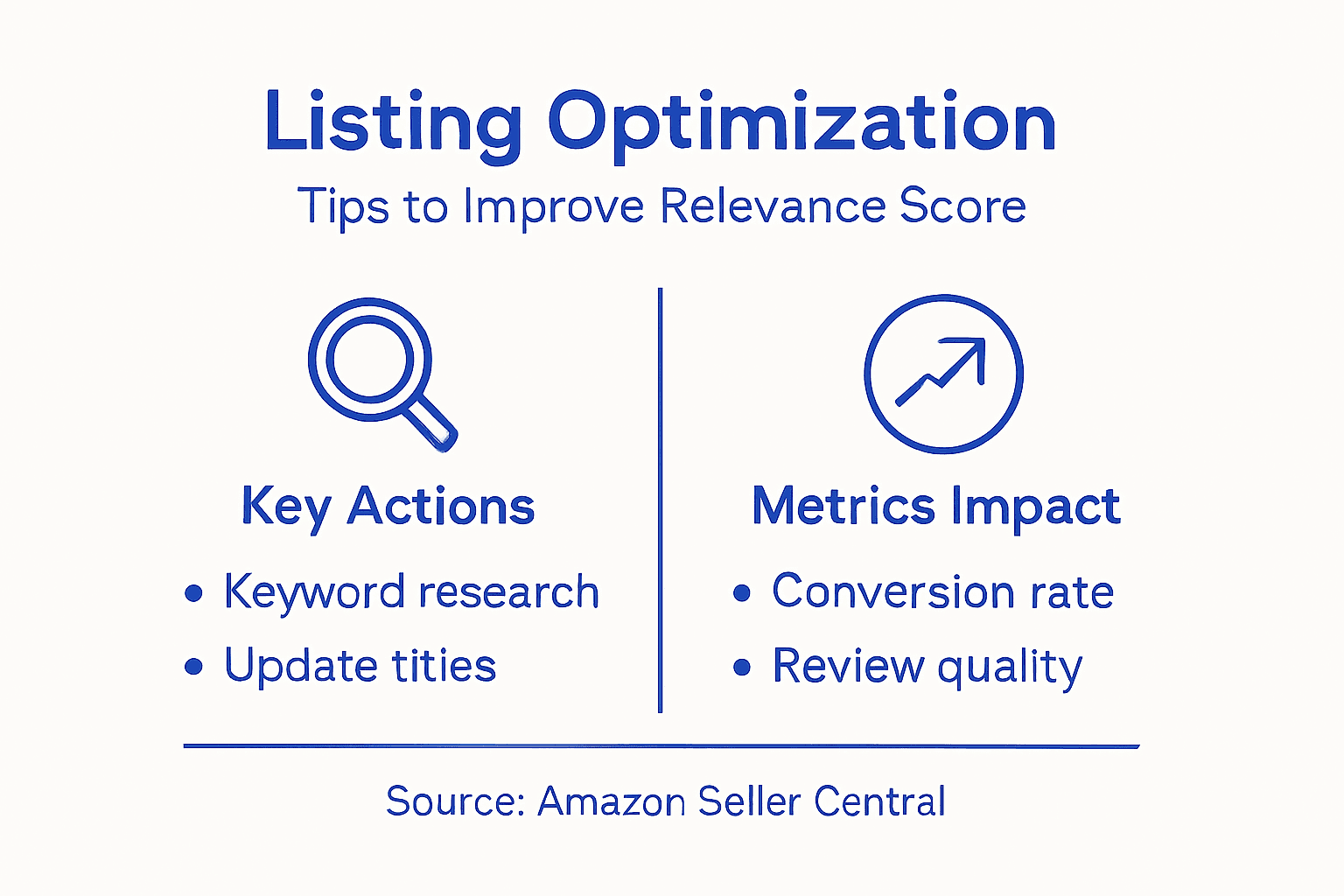
Keyword optimization forms the foundation of listing relevance. Sellers should focus on strategic product listing techniques that incorporate high-performing search terms naturally throughout the listing. This means carefully selecting keywords that accurately reflect the product’s features, benefits, and potential customer search intents. Titles, bullet points, and product descriptions should seamlessly integrate relevant keywords while maintaining readability and compelling narrative flow.
Beyond keyword placement, sellers must enhance their listings with rich, detailed content that demonstrates genuine value. This involves creating comprehensive product descriptions that answer potential customer questions, highlighting unique selling points, and providing clear, precise information. High-quality product images, detailed specifications, and transparent shipping and return policies can significantly boost a listing’s perceived relevance and attractiveness to potential buyers.
Pro Tip: Conduct regular keyword research and systematically update your listing content to maintain optimal search alignment and relevance.
Common Mistakes That Lower Your Score
Amazon sellers frequently undermine their product relevance through well-intentioned but misguided optimization strategies. Understanding these critical errors can help prevent inadvertently damaging your listing’s search performance and visibility.
One of the most prevalent mistakes is keyword stuffing, where sellers aggressively cram irrelevant or repetitive search terms into product titles and descriptions. This approach not only sounds unnatural but can trigger Amazon’s algorithm to penalize the listing. Instead, strategic listing optimization requires carefully selected keywords that flow naturally and genuinely represent the product’s value proposition. Sellers should focus on creating readable, compelling content that authentically addresses customer search intentions.
Another significant pitfall involves neglecting product performance metrics that directly influence relevance scoring. Low-quality product images, incomplete descriptions, inconsistent inventory management, and poor customer feedback can dramatically reduce a listing’s algorithmic ranking. Sellers must proactively manage their entire product presentation, ensuring high-resolution images, comprehensive specifications, competitive pricing, and responsive customer service. These elements collectively signal to Amazon’s algorithm that the product is credible, valuable, and worthy of higher search placement.
Common listing mistakes and their consequences on relevance:
| Mistake | Consequence on Ranking | Prevention Strategy |
|---|---|---|
| Keyword Stuffing | Algorithmic penalty | Use natural, concise keywords |
| Incomplete Description | Lower conversion rates | Add detailed, comprehensive content |
| Poor Images | Reduced buyer engagement | Upload high-resolution photos |
| Price Inconsistency | Lowered visibility | Monitor and adjust pricing regularly |
Pro Tip: Regularly audit your product listings from a customer’s perspective, identifying and addressing potential barriers to conversion and search relevance.
Unlock Your Amazon Listing’s True Potential with Expert Optimization
Understanding the complexities of Amazon’s relevance score means recognizing the importance of strategic keyword placement, authentic content, and strong performance metrics. If you struggle with aligning your product listings to these dynamic factors or feel overwhelmed by how Amazon continuously adjusts its ranking system, you are not alone. Key challenges like avoiding keyword stuffing, maintaining consistent inventory, and boosting conversion rates require focused, data-driven strategies.
Take control of your Amazon presence today by exploring proven E-commerce Tips & Strategies to Grow Your Online Business.
Our specialized services at SearchOneers are designed specifically to enhance your titles, bullet points, descriptions, and backend keywords, giving you superior visibility. Combine this with our Amazon SEO and analytics expertise to evolve your listings alongside the marketplace changes. Don’t let complex algorithms hold you back. Visit us now to transform your listings into powerful sales drivers and achieve the relevance your products deserve.
Frequently Asked Questions
What is the Amazon relevance score?
The Amazon relevance score is an algorithmic measurement that determines how closely a product listing matches potential customer search queries and purchasing behaviors, using various factors including behavioral data and contextual signals.
How does Amazon calculate the relevance score for my product listings?
Amazon calculates the relevance score using a probabilistic ranking framework called BM-25, which evaluates components such as keyword placement, click-through rates, conversion metrics, and purchase patterns to determine the ranking of product listings.
What factors influence my product’s relevance ranking on Amazon?
Key factors influencing relevance rankings include keyword relevance, conversion rates, customer reviews, and inventory consistency. Sellers should focus on creating listings that incorporate relevant keywords while maintaining high-quality content and strong performance metrics.
What are some common mistakes that can lower my Amazon relevance score?
Common mistakes include keyword stuffing, having incomplete product descriptions, using poor-quality images, and not managing pricing consistency. These errors can negatively impact the visibility and performance of your listings on Amazon.