Most American sellers know that over 80 percent of Amazon shoppers rely on search filters to find products quickly and accurately. These powerful tools shape the way buyers discover listings, yet many e-commerce experts underestimate the complexity behind filter optimization. Understanding how filters interact with product taxonomy and ranking algorithms is crucial for anyone aiming to outperform competitors. This guide offers advanced insights that help you move beyond basic tactics, making your Amazon strategy smarter and more effective.
Table of Contents
- Defining Amazon Search Filters And Misconceptions
- Major Types Of Amazon Product Filters
- How Search Filters Influence Product Rankings
- Optimizing Listings For Specific Filter Paths
- Frequent Filter Mistakes And How To Avoid Them
Key Takeaways
| Point | Details |
|---|---|
| Understanding Filters | Amazon search filters refine product searches by attributes like price and ratings, significantly affecting visibility. |
| Complexity of Algorithms | Filters are not universal; effective use requires strategic optimization based on Amazon’s classification system. |
| Dynamic Ranking | Product rankings are fluid, influenced by real-time data and user behavior; sellers must adapt to stay relevant. |
| Common Mistakes | Overfitting to single filters and ignoring algorithm dynamics can hinder success; a multi-dimensional approach is essential. |
Defining Amazon Search Filters and Misconceptions
Amazon search filters are sophisticated navigation tools that help shoppers refine product searches by specific attributes like price, brand, color, size, and customer ratings. Understanding Amazon’s search algorithm reveals how these filters dramatically impact product visibility and consumer purchasing decisions.
Contrary to common misconceptions, search filters are not universal or equally accurate across all product categories. Some sellers mistakenly believe that simply enabling all possible filters will automatically improve their product’s discoverability. In reality, strategic filter optimization requires deep understanding of how Amazon’s taxonomy classifies and ranks products within specific marketplace segments.
The complexity of Amazon’s filtering system stems from its intricate product classification framework, which assigns detailed attributes and metadata to each listing. This granular approach allows consumers to drill down through massive product inventories, finding precisely what they want with minimal effort. Sellers must recognize that filters represent more than simple sorting mechanisms – they are sophisticated matching algorithms designed to connect consumer intent with relevant product offerings.
Pro tip: Regularly audit your product listings to ensure they include comprehensive, accurate attributes that align with Amazon’s recommended taxonomy, maximizing your chances of appearing in relevant filter results.
Major Types of Amazon Product Filters
Amazon employs multiple sophisticated filter types designed to enhance product discovery and personalization. Collaborative filtering techniques represent the most advanced approach, analyzing user behavior patterns to generate highly targeted product recommendations across different marketplace segments.
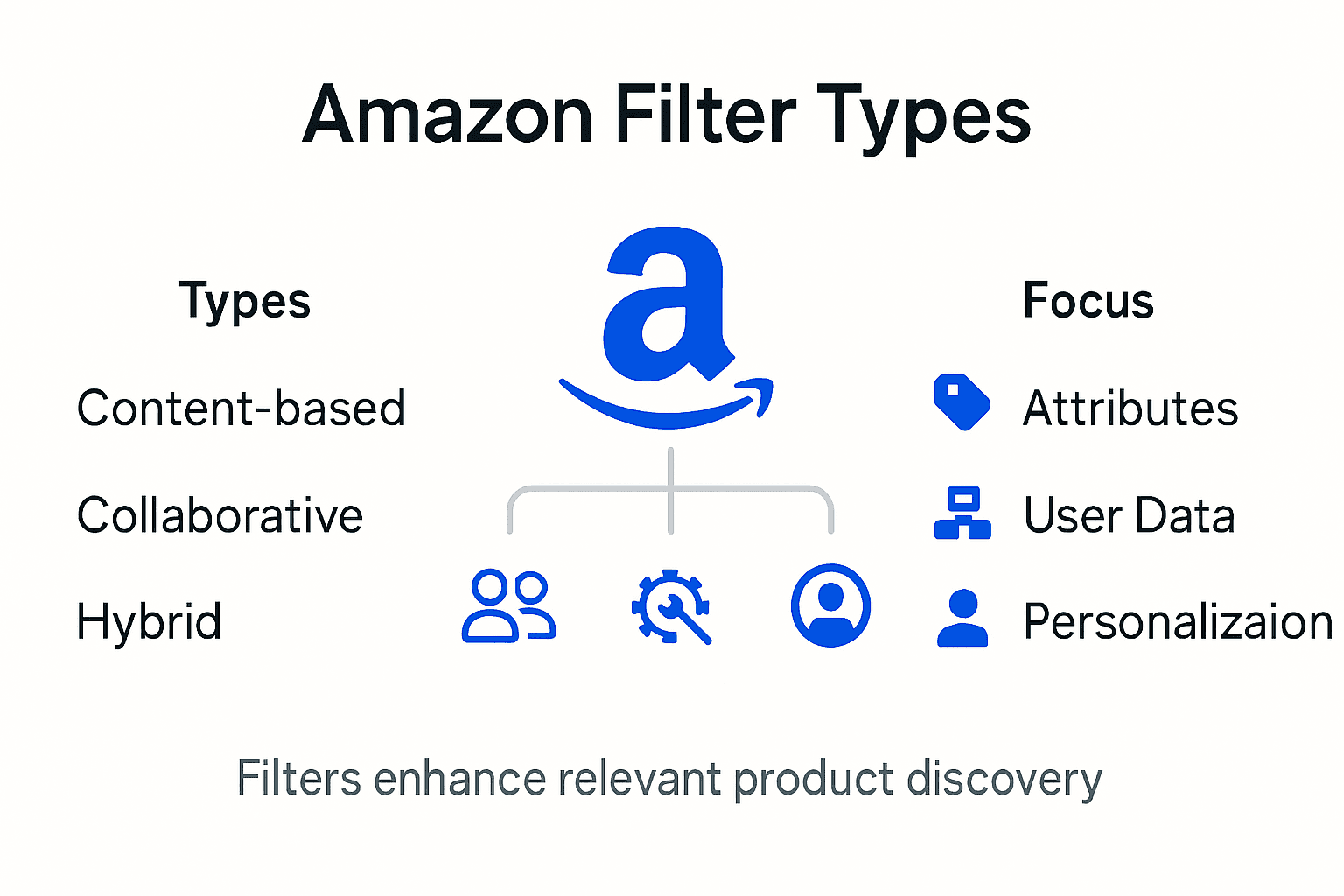
The primary categories of Amazon product filters include content-based filters, collaborative filters, and hybrid filtering systems. Content-based filters examine specific product attributes like price, color, size, brand, and customer ratings, allowing shoppers to narrow search results precisely. Collaborative filters, in contrast, generate recommendations by analyzing aggregate user behavior, identifying products frequently purchased or viewed together by similar customer segments.
Hybrid filtering systems combine multiple approaches to deliver the most accurate and personalized product recommendations. These sophisticated algorithms integrate user historical data, product metadata, and real-time interaction patterns to surface the most relevant items. By analyzing complex recommendation models, Amazon creates a dynamic filtering ecosystem that adapts continuously to changing consumer preferences and marketplace trends.
Pro tip: Optimize your product listings with comprehensive, accurate attributes to maximize visibility across multiple filter categories and increase the likelihood of appearing in relevant customer searches.
Here’s a comparison of Amazon’s main filter types and their impact on product discovery:
| Filter Type | Core Mechanism | Typical Use Cases | Business Impact |
|---|---|---|---|
| Content-Based | Analyzes product attributes | Narrowing by features | Higher search precision |
| Collaborative | Tracks user behavior | Personalized suggestions | Increased likelihood of cross-sell |
| Hybrid | Combines multiple models | Adaptive recommendations | Enhanced conversion and retention |
How Search Filters Influence Product Rankings
Micro-level search ranking dynamics demonstrate that Amazon’s search filters profoundly impact product visibility, creating intricate pathways that determine which items surface in customer search results. These sophisticated filtering mechanisms go far beyond simple sorting, actively shaping the competitive landscape for sellers across different product categories.
The algorithm integrates multiple ranking signals through contextual filters, including historical performance metrics, customer interaction data, and product attribute relevance. Ranking factors such as conversion rates, customer reviews, price competitiveness, and inventory availability are dynamically weighted to create a complex hierarchical system that continuously adjusts product placement. Advanced ranking architectures blend filtered and unfiltered results, creating nuanced visibility strategies that prioritize the most relevant and high-performing product listings.
Sellers must recognize that search filters are not static mechanisms but intelligent, adaptive systems that respond to real-time marketplace dynamics. The ranking algorithm continuously learns from user behavior, adjusting product visibility based on emerging trends, seasonal variations, and shifting consumer preferences. This means that product rankings are not fixed but represent a fluid ecosystem where strategic optimization can significantly enhance marketplace performance.
Pro tip: Continuously monitor and optimize your product listings across multiple attributes to improve your chances of ranking higher in Amazon’s dynamic filtering ecosystem.
Optimizing Listings for Specific Filter Paths
Strategic attribute optimization techniques are critical for ensuring product listings appear in the most relevant Amazon search filter paths. Sellers must meticulously structure their product data to align with Amazon’s complex filtering algorithms, understanding that every attribute contributes to discoverability and ranking potential.
Successful optimization requires a multifaceted approach targeting key filter dimensions. Product attributes such as size, color, material, brand, and technical specifications must be precisely defined and consistently formatted. Sellers should focus on comprehensive backend keyword strategies, ensuring that each relevant filter category contains accurate, searchable metadata that matches potential customer search behaviors. This means going beyond basic descriptions and anticipating the specific filter paths shoppers might use when searching for similar products.

The most effective listings leverage granular categorization and contextual relevance. This involves understanding the intricate relationship between product taxonomy and search filter mechanics. By mapping product attributes to the most precise Amazon category and subcategory, sellers can increase the likelihood of appearing in targeted filter results. Detailed, accurate product information acts as a strategic signal to Amazon’s ranking algorithms, improving the chances of surfacing in specific customer filter paths and enhancing overall marketplace visibility.
Pro tip: Conduct regular audits of your product attributes and backend keywords, systematically testing and refining how your listings appear across different filter combinations to maximize search visibility.
This table summarizes key steps for filter path optimization and their marketplace benefits:
| Step | Action Required | Marketplace Benefit |
|---|---|---|
| Attribute Completeness | Add detailed specs and metadata | Greater filter visibility |
| Strategic Keyword Mapping | Match backend terms to searches | Higher ranking for key terms |
| Category Precision | Select exact taxonomy placement | Improved customer targeting |
Frequent Filter Mistakes and How to Avoid Them
Common product research filter errors represent significant obstacles for sellers seeking to optimize their Amazon marketplace performance. These mistakes often stem from oversimplified approaches to data interpretation and a limited understanding of Amazon’s complex filtering ecosystem.
One critical mistake sellers frequently make is overfitting their product research to a single narrow filter parameter. This myopic approach can lead to misinterpreting market trends and missing broader opportunities. Successful Amazon sellers must develop a comprehensive filtering strategy that considers multiple dimensions simultaneously, including price points, customer ratings, sales velocity, and competitive landscape. By avoiding the trap of tunnel vision, sellers can create more nuanced and accurate product positioning strategies.
Another significant error involves neglecting the dynamic nature of Amazon’s filtering algorithms. Sellers who rely on static data snapshots or outdated filtering techniques risk making strategic decisions based on incomplete information. The marketplace requires continuous monitoring and adaptive filtering approaches that respond to real-time changes in consumer behavior, seasonal trends, and emerging product categories. This means regularly updating research methodologies, cross-referencing multiple data sources, and maintaining flexibility in product selection and optimization strategies.
Pro tip: Develop a multi-dimensional filtering approach that integrates at least five different research parameters, ensuring a comprehensive and adaptable marketplace strategy.
Unlock the Full Potential of Amazon Search Filters for Your Products
Mastering Amazon search filters requires precise listing optimization and a deep understanding of how attributes influence visibility and rankings. If you find yourself struggling with complex taxonomy and evolving filter algorithms, you are not alone. Many sellers face the challenge of aligning product data with Amazon’s dynamic filter ecosystem to achieve higher search precision and customer targeting.
At Search Oneers, we specialize in helping sellers just like you by enhancing your Amazon listings with optimized titles, bullet points, descriptions, and backend keywords designed to maximize your reach across various filter categories. Our data-driven Amazon SEO and Analytics strategies adapt to marketplace shifts so your products stay ahead of the competition.
Explore our expert advice on E-commerce Tips & Strategies to Grow Your Online Business and discover how to convert Amazon’s sophisticated filtering into your advantage.
Take control of your marketplace success today with proven optimization tactics. Visit Search Oneers now to start refining your listings and climbing those search rankings. Don’t let complex filters hold back your sales — act now for greater visibility and stronger sales performance.
Frequently Asked Questions
What are Amazon search filters?
Amazon search filters are tools that help shoppers narrow down product searches based on specific attributes like price, brand, color, size, and customer ratings, making it easier for them to find exactly what they want.
How do search filters affect product visibility on Amazon?
Search filters significantly influence product visibility by using sophisticated algorithms that integrate various ranking factors, such as conversion rates and customer reviews, to determine which products appear in search results.
What types of filters does Amazon use for product searches?
Amazon utilizes content-based filters, collaborative filters, and hybrid filtering systems. Content-based filters analyze product attributes, while collaborative filters recommend products based on user behavior. Hybrid systems combine both approaches for enhanced recommendations.
How can I optimize my product listings for Amazon search filters?
To optimize your product listings, ensure they include comprehensive, accurate attributes aligned with Amazon’s taxonomy. This includes defining product specifications clearly and utilizing relevant backend keywords to improve discoverability in search filter paths.