Juggling rapid growth expectations and shifting Amazon requirements challenges even seasoned E-commerce leaders. Understanding the value of a direct partnership through Amazon Vendor Services can separate profitable brands from those stuck in operational headaches. This guide clarifies how advanced vendor programs, strategic relationship models, and robust data strategies drive performance, so you can optimize listings and sharpen your ROI in ways that simpler seller setups cannot match.
Table of Contents
- Understanding Amazon Vendor Services Basics
- Types of Amazon Vendor Relationships Explained
- Listing Optimization and Data Strategy Integration
- ROI, Costs, and Common Pitfalls for Vendors
- Comparing Vendor Central With Seller Central
Key Takeaways
| Point | Details |
|---|---|
| Amazon Vendor Services (AVS) Advantages | Participating brands benefit from direct wholesale relationships, dedicated support, and enhanced visibility on Amazon’s platform. |
| Vendor Relationship Models | Brands can choose between various relationship types, such as First-Party, Third-Party, or Vendor Flex, each offering distinct advantages and dynamics. |
| Listing Optimization | Effective listing strategies combining keyword research, quality imagery, and data analysis are critical for maximizing product visibility and sales. |
| Financial Considerations | Vendors must navigate complex costs and potential pitfalls, emphasizing the importance of robust financial models and demand forecasting. |
Understanding Amazon Vendor Services Basics
Amazon Vendor Services (AVS) represents a premium partnership program where Amazon directly purchases products from brands at wholesale prices to resell on their marketplace. Unlike traditional seller models, AVS offers brands a comprehensive support ecosystem designed to optimize their online retail performance.
The program provides several distinctive advantages for participating brands:
- Direct wholesale relationship with Amazon
- Dedicated customer success management
- Strategic operational support
- Enhanced visibility across Amazon’s platform
- Access to specialized internal Amazon teams
Brands interested in AVS must typically receive a direct invitation from Amazon, which carefully selects potential vendor partners based on their product portfolio, market potential, and growth trajectory. This selective approach ensures that only high-performing brands gain entry into this exclusive program.
Amazon’s vendor managers play a critical role in the AVS ecosystem, providing hands-on guidance across multiple strategic dimensions. They assist brands with complex operational challenges, including:
- Supply chain optimization
- Catalog management
- Performance enhancement strategies
- Market expansion initiatives
Pro tip: Prepare a comprehensive product portfolio and performance metrics before engaging with an Amazon vendor manager to maximize your program potential.
Types of Amazon Vendor Relationships Explained
Amazon offers multiple vendor relationship models that provide brands with strategic opportunities to engage with the world’s largest ecommerce marketplace. Strategic vendor partnerships range from traditional wholesale arrangements to more complex collaborative frameworks.
The primary vendor relationship types include:
- First-Party (1P) Vendor: Direct wholesale relationship where Amazon purchases products outright
- Third-Party (3P) Seller: Brands sell directly to consumers through Amazon’s platform
- Vendor Flex: Collaborative model integrating Amazon’s technology with supplier assets
- Invited Vendor: Brands selected by Amazon for specialized partnership programs
Each relationship type offers unique advantages and operational dynamics. First-Party Vendors benefit from direct wholesale purchasing, where Amazon buys inventory at predetermined rates and manages product resale. These vendors typically utilize Vendor Central, Amazon’s dedicated management platform for wholesale relationships.

The Vendor Flex model represents an advanced partnership strategy designed to optimize supply chain efficiency. This approach integrates technological innovation with strategic collaboration to create mutually beneficial operational frameworks.
Vendor relationship tiers typically include:
Here’s a comparison of primary Amazon vendor relationship models:
| Relationship Model | Who Owns Inventory | Control Over Pricing | Main Platform |
|---|---|---|---|
| First-Party Vendor | Amazon after purchase | Amazon sets pricing | Vendor Central |
| Third-Party Seller | Brand retains ownership | Brand decides pricing | Seller Central |
| Vendor Flex | Shared/varies by contract | Collaborative pricing | Hybrid |
| Invited Vendor | Typically Amazon | Negotiated pricing | Vendor Central |
- Standard Vendor Agreement
- Premium Vendor Services
- Strategic Partnership Program
- Enterprise Vendor Collaboration
Pro tip: Carefully document your product performance metrics and operational capabilities to increase your attractiveness for advanced Amazon vendor relationship opportunities.
Listing Optimization and Data Strategy Integration
Amazon listing optimization represents a critical strategy for brands seeking to maximize visibility and sales potential within the competitive ecommerce marketplace. Amazon content strategy requires a sophisticated approach that combines data-driven insights with strategic product presentation.
Key elements of effective listing optimization include:
- Precise keyword research and implementation
- High-quality product imagery
- Compelling product descriptions
- Strategic backend keyword optimization
- Performance data tracking and analysis
Keyword Integration plays a pivotal role in improving product discoverability. Vendors must conduct comprehensive research to identify high-volume, relevant search terms that align with their product’s unique value proposition. This process involves analyzing customer search patterns, competitor listings, and Amazon’s search algorithm preferences.
Data strategy integration demands a multifaceted approach to understanding and leveraging performance metrics. Successful vendors utilize advanced analytics tools to track:
- Conversion rates
- Click-through percentages
- Search ranking positions
- Customer engagement signals
- Competitive positioning
Pro tip: Develop a systematic approach to tracking and updating your product listings weekly, using performance data to continuously refine your optimization strategy.
ROI, Costs, and Common Pitfalls for Vendors
Amazon Vendor Services present a complex financial landscape where strategic decision-making directly impacts profitability. Amazon product strategy requires a nuanced understanding of investment costs, potential returns, and operational challenges.
Key financial considerations for vendors include:
- Initial onboarding expenses
- Inventory acquisition and management costs
- Marketing and advertising investments
- Performance fee structures
- Potential chargeback and compliance expenses
Vendor Cost Breakdown reveals multiple financial layers that vendors must carefully navigate. The most significant expenses typically involve inventory procurement, Amazon’s commission rates, and marketing expenditures. Vendors often experience unexpected costs related to:
- Storage fees
- Long-term inventory holding charges
- Product return processing
- Freight and shipping expenses
- Compliance-related penalties
Common pitfalls that can erode vendor profitability include overestimating demand, inadequate inventory management, and failing to optimize pricing strategies. Successful vendors develop robust financial models that account for Amazon’s dynamic marketplace requirements and potential fluctuations in consumer behavior.
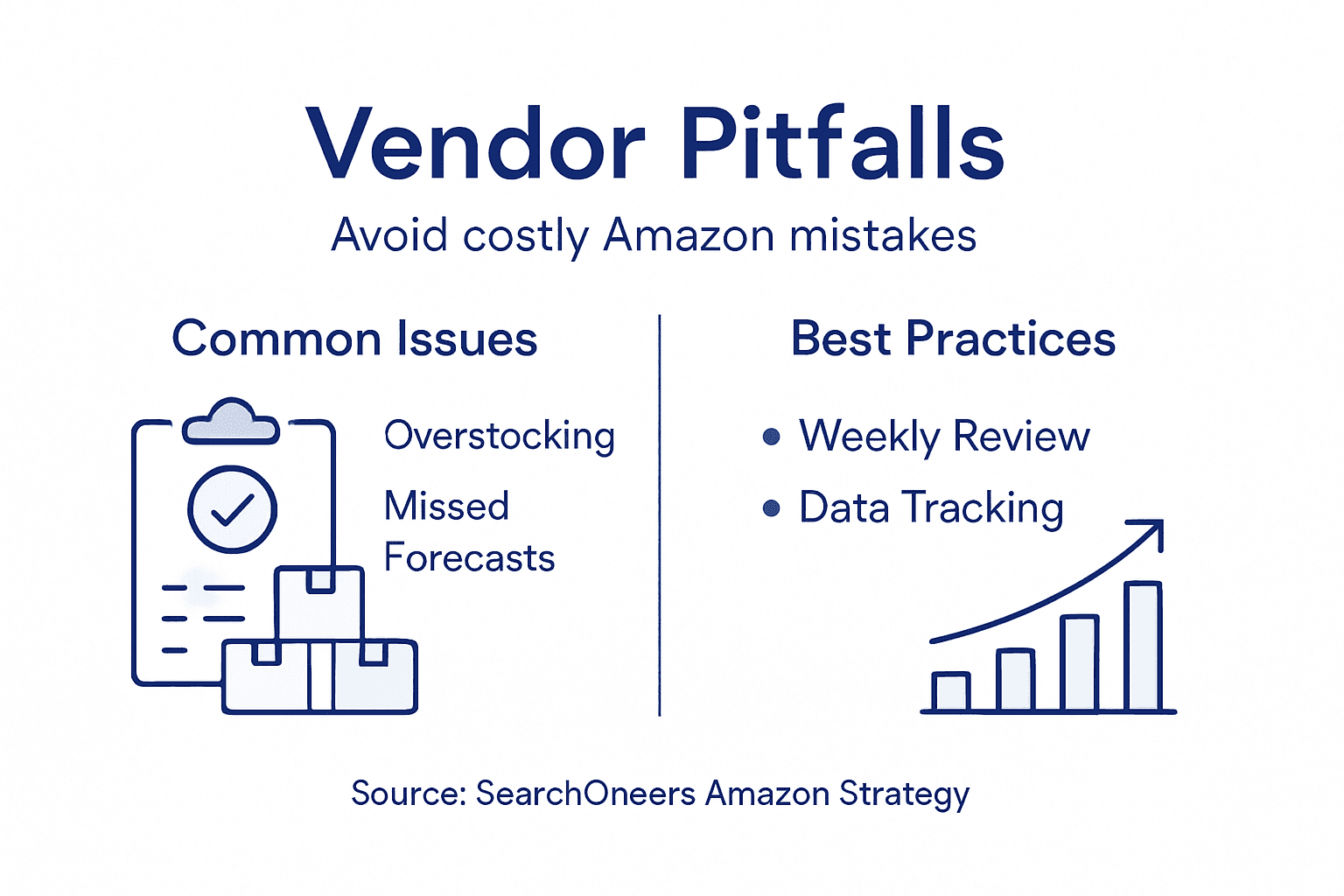
Review this summary of common vendor profit pitfalls and financial impacts:
| Pitfall | Financial Impact | Preventive Action |
|---|---|---|
| Overestimating demand | Inventory holding fees increase | Accurate demand forecasting |
| Inadequate inventory mgmt | Lost sales, higher penalties | Automated inventory tracking |
| Poor pricing strategies | Margins shrink, lost competitiveness | Regular market analysis |
| Non-compliance issues | Chargebacks and extra fees | Ongoing compliance audits |
Pro tip: Develop a comprehensive financial model that includes a 20% buffer for unexpected marketplace expenses and creates multiple revenue scenarios to mitigate potential financial risks.
Comparing Vendor Central With Seller Central
Navigating Amazon’s selling platforms requires a deep understanding of the fundamental differences between Vendor Central and Seller Central. Seller Central complete guide provides critical insights into the operational nuances of these two distinct marketplace interfaces.
Key distinctions between Vendor Central and Seller Central include:
- Ownership of inventory
- Sales model (wholesale vs. direct)
- Level of platform control
- Pricing flexibility
- Operational responsibilities
Vendor Central operates as a wholesale model where Amazon purchases products directly from manufacturers and resells them. Brands are effectively selling inventory to Amazon, which then manages product listing, pricing, and customer interactions. This model provides several advantages:
- Guaranteed purchase orders from Amazon
- Reduced direct customer management
- Potential for larger volume sales
- Simplified inventory forecasting
- Strategic brand positioning
Seller Central, in contrast, enables brands to sell products directly to consumers, maintaining greater control over pricing, inventory, and customer relationships. Sellers act as independent retailers on Amazon’s platform, handling their own inventory, shipping, and customer service.
Pro tip: Carefully analyze your brand’s operational capabilities, inventory management strengths, and growth objectives before selecting between Vendor Central and Seller Central platforms.
Unlock Your Amazon Vendor Growth Potential with Expert Support
Struggling to navigate the complexities of Amazon Vendor Services or looking to elevate your brand’s online performance? This article highlights the critical challenges vendors face such as optimizing product listings, mastering data-driven strategies, and managing vendor relationships effectively. If your goal is to maximize visibility, improve ROI, and avoid common vendor pitfalls, you need a partner who understands how to transform these challenges into growth opportunities.
At SearchOneers, we specialize in Amazon Listing Optimization including enhanced titles, bullet points, descriptions, and backend keywords to boost your product discoverability. Our Amazon SEO & Analytics services provide smart, data-driven insights that help you stay ahead in a dynamic marketplace. Explore practical advice and proven tactics in our E-commerce Tips & Strategies to Grow Your Online Business category to start improving your Amazon vendor performance today. Visit SearchOneers now to take the first step toward profitable growth and strategic success on Amazon.
Frequently Asked Questions
What is Amazon Vendor Services (AVS)?
Amazon Vendor Services is a premium partnership program where Amazon directly purchases products from brands at wholesale prices to resell them on its marketplace. It provides a range of support services aimed at optimizing a brand’s online retail performance.
How does the First-Party (1P) Vendor relationship work compared to Third-Party (3P) Seller?
In a First-Party Vendor relationship, brands sell their products directly to Amazon, which then manages resale and inventory. In contrast, Third-Party Sellers maintain control over the inventory and pricing and sell directly to consumers through Amazon’s platform.
What are some common pitfalls for vendors using Amazon Vendor Services?
Common pitfalls include overestimating demand, inadequate inventory management, poor pricing strategies, and non-compliance with Amazon’s policies. These can lead to financial losses due to holding fees, lost sales, or chargebacks.
How can I optimize my Amazon product listings?
To optimize your Amazon product listings, conduct precise keyword research, use high-quality imagery, write compelling descriptions, optimize backend keywords, and regularly track performance data to refine your strategy.