Every item you return to Amazon enters a carefully managed process designed to give it a second life. Returned products flow through specialized return centers where trained associates and machine-learning systems inspect, categorize, and route each item toward the best possible outcome. The vast majority are either restocked as new, sold at a discount through Amazon Resale, repaired by partner vendors, donated to nonprofits, or recycled. Only items that are hazardous or completely unsellable, think shattered glass or leaking liquids, go to energy recovery as an absolute last resort.
Here is a quick snapshot of what happens after you drop off a return:
- Returned items are consolidated and routed by product type to dedicated return centers.
- Each item is inspected for packaging integrity, signs of use, and condition.
- X-ray scanners and machine-learning algorithms evaluate condition and flag security risks.
- Items are categorized as new, Amazon Resale, charity-eligible, recyclable, or disposal candidates.
- Amazon’s stated mission is to give every returned product a “second life,” aligned with The Climate Pledge for net-zero carbon by 2040.
- Customers can drop off returns label-free and box-free at partner locations like Whole Foods Market, FedEx Office, Staples, and Kohl’s.
What Amazon’s return policy actually covers
Amazon’s standard return policy gives customers 30 days from delivery to return most items, provided they are in original or unused condition. That window applies to items shipped directly by Amazon, including Amazon Warehouse purchases.
- Most returns are free, and the “FREE Returns” badge under the price confirms eligibility before you buy.
- Refunds for eligible returns are typically issued within five hours of return confirmation in the U.S.
- Amazon Renewed products get a longer window: 90 days, and Renewed Premium products get a full year.
- Third-party seller returns follow a separate process; if a seller does not respond within two business days, the Amazon A-to-z Guarantee covers you.
- Before initiating a return, customers can access free product support through the “Your Orders” page, including troubleshooting, part replacement, and exchanges on eligible items.
- Certain categories, including Amazon Pharmacy, digital purchases, and custom-engraved products, fall outside the standard policy entirely.
Policy variations exist, but the 30-day window covers the overwhelming majority of everyday purchases. Knowing the policy before you buy, not after, is what saves you the most hassle.
How Amazon processes returns: inspection and categorization
Returned items do not land in a single warehouse and sit there. Amazon routes each item by category to dedicated return centers built to handle specific product types, whether that is clothing, electronics, or furniture. That specialization is what makes the process fast and accurate.
- Associates scan the shipping label to match the physical item with the correct order in Amazon’s system.
- Packaging is evaluated on all sides for broken seals or damage before the item inside is even touched.
- The item itself is checked against its description, inspected for signs of use, and assessed for any damage.
- Machine-learning systems then classify the item automatically based on the associate’s condition inputs, using advanced tools like the AI Search Audit that optimize evaluation for returns processing.
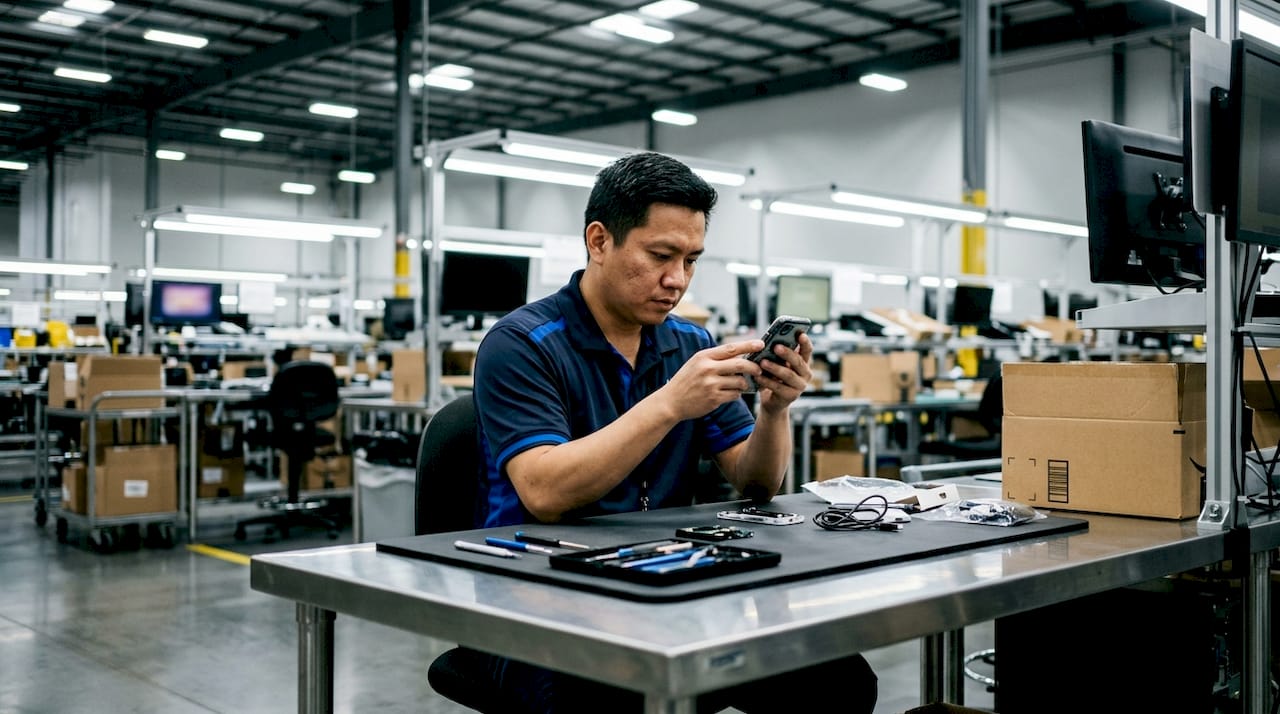
- Electronics go through a dedicated tech assessment area where X-ray scanners detect counterfeits, unauthorized repairs, and security risks invisible to the naked eye.
- Phones and tablets are connected to testing equipment that checks microphone quality, camera performance, battery health, and biometric functions like Touch ID and Face ID.
- Returned drones are actually flown in a dedicated testing cage to verify battery performance, camera functionality, and flight stability.
- All customer data is wiped from every electronic device before it moves to the next stage.
- Items passing inspection with no signs of use are restocked as new inventory and shipped to a fulfillment center.
The categorization outcomes break down like this:
| Condition outcome | Description | Next step |
|---|---|---|
| New/pristine | Unused, sealed, no signs of wear | Restocked as new inventory |
| Amazon Resale | Minor cosmetic issues or damaged packaging | Graded “Like New” to “Acceptable,” listed at discount |
| Charity-eligible | Functional but not resalable | Donated to nonprofit partners |
| Recyclable | Not resalable or donatable | Sent to recycling facilities |
| Energy recovery | Hazardous or completely unsellable | Waste-to-energy conversion |
Pro Tip: If you are buying a returned item through Amazon Resale, the condition grades are standardized and meaningful. “Like New” means minimal to no signs of use with all accessories present; “Acceptable” means heavy wear but fully functional. Read the condition notes before you buy.
Where returned products actually end up
The destination of a returned item depends entirely on what the inspection reveals. Most items do not end up in a landfill. Amazon’s priority order runs from resale to repair to donation to recycling, with disposal as the final option.
- Items that meet Amazon’s quality bar are relisted as new, the most common outcome for returned products.
- Items with cosmetic issues or damaged packaging qualify for Amazon Resale, where they are sold at a discount with a detailed condition description.
- Before listing on Amazon Resale, each item receives a second, more thorough inspection, including factory resets for electronics.
- Items that cannot be relisted are sent to specialty repair vendors. More than 7.6 million products were repaired through Amazon’s partners in the U.S. and Europe in 2022 alone.
- Products that are functional but not resalable, perhaps due to damaged packaging, are donated. In 2023, Amazon and its selling partners donated over 160 million products worldwide through nonprofit partners including Good360, which distributes to more than 700 U.S. nonprofits.
- Recycling is pursued when resale and donation are both off the table.
- Energy recovery, burning waste to generate electricity, is reserved for items that are unsafe or impossible to recycle, such as products with leaking liquids or shattered glass. It is the last resort, both environmentally and economically.
The scale of the donation program alone tells you something about how seriously Amazon treats the reuse priority. Household appliances, school supplies, electronics, tools, and clothing all flow through these channels rather than going straight to disposal.
How Amazon makes returns easy for you
The return experience is built around one idea: remove every possible friction point. You should not need a box, a label, or even a printer to return most items.
- Over 10,000 drop-off locations exist across the U.S., including FedEx Office, Whole Foods Market, Staples, Kohl’s, The UPS Store, and Rent-A-Center.
- Most Amazon customers in the U.S. live within a short distance of one of these locations.
- Many Whole Foods Market locations include Amazon returns kiosks where the entire process takes 60 seconds or less.
- You show a QR code on your phone. Associates at the drop-off location handle packing, labeling, and shipping.
- Eligible items can be dropped off in the original manufacturer’s packaging, no extra shipping box needed.
- Refunds for most eligible returns are issued within five hours of confirmation.
- Before returning, customers can access free product support through “Your Orders,” including troubleshooting guides, part replacements, and exchanges, which often resolves the issue without a return at all.
The label-free, box-free return system is genuinely one of the more consumer-friendly logistics setups in retail. The fact that Amazon handles the physical logistics at the drop-off point shifts the burden almost entirely off the customer.
Tracking a returned item: the real journey from your hands to its next home
Here is what actually happens after you hand over a return at a Whole Foods kiosk. The journey is longer and more complex than most people expect.
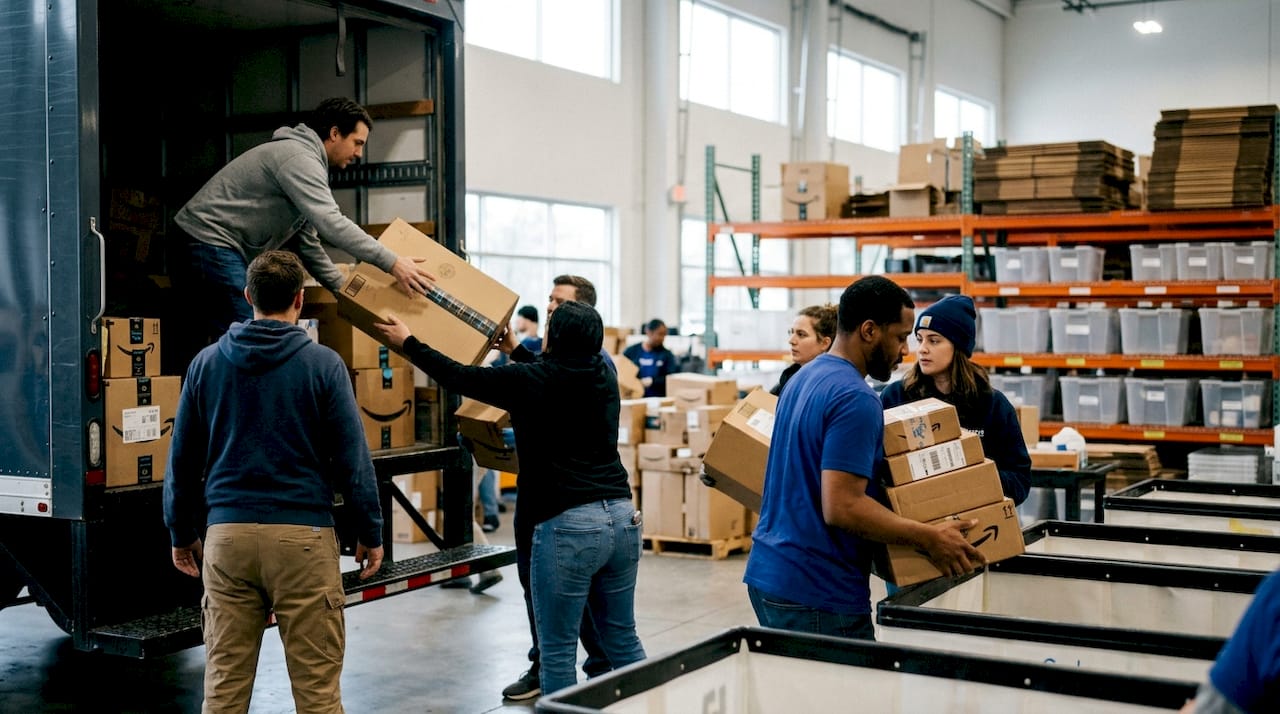
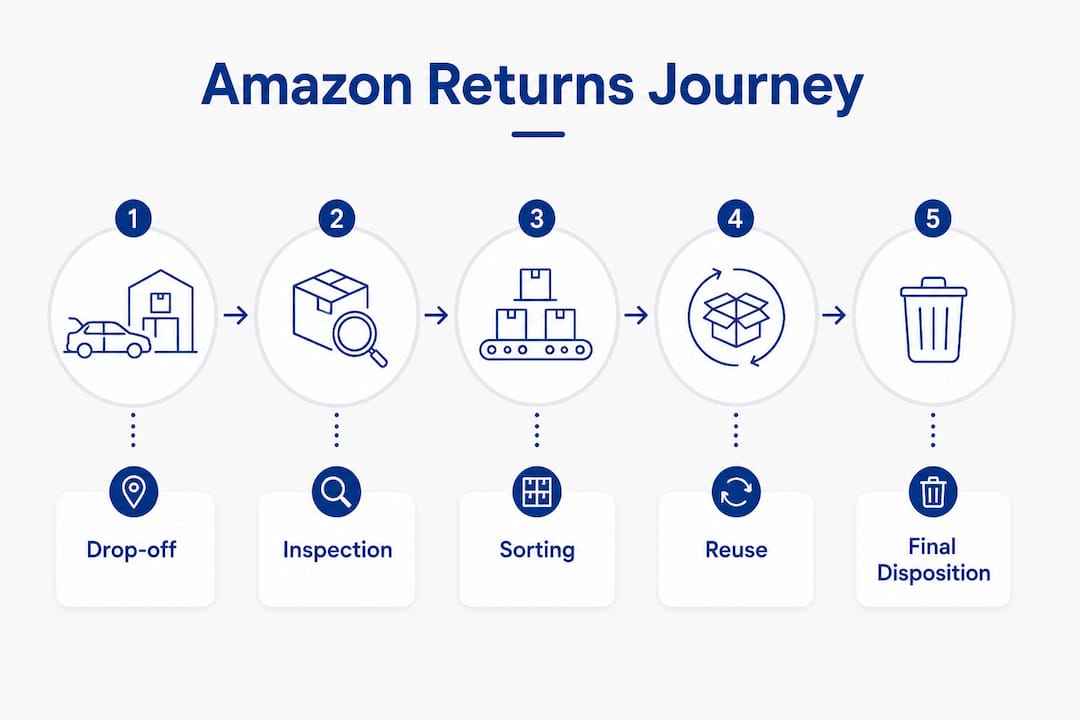
- Drop-off and labeling. A specialized shipping label is attached to your parcel at the drop-off location. That label contains all the order details and routes the package to the correct return center.
- Consolidation and transport. Your item is grouped with other returns and shipped, often hundreds or thousands of miles, to a dedicated Amazon return center matched to its product category.
- Arrival and decanting. At the return center, the item lands on a conveyor belt and moves to an associate’s workstation. The associate scans the label, matches the item to the order in Amazon’s system, and sorts it by product category.
- Condition assessment. A second associate evaluates the item: Is it sealed? Are there signs of use? Is the packaging intact? Their answers feed directly into the machine-learning classification system.
- Technology screening. For electronics, the item moves to a dedicated tech assessment area. X-ray scanners check for counterfeits or unauthorized modifications. Testing equipment verifies every function.
- Categorization and routing. The machine-learning system assigns the item to a disposition path: new inventory, Amazon Resale, repair, donation, recycling, or energy recovery.
- Preparation for next destination. If restocking as new, associates remove old labels using a hairdryer and chemical solution, apply fresh security seals, clean the item, and pack it for shipment to a fulfillment center. If going to Amazon Resale, a specialist performs light repairs if needed, assigns a condition grade, and documents any defects in detail.
- Reintegration or redistribution. New inventory ships to a fulfillment center and goes live on Amazon within days. Resale items are listed with their condition grade and notes. Donation items go to nonprofit partners like Good360.
| Stage | Location | Key action |
|---|---|---|
| Drop-off | Partner retail location | Label attached, item consolidated |
| Transit | Shipping network | Routed to category-specific return center |
| Decanting | Return center | Scanned, matched to order, sorted |
| Inspection | Return center | Condition assessed by associate |
| Tech screening | Dedicated assessment area | X-ray, device testing, data wipe |
| Disposition | Return center | Categorized and routed |
| Fulfillment | Fulfillment center or nonprofit | Listed for sale or donated |
The entire journey can span thousands of miles and multiple facilities. What started as a sweater that did not fit could end up on someone else’s doorstep within a week, or in the hands of a family in need through Good360.
How to make the most of Amazon returns as a consumer
Knowing how the system works puts you in a better position to use it well. A few practical moves make the process faster and more predictable.
- Start with product support before returning. Go to “Your Orders,” click “Get Product Support,” and check whether troubleshooting, a replacement part, or an exchange resolves the issue. This often saves you the trip entirely.
- Use the label-free, box-free option whenever possible. Select a drop-off location during the return initiation, grab the QR code, and you are done in minutes. No printer, no tape, no box hunting.
- Match your return method to the item. High-value electronics benefit from drop-off at locations with dedicated Amazon staff. Clothing and small items work fine at any of the 10,000-plus partner locations.
- Check the return window before you buy. The standard window is 30 days, but Amazon Renewed products give you 90 days, and Renewed Premium gives you a full year. Knowing this upfront changes how you shop.
- Read Amazon Resale condition grades carefully when buying returned items. “Like New” means all accessories are present and signs of use are minimal. “Acceptable” means the item works but shows heavy wear. The condition notes written by associates are specific, not generic.
- Erase personal data before returning electronics. Factory reset laptops, phones, and tablets before drop-off. Amazon wipes data at the return center, but doing it yourself first is the safer practice.
Pro Tip: If you return an item frequently from the same product category, check whether Amazon has flagged similar listings with a “Frequently returned item” badge. That badge signals that other customers had the same issue, and it can save you from a repeat purchase mistake.
Understanding Amazon’s marketplace operations also helps you shop smarter on the resale side. Items on Amazon Resale have been inspected twice and graded by trained associates, which makes them a genuinely reliable option for budget-conscious buyers.
Amazon’s commitment to sustainability through returns management
Amazon’s returns operation is not just a logistics function. It is a direct expression of the company’s broader environmental commitments, specifically The Climate Pledge, which targets net-zero carbon by 2040.
The priority order built into every return center reflects that mission. Repair comes before liquidation. Donation comes before recycling. Recycling comes before energy recovery. Each step down the chain is a fallback, not a default.
Amazon’s donation programs operate at a scale that is hard to visualize: over 160 million products donated globally in 2023 through partnerships with organizations like Good360, which connects Amazon’s surplus to more than 700 U.S. nonprofits. In Europe, the numbers are similarly large, with over 35 million items donated by Amazon and its selling partners in 2025 alone.
Technology plays a direct role in hitting these sustainability targets. Machine-learning classification systems route items faster and more accurately than manual sorting alone, which means fewer items fall through the cracks into disposal. X-ray screening catches counterfeits and unauthorized modifications early, protecting both the resale channel and the donation stream from items that should not be in circulation. The machine-learning systems that power this sorting represent one of the more consequential applications of AI in retail logistics today.
Amazon also works upstream to reduce returns in the first place. Features like the “Frequently returned item” badge, Virtual Try-On for shoes and eyewear, and a size recommendation tool that achieves over 90% customer satisfaction on apparel all aim to get the right product to the right person on the first try. Fewer returns mean less processing load and a smaller environmental footprint across the entire supply chain.
Key Takeaways
Amazon’s returns process prioritizes resale, repair, and donation over disposal, with energy recovery reserved only for hazardous or completely unsellable items.
| Point | Details |
|---|---|
| Most returns are resold | The majority of returned items are restocked as new or listed through Amazon Resale at a discount. |
| Repair extends product life | More than 7.6 million products were repaired through Amazon’s partners in the U.S. and Europe in 2022. |
| Donations reach millions | Amazon and its selling partners donated over 160 million products globally in 2023 through nonprofit partners. |
| Returns take minutes to drop off | Four out of five U.S. customers live within five miles of one of Amazon’s 10,000-plus drop-off locations. |
| Sustainability drives decisions | Every disposition path follows The Climate Pledge goal of net-zero carbon by 2040, with landfill as the last resort. |
If you sell on Amazon, the returns ecosystem directly affects your listings, your inventory, and your reputation. Products that come back frequently signal a listing problem, not just a product problem. Searchoneers specializes in Amazon listing optimization that reduces return rates by making sure your titles, bullet points, and descriptions set accurate expectations from the first click. When customers know exactly what they are getting, they keep it.

Ready to tighten your listings and cut unnecessary returns? Searchoneers builds data-driven listing strategies that work with Amazon’s algorithm, not against it. Your next sale should be a keeper.