

TL;DR:
- Successful Amazon sellers focus on building systems that grow over time rather than relying on short-lived promotions.
- They leverage the flywheel model by optimizing pricing, reviews, and traffic to reduce costs and increase rankings.
A sound business strategy on Amazon is defined by one principle: build systems that compound, not campaigns that expire. Amazon’s platform rewards sellers who understand its flywheel model, use its infrastructure tools deliberately, and treat their storefront as a real brand channel. The entrepreneurs who win here are not the ones running the most promotions. They are the ones who align their ecommerce strategy with how Amazon itself grows. This guide breaks down exactly how that works in 2026, from fulfillment decisions to marketing systems to brand development.
How does Amazon’s flywheel model drive business growth?
The flywheel effect is the engine behind Amazon’s entire growth model. Lower prices improve the customer experience, which attracts more traffic. More traffic draws more third-party sellers. More sellers expand product selection, which lowers prices further. The loop feeds itself.
This self-reinforcing cycle also reduces customer acquisition costs over time. That is the part most sellers miss. Amazon does not just grow bigger. It grows cheaper to operate at scale.
As an entrepreneur, you can build a smaller version of this loop inside your own storefront. Price competitively to win early traffic. Use that traffic to generate reviews. Use reviews to improve conversion rates (CVR). Higher CVR signals quality to Amazon’s A10 algorithm, which pushes your listing higher. Higher rankings bring more traffic. The loop starts again.
Pro Tip: Map your own flywheel on paper before you launch. Identify which input, whether price, reviews, or selection, will trigger the first rotation for your specific product category.
| Flywheel element | What Amazon does | What you should do |
|---|---|---|
| Lower prices | Undercuts competitors to attract volume | Price within the top 20% of your category |
| Better experience | Invests in fast shipping and easy returns | Use FBA to meet Prime delivery standards |
| More traffic | Drives buyers through search and ads | Run Sponsored Products to seed early traffic |
| More sellers | Expands catalog through third-party sellers | Add product variations to widen your selection |
| Expanded selection | Increases relevance for more search queries | Build a catalog, not just a single listing |
What are the key strategic components for selling on Amazon?
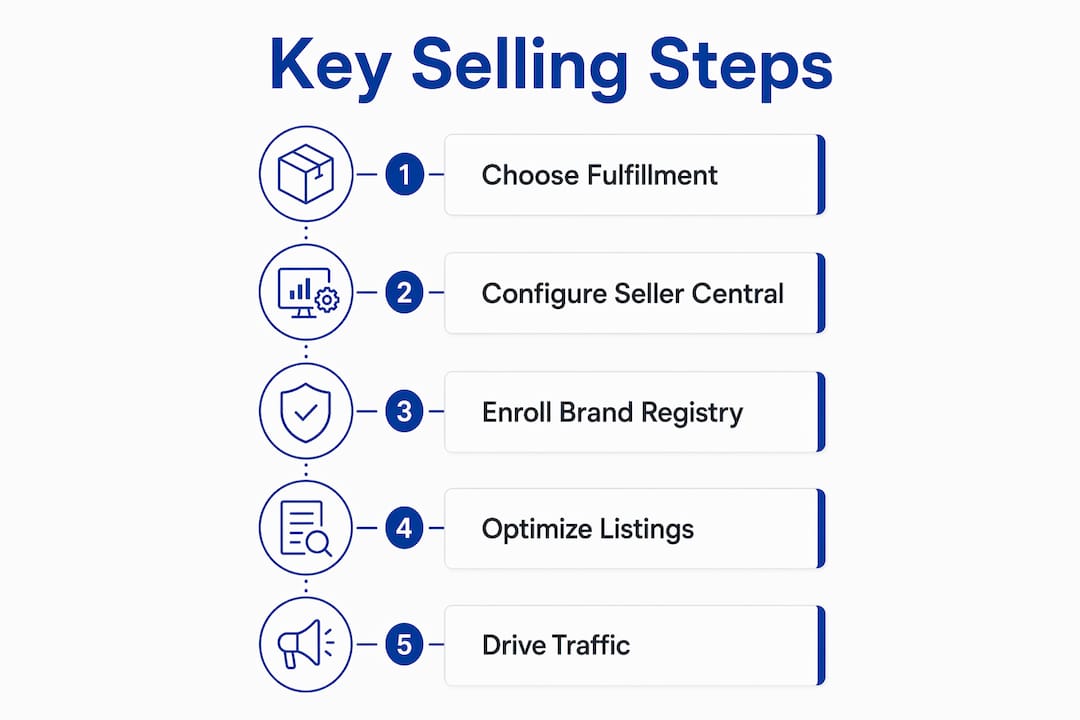
Sellers in 2026 follow five core steps: choose a fulfillment plan, configure Seller Central, enroll in Brand Registry, optimize product listings, and monitor account health. Each step is a strategic decision, not just an administrative task.

Fulfillment by Amazon (FBA) places your inventory in Amazon’s warehouses and makes your products Prime-eligible. Fulfillment by Merchant (FBM) gives you more control over shipping but removes the Prime badge for most listings. For most entrepreneurs building a scalable brand, FBA is the stronger starting point because Prime eligibility directly affects click-through rate (CTR) and conversion.
Brand Registry unlocks tools that FBA alone cannot provide. These include A+ Content, which replaces plain text descriptions with rich images and comparison charts, and Amazon Vine, which places your product with verified reviewers to build early social proof. Both tools improve listing quality before you spend a dollar on ads.
Here is what a complete listing strategy covers:
- Title: Include your primary keyword, brand name, key feature, and size or quantity. Keep it under 200 characters.
- Bullet points: Lead each bullet with a benefit, not a feature. Buyers scan these first.
- Images: Use all available image slots. Include lifestyle photos, infographics, and a size reference image.
- A+ Content: Add comparison modules and brand story sections to reduce bounce rate.
- Backend keywords: Fill every character of the backend search term field with relevant phrases buyers use but that do not appear in your visible copy.
- Reviews: Treat review growth the way top brands treat their Google and Trustpilot ratings. Volume and recency both affect ranking.
Pro Tip: Enroll in Brand Registry as early as possible. The Vine program, A+ Content, and Sponsored Brand ads are all locked behind it. Waiting costs you ranking time.
How do Amazon marketing strategies reduce customer acquisition costs?
Amazon’s recommendation algorithm generates an estimated 35% of its total revenue by using purchase patterns to power features like Frequently Bought Together. That figure shows how much of Amazon’s growth runs on autopilot once the data loop is established.
Amazon Prime has over 200 million members globally. Those members shop more frequently and spend more per visit than non-Prime customers. When your product is Prime-eligible, you are not just getting a badge. You are accessing the most loyal buyer base in ecommerce.
Amazon’s marketing advantage comes from integrated infrastructure systems, specifically Prime, the recommendation engine, and the advertising platform, rather than traditional creative campaigns. This infrastructure reduces customer acquisition costs and creates compounding growth. You benefit from that infrastructure the moment your listing is live and indexed.
Tactically, sellers use promotions, coupons, Lightning Deals, and Sponsored Products pay-per-click (PPC) ads to improve product visibility and sales. Sponsored Products are cost-per-click (CPC) based and push individual listings higher in search results. Used correctly, they seed the review and sales velocity that organic ranking requires.
| Marketing method | How it works | Best use case |
|---|---|---|
| Sponsored Products | CPC ads targeting keywords in search results | New listings needing early sales velocity |
| Coupons | Percentage or dollar-off displayed on the listing | Boosting CVR on established products |
| Lightning Deals | Time-limited promotions on the Deals page | Clearing inventory or launching a variation |
| Recommendation engine | Algorithm-driven cross-sell and upsell placements | Catalog sellers with complementary products |
| Off-Amazon marketing | Social media, email, influencer traffic to listings | Reducing dependence on Amazon’s own traffic |
What pitfalls should sellers avoid when building an Amazon brand?
Effective Amazon sellers treat the platform as a formal brand channel, not a side marketplace. The difference shows up in design consistency, messaging clarity, and how seriously they manage account health metrics.
The most common mistake is building a single product listing and waiting for organic traffic. Amazon’s A10 algorithm rewards sales history, review velocity, and listing completeness. A listing with no reviews, thin copy, and a single image will not rank, regardless of how good the product is.
Here are the pitfalls that consistently hold sellers back, and the fixes:
- Inconsistent branding: Your storefront, A+ Content, and packaging should share the same visual identity. Buyers notice when they do not match.
- Ignoring off-Amazon traffic: Successful sellers integrate social media, influencer partnerships, and email lists to reduce dependence on Amazon’s own traffic. This also signals external demand to the algorithm.
- Poor inventory management: Stockouts kill ranking. Use demand forecasting tools and set reorder alerts inside Seller Central before you hit your last 30 days of stock.
- Manual ad management at scale: Automation of pricing, advertising bids, and stock monitoring supports scaling storefronts efficiently. Manual management works for one or two SKUs. It breaks down at ten.
- Neglecting repeat purchase mechanics: Add a product insert with a QR code pointing to your brand’s email list. Build a customer base you own, not just one Amazon loans you.
Pro Tip: Check your Account Health dashboard in Seller Central weekly. A single policy violation can suppress your listings before you notice a sales drop. Catching it early is the difference between a warning and a suspension.
You can follow a structured listing optimization workflow to cover all these bases systematically rather than reactively.
Key Takeaways
A winning Amazon ecommerce strategy requires a self-reinforcing flywheel, disciplined listing optimization, and an off-platform brand presence working together.
| Point | Details |
|---|---|
| Build a flywheel, not a campaign | Lower prices, better reviews, and more traffic feed each other when set up correctly. |
| FBA plus Brand Registry is the baseline | Prime eligibility and A+ Content together improve CTR, CVR, and ranking simultaneously. |
| Infrastructure beats one-off promotions | Amazon’s recommendation engine drives 35% of revenue. Align with it rather than fighting it. |
| Off-Amazon marketing reduces platform risk | Social media, email, and influencer traffic protect you when Amazon’s algorithm shifts. |
| Automate before you scale | Manual ad and inventory management breaks down past a handful of SKUs. |
What I have learned about building a real Amazon business
After working with sellers across dozens of categories, the pattern is clear. The ones who struggle are chasing tactics. The ones who grow are building systems.
The flywheel concept sounds abstract until you see it work. A seller in the kitchen tools category once told me their first 50 reviews cost them more in Vine units and PPC spend than their first month of profit. Six months later, those reviews were driving organic rank on three high-volume keywords, and their ad spend as a percentage of revenue had dropped by more than half. That is the flywheel in practice.
The uncomfortable truth about Amazon brand development is that shortcuts compound in the wrong direction. Fake reviews get accounts suspended. Thin listings get buried. Ignoring off-Amazon channels leaves you entirely dependent on a platform that can change its algorithm or fee structure overnight.
What actually works is boring and consistent. Optimize your listing completely before you run a single ad. Build reviews through Vine and post-purchase follow-up sequences. Run Sponsored Products with tight keyword targeting, not broad match on everything. Then take a share of your margin and invest it in an email list or a social presence that Amazon cannot touch.
The sellers I have seen build durable businesses on Amazon treat it the way a retailer treats a flagship store location. They invest in the display, manage the inventory carefully, and market the brand beyond the four walls. That mindset is the real business strategy Amazon rewards.
— Goga
Searchoneers can sharpen your Amazon listing performance
Your listing is your storefront, your salesperson, and your ad all at once. If any element is weak, the whole system underperforms regardless of how good your product is.

Searchoneers specializes in Amazon listing optimization and SEO, building listings that rank higher, convert better, and hold their position as the marketplace evolves. From title structure and bullet point copy to backend keywords and A+ Content, every element is built around what Amazon’s algorithm and real buyers actually respond to. Sellers working with Searchoneers get data-backed decisions, not guesswork. Check out the Amazon listing enhancement guide to see exactly how the process works, or use the Amazon SEO step-by-step guide to start improving your visibility today.
FAQ
What is Amazon’s flywheel business model?
Amazon’s flywheel is a self-reinforcing growth loop where lower prices attract more customers, more customers attract more sellers, and more sellers expand selection to lower prices further. This loop reduces customer acquisition costs over time.
What is the difference between FBA and FBM?
FBA stores your inventory in Amazon’s warehouses and makes listings Prime-eligible, which improves CTR and CVR. FBM lets you ship directly but removes the Prime badge for most listings.
How does Amazon’s recommendation algorithm help sellers?
Amazon’s recommendation engine generates an estimated 35% of total revenue by surfacing products through features like Frequently Bought Together. Sellers with strong sales history and review counts benefit most from these placements.
Why do sellers need off-Amazon marketing?
Off-Amazon channels like social media, email lists, and influencer partnerships reduce your dependence on Amazon’s traffic and algorithm. They also signal external demand, which can positively influence your organic ranking.
What tools does Brand Registry unlock for sellers?
Brand Registry gives sellers access to A+ Content, Amazon Vine, Sponsored Brand ads, and the Amazon Storefront builder. These tools improve listing quality, build social proof, and support long-term Amazon brand development.

Comments
8 responses to “Amazon Business Strategy: Your 2026 Seller’s Guide”
[…] Amazon Business Strategy: Your 2026 Seller’s Guide – Searchoneers […]
[…] Amazon Business Strategy: Your 2026 Seller’s Guide – Searchoneers […]
[…] Amazon Business Strategy: Your 2026 Seller’s Guide – Searchoneers […]
[…] To build toward an invitation, prioritize these areas in your Amazon business strategy: […]
[…] Amazon Business Strategy: Your 2026 Seller’s Guide – Searchoneers […]
[…] Amazon Business Strategy: Your 2026 Seller’s Guide – Searchoneers […]
[…] inventory prevents this conflict. For a broader view of how to structure your selling approach, the 2026 seller strategy guide from Searchoneers covers channel segmentation in […]
[…] Amazon Business Strategy: Your 2026 Seller’s Guide – Searchoneers […]