TL;DR:
- An Amazon Store is a free, multi-page branded storefront that helps registered brands showcase their products without competitor ads. It significantly increases purchase frequency, average order value, and customer loyalty through customizable layouts and analytics. Regular updates and quality content are key to maximizing its sales and marketing potential.
An Amazon Store is a free, multi-page branded storefront hosted inside Amazon that lets registered brands showcase their full product catalog without competitor ads appearing anywhere on the page. Known officially as an Amazon Brand Store, this feature gives sellers a mini-website inside the world’s largest e-commerce marketplace. You get a custom URL, curated product collections, and full control over how your brand looks and feels to shoppers. For individuals and small businesses asking what is an amazon store, the short answer is this: it is your own branded space on Amazon, built to convert browsers into buyers.
What are the main features and benefits of an Amazon Store?
An Amazon Brand Store delivers multi-page customizable layouts, navigation menus, curated product collections, enhanced visuals, and built-in analytics, all with no competitor ads inside the storefront. That last point matters more than most sellers realize. On a standard product listing, Amazon shows shoppers ads from your competitors right below your buy box. Inside your Brand Store, that distraction disappears entirely.
The performance numbers behind Brand Stores are hard to ignore:
- Customers visiting Brand Stores purchase 53.9% more frequently than shoppers who never visit the Store.
- Add-to-cart rates run 52.1% higher among Store visitors.
- Average order values are 71.3% higher for customers who engage with a Brand Store.
Those figures come from Amazon’s own data published in march 2026. They show that a Brand Store does not just look good. It actively changes buyer behavior in your favor.
Beyond the sales lift, Brand Stores give you a dedicated analytics dashboard. You can track page views, sales attributed to the Store, traffic sources, and visitor behavior across every page. That data tells you which product collections drive the most revenue and where shoppers drop off.

Pro Tip: Link your Sponsored Brands ads directly to your Store homepage instead of a single product listing. Brands that route ad traffic to the Store homepage see longer dwell times and more cross-selling across the full catalog.
How does an Amazon Store differ from other Amazon selling options?
Amazon offers several types of storefronts, and sellers often confuse them. The table below breaks down the key differences.
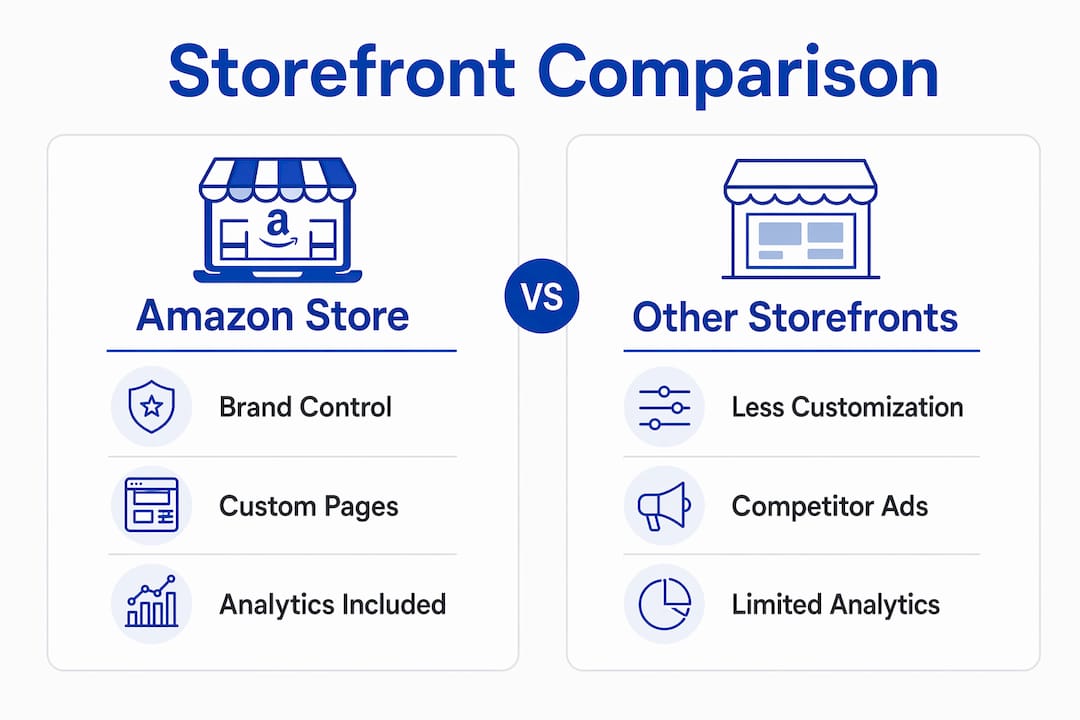
| Storefront type | Who can use it | Competitor ads present | Custom pages | Analytics |
|---|---|---|---|---|
| Amazon Brand Store | Brand Registry sellers | No | Yes, multi-page | Yes |
| Amazon Influencer storefront | Approved content creators | Yes | Limited | Basic |
| Standard product listing | All sellers | Yes | No | Basic |
The Amazon Influencer Program lets creators build a page of recommended products, but that page is not a brand-controlled space. It shows competitor ads, and the creator, not your brand, controls what appears there. A standard product listing page is even more exposed. Competitor Sponsored Products ads appear throughout, and you have no ability to tell your brand story beyond a title, bullets, and images.
An Amazon Brand Store functions more like a standalone website. You build multiple pages organized by product category, lifestyle theme, or customer need. A kitchenware brand, for example, might create separate pages for bakeware, cookware, and kitchen accessories, each with its own imagery and copy.
Brand Stores also integrate directly with Amazon Ads. Sponsored Brands campaigns can point traffic straight to your Store homepage or to a specific sub-page. That connection between paid traffic and a controlled brand environment is something no standard listing can replicate.
Pro Tip: Treat your Store’s navigation menu like a website’s top nav. Group products by how customers think, not by how your internal catalog is organized. Shoppers who find what they want faster convert at higher rates.
What are the requirements and steps to set up an Amazon Store?
Setting up a Brand Store requires two things: a Professional seller account and enrollment in Amazon Brand Registry. Creating a Brand Store is free, but the Professional selling account costs $39.99 per month as of april 2026. Brand Registry requires a registered or pending trademark for your brand. That trademark requirement is the step that stops most new sellers, so apply early.
Once you meet those requirements, the setup process follows these steps:
- Log into Seller Central and navigate to the Stores section under the “Brand” menu.
- Choose your brand from the Brand Registry-enrolled brands linked to your account.
- Select a Store template from Amazon’s pre-built options, including a marquee layout, product grid, or product highlight template.
- Build your pages by adding tiles for images, videos, text, product collections, and featured deals.
- Add a Store logo and brand header image that meet Amazon’s dimension requirements.
- Submit for review. Amazon typically approves new Stores within 72 hours.
The free setup is only part of the real cost. Quality lifestyle images, videos, and professional copywriting are what separate a Store that converts from one that sits idle. Sellers who invest in high-quality creative content see measurably better results. Agencies and freelance designers typically charge for this work, so budget for it from the start.
For a detailed walkthrough of the full process, Searchoneers covers every setup step for 2026, including account type decisions and Brand Registry tips.
Pro Tip: Before you build, map out your Store pages on paper. Decide how many pages you need, what products go on each, and what story each page tells. Building without a plan leads to a cluttered Store that confuses shoppers.
How do you optimize your Amazon Store for better sales and loyalty?
Most sellers make one critical mistake: they build the Store once and never touch it again. Stores updated within 90 days see 11% more repeat visitors and 13% higher sales per visitor compared to static Stores. That gap compounds over time. A Store you refresh quarterly performs significantly better than one you built a year ago and forgot.
Here are the core optimization practices that move the needle:
- Add Premium A+ Content. Premium A+ Content can lift conversion rates by up to 20%. It works because it reaches shoppers at the exact moment they are deciding whether to buy.
- Update seasonal content. Swap in holiday-specific imagery, gift bundles, and seasonal messaging every 60–90 days.
- Audit your navigation. Remove pages with low traffic. Consolidate products that perform better together.
- Use Store Insights. Check your traffic sources tab monthly. If most visitors come from Sponsored Brands, test organic social traffic to diversify.
- Tell a brand story on your homepage. A short video or lifestyle image sequence showing your product in use builds emotional connection faster than a product grid alone.
The analytics dashboard inside Brand Stores is underused by most sellers. It shows you attributed sales, page-level traffic, and source breakdowns. Pair that data with your Amazon analytics workflow and you have a clear picture of what is working and what needs fixing.
Searchoneers also covers Amazon Enhanced Brand Content in depth, including how Premium A+ Content integrates with your Store to drive conversions at every stage of the buyer journey.
Pro Tip: Set a calendar reminder every 60 days to review your Store’s top three pages. Check which tiles get the most clicks and move your best-selling products to the highest-visibility positions on each page.
Key Takeaways
An Amazon Brand Store is the single most effective way for registered brands to control the customer experience, eliminate competitor distractions, and drive measurably higher order values on Amazon.
| Point | Details |
|---|---|
| Brand Store definition | A free, multi-page branded storefront inside Amazon, available to Brand Registry sellers. |
| Sales impact | Store visitors purchase 53.9% more often and generate 71.3% higher average order values. |
| Setup requirements | A Professional seller account ($39.99/month) and an Amazon Brand Registry enrollment are both required. |
| Optimization cadence | Update Store content within 90 days to see 11% more repeat visitors and 13% higher sales per visitor. |
| Content investment | Quality images, video, and Premium A+ Content are what convert visitors into buyers. |
Why I think most sellers underestimate their Amazon Store
After working with dozens of Amazon sellers, I keep seeing the same pattern. A brand invests real effort into getting Brand Registry approved, builds a Store in a weekend, and then treats it like a checkbox. The Store goes live, looks decent, and then nothing changes for 18 months.
That approach leaves serious money on the table. The sellers I have seen grow fastest treat their Store the way a good marketing team treats a website. They test new page layouts. They swap in seasonal content. They run Sponsored Brands campaigns that point directly to the Store and then study the dwell time data to see what keeps shoppers engaged.
The other thing I notice is that small brands often skip video entirely because it feels expensive. That is a mistake. A 30-second lifestyle video on your Store homepage does more for brand trust than any amount of bullet points. Shoppers who watch a video are already more invested before they click “Add to Cart.”
One more thing worth saying plainly: an Amazon Store is not a replacement for your own website, but for most small businesses starting out, it is a faster path to revenue. You get Amazon’s traffic, Amazon’s trust, and Amazon’s checkout, all inside a branded environment you control. That combination is hard to beat when you are building from scratch.
The sellers who win in 2026 are the ones who treat their Store as a living asset, not a one-time project.
— Goga
How Searchoneers can support your Amazon Store growth
Building a Brand Store is the starting point, not the finish line. The sellers who see the biggest returns pair a strong Store with listings that are built to rank and convert.
Searchoneers specializes in exactly that combination. The listing enhancement guide walks you through every element of a high-converting product page, from titles and bullet points to backend keywords. The listing optimization workflow gives you a repeatable process to apply those improvements across your full catalog. When your Store drives traffic and your listings close the sale, that is when Amazon selling becomes genuinely profitable.
FAQ
What is an Amazon Store, exactly?
An Amazon Store, officially called an Amazon Brand Store, is a free multi-page branded storefront inside Amazon available to sellers enrolled in Brand Registry. It gives brands a custom URL, curated product pages, and a competitor-ad-free shopping environment.
Is an Amazon Store profitable?
Yes, Amazon Brand Stores are profitable for most registered brands. Store visitors generate 71.3% higher average order values and purchase 53.9% more frequently than shoppers who never visit a Store.
How much does it cost to set up an Amazon Store?
Creating a Brand Store is free, but it requires a Professional seller account, which costs $39.99 per month. Additional costs for professional design, photography, and copywriting are common and worth budgeting for.
How do you set up an Amazon Store?
You need a Professional seller account and Amazon Brand Registry enrollment. From Seller Central, navigate to Stores, choose a template, build your pages with images and product tiles, and submit for Amazon’s review, which typically takes up to 72 hours.
What is the difference between an Amazon Store and an Influencer storefront?
An Amazon Brand Store is controlled by the brand, has no competitor ads, and includes full multi-page customization with analytics. An Amazon Influencer storefront is controlled by a content creator, shows competitor ads, and offers limited customization.