TL;DR:
- The Amazon 1P model involves brands selling inventory directly to Amazon, which manages retail operations and customer service. It offers benefits like the “Ships from and sold by Amazon” badge but limits pricing control and involves risks like chargebacks and slow payments. Brands must actively monitor margins, enforce compliance, and consider hybrid strategies for better control and profitability.
Amazon 1P is a wholesale selling model where brands supply inventory directly to Amazon, which then retails those products to customers while controlling pricing, fulfillment, and customer service. Known formally as the Vendor Central model, 1P selling grants your products the coveted “Ships from and sold by Amazon” badge, which builds immediate shopper trust. The trade-off is real: you surrender pricing control, accept longer payment cycles, and absorb chargebacks that can quietly erode your margins. This guide breaks down the financial mechanics, operational demands, and strategic decisions every serious vendor needs to understand before committing to or continuing with a 1P seller account.
What is the 1P Amazon model and how does it work?
The 1P model on Amazon operates as a wholesale relationship. You receive purchase orders from Amazon through Vendor Central, fulfill them at a negotiated wholesale price, and Amazon handles everything downstream: listing presentation, retail pricing, customer service, and fulfillment. Your role shifts from retailer to supplier.

1P listings on Amazon carry the “Ships from and sold by Amazon” label, which consistently outperforms third-party listings in consumer trust metrics. That trust signal is the primary reason large brands accept the model’s constraints. The operational offload is also real: you are not managing individual customer orders, returns, or shipping logistics.
The catch is control. Amazon can override titles, suppress images, and discount prices without vendor approval. Your listing content is Amazon’s property, not yours. For brands that have invested heavily in product presentation and brand equity, this is a significant constraint that demands careful consideration before signing a vendor agreement.
What are the financial and operational trade-offs of 1P selling?
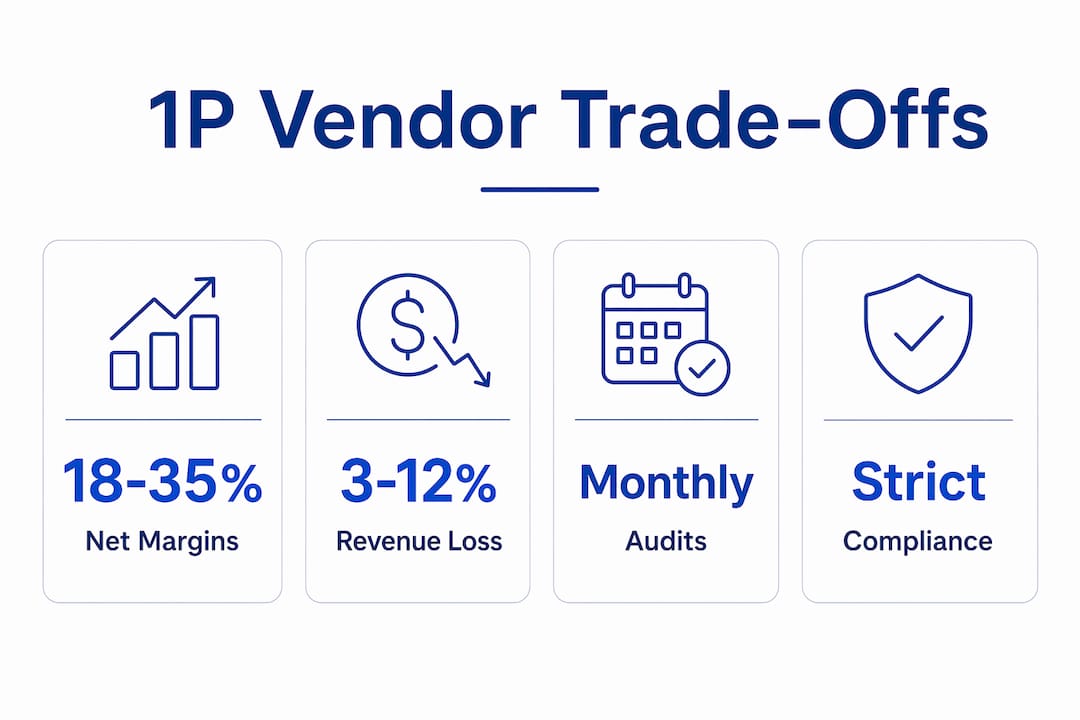
The margin math on 1P is the first thing you need to understand clearly. 1P vendors typically see net margins of 18–35% after wholesale price negotiation and deductions, compared to 25–45% for third-party sellers. That gap reflects the cost of convenience and scale.
The chargeback problem
Chargebacks are the single biggest margin threat most vendors underestimate. Chargebacks reduce revenue by 3–12% for 1P vendors, triggered by compliance failures like late shipments, incorrect labeling, or ASN (Advance Ship Notice) timing errors. These deductions are automated and often go uncontested, which means vendors who do not audit them regularly are simply leaving money on the table.
Cash flow and payment terms
1P vendors face payment terms of Net 60 to Net 90 days. For a brand shipping $500,000 in product monthly, that means roughly $1–1.5 million in receivables sitting unpaid at any given time. This working capital strain is a structural feature of the model, not an exception.
The operational requirements compound the financial pressure. Vendor Central demands strict EDI (Electronic Data Interchange) compliance, precise ASN timing, and specific packaging and labeling standards. Failure on any of these triggers chargebacks automatically. The system is not forgiving of manual processes or inconsistent supply chains.
- Wholesale price negotiation: Amazon negotiates hard on cost prices, often pushing vendors toward margins that leave little room for error.
- Co-op fees: Marketing contributions, freight allowances, and damage allowances are standard deductions that reduce your effective margin further.
- Chargeback categories: Common triggers include PO accuracy failures, carton content errors, and routing guide violations.
- Pricing control: Amazon sets the retail price and can discount aggressively, which affects your brand positioning and downstream channel pricing.
Pro Tip: Run a monthly chargeback reconciliation report in Vendor Central. Dispute every invalid deduction within the 30-day window. Vendors who do this consistently recover 2–5% of revenue that would otherwise be written off.
How has Amazon’s 1P vendor ecosystem shifted in 2026?
The 1P vendor ecosystem has undergone a structural shift since 2024. Amazon narrowed its vendor roster toward high-volume, operationally reliable suppliers, and SKU rationalization became a defining feature of vendor account management. Smaller brands felt this most acutely.
Here is what that shift looks like in practice for vendors today:
- Vendor invitations now require scale. Vendor Central invites generally require $5M or more in annual Amazon revenue or strategic category importance. Brands below that threshold are being migrated to Seller Central.
- SKU rationalization is ongoing. Amazon is actively pruning low-velocity SKUs from vendor catalogs. If a product does not move at sufficient volume, Amazon may stop issuing purchase orders for it entirely.
- Negotiation terms have tightened. Post-2024 vendor account closures signaled that Amazon is less willing to maintain unprofitable vendor relationships. Expect harder pushback on cost prices and co-op contributions.
- Operational compliance expectations have risen. Amazon’s automated systems flag compliance failures faster and with less tolerance than before. Vendors without internal compliance tracking systems are at a structural disadvantage.
- Enterprise-scale vendors gain preferential treatment. Brands with consistent supply chains, high sell-through rates, and strong category performance receive better support, more favorable terms, and priority in purchase order volume.
The practical implication is clear: if you want to maintain 1P status on Amazon, you need to operate with the discipline of a large supplier, regardless of your actual size. Build the systems before Amazon demands them.
What operational best practices do successful 1P vendors use?
Margin protection in the 1P model is an active discipline, not a passive outcome. The vendors who sustain healthy margins build internal systems that monitor, audit, and dispute financial leakage continuously.
Chargeback auditing and dispute management
Successful 1P vendors build monthly audit processes to review and dispute chargebacks. Margin erosion of 8–12% annually is common when these audits are neglected. Automation tools that pull Vendor Central data and flag anomalies reduce the manual workload significantly and improve dispute win rates.
Supply chain consistency
Amazon’s Retail Engine bases purchase orders on supply chain and sell-through consistency. Inconsistent supply triggers automated pricing changes and restricted visibility. This means your inventory reliability directly affects your organic ranking and purchase order volume. A stockout is not just a lost sale; it is a signal to Amazon’s algorithm that you are an unreliable supplier.
Hybrid 1P/3P models
Hybrid selling requires separating inventories by SKU or using distinct ASINs to prevent 1P and 3P listings from competing for the Buy Box. Done correctly, a hybrid model lets you run high-volume commodity SKUs through 1P while retaining pricing control on premium or differentiated products through Seller Central.
Here is a practical framework for operational best practices:
- Monthly margin reviews: Track net margin per SKU, accounting for co-op fees, chargebacks, and freight allowances.
- Compliance calendar: Map all EDI submission deadlines, ASN windows, and labeling requirements by PO.
- Dispute documentation: Maintain a dispute log with supporting evidence for every chargeback category you contest.
- Pricing monitoring: Even though Amazon controls retail pricing, track price movements to detect aggressive discounting that undermines your channel strategy.
- Negotiation records: Document all co-op fee agreements and vendor terms in writing to support future renegotiation.
Pro Tip: Schedule a quarterly business review with your Amazon vendor manager. Bring margin data, compliance metrics, and sell-through rates. Vendors who show up with data negotiate better terms than those who show up with complaints.
You can also use the Amazon pricing strategy guide from Searchoneers to understand how Amazon’s pricing mechanics interact with your wholesale cost structure.
When should you consider a hybrid or 3P strategy instead?
The 1P model suits large brands that value operational offload and Amazon’s retail capabilities. Most mid-market brands now prefer 3P for better margins and operational control, unless they have the vendor infrastructure to manage 1P complexities. The decision point is not arbitrary.
Signals that 3P or hybrid makes more sense
- Your annual Amazon revenue is below $20–25M, making it harder to absorb the fixed operational costs of Vendor Central compliance.
- Your product line includes premium or differentiated items where brand presentation and pricing control matter more than volume.
- Your cash flow cannot absorb Net 60–90 payment terms without straining operations.
- You want faster access to customer data and sales analytics, which Seller Central provides more directly.
- Amazon has reduced purchase order frequency for your SKUs, signaling low priority in their vendor roster.
How hybrid models work in practice
A practical hybrid approach assigns your highest-volume, lowest-differentiation SKUs to 1P and routes premium or newer products through a Seller Central account. This captures the trust signal and fulfillment efficiency of 1P where it matters most, while preserving pricing control and margin on products where brand equity is the primary value driver.
The risk in hybrid models is Buy Box cannibalization. If the same ASIN appears in both 1P and 3P channels, Amazon’s algorithm will favor the 1P listing, effectively undercutting your 3P price. Using distinct ASINs or tightly controlling channel inventory prevents this conflict. For a broader view of how to structure your selling approach, the 2026 seller strategy guide from Searchoneers covers channel segmentation in detail.
Brands that learn how to sell on Amazon across both models consistently report better overall margin performance than those locked into a single channel.
Key Takeaways
The 1P Amazon model delivers scale and trust signals but demands active margin management, strict compliance systems, and a clear-eyed view of when 3P or hybrid selling better serves your brand’s financial goals.
| Point | Details |
|---|---|
| Margins are lower in 1P | Net margins of 18–35% are typical, versus 25–45% for third-party sellers. |
| Chargebacks erode revenue fast | Uncontested chargebacks reduce revenue by 3–12%; monthly audits are non-negotiable. |
| Cash flow requires planning | Net 60–90 payment terms tie up significant working capital for active vendors. |
| Amazon controls your listings | Titles, images, and pricing can be changed by Amazon without vendor approval. |
| Hybrid models need ASIN separation | Distinct ASINs or inventory controls prevent Buy Box cannibalization across channels. |
Why the “hands-off” myth about 1P costs vendors real money
The most persistent misconception I encounter about the 1P model is that it is passive. Brands sign a vendor agreement, ship product, and collect checks. That framing is how vendors end up with 8–12% annual margin erosion they cannot explain.
The reality is that 1P requires more internal discipline than 3P in several ways. You do not control pricing or content, which means your only lever for profitability is cost management, compliance, and negotiation. Vendors who invest in internal margin monitoring systems, even simple monthly spreadsheet reviews of chargebacks and co-op fees, consistently outperform those who treat Vendor Central as a set-and-forget channel.
The other thing I have seen repeatedly is brands staying in 1P out of inertia rather than strategy. The “Ships from and sold by Amazon” badge feels like validation, and it is. But that badge does not pay your bills if your net margin is 15% and your payment terms are Net 90. Evaluate your 1P relationship the same way you would evaluate any wholesale account: on margin, cash flow, and strategic fit.
My honest advice for 2026 is to treat your Amazon vendor relationship as a negotiation that never ends. Bring data to every conversation. Document every agreement. And if your margins are consistently below 20% after chargebacks and co-op fees, run the numbers on a hybrid or full 3P transition before Amazon makes the decision for you.
— Goga
How Searchoneers helps 1P and hybrid sellers protect their margins
The financial pressure of 1P selling does not stop at chargebacks and payment terms. Listing quality directly affects sell-through rates, and sell-through rates directly affect how Amazon treats your vendor account.

Searchoneers specializes in Amazon listing optimization that improves visibility and conversion for both 1P and hybrid sellers. Strong titles, precise bullet points, and well-structured backend keywords increase your sell-through velocity, which signals reliability to Amazon’s ordering algorithm. Better sell-through means more consistent purchase orders and stronger negotiating leverage. The listing optimization workflow from Searchoneers gives you a repeatable process for keeping your content sharp across every SKU in your catalog.
FAQ
What is a 1P seller account on Amazon?
A 1P seller account, formally called Vendor Central, is an invitation-only wholesale model where brands sell inventory directly to Amazon at a negotiated price, and Amazon retails the products to customers.
What is the difference between 1P and 3P Amazon?
In 1P, Amazon buys your inventory wholesale and controls pricing, fulfillment, and customer service. In 3P, you sell directly to customers through Seller Central and retain control over pricing, content, and fulfillment.
How do chargebacks affect 1P vendors?
Chargebacks from compliance failures like late shipments or labeling errors reduce 1P vendor revenue by 3–12%. Monthly audits and timely disputes are the most effective way to recover those deductions.
Can you sell both 1P and 3P on Amazon at the same time?
Yes, a hybrid model is possible and increasingly common. Successful hybrid sellers use distinct ASINs or separate inventory pools to prevent 1P and 3P listings from competing for the same Buy Box.
How do you qualify to sell 1P on Amazon?
Amazon typically requires $5M or more in annual Amazon revenue or strategic category importance before extending a Vendor Central invitation. Smaller brands are generally directed to Seller Central instead.