

TL;DR:
- Amazon’s dynamic pricing adjusts roughly 2.5 million prices daily by AI algorithms, emphasizing competitive pricing over profit maximization. Sellers must monitor market signals, set price floors and ceilings, and focus on listing quality and value signals to succeed. Fulfillment methods influence pricing power and Buy Box ownership, with FBA offering advantages like trust and higher price flexibility.
The pricing strategy of Amazon is defined as a real-time dynamic pricing system that adjusts roughly 2.5 million prices daily across its marketplace. That number is not a rounding error. It reflects a deliberate philosophy: competitive pricing beats simple profit maximization every time. Amazon’s 365-day price history feature keeps that philosophy visible to every shopper. For sellers, understanding how Amazon determines prices is not optional. It is the foundation of every profitable decision you make on the platform.
How does Amazon’s dynamic pricing model work?
Dynamic pricing, also called algorithmic price adjustment, is the practice of changing product prices automatically based on real-time market signals. Amazon runs this at a scale no human team could match. Its $200 billion AI infrastructure investment in 2026 powers the algorithms that scan competitor prices, demand shifts, inventory levels, and seasonal trends simultaneously. The result is a marketplace where prices move like a live auction, not a static catalog.
Here is what actually triggers a price change on Amazon:
- Competitor price drops. When a rival listing drops its price, Amazon’s algorithm detects it within minutes and may adjust its own price or suppress your Buy Box eligibility.
- Demand spikes. High search volume or sudden sales velocity increases signal the algorithm to test higher price points.
- Inventory levels. Low stock on a competing ASIN often triggers upward price movement across similar listings.
- Time of day and seasonality. Prices on high-demand categories shift during peak shopping hours and around major retail events.
- Fulfillment method. FBA listings receive algorithmic preference, which affects the price point needed to win the Buy Box.
The practical implication for you is clear. Prices you set today may be undercut or outpaced by tomorrow morning. Sellers who treat their price as a fixed number lose ground fast.
Pro Tip: Set up automated price monitoring alerts using your seller dashboard or a reputable repricing tool. Check Buy Box ownership daily, not weekly. A 24-hour lag in response costs real revenue.

What pricing tactics work within Amazon’s competitive model?
Amazon’s pricing philosophy intentionally makes lowering prices easier than raising them to protect long-term customer trust. That asymmetry shapes every tactic you should use. The goal is not to be the cheapest seller. The goal is to be the most credible seller at a price the algorithm rewards.
Treat pricing as a data science problem, not a gut-feel exercise. Analyzing competitor price-to-rating ratios reveals where rivals are vulnerable. A competitor charging $34.99 with a 3.2-star rating is not your real competition. A seller at $39.99 with 4.6 stars and 2,000 reviews is. Price against quality signals, not just dollar amounts.
Here are five tactics that align with how Amazon’s marketplace actually operates:
- Set price floors and ceilings before you automate anything. Strict price floors and ceilings are the single most effective safeguard against automated pricing errors. Without them, a repricing tool can race your price to zero overnight.
- Use loss-leader pricing in high-visibility categories. Amazon itself built its early dominance through loss-leader pricing in books and electronics. For sellers, this means pricing one SKU aggressively to drive traffic to your full catalog, not to make margin on that item alone.
- Analyze sales velocity before cutting price. A slow sales rank does not always mean your price is too high. Check whether your images, title, and reviews are the real bottleneck first. Cutting price when the listing is the problem wastes margin without fixing the cause.
- Monitor price elasticity in your niche. Tracking sales velocity relative to price changes tells you exactly how sensitive your buyers are to price movement. Some categories tolerate a $5 increase with no sales drop. Others collapse at $1.
- Compete on value signals, not price alone. Strong reviews, A+ Content, and a well-optimized listing let you hold a higher price point. Sellers who invest in data-driven listing optimization consistently outperform those who rely on price cuts alone.
Pro Tip: Before running any price promotion, calculate your break-even unit economics including FBA fees, COGS, and ad spend. A price that looks competitive on the surface can destroy profitability once fees are factored in.
How does Amazon’s fulfillment model affect pricing power?
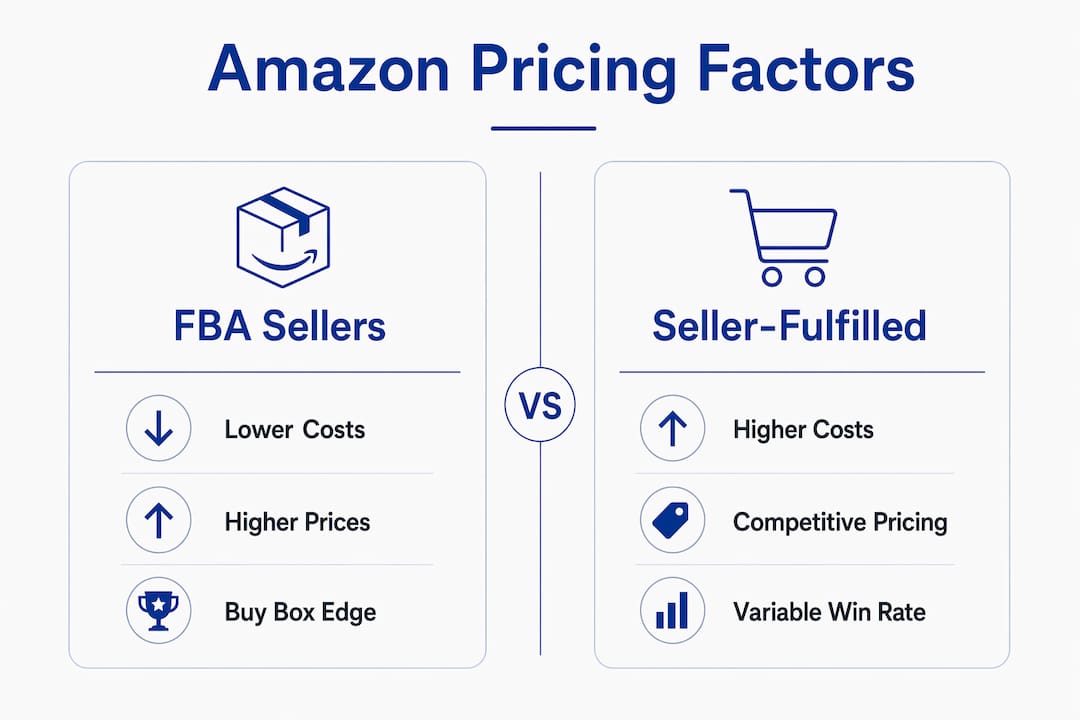
Amazon CEO Andy Jassy identifies reducing the cost-to-serve as the core mechanism behind sustainable low prices through fulfillment innovation. This is not just a corporate talking point. It is a structural advantage that directly affects what price you need to compete at.
Amazon’s regionalized fulfillment network places inventory closer to buyers, cutting delivery miles and shipping costs. That cost reduction flows into lower prices without sacrificing margin at the platform level. For third-party sellers using FBA, this creates a real opportunity. Your products benefit from the same fast, low-cost delivery infrastructure that Amazon uses for its own inventory.
The table below shows how fulfillment method affects the key pricing variables sellers control:
| Fulfillment factor | FBA advantage | Seller-fulfilled impact |
|---|---|---|
| Shipping cost per unit | Lower due to Amazon’s carrier rates | Higher, seller absorbs full cost |
| Buy Box eligibility | Strong algorithmic preference | Requires price offset to compete |
| Delivery speed | Prime-eligible, 1–2 days | Variable, often 3–5 days |
| Customer trust signal | Prime badge increases conversion | No Prime badge, lower CTR |
| Pricing flexibility | Can hold higher price with Prime | Must price lower to offset trust gap |
The takeaway is direct. FBA sellers can price higher than seller-fulfilled competitors and still win the Buy Box. That pricing flexibility is a structural advantage worth paying for in most categories. Use your competitor analysis workflow to confirm whether FBA or seller-fulfilled rivals dominate your niche before setting your price strategy.
How does pricing affect Buy Box ownership and profitability?
The Buy Box is not awarded to the lowest price. Amazon’s algorithm weighs price alongside fulfillment method, seller metrics, shipping speed, and account health. Price is the most visible factor, but it is not the only one. Sellers who understand this stop racing to the bottom and start competing on the full scorecard.
The factors that influence Buy Box eligibility beyond price include:
- Order defect rate. Sellers with rates above 1% lose Buy Box eligibility regardless of price.
- Fulfillment method. FBA listings receive a significant algorithmic advantage over merchant-fulfilled at the same price.
- Shipping time. Faster promised delivery improves Buy Box share even at a slightly higher price.
- Seller feedback score. A score above 95% is the threshold where price becomes the primary differentiator.
- In-stock rate. Stockouts immediately remove you from Buy Box contention. Inventory management and pricing are inseparable.
The most effective approach to Buy Box ownership is to price at or just below the featured offer price while maintaining strong seller metrics. A repricing strategy built on the e-commerce pricing strategies framework gives you a structured way to do this without constant manual intervention. Pair your pricing decisions with regular review of your sales velocity data. When velocity drops after a price increase, you have found your ceiling. When it holds steady, you have room to test higher.
Key takeaways
Amazon’s pricing strategy is a data-driven, algorithmic system where competitive positioning, fulfillment efficiency, and seller metrics determine profitability far more than price cuts alone.
| Point | Details |
|---|---|
| Dynamic pricing scale | Amazon adjusts roughly 2.5 million prices daily, requiring sellers to monitor and respond continuously. |
| Price floors and ceilings | Set hard limits before automating any repricing to prevent margin-destroying errors. |
| FBA pricing advantage | FBA sellers can hold higher prices and still win the Buy Box due to Prime eligibility and trust signals. |
| Buy Box beyond price | Order defect rate, fulfillment speed, and seller feedback score all influence Buy Box ownership alongside price. |
| Value signals over discounts | Strong reviews and optimized listings let sellers maintain higher prices without losing conversion rates. |
Pricing strategy lessons I learned the hard way
The most common mistake I see sellers make is treating Amazon’s marketplace like a race. They see a competitor drop to $18.99 and immediately match it. Two weeks later, both sellers are at $16.50 and neither is profitable. That is not a pricing strategy. That is a slow margin bleed.
What actually works is treating your price as one variable in a system. Your listing quality, your review velocity, your fulfillment method, and your inventory health all interact with price. I have watched sellers hold a $4 premium over the field simply because their listing was better. Their images were cleaner, their bullet points answered the real buyer question, and their review count gave shoppers confidence. Price became almost irrelevant.
The other lesson is about the asymmetry Amazon builds into its own pricing philosophy. Amazon makes it easier to lower prices than to raise them because customer trust is built on the expectation of fair pricing. As a seller, you should internalize that same logic. Raise prices slowly and test. Drop prices only when you have data that says it will move the needle. And never, ever let a repricing tool run without guardrails.
The future of Amazon pricing will be shaped by AI at a scale we are only beginning to see. The $200 billion AI investment powering Amazon’s 2026 pricing algorithms will make manual repricing increasingly obsolete. Sellers who build systems now, with proper floors, ceilings, and data feedback loops, will be positioned to adapt. Those who rely on intuition alone will find the gap widening fast.
— Goga
How Searchoneers helps sellers price and rank with confidence
Pricing without listing quality is a losing equation. A competitive price gets you the click. A well-built listing closes the sale.

Searchoneers specializes in the listing side of that equation. The Amazon Listing Enhancement Guide walks you through title structure, bullet point strategy, and backend keyword placement so your listing converts at the price you set. The Listing Optimization Workflow gives you a repeatable process to audit and improve every ASIN in your catalog. When your listing earns trust, your price earns margin. That is the combination that builds a sustainable Amazon business.
FAQ
What is Amazon’s pricing strategy called?
Amazon uses dynamic pricing, also called algorithmic price adjustment. The system updates roughly 2.5 million prices daily based on competitor data, demand signals, and inventory levels.
How does Amazon determine prices for its products?
Amazon’s algorithm factors in competitor prices, sales velocity, inventory availability, fulfillment method, and historical demand. AI infrastructure processes these signals in real time to set the most competitive price at any given moment.
Does the lowest price always win the Buy Box?
No. The Buy Box algorithm weighs fulfillment method, seller feedback score, shipping speed, and order defect rate alongside price. FBA sellers often win the Buy Box at a higher price than merchant-fulfilled competitors.
What are price floors and ceilings in Amazon repricing?
Price floors set the minimum price your repricing tool will go to, and ceilings set the maximum. They act as guardrails that prevent automated pricing errors from destroying your margins during algorithm-driven price swings.
How can sellers avoid price wars on Amazon?
Sellers avoid price wars by competing on value signals such as review count, listing quality, and fulfillment speed rather than price alone. Monitoring price elasticity in your niche tells you exactly how much pricing room you have before sales volume drops.

Leave a Reply