TL;DR:
- Amazon Lightning Deals are limited-time discounts on products that operate on short durations and quantity caps. To secure a deal, shoppers must add the item within 15 minutes and complete checkout quickly, often leading to missed opportunities. Many deals are not genuine savings, as prices may be inflated beforehand, so checking price history is essential for confirming real bargains.
Amazon Lightning Deals are time-limited promotional discounts on select products, designed to offer real savings to shoppers who act within a short window. These flash sales appear on Amazon’s Today’s Deals page and run with visible countdown timers and claimed progress bars, creating genuine urgency. Unlike standard Amazon daily deals, a Lightning Deal can sell out before the clock runs down. Knowing how they work, when to find them, and how to spot a real bargain versus a marketing trick separates shoppers who save big from those who just feel like they did.
How do Amazon Lightning Deals work?
Lightning Deals operate on two limits at once: time and quantity. Most deals run between 4 and 12 hours, with a countdown timer displayed on the product page. That timer creates pressure, but the quantity cap is often what ends the deal first.
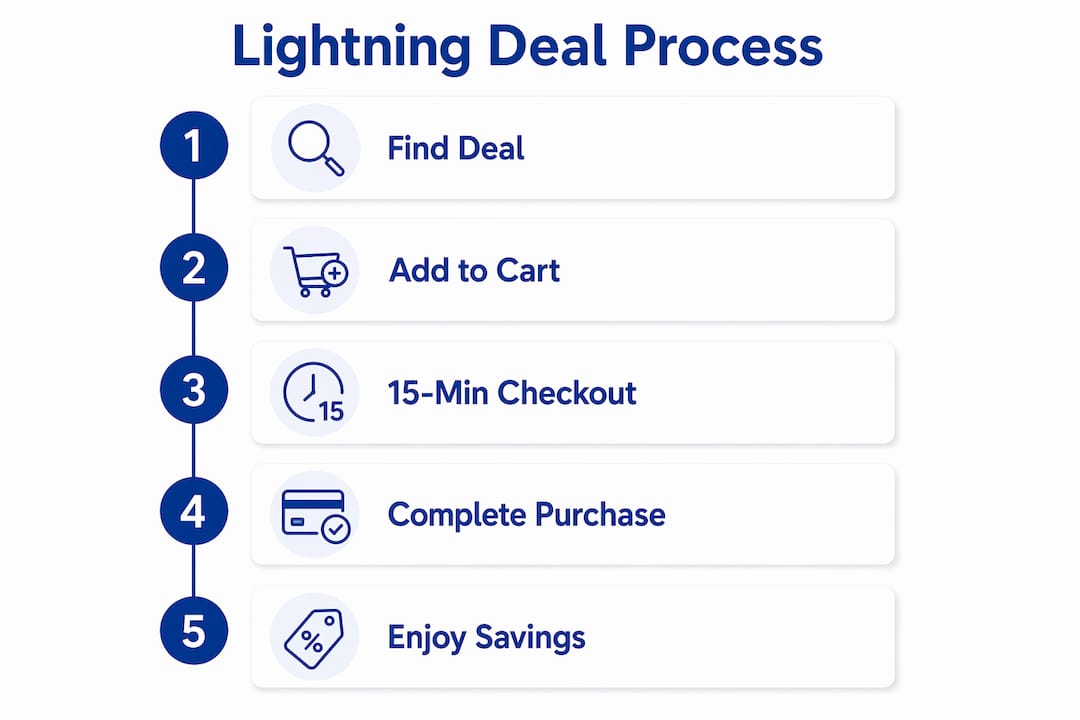
Here is the step-by-step process every shopper needs to know:
- Find the deal. Go to Amazon’s Today’s Deals page and look for the Lightning bolt icon next to a product listing.
- Add to cart immediately. Clicking “Add to Cart” reserves your unit and locks in the discounted price.
- Check out within 15 minutes. You must complete checkout within 15 minutes after adding the item. Miss that window and the price reverts to normal, even though the item stays in your cart.
- Watch for the waitlist. If a deal appears fully claimed, you can join a waitlist. Units return to available inventory when other shoppers miss the 15-minute checkout window.
- Check Prime eligibility. During major events like Prime Day 2026 (june 23–26), Prime members received 30-minute early access to many Lightning Deals before general shoppers could see them.
The 15-minute rule catches a lot of shoppers off guard. You add the item, get distracted, and return to find the deal price gone. That is not a glitch. It is by design.
Pro Tip: Set a phone timer the moment you add a Lightning Deal item to your cart. Fifteen minutes passes faster than you think, especially during high-traffic events like Prime Day or Black Friday.

During major sales events, deal volume spikes and competition for units intensifies. Planning your Amazon sales event timing in advance gives you a real edge over shoppers who browse casually.
What makes a Lightning Deal genuine?
Not every Lightning Deal is the bargain it appears to be. Amazon requires products to meet specific standards before they qualify. Products must carry a minimum 3-star rating, be in new condition, and be Prime eligible. Those requirements filter out low-quality listings, but they do not guarantee the discount is real.
The bigger issue is list price inflation. Sellers set their own list prices on Amazon, and those prices may be artificially high. A product listed at $100 with a “50% off” Lightning Deal badge may have sold for $55 routinely for the past three months. The discount looks dramatic but the actual savings are modest.
Before you buy any Lightning Deal, check the product’s price history using a browser extension or third-party price tracking tool. The real question is not “how much off the list price?” but “how much off the price I would normally pay?”
The claimed progress bar adds another layer of complexity. The bar shows units added to carts, not units actually purchased. A deal showing 80% claimed may have plenty of inventory returning as shoppers miss checkout deadlines. High claimed percentages create urgency, but they do not always reflect true scarcity.
Here is what to watch for when evaluating deal quality:
- 3-star minimum rating: Amazon’s baseline requirement protects against junk products, but always read recent reviews before buying.
- Price history check: Compare the deal price to what the product sold for over the past 30–90 days.
- Claimed bar context: Amazon does not disclose total units per deal, so 50% claimed could mean 5 units or 500 units depending on inventory size.
- Inflated MSRP: Watch for list prices that appear suspiciously high relative to similar products in the same category.
- Category norms: Electronics and kitchen appliances see the most genuine Lightning Deals. Fashion and accessories see more inflated list price tactics.
Expert guidance confirms that verifying price history before buying is the single most effective way to avoid impulse purchases driven by artificial urgency. Discipline here is the difference between a real win and a regret.
When and where to find Lightning Deals on Amazon
Amazon’s Today’s Deals page is the central hub for all active and upcoming flash sales. You can reach it directly from the Amazon homepage navigation bar. The page refreshes constantly as deals go live and expire throughout the day.
Filtering makes the page far more useful. Using the “Discount: High to Low” filter surfaces the steepest discounts first, saving you from scrolling through modest 10% offers to find the real deals. You can also filter by category, Prime eligibility, and deal type.
| Where to look | What you find |
|---|---|
| Amazon Today’s Deals page | All active Lightning Deals and daily deals in one place |
| “Discount: High to Low” filter | Steepest percentage discounts sorted to the top |
| Deals preview / sneak peek | Upcoming deals visible hours before they go live |
| Prime Day dedicated page | Exclusive member-only deals during the june 23–26, 2026 event |
| Waitlist feature | Access to deals that appear sold out but may reopen |
Sneak peek pages are underused by most shoppers. Amazon often shows upcoming Lightning Deals hours before they activate. Checking the preview page the night before a major sale event lets you plan which deals to target and set reminders.
The Amazon holiday calendar follows predictable patterns. Lightning Deals peak during Prime Day, Black Friday, Cyber Monday, and the pre-holiday period in october and november. Knowing these windows lets you hold off on purchases and wait for the deal version of a product you already want.
Practical strategies for maximizing your Lightning Deal success
Speed matters, but speed without preparation leads to bad purchases. The shoppers who consistently win Lightning Deals combine fast action with prior research.
- Build a wish list before sale events. Add products you genuinely want to your Amazon wish list weeks before Prime Day or Black Friday. When a Lightning Deal activates on one of those items, you already know the normal price and can judge the deal instantly.
- Verify price history first. Use a price tracking tool to check 90-day price history before committing. A deal that looks like 40% off may be 10% off the real market price.
- Act fast, then checkout faster. Add the item to your cart the moment you see the deal. Then go straight to checkout. Do not browse other deals first.
- Reset the cart if you miss the window. Deleting the item from your cart and re-adding it can restore the deal price if the deal is still active and units remain. This trick works because removing the item releases your reserved unit back to inventory, and re-adding it starts a fresh 15-minute window.
- Join the waitlist without hesitation. A fully claimed deal is not a dead end. Waitlisted shoppers frequently get access as checkout windows expire across the board.
- Use Prime membership strategically. During Prime Day 2026, Prime members got early access to many deals. That 30-minute head start is often the difference between securing a popular item and missing it entirely.
Pro Tip: During high-traffic events, Amazon’s checkout can slow down. Pre-save your shipping address and payment method so you can complete the 15-minute window in under two minutes.
Recognizing deal patterns across events also pays off. Electronics deals tend to hit hardest on the first day of Prime Day. Home goods and kitchen items peak on day two. Toys and games dominate the Black Friday window. Knowing the category rhythm helps you prioritize your time.
Protecting yourself from scam sellers matters too. Spotting and avoiding suspicious Amazon sellers is especially relevant during high-volume sale events when bad actors try to exploit deal traffic.
Key Takeaways
Lightning Deals reward shoppers who combine speed with price research, Prime membership, and knowledge of Amazon’s checkout rules.
| Point | Details |
|---|---|
| 15-minute checkout rule | Add to cart and complete purchase within 15 minutes or the deal price disappears. |
| Claimed bar is not a sellout signal | High claimed percentages reflect cart additions, not confirmed purchases. |
| List prices can be inflated | Always check 90-day price history to confirm the deal reflects real savings. |
| Prime membership unlocks early access | Prime members get 30-minute early access to many deals during events like Prime Day. |
| Cart reset can recover a missed deal | Deleting and re-adding an item can restore the deal price if the deal is still active. |
Why I think most shoppers misread Lightning Deals entirely
The claimed progress bar is the most misunderstood feature on Amazon. Shoppers treat a bar at 85% as a near-sellout alarm. They rush, skip price checks, and buy things they did not plan to buy. That is exactly the response the design is built to trigger.
Here is what I have observed after watching deal patterns across multiple Prime Day and Black Friday cycles: the urgency is real, but the scarcity is often manufactured. Amazon does not publish unit counts. A bar at 70% claimed on a product with 10,000 units allocated looks identical to one with 50 units. You cannot tell the difference from the interface.
The shoppers who come out ahead treat Lightning Deals like a tool, not a race. They pre-research products, know their target price, and only pull the trigger when the deal clears their threshold. They also know the cart reset trick, which alone has saved me from missing deals I wanted after getting pulled away mid-checkout.
The psychological design of these promotions is genuinely clever. Countdown timers, progress bars, and “limited quantity” labels all compress decision-making time. Knowing that mechanism exists does not make you immune to it, but it does give you a half-second pause to ask: “Did I want this before I saw the timer?” That question is worth more than any deal-finding tool.
— Goga
How Searchoneers helps sellers win with better Amazon listings
If you are a seller, the deal is only as good as the listing behind it. A Lightning Deal drives traffic to your product page fast. If your title, bullet points, and images do not convert that traffic, the deal burns through your inventory without the sales velocity you need.

Searchoneers specializes in Amazon listing enhancement that prepares your product pages for exactly this kind of high-traffic moment. From keyword-rich titles to backend search terms, every element of your listing affects whether deal shoppers click, read, and buy. Searchoneers also offers a step-by-step listing optimization workflow built for sellers who want to maximize conversion during sale events. When your listing is ready, a Lightning Deal becomes a growth engine, not just a discount.
FAQ
What is an Amazon Lightning Deal?
An Amazon Lightning Deal is a short-term, limited-quantity discount on a specific product, available on the Today’s Deals page until the time runs out or inventory sells through.
How long do Lightning Deals last?
Most Lightning Deals run between 4 and 12 hours, with a visible countdown timer. Some deals during major events like Prime Day may run shorter windows.
What happens if I miss the 15-minute checkout window?
The deal price reverts to the standard price, but the item stays in your cart. Deleting the item and re-adding it can sometimes restore the discounted price if the deal is still active.
Are Lightning Deals always genuine discounts?
Not always. Sellers set their own list prices, which can be inflated. Always check the product’s 90-day price history to confirm the deal reflects a real reduction from the typical selling price.
Do you need Prime to access Lightning Deals?
Most Lightning Deals are open to all shoppers, but during events like Prime Day 2026, Prime members received 30-minute early access to many deals before general shoppers could see them.