TL;DR:
- The Amazon conversion blue badge recognizes listings with consistent, high conversion rates and customer satisfaction. It enhances visibility and strengthens Amazon’s ranking signals, influencing sales and organic reach. Achieving the badge depends on optimizing listing quality, maintaining inventory, and fostering positive reviews.
The amazon conversion blue badge is a product label Amazon assigns to listings that demonstrate strong, consistent conversion performance. It signals to shoppers that a product reliably turns browsers into buyers. Unlike badges tied purely to sales volume, this badge rewards conversion reliability, customer satisfaction, and listing quality. For sellers, earning it means more visibility, stronger click-through rates (CTR), and a meaningful edge in Amazon’s A10 algorithm. This guide breaks down exactly what it takes to earn the badge, how it compares to other Amazon product badges, and the practical steps you can take right now.
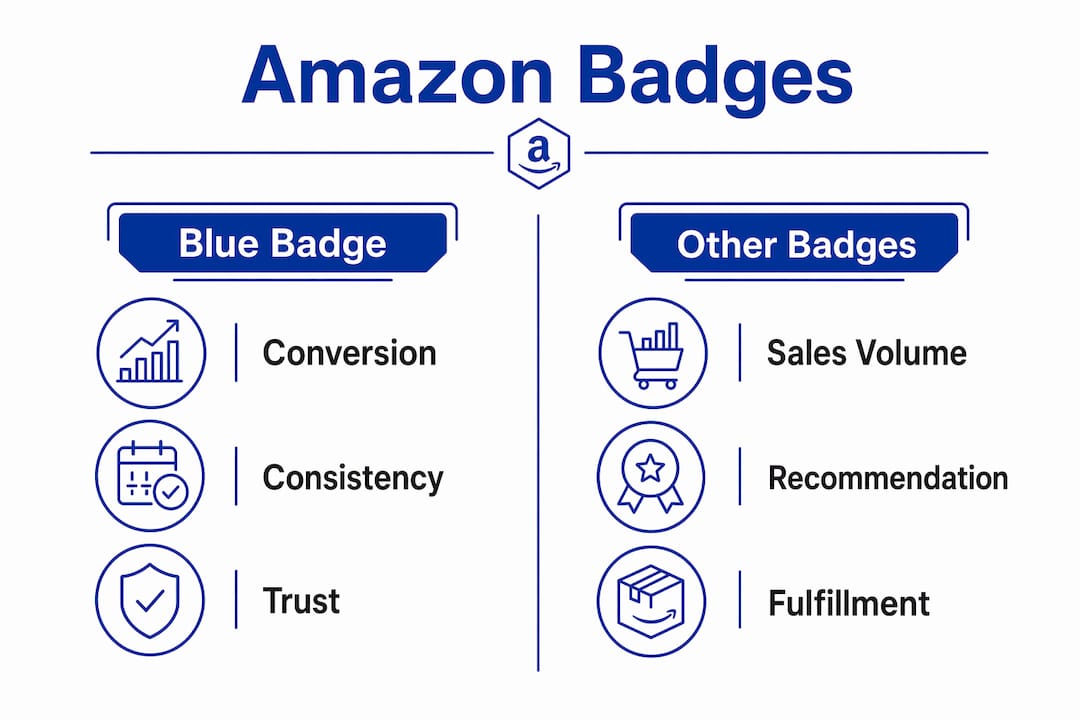
What qualifies a product for the Amazon conversion blue badge?
The blue badge is awarded algorithmically. Amazon does not publish an official checklist, but the performance signals that drive eligibility are well understood by experienced sellers.
The core factors include:
- Conversion rate (CVR): This is the primary signal. Your listing must convert at a rate that outperforms category averages. A high CVR tells Amazon’s algorithm that shoppers find your product relevant and compelling.
- Review count and rating: Maintaining at least 30 positive reviews and an average rating of 4.3 stars or higher is the standard threshold for badge consideration. Fewer reviews or a lower rating significantly reduces eligibility.
- Prime eligibility: Fulfillment by Amazon (FBA) or Seller Fulfilled Prime (SFP) status is a strong qualifier. Prime badge status boosts conversion among Prime members to 74% compared to 13% for non-Prime listings. That 5.7x difference directly affects your CVR signal.
- Inventory consistency: Stockouts reset your performance history. Amazon’s algorithm evaluates recent inventory availability as part of badge eligibility.
- Competitive pricing: Your price must be competitive within your category. Overpriced listings see lower CVR, which hurts badge eligibility.
- Low return rates: Amazon’s Choice rewards consistent conversion, low return rates, and customer satisfaction rather than raw sales volume. The blue badge follows the same logic.
Pro Tip: Badge status can change within 24–48 hours based on seller performance metrics. Monitor your CVR and inventory daily, not weekly.
Amazon’s algorithm also uses lookback periods of 3, 7, 15, 30, and up to 365 days to assess product relevance. Recent sales velocity and conversion rates carry more weight than older data. This means a short burst of strong performance can accelerate badge eligibility, but a dip in any metric can remove it just as fast.

How does the blue badge differ from other Amazon badges?
Sellers often confuse the conversion blue badge with Amazon’s Choice, Best Seller, and Prime badges. Each badge serves a different purpose and rewards different behaviors.
| Badge | Color | Primary Signal | Awarded Based On |
|---|---|---|---|
| Conversion blue badge | Blue | Conversion reliability | CVR, ratings, listing quality |
| Amazon’s Choice | Black | Recommendation reliability | Consistent conversion, low returns, satisfaction |
| Best Seller | Orange | Sales volume | Units sold in category |
| Prime badge | Blue/Prime | Fulfillment speed | FBA or SFP enrollment |
The orange Best Seller badge is determined by sales volume, not conversion quality. A product can rank as a Best Seller through heavy discounting or advertising spend without ever earning the conversion badge. The conversion blue badge reflects a deeper trust signal. It tells shoppers this product consistently satisfies buyers, not just that it sells a lot of units.
Amazon’s Choice (black badge) is the closest relative to the blue badge. Both reward recommendation reliability rather than just sales volume, focusing on consistent conversion and customer satisfaction. The key difference is that Amazon’s Choice is often tied to specific keyword searches, while the conversion blue badge applies to the listing’s overall performance profile.
The Prime badge, while also blue, signals fulfillment speed and availability. It is a prerequisite for strong CVR, not a badge that reflects conversion performance itself. Think of Prime eligibility as the foundation. The conversion blue badge is the reward for building well on top of it.
What steps can sellers take to earn the blue badge?
Earning the badge is not a single action. It is the result of consistent execution across your listing, fulfillment, pricing, and review strategy.
Optimize your product listing for conversion. Write titles that match high-intent search queries. Use bullet points to address buyer objections directly. Professional product images drive CTR and CVR improvements that feed badge eligibility. A listing that looks polished and answers buyer questions converts at a higher rate.
Enroll in FBA or SFP. Prime eligibility is non-negotiable for serious badge contenders. FBA removes fulfillment friction and signals trust to both shoppers and Amazon’s algorithm. Use the conversion rate checklist from Searchoneers to audit your listing before enrolling.
Build your review base ethically. Use Amazon’s “Request a Review” button and include product inserts that encourage honest feedback. Both tactics are Amazon-compliant and proven to increase review counts. Aim for 30+ reviews with a 4.3-star average before expecting badge consideration.
Protect your inventory levels. Set reorder alerts well before you hit low stock. A stockout resets your recent performance data and can remove badge status overnight. Use the inventory optimization guide at Searchoneers to build a reliable restocking system.
Price competitively within your category. Monitor competitor pricing weekly. You do not need to be the cheapest option, but your price must sit within a range that shoppers consider fair. Overpriced listings suppress CVR and push badge eligibility out of reach.
Monitor your CVR through Seller Central. Track your unit session percentage (the CVR metric Amazon uses internally) weekly. A rate below category average signals a listing problem, not a traffic problem.
Pro Tip: Backend keywords directly affect search relevance, which drives qualified traffic to your listing. Qualified traffic converts at a higher rate, which feeds your CVR signal. Treat backend keyword optimization as a CVR tactic, not just an SEO task.
How does the badge impact sales performance and Amazon’s algorithm?
The badge creates a compounding effect. Earning it improves visibility, which drives more traffic, which generates more conversions, which reinforces badge status.
Products with Amazon’s Choice badge see 40–50% higher click-through rates and 30–35% better conversion rates. The conversion blue badge operates on the same trust mechanics. Shoppers who see a badge on a listing interpret it as a third-party endorsement from Amazon itself. That perception reduces purchase hesitation and shortens the decision cycle.
The algorithm benefits are equally significant:
- Higher organic ranking: Amazon’s A10 algorithm rewards listings with strong CVR by ranking them higher in search results. The badge is both a symptom and a cause of better ranking.
- Buy Box advantage: Consistent CVR, competitive pricing, and Prime eligibility are the same factors that determine Buy Box ownership. Badge-eligible listings are almost always Buy Box contenders.
- Sustained visibility: Unlike paid advertising, which stops the moment you stop spending, badge-driven visibility compounds over time. A listing that holds its badge for 60+ days builds a performance history that is hard for competitors to displace.
- Reduced reliance on PPC: Sellers with badge status often report lower advertising cost of sale (ACoS) because organic traffic converts at a higher rate, reducing the need to buy every click.
The badge also functions as a trust signal that reduces purchase friction. Shoppers on Amazon make fast decisions. A visible badge answers the question “Is this product worth buying?” before the shopper even reads the title.
Key Takeaways
The Amazon conversion blue badge rewards consistent CVR, strong ratings, Prime eligibility, and listing quality. It is not awarded for sales volume alone.
| Point | Details |
|---|---|
| CVR is the primary signal | Your listing must convert above category average to qualify for badge consideration. |
| 30+ reviews at 4.3 stars | This is the minimum review threshold that supports badge eligibility alongside other factors. |
| Prime eligibility matters | FBA or SFP enrollment is a prerequisite because it directly boosts CVR among Prime members. |
| Badge status changes fast | Performance metrics are evaluated daily; a stockout or pricing error can remove the badge within 48 hours. |
| Badge drives compounding returns | Higher CTR and CVR from badge status feed the algorithm, creating sustained organic visibility. |
Why I think most sellers chase the badge backward
Most sellers I work with treat the blue badge as a goal. They ask, “How do I get the badge?” The better question is, “Why isn’t my listing converting?” The badge is a byproduct of a listing that genuinely works. When you fix the listing, the badge follows.
The sellers who struggle longest are the ones who invest in advertising before fixing conversion. They drive traffic to a listing with weak images, vague bullet points, and 12 reviews at 3.8 stars. Traffic without conversion is expensive noise. It does not move the badge needle.
The sellers who earn the badge fastest do three things well: they build a listing that answers every buyer question before it gets asked, they protect their inventory like it is their most valuable asset, and they treat review generation as a weekly habit rather than a one-time campaign. Those three habits create the CVR signal Amazon rewards.
One more thing most articles skip: pricing discipline matters more than pricing aggression. You do not need to be the cheapest. You need to be priced in a way that shoppers perceive as fair for the quality your reviews describe. Overpricing a well-reviewed product suppresses CVR just as much as underpricing a poorly reviewed one. Find the price point where your conversion rate peaks, and defend it. That is where the badge lives.
— Goga
Searchoneers can help you earn and keep your badge
Earning the conversion blue badge requires getting multiple performance signals right at the same time. Searchoneers specializes in exactly that.
The Searchoneers listing enhancement guide walks you through every element that affects CVR, from title structure and image quality to backend keywords and pricing strategy. For sellers who want a structured path, the listing optimization workflow maps out each step in the order that produces results fastest. Both resources are built for sellers who want data-backed improvements, not generic advice. If your listing is not converting at the rate it should, Searchoneers has the tools to show you exactly where the gap is and how to close it.
FAQ
What is the Amazon conversion blue badge?
The Amazon conversion blue badge is a product label that Amazon assigns algorithmically to listings with strong, consistent conversion rates and high customer satisfaction. It signals to shoppers that the product reliably turns browsers into buyers.
How many reviews do I need to qualify for the blue badge?
Maintaining at least 30 positive reviews and an average rating of 4.3 stars or higher is the standard threshold for badge consideration. Review quality and recency also factor into the algorithm’s assessment.
Can I lose the badge after earning it?
Yes. Badge status can change within 24–48 hours based on shifts in your performance metrics. A stockout, pricing error, or drop in CVR can remove the badge quickly.
Does FBA enrollment help with badge eligibility?
FBA enrollment is a strong qualifier because Prime eligibility boosts conversion rates significantly among Prime members. Higher CVR is the primary signal Amazon uses to award the badge.
How is the blue badge different from Amazon’s Choice?
The conversion blue badge reflects overall listing CVR and quality, while Amazon’s Choice is often tied to specific keyword searches. Both reward conversion reliability over raw sales volume, but they are awarded through different algorithmic triggers.