Chasing profitability on Amazon can feel like pouring money into ads without knowing if the returns justify the spend. ACoS, or Advertising Cost of Sales, stands at the center of this challenge, measuring how efficiently your ad dollars convert into actual sales. For Amazon sellers and e-commerce professionals, mastering Amazon ACoS means gaining control over campaign efficiency, budget allocation, and long-term business health. This guide unpacks the definition, role, and practical impact of ACoS so you can make smarter, more profitable advertising decisions.
Table of Contents
- Defining Amazon ACoS And Core Concepts
- How Amazon ACoS Is Calculated And Used
- Key Metrics: ACoS, ROAS, And TACoS Explained
- Major Factors Affecting Your ACoS
- Common Seller Mistakes To Avoid With ACoS
- Strategies To Lower And Optimize ACoS
Key Takeaways
| Point | Details |
|---|---|
| Understanding ACoS is crucial | ACoS measures the efficiency of ad spend, and lower ACoS suggests better profitability. |
| Choose keywords wisely | Focus on high-converting keywords to control costs and drive conversions effectively. |
| Segment your campaigns | Separate campaigns by product performance to optimize advertising budget allocation. |
| Monitor and adjust constantly | Regularly review ACoS and campaign performance to identify trends and make data-driven decisions. |
Defining Amazon ACoS and Core Concepts
Amazon ACoS stands for Advertising Cost of Sales. It’s a core metric that tells you exactly how much you’re spending on advertising for every dollar of sales those ads generate. Think of it as your advertising efficiency ratio.
Here’s the practical definition: ACoS measures ad spend relative to sales revenue from those specific ads. If you spend $50 on ads and generate $200 in sales, your ACoS is 25% (50 divided by 200, multiplied by 100). Lower numbers mean more efficient spending. Higher numbers signal you’re burning money on ads that don’t convert effectively.
Why does this matter for your bottom line? Your ACoS directly determines profitability. A 20% ACoS might be sustainable and profitable for your business. A 50% ACoS probably isn’t. The difference between these two scenarios is literally the difference between running a healthy business and operating at a loss. Amazon sellers use this metric as a fundamental tool for financial analysis and strategic planning.
ACoS operates across three main advertising types on Amazon. Sponsored Products ads appear in search results and on product pages. Sponsored Brands campaigns showcase your logo and multiple products at the top of search pages. Sponsored Display reaches shoppers both on and off Amazon through display advertising. Each type carries its own ACoS performance expectations.
Here’s a comparison of Amazon’s main ad types and their influence on ACoS:
| Ad Type | Placement | Typical ACoS Range | Unique Benefit |
|---|---|---|---|
| Sponsored Products | Search & Product Pages | 15% – 35% | Drives direct conversions |
| Sponsored Brands | Top of Search Pages | 20% – 40% | Boosts brand visibility |
| Sponsored Display | On/Off Amazon Sites | 25% – 45% | Reaches broader audience |
Your ACoS benchmark depends entirely on your product margins and business goals. A seller with 60% product margins can comfortably sustain a 30% ACoS. A seller with 25% margins cannot. This is why comparing your ACoS to a competitor’s makes no sense unless you have identical margins and business structures.
The critical distinction: ACoS only tracks advertising performance, not overall profitability. You could have a stellar 15% ACoS but still lose money if your product costs, fulfillment fees, and referral fees exceed your selling price. That’s why understanding ACoS within the context of your complete cost structure matters tremendously.
Pro tip: Calculate your target ACoS by working backward from your product’s profit margin. If you make $30 profit per sale and want 20% profit margin, your maximum sustainable ACoS is the difference between your selling price and all non-advertising costs.
How Amazon ACoS Is Calculated and Used
The ACoS formula is straightforward, but understanding what goes into each component matters far more than the math itself. The calculation is advertising cost of sales formula: (Ad Spend divided by Ad Revenue) multiplied by 100%. That’s it. Divide what you spent on ads by the sales those ads generated, then multiply by 100 to get a percentage.
Let’s use a real example. You run Sponsored Products ads for a hair brush. Over one month, you spend $300 on ads and those ads directly produce $1,500 in sales revenue. Your ACoS is (300 divided by 1,500) times 100, which equals 20%. This means you’re spending 20 cents to generate every dollar of ad revenue. Clean. Measurable. Actionable.

Here’s where sellers often stumble: Amazon only counts attributed sales in this formula. If someone clicks your ad but buys three weeks later, that purchase counts. If they click your ad, leave, and buy from a competitor, it doesn’t count. Amazon’s attribution window varies by ad type, typically 7 to 30 days. This window matters because it affects which sales you can actually claim.
Why calculate ACoS constantly? Sellers assess campaign profitability by tracking ACoS to understand which campaigns pull their weight and which drain profits. A campaign with 15% ACoS performs vastly differently from one with 45% ACoS. This comparison drives optimization decisions.
ACoS serves three distinct purposes. First, it reveals campaign efficiency at a glance. Second, it highlights which products are profitable to advertise. Third, it guides budget allocation across your portfolio. A product with 12% ACoS deserves more budget. A product with 60% ACoS needs restructuring or discontinuation.
The real power emerges when you track ACoS over time, not just in isolation. A campaign might show 25% ACoS today but 18% next month after optimization. That downward trend signals you’re improving efficiency and capturing more profit per advertising dollar. Conversely, rising ACoS warns you that something’s broken before you bleed significant money.
Pro tip: Track ACoS separately by campaign and by product, not just by the entire advertising account, to identify exactly which areas of your advertising spend generate returns and which drain resources.
Key Metrics: ACoS, ROAS, and TACoS Explained
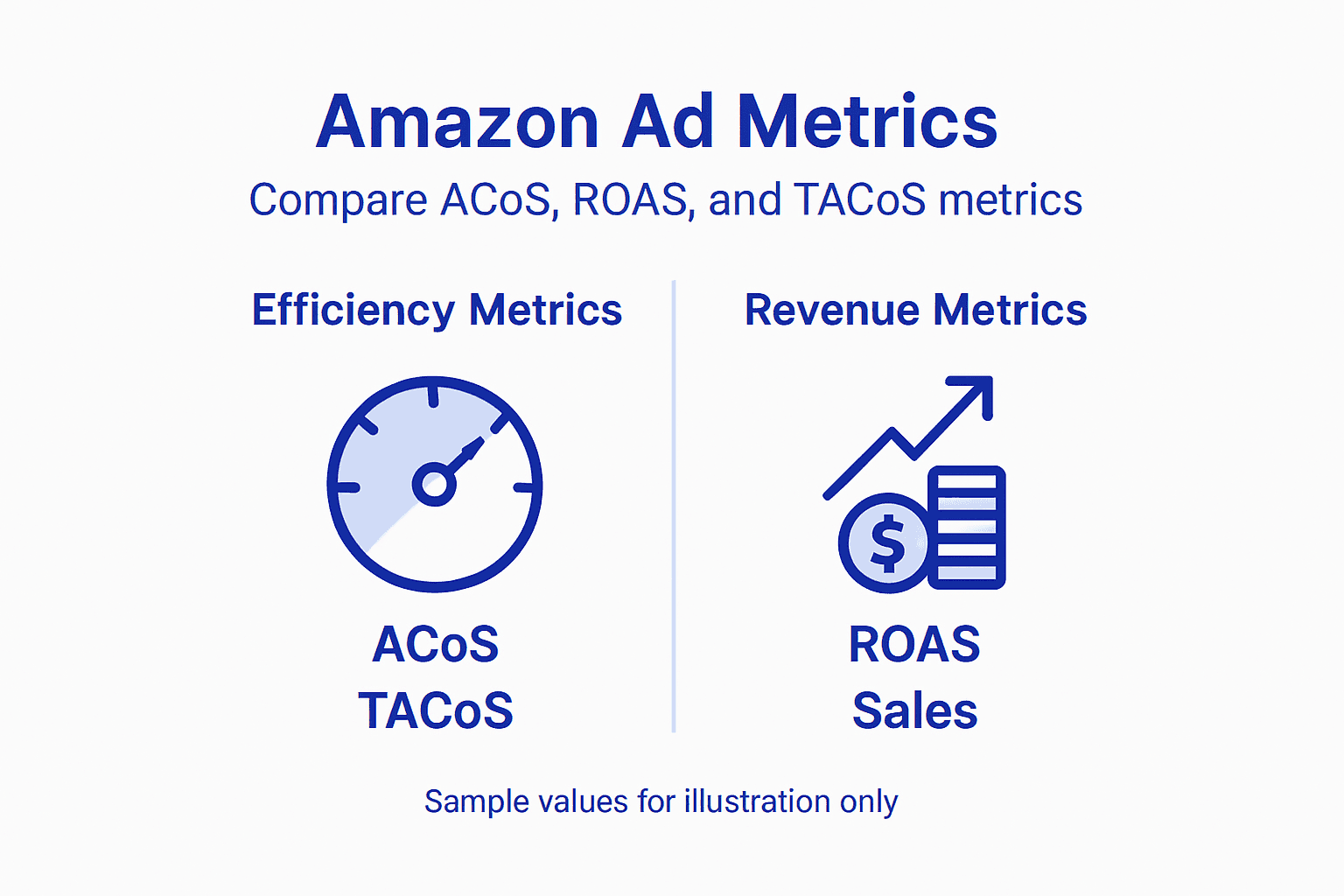
Amazon sellers live in a world of metrics, but three stand out as the true pillars of advertising performance: ACoS, ROAS, and TACoS. Understanding how these three relate to each other transforms how you read your campaign data and make budget decisions.
ACoS (Advertising Cost of Sales) measures what percentage of your ad revenue gets consumed by advertising spend. You already know this one: divide ad spend by sales and multiply by 100. If ACoS is 25%, you’re spending a quarter of your revenue on ads.
ROAS (Return on Ad Spend) flips ACoS on its head. Instead of measuring cost, ROAS shows revenue generated per dollar spent as a multiplier. A ROAS of 4.0 means every dollar you spend on ads generates four dollars in sales revenue. The math is simple: divide your ad revenue by your ad spend. A ROAS of 4.0 equals a 25% ACoS. They’re inverse metrics telling the same story from different angles.
Here’s why both matter. Some sellers think in percentages. ACoS feels intuitive to them: lower is better, anything under 30% looks good. Other sellers think in multipliers. ROAS of 3.0 or higher feels healthy to them. Pick whichever language matches your brain, but understand that 25% ACoS and 4.0 ROAS are identical performance.
TACoS (Total Advertising Cost of Sales) explodes the picture wide open. TACoS includes not just your Sponsored Products ads, but also Sponsored Brands, Sponsored Display, and any other advertising Amazon offers. More importantly, TACoS measures your ad spend against your total sales, not just the sales those specific ads generated.
Let’s ground this in reality. You spend $500 on Sponsored Products ads and they generate $1,500 in attributed sales. Your ACoS is 33%. But those ads also influenced customers who bought organic results. Your total sales that month across all channels hit $3,000. Your TACoS is 17% (500 divided by 3,000). TACoS reveals the broader impact of your advertising ecosystem.
Why track all three? ACoS shows individual campaign health. ROAS shows the same thing in multiplier format. TACoS shows whether your advertising strategy, taken as a whole, drives overall profitability. A seller with 35% ACoS on individual campaigns but 12% TACoS overall is running an efficient advertising machine.
Use this summary table to quickly compare key Amazon advertising metrics:
| Metric | What It Measures | Use Case | Calculation Example |
|---|---|---|---|
| ACoS | Ad spend vs. attributed sales | Campaign efficiency tracking | $300/$1,500 x 100 = 20% |
| ROAS | Revenue per ad dollar spent | Budget allocation decisions | $1,500/$300 = 5.0 ROAS |
| TACoS | Ad spend vs. total sales | Overall profit assessment | $500/$3,000 x 100 = 17% |
Pro tip: Use ACoS and ROAS for daily campaign optimization, but review TACoS monthly to ensure your total advertising budget aligns with your profit margins and overall business goals.
Major Factors Affecting Your ACoS
Your ACoS doesn’t exist in a vacuum. Multiple forces push it up or pull it down, and understanding these levers gives you control over your profitability. Some factors sit squarely in your hands. Others depend on Amazon’s algorithm or market dynamics beyond your immediate control.
Keyword Selection and Bidding Strategy form the foundation of ACoS management. Keywords that convert well require strategic optimization to balance cost-effectiveness with volume. Broad keywords attract more clicks but often at higher costs per conversion. Exact match keywords cost less per click but generate fewer impressions. Your job is finding the sweet spot where keyword relevance matches your bid levels.
Bid amounts directly influence your ACoS. Increase your bids, and you’ll typically see more impressions and clicks but higher per-click costs. Lower your bids, and you’ll pay less per click but lose visibility to competitors. The tension between these forces requires constant adjustment.
Product Pricing acts as a silent partner in your ACoS equation. A product priced at $19.99 with a $5 profit margin behaves differently than the same product priced at $24.99 with a $10 margin. Higher margins can absorb higher ACoS percentages while remaining profitable. Lower margins demand lower ACoS to survive. If you raise your price, the same ACoS percentage now generates more absolute profit. Conversely, aggressive pricing squeezes your profit window dramatically.
Competition and Market Conditions create headwinds you cannot fully control. When five competitors launch sales simultaneously, advertising costs rise across the category as everyone bids higher to maintain visibility. Seasonal peaks shift demand and increase competition costs. New market entrants sometimes trigger price wars that compress margins across the board.
Ad Placement and Auction Dynamics matter significantly. Top-of-search placements cost substantially more than below-the-fold positions but convert at higher rates. Your actual placement depends on your bid, your product relevance score, and how aggressively competitors bid. Amazon’s algorithms continuously recalculate these auctions, meaning your placement and cost can shift daily.
Product Page Quality influences your conversion rate, which directly impacts ACoS. A listing with poor images and weak bullet points converts visitors at maybe 2%. An optimized listing with compelling imagery and benefit-focused copy might convert at 8%. That four-fold improvement in conversion rate cuts your effective ACoS by 75% without spending a single extra dollar on ads.
Pro tip: Focus your optimization efforts first on conversion rate improvements through listing quality, then on keyword selection, and finally on bid adjustments, since improving your baseline conversion rate amplifies the efficiency of every advertising dollar spent.
Common Seller Mistakes to Avoid With ACoS
Most Amazon sellers sabotage their own profitability through repeated, preventable mistakes. Understanding these traps helps you sidestep them and keep more money in your pocket.
The first major error: Setting campaigns and forgetting them. Sellers launch advertising campaigns then disappear for weeks. Meanwhile, their keywords are tanking conversions, their bids are inflated, and their money is hemorrhaging into unproductive channels. Neglecting ACoS optimization and failing to analyze advertising performance data destroys profitability faster than almost anything else. Campaigns need weekly attention minimum. Check your data. Adjust bids. Pause what doesn’t work. This takes thirty minutes. Skip it, and you lose hundreds.
The second mistake: Bidding the same amount across all keywords. Sellers often set a uniform bid of, say, $1.50 per click across their entire campaign. High-converting branded keywords could sustain bids of $3.00. Low-converting generic terms should drop to $0.75. One-size-fits-all bidding is money left on the table and money wasted simultaneously.
Third: Overspending on low-converting keywords without pausing them. A keyword generating 2% conversion rate while your average is 8% should get paused, not perpetually funded. Too many sellers see a keyword generating some sales and keep pouring money into it out of habit. That’s backwards. Kill the underperformers aggressively.
Fourth: Ignoring your overall cost structure. Your ACoS percentage means nothing in isolation. A 25% ACoS sounds healthy until you realize your product margins are only 18%. You’re actually losing money on every sale. Before launching any campaign, calculate your profit per unit at your current price. Then work backward to determine your maximum sustainable ACoS. Operating blind to this math is fatal.
Fifth: Not adjusting campaigns based on performance data. High-performing campaigns deserve more budget. Low-performing campaigns need pausing or restructuring. Allocation based on gut feeling or habit leaves money on the table. Let data guide your resource distribution.
Sixth: Underestimating the cost of Amazon fees. Your ACoS calculation must account for referral fees, fulfillment fees, and storage costs. Many sellers optimize for sales revenue without factoring these expenses. A sale looks profitable at 20% ACoS until you subtract all fees and realize you actually lost money.
Pro tip: Audit your bottom three performing keywords weekly and either pause them or reduce bids by 40 percent, redirecting that budget to your top ten converting keywords.
Strategies to Lower and Optimize ACoS
Lowering ACoS isn’t magic. It’s systematic work applied consistently over weeks and months. You control more levers than you think, and pulling the right ones transforms your profitability.
Start with keyword strategy. Not all keywords deserve equal investment. High-converting search terms require targeted optimization to maximize your advertising efficiency. Branded keywords (your brand name plus category) typically convert at 15% to 25%. Generic keywords (product type only) convert at 3% to 8%. Long-tail keywords (specific product features) convert at 10% to 20%. Build your campaigns around high-intent, high-converting keywords first. Allocate your budget to winners before expanding to experimental terms.
Second, implement bid adjustments based on keyword performance. Your highest-converting keywords can sustain higher bids. Your lowest-converting keywords need aggressive bid cuts. Review conversion rate by keyword weekly. If a keyword converts below your overall campaign average, reduce its bid by 25 to 50 percent or pause it entirely. This reallocation is pure profit.
Segment campaigns by product performance. Running all products in one campaign masks what actually works. Create separate campaigns for high-margin products, low-margin products, and new launches. High-margin products can absorb higher ACoS. New launches often require temporary higher spend to gather data. Low-margin products need ruthless cost control. Segmentation gives you precision.
Third, set a realistic target ACoS based on your profit math. Setting target ACoS based on profit margins keeps you aligned with actual profitability. Calculate your profit per unit after all Amazon fees. If you make a $15 profit and want to spend 20% of revenue on advertising, your target ACoS is the percentage that allows $15 profit. Work backward from profit, not forward from revenue.
Optimize your product pages relentlessly. Better conversion rates lower your effective ACoS without touching bids. Improve images. Test new bullet points. Rewrite descriptions to emphasize benefits. A 2 percent conversion improvement cuts your effective cost per sale by 50 percent. This leverage is enormous.
Fourth, monitor data obsessively and adjust continuously. Pull reports weekly. Identify trends. Spot problems early. Winners get more budget. Losers get paused. Data drives everything. Guessing costs money.
Pro tip: Create a break-even ACoS target by dividing your profit per sale by your average selling price, then set all campaign rules to pause or reduce bids on keywords exceeding this percentage.
Optimize Your Amazon Advertising Efficiency with Proven Strategies
Struggling to manage your Amazon ACoS while keeping profitability on track can be overwhelming. The article highlights how crucial it is to control advertising costs relative to sales and improve product page quality for better conversion rates. If you want to turn these insights into actionable results featuring enhanced listings and data-driven keyword strategies, exploring expert support is key. Improve your advertising campaigns with our specialized services that focus on Amazon Listing Optimization and Amazon SEO & Analytics designed to lower your ACoS and boost your sales.

Ready to transform your advertising performance and safeguard your profits? Discover powerful E-commerce Tips & Strategies to Grow Your Online Business that align directly with your goals. Visit Searchoneers now to gain tailored solutions that sharpen your bidding strategies, refine your product listings, and elevate your Amazon sales with measurable results.
Frequently Asked Questions
What is Amazon ACoS?
Amazon ACoS, or Advertising Cost of Sales, is a metric that measures the cost of advertising relative to the sales revenue generated from those ads. It is calculated by dividing ad spend by attributed sales and multiplying by 100 to get a percentage.
How is ACoS calculated?
ACoS is calculated using the formula: (Ad Spend divided by Ad Revenue) multiplied by 100%. For example, if you spend $300 on ads that generate $1,500 in sales, your ACoS would be (300/1500) x 100, resulting in an ACoS of 20%.
What does a high ACoS indicate for my business?
A high ACoS indicates that a larger percentage of your sales revenue is being spent on advertising, which can signal inefficiency. If your ACoS is too high compared to your profit margins, it can lead to lower profitability and potentially operating at a loss.
How can I optimize my ACoS to improve profitability?
To optimize ACoS, focus on selecting high-converting keywords, adjusting bids based on performance, segmenting campaigns to better understand product performance, and continuously improving product pages to enhance conversion rates. Monitoring and adjusting your strategy based on performance data is crucial for profitability.