More than 60 percent of American consumers shop on Amazon each month, making competition fiercer than ever. Understanding how Amazon Sales Rank works is essential for anyone hoping to stand out in this crowded marketplace. With rankings shifting in real time and so many factors at play, knowing what drives a product up the charts can give sellers a valuable edge and help buyers find the hottest items faster.
Table of Contents
- Amazon Sales Rank Defined And Its Role
- How Amazon Calculates Sales Rank
- What Counts As A Good Sales Rank
- Factors That Influence Sales Rank Performance
- Common Misconceptions About Sales Rank
Key Takeaways
| Point | Details |
|---|---|
| Understanding Sales Rank | Amazon Sales Rank reflects product popularity and is calculated using real-time sales data. A lower rank indicates higher sales volume compared to other products. |
| Dynamic Nature of Sales Rank | Sales Rank is updated frequently, prioritizing recent sales performance over historical data, making adaptability crucial for sellers. |
| Good Sales Rank Definition | A good sales rank varies by category; consistent sales velocity within the unique product ecosystem is more important than a specific number. |
| Common Misconceptions | Sales Rank is solely influenced by actual sales transactions, not page views or keyword optimization, emphasizing the need for consistent sales performance. |
Amazon Sales Rank Defined and Its Role
Amazon Sales Rank represents a complex numeric metric tracking product popularity within Amazon’s massive marketplace. This algorithmic ranking provides sellers and shoppers a dynamic snapshot of a product’s relative performance across millions of available items. Essentially, the Sales Rank indicates how frequently an item sells compared to other products in the same category.
The calculation involves real-time sales data, with sales performance tracked hourly to generate constantly updating rankings. A lower number signifies higher sales volume – meaning a product ranked #1 sells more units than a product ranked #500,000. This ranking system helps Amazon determine which products merit placement on bestseller lists and provides valuable insights for sellers seeking to understand their market positioning.
Specifically, Sales Rank considers several nuanced factors beyond raw sales volume. These include recent sales velocity, total historical sales, product category, and competitive landscape. While the exact algorithmic details remain proprietary, sellers can use this metric to gauge product performance, identify trends, and make strategic inventory and marketing decisions. The rank updates frequently, sometimes within hours, reflecting the dynamic nature of Amazon’s marketplace.
Pro Seller Tip: Monitor your Amazon Sales Rank consistently and track trends over time, as sudden changes can signal shifts in market demand or emerging competitive challenges.
Additionally, sellers can leverage Amazon Sales Rank tracking strategies to gain deeper competitive insights and optimize their product positioning.
How Amazon Calculates Sales Rank
Amazon’s Sales Rank calculation is a sophisticated algorithmic process that goes far beyond simple sales volume tracking. The system creates a complex, dynamic ranking that reflects a product’s performance in near real-time. Sales Rank emerges from a multifaceted analysis that considers several critical data points, providing sellers with a nuanced view of their product’s marketplace standing.
The algorithm prioritizes recent sales performance over historical data, giving greater weight to products that have sold consistently in the past 12-24 hours. This approach means a product with steady recent sales will typically rank higher than an item that sold many units months ago but has since stalled. While Amazon keeps the exact calculation proprietary, experts understand that sales velocity plays a crucial role. The more frequently a product sells, the lower its Sales Rank number will be, indicating higher marketplace popularity.
Understanding Amazon’s Best Seller Rank mechanics reveals that the ranking system also accounts for comparative performance within specific product categories. A kitchen appliance isn’t measured against a book, but rather against other kitchen appliances. This category-specific approach ensures more meaningful and precise ranking metrics. Additional factors likely include customer reviews, pricing competitiveness, and product availability, though these are not explicitly confirmed by Amazon’s official documentation.
Pro Seller Tip: Track your Sales Rank consistently across different timeframes to identify emerging trends and potential seasonal variations in your product’s marketplace performance.
The dynamic nature of Sales Rank means sellers must remain adaptable, continuously monitoring their product’s performance and responding quickly to marketplace shifts.
What Counts as a Good Sales Rank
Defining a good sales rank on Amazon is not a one-size-fits-all proposition. The interpretation varies dramatically across different product categories, making it crucial for sellers to understand nuanced ranking dynamics. Sales performance benchmarks suggest that products ranking in the top 1% of their specific category are considered high performers, though this percentage can represent dramatically different absolute numbers depending on the marketplace segment.

In practical terms, a good sales rank represents consistent sales velocity and competitive positioning within a specific product category. For instance, in a category containing 100,000 products, a rank of 1,000 or better would signal strong marketplace performance. However, sellers must recognize that these benchmarks fluctuate constantly. A rank that represents excellence in one category might represent mediocre performance in another, making contextual understanding critical for accurate interpretation.
The complexity of sales rank becomes even more apparent when examining larger product categories. In massive marketplaces with millions of products, ranking stratification becomes increasingly sophisticated. A product ranked in the top 100,000 might seem unremarkable in a category with 10 million items, but could represent significant sales potential. Sellers should focus not just on the absolute number, but on their relative performance compared to direct competitors and category-specific trends.
Pro Seller Tip: Develop category-specific benchmarks by tracking your product’s sales rank over multiple months, identifying seasonal variations and establishing a personalized performance baseline.
Ultimately, a good sales rank is less about hitting a specific number and more about demonstrating consistent, competitive sales performance within your unique product ecosystem.
The following table compares sales rank benchmarks across different product categories:
| Product Category | Top 1% Rank Example | Competitive Threshold (Approx.) | Notes |
|---|---|---|---|
| Books | 100,000 | Top 1,000 | Highly competitive, rapid changes |
| Kitchen Appliances | 1,000 | Top 100 | Narrower pool, slower shifts |
| Electronics | 10,000 | Top 500 | Fast-moving, stiff competition |
Factors That Influence Sales Rank Performance
The Amazon Sales Rank ecosystem involves multiple interconnected factors that dynamically influence a product’s marketplace performance. At the core of this complex system, sales velocity emerges as the most critical element determining a product’s ranking potential. Sales momentum plays a pivotal role in how quickly a product can climb or descend the rankings, with consistent sales serving as the primary driver of sustained marketplace visibility.
Several nuanced elements contribute to sales rank beyond raw transaction numbers. Customer reviews, product pricing, inventory availability, and conversion rates all interact to create a comprehensive performance profile. Sellers must recognize that Amazon’s algorithm considers not just the quantity of sales, but the quality and consistency of those sales. A product generating steady, predictable sales will often outperform one with sporadic, unpredictable transaction patterns, even if the total sales volume might be similar.
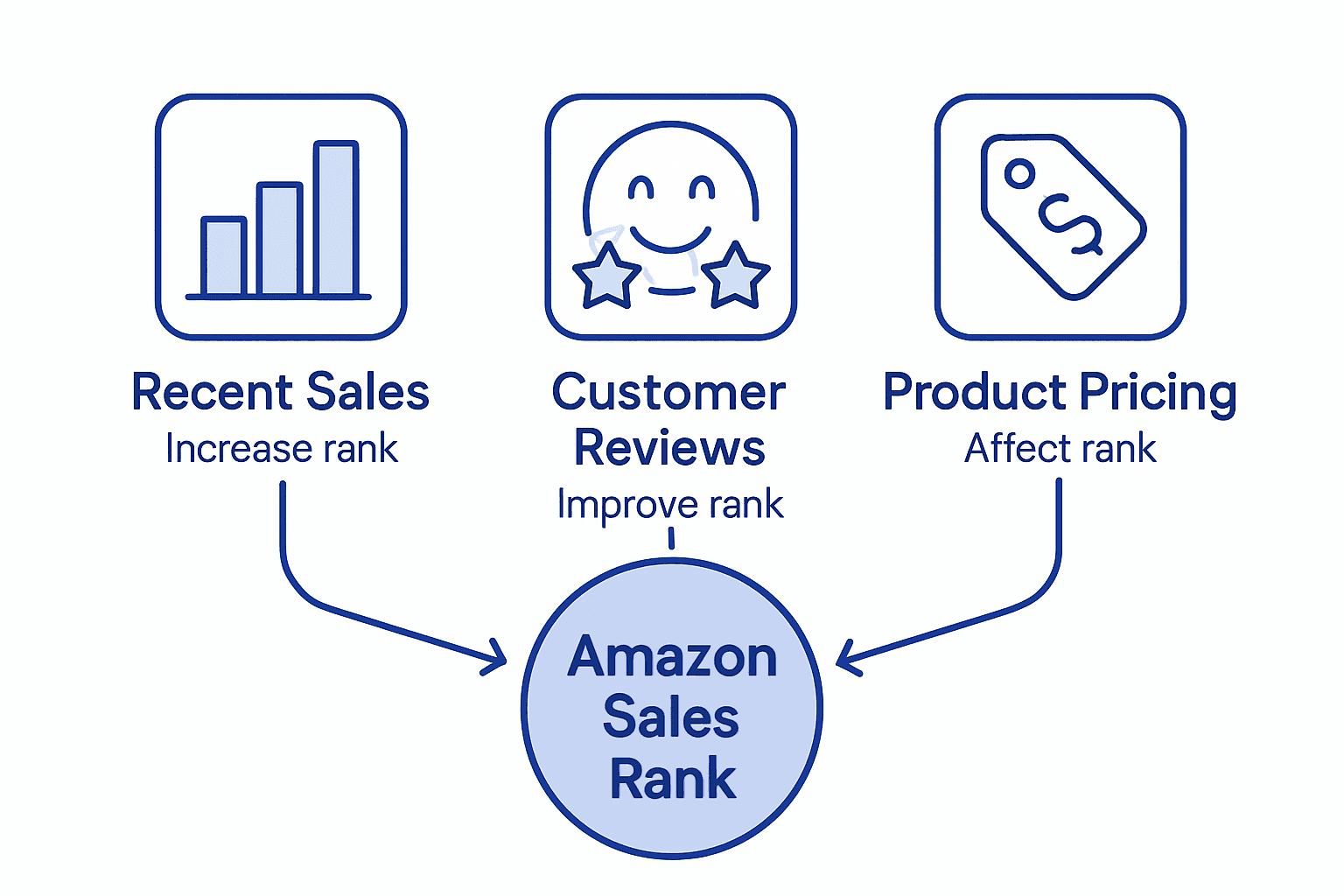
The temporal dynamics of sales rank are particularly intricate. Recent sales carry more weight than historical performance, meaning a product’s current sales trajectory can rapidly transform its marketplace standing. This approach incentivizes sellers to maintain consistent marketing efforts, optimize listing quality, and continuously engage potential buyers. External factors like seasonal demand, competitive pricing, and promotional strategies can create significant fluctuations in a product’s ranking, making adaptability a crucial seller skill.
Pro Seller Tip: Develop a holistic sales strategy that focuses on maintaining consistent sales velocity, optimizing product listings, and generating positive customer interactions to support long-term sales rank improvement.
Successful Amazon sellers understand that sales rank is not a static metric, but a dynamic reflection of ongoing marketplace performance and strategic positioning.
Here’s a summary of primary factors influencing Amazon Sales Rank and their business impact:
| Influencing Factor | Business Impact | How to Leverage |
|---|---|---|
| Recent sales velocity | Drives immediate rank improvements | Run time-limited promos |
| Historical sales | Sustains long-term market position | Encourage repeat buys |
| Category competition | Defines relative performance benchmarks | Target niche categories |
| Product availability | Prevents rank loss from stockouts | Monitor inventory closely |
Common Misconceptions About Sales Rank
Sales Rank remains one of the most misunderstood metrics in Amazon’s complex marketplace ecosystem. Sellers often develop incorrect assumptions about how this ranking system truly operates, leading to ineffective strategies and missed opportunities. Page views and advertising clicks do not directly influence sales rank, contrary to what many sellers mistakenly believe. Only actual sales transactions contribute to a product’s ranking, highlighting the critical importance of converting potential customer interest into real purchases.
Another prevalent misconception is that sales rank represents a static, unchanging metric. In reality, Amazon’s algorithm considers a sophisticated blend of recent and historical sales data, with recent performance carrying significantly more weight. Sellers frequently assume that a single successful sales day can permanently elevate their product’s ranking, but the truth is far more nuanced. The ranking system rewards consistent sales performance, meaning sustained velocity matters more than sporadic spikes in transaction volume.
Many sellers also erroneously believe that manipulating external factors like keyword optimization or advertising spend will directly improve their sales rank. While these strategies can indirectly support sales, the algorithm remains focused exclusively on verified sales transactions. External marketing efforts must ultimately translate into actual purchases to impact ranking. This means sellers should concentrate on creating compelling product listings, maintaining competitive pricing, and delivering exceptional customer value rather than seeking shortcuts to artificially inflate their sales performance.
Pro Seller Tip: Focus on generating genuine customer value and maintaining consistent sales performance, understanding that sustainable growth trumps short-term ranking manipulation.
Successful Amazon sellers recognize that sales rank reflects real marketplace performance, not marketing tactics or wishful thinking.
Boost Your Amazon Sales Rank with Proven Strategies
Struggling to maintain a good Amazon Sales Rank that truly reflects your product’s potential We understand the challenge of navigating complex sales rank metrics and staying ahead of fierce competition Our expertise covers everything you need to turn your ranking into consistent sales by focusing on enhanced listing optimization and smart, data-driven SEO methods

Discover how our specialized services at SearchOneers can help you optimize your Amazon listings with compelling titles bullet points descriptions and backend keywords designed for superior visibility Combine this with innovative Amazon SEO & Analytics strategies tailored to evolve with marketplace changes and watch your sales rank improve fast Learn more about e-commerce success in our E-commerce Tips & Strategies to Grow Your Online Business section Ready to gain competitive edge and convert your efforts into real sales Act now to start unlocking your Amazon potential today
Frequently Asked Questions
What does a good sales rank mean on Amazon?
A good sales rank indicates that a product is performing well in terms of sales compared to others in its category, typically reflecting consistent sales velocity and competitive positioning.
How is Amazon’s sales rank calculated?
Amazon’s sales rank is calculated using a complex algorithm that considers factors like recent sales performance, historical sales, product category, and competitive landscape, prioritizing recent sales over older data.
Why is sales velocity important for Amazon sellers?
Sales velocity is crucial because it directly impacts a product’s sales rank. Higher sales velocity leads to a better ranking, which enhances visibility and the likelihood of further sales.
Can external factors like advertising or page views affect sales rank?
No, sales rank is solely based on actual sales transactions. While advertising and page views may help generate interest, they do not directly influence the sales rank; only real purchases count towards it.