TL;DR:
- Email marketing helps Amazon sellers build direct, repeat customer relationships outside the platform.
- Proper list building methods include product inserts, landing pages, and customer registrations with consent.
- Automated, personalized campaigns and analytics improve conversion rates and increase overall ROI.
Many Amazon sellers assume that because Amazon controls the buyer relationship, email marketing is off the table. That assumption is costing them real money. Strategic email marketing remains one of the highest-return channels available to Amazon sellers, even within the platform’s strict rules. When done right, it builds repeat buyers, generates reviews, and creates a customer base you actually own. This guide walks you through every stage: building a compliant list, crafting campaigns that convert, choosing the right tools, and measuring results that matter to your bottom line.
Table of Contents
- Why email marketing is a game-changer for Amazon sellers
- Building your Amazon email list: Legal and effective methods
- Crafting email campaigns that convert Amazon buyers
- The right tools for Amazon email marketing success
- Measuring and optimizing your Amazon email marketing ROI
- Why most Amazon sellers underestimate the power of email
- Supercharge your Amazon growth with expert optimization
- Frequently asked questions
Key Takeaways
| Point | Details |
|---|---|
| Compliance is key | Only collect and use buyer emails in ways that comply with Amazon’s rules and data privacy laws. |
| Segment campaigns | Tailor email content to buyer intent and purchase stage for higher engagement. |
| Leverage automation | Use automation tools to deliver timely, relevant emails and boost efficiency. |
| Track and optimize | Measure results with the right metrics and continually improve your campaigns. |
Why email marketing is a game-changer for Amazon sellers
Amazon is a powerful sales engine, but it comes with a significant trade-off. You never truly own the customer relationship. Amazon controls the data, the communication, and the next recommendation your buyer sees. That makes building any connection outside the platform not just smart, but necessary for long-term growth.
The good news? Amazon sellers using email report higher customer retention and increased sales compared to those who rely solely on Amazon’s ecosystem. That gap matters. A buyer who hears from you directly is far more likely to return, leave a review, and choose your brand over a cheaper competitor.
Here is what email marketing can realistically do for your Amazon business:
- Drive repeat purchases by staying top-of-mind between buying cycles
- Generate product reviews through compliant post-purchase follow-up sequences
- Reduce dependence on Amazon ads by building a channel you control
- Increase lifetime customer value through targeted promotions and loyalty offers
- Protect your business from algorithm changes and account suspensions
Those are not small wins. For sellers investing heavily in driving Amazon traffic, email is the retention layer that turns one-time buyers into loyal customers.
“Email gives Amazon sellers something the platform never will: a direct line to the customer that no algorithm can take away.”
Pro Tip: Even a small email list of 500 engaged subscribers can outperform a much larger, cold paid-traffic audience. Focus on quality and relevance from day one.
The key is understanding what Amazon allows and building your strategy around those boundaries. Sellers who treat email as a compliance headache miss the point entirely. Those who treat it as a brand-building asset see compounding returns over time.
Building your Amazon email list: Legal and effective methods
Now that you understand the value of email marketing, let’s explore how Amazon sellers can build a compliant email list.
Amazon prohibits sellers from directly exporting buyer email addresses. Attempting to do so violates their terms of service and can result in account suspension. But that does not mean you are stuck. There are several legal, effective ways to grow your list.
It is critical that Amazon sellers comply with Amazon’s messaging policies to avoid penalties. Here is how to do it correctly:
- Product inserts: Include a card inside your packaging that invites buyers to register their product, access a warranty, or join a VIP community. Never ask for reviews directly on inserts.
- Landing pages: Drive traffic from social media, ads, or influencer partnerships to a dedicated opt-in page. Offer something valuable in exchange for the email address.
- Off-Amazon promotions: Run giveaways, discount campaigns, or content upgrades that require an email signup before the buyer accesses the deal.
- Warranty or registration forms: Customers who register their purchase voluntarily provide their contact details, making them a high-quality segment.
- Amazon’s Buyer-Seller Messaging: Use this tool for transactional communication. It is compliant and keeps you connected within the platform’s rules.
Always follow Amazon Communication Guidelines and ensure your off-Amazon collection methods meet GDPR and CCPA requirements. Explicit consent is non-negotiable. A checkbox that says “I agree to receive marketing emails” is the minimum standard.
For a broader view of staying within the rules while growing your reach, reviewing Amazon seller best practices will help you build a sustainable strategy.
Pro Tip: Offer a genuine incentive for signing up, such as an exclusive discount, a how-to guide related to your product, or early access to new launches. Value-driven signups convert at a much higher rate than generic “subscribe” prompts.
Crafting email campaigns that convert Amazon buyers
Once you’ve started building your list, it is time to create compelling email campaigns for your Amazon customers.

Automated email campaigns like order confirmations and post-purchase follow-ups boost engagement rates significantly for Amazon sellers. The structure of your campaigns matters as much as the content inside them.
Here are the core campaign types every Amazon seller should run:
- Welcome series: Introduce your brand, set expectations, and deliver the promised incentive within minutes of signup
- Post-purchase follow-up: Thank the buyer, provide usage tips, and invite a review (following Amazon’s guidelines)
- Review request emails: Sent 5 to 10 days after delivery, these are among the highest-converting emails in your sequence
- Promotional campaigns: Announce new products, seasonal deals, or exclusive discounts to your list before anyone else
- Win-back flows: Re-engage subscribers who have not opened or purchased in 60 to 90 days with a compelling offer
Personalization is not optional. Use the buyer’s first name, reference the product they purchased, and tailor the message to where they are in the customer journey. Generic blasts get ignored.
A/B testing subject lines is one of the fastest ways to improve open rates. Test one variable at a time: the subject line, the send time, or the call-to-action button. Review the Amazon email marketing strategies that leading brands use to stay ahead.
| Campaign type | Avg. open rate | Avg. conversion rate |
|---|---|---|
| Welcome email | 45-55% | 8-12% |
| Post-purchase follow-up | 35-45% | 5-8% |
| Review request | 30-40% | 3-6% |
| Promotional blast | 18-25% | 2-4% |
| Win-back flow | 12-20% | 1-3% |
For managing the content side of your campaigns, a clear Amazon content workflow keeps your messaging consistent and on-brand across every touchpoint.
Pro Tip: Send review request emails in the buyer’s local time zone. A message arriving at 9 a.m. on a Tuesday outperforms one landing at 11 p.m. on a Friday by a wide margin.
The right tools for Amazon email marketing success
To get the most out of your campaigns, selecting the right email marketing software is crucial.
Specialized email tools allow Amazon sellers to automate customer follow-ups and maintain compliance without manual effort. The right platform handles sequencing, segmentation, and reporting so you can focus on strategy.
Here are the key features to look for in any Amazon email marketing tool:
- Amazon API integration to sync order data and trigger automated sequences
- Compliance filters that flag messages violating Amazon’s communication rules
- Segmentation capabilities to target buyers by product, purchase date, or review status
- A/B testing support for subject lines and email content
- Analytics dashboards showing open rates, clicks, and revenue attribution
| Tool | Best for | Compliance support | Starting price |
|---|---|---|---|
| FeedbackWhiz | Review management and follow-ups | Strong | $19.99/month |
| Helium 10 (Follow-Up) | All-in-one Amazon sellers | Strong | Included in plans |
| Klaviyo | Off-Amazon list building | Moderate | Free up to 500 contacts |
| Omnisend | Multi-channel automation | Moderate | Free tier available |
For sellers building out a full tech stack, exploring Amazon SEO tools alongside your email platform creates a more connected workflow. You can also review independent Amazon email software options to compare features before committing.
“The best tool is the one your team will actually use consistently. A simple platform with strong compliance features beats a complex one that collects dust.”
Measuring and optimizing your Amazon email marketing ROI
With the right toolset in place, it is time to ensure your email marketing delivers measurable results.
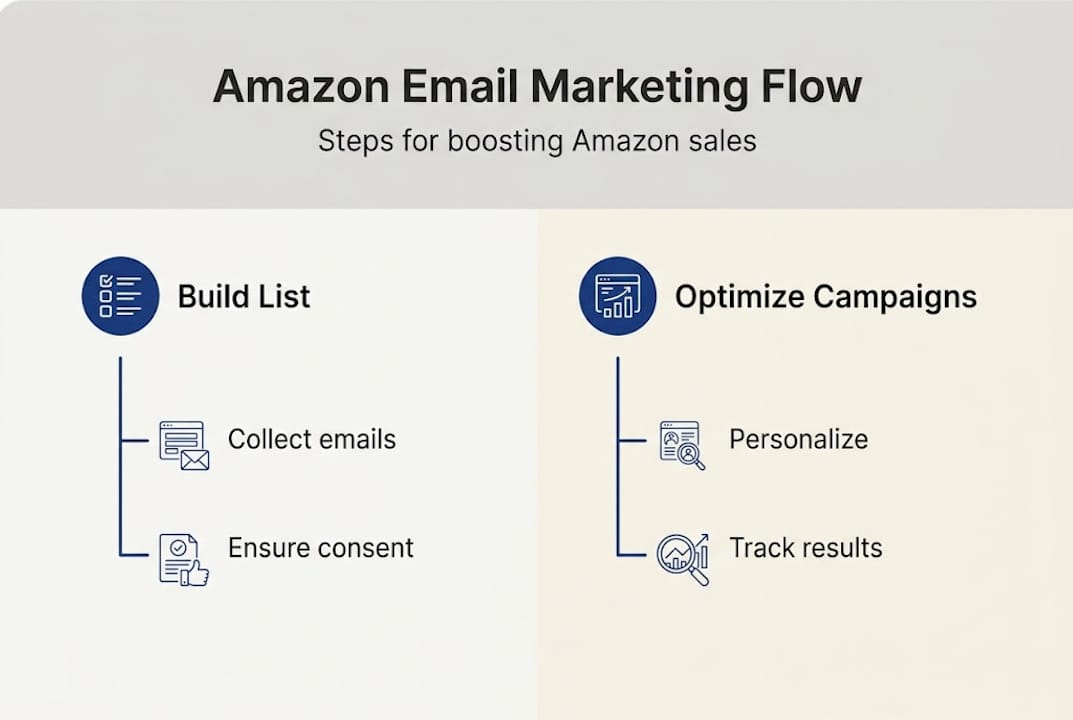
Top-performing Amazon sellers use analytics to continually improve their email marketing ROI. Without tracking, you are guessing. With it, every campaign teaches you something useful.
Focus on these core metrics:
- Open rate: Measures subject line effectiveness. Industry average for ecommerce sits around 20 to 25%.
- Click-through rate (CTR): Shows how compelling your content and call-to-action are. Aim for 2 to 5%.
- Conversion rate: The percentage of email recipients who complete a purchase or desired action.
- Unsubscribe rate: A spike here signals irrelevant content or too-frequent sending. Keep it below 0.5%.
- Revenue per email: The clearest indicator of actual business impact from your campaigns.
| Metric | Healthy benchmark | Action if below benchmark |
|---|---|---|
| Open rate | 20-25% | Test new subject lines |
| CTR | 2-5% | Improve CTA clarity and placement |
| Conversion rate | 1-3% | Refine offer or landing page |
| Unsubscribe rate | Below 0.5% | Reduce frequency or improve targeting |
Set up UTM parameters (tracking codes added to your URLs) so you can attribute sales to specific campaigns inside Google Analytics or your email platform’s dashboard. This connects email activity directly to revenue. For deeper performance context, Amazon sales growth tips help you interpret what strong numbers actually look like at scale.
Pro Tip: Review your email analytics weekly during active campaigns and monthly for baseline performance. Patterns only become visible over time, so consistency in tracking is as important as the metrics themselves. You can also benchmark your numbers against email analytics best practices to see where you stand.
Why most Amazon sellers underestimate the power of email
After measuring performance, let’s step back for a candid look at what most sellers get wrong.
The prevailing belief is that Amazon’s restrictions make email marketing not worth the effort. That belief is both understandable and expensive. Most sellers see the compliance requirements and decide the juice is not worth the squeeze. Meanwhile, a smaller group of sellers is quietly building email lists that generate consistent, algorithm-proof revenue.
Here is the uncomfortable truth: Amazon’s restrictions actually create a competitive advantage for sellers willing to work within them. Because most sellers give up, the ones who persist face almost no competition in the inbox. Your Amazon email results will reflect that gap.
Email is not a quick win. It is a compounding asset. A list of 2,000 engaged buyers is worth more than a viral product launch that attracts one-time purchasers. Sellers who understand this shift their entire growth strategy, and their businesses become far more resilient as a result.
Supercharge your Amazon growth with expert optimization
Ready to get even more from your Amazon business? Strong email marketing works best when your listings are already converting at a high level. If buyers click through from your emails and land on a weak listing, you lose the sale regardless of how good your campaign is.

At Searchoneers, we help Amazon sellers close that gap. From our Amazon listing enhancement guide to hands-on support for sellers who want to optimize Amazon listings for maximum visibility, our resources are built for sellers serious about growth. Pair your email strategy with solid Amazon SEO optimization and you create a system where every part of your funnel works together.
Frequently asked questions
Can I email Amazon customers directly?
Amazon restricts direct access to customer email addresses, but you can communicate through Amazon’s Buyer-Seller Messaging and build your own list off-Amazon with proper buyer consent.
What are the best tools for Amazon email marketing?
Specialized software exists to automate and manage email campaigns for Amazon sellers, with leading options including FeedbackWhiz, Helium 10’s Follow-Up tool, and Klaviyo for off-Amazon list building.
Is it legal to collect Amazon customer emails?
Yes. Amazon’s TOS allows email collection through off-platform, permission-based methods such as product inserts, landing pages, and opt-in promotions, as long as you follow applicable data privacy laws.
What types of email campaigns work best for Amazon sellers?
Automated transactional and review request emails deliver the highest engagement, while promotional and win-back campaigns add strong revenue impact when layered into a full sequence.
How can I measure the ROI of my Amazon email campaigns?
Analytics help Amazon sellers measure performance through open rates, click-throughs, and revenue attribution, giving you the data needed to optimize every campaign over time.