

TL;DR:
- International Amazon success depends on localized listings tailored to each market’s buyer behavior and regulations.
- Proper compliance, including VAT registration and accurate HS codes, is crucial to avoid penalties and delays.
- Continuous performance monitoring and market-specific strategies are essential for scalable international growth.
Selling well on Amazon US is a real achievement, but assuming that success will copy-paste to Germany, Japan, or the UK is one of the most expensive mistakes you can make. Every international marketplace runs on its own rules: different buyer psychology, different search behavior, different regulations, and different competitive dynamics. The sellers who scale globally are not the ones who replicate their domestic listings. They are the ones who treat each market as its own business. This guide walks you through the exact strategies for localization, compliance, pricing, and performance monitoring that turn international expansion from a gamble into a calculated growth move.
Table of Contents
- Why international expansion matters for Amazon sellers
- Localization: The key to international Amazon sales success
- Navigating compliance, shipping, and customs as an international seller
- Optimizing performance: Monitoring, analytics, and scaling up
- Why most Amazon international seller advice falls short
- Scale your Amazon global sales with expert support
- Frequently asked questions
Key Takeaways
| Point | Details |
|---|---|
| Localization is critical | Adapting listings to each market’s language and preferences drives higher sales. |
| Know regulations | Compliance with taxes, HS codes, and local laws prevents costly delays and issues. |
| Monitor and adapt | Continuously track market-specific metrics to refine your international Amazon strategy. |
| Tailored scaling | Scale up by reinvesting carefully and adjusting tactics for each region’s market. |
Why international expansion matters for Amazon sellers
Amazon operates marketplaces across North America, Europe, Asia-Pacific, and the Middle East. That reach is not just impressive on paper. It represents hundreds of millions of active buyers who will never see your product unless you show up where they shop. International Amazon marketplaces offer access to millions of new customers that no domestic strategy can reach.
The business case for going global is straightforward. Diversification protects your revenue when one marketplace slows down. Brand recognition compounds across borders. And entirely new revenue streams open up without requiring a new product line. The EU growth potential alone is significant, with Amazon’s European marketplaces generating billions in third-party seller revenue annually.
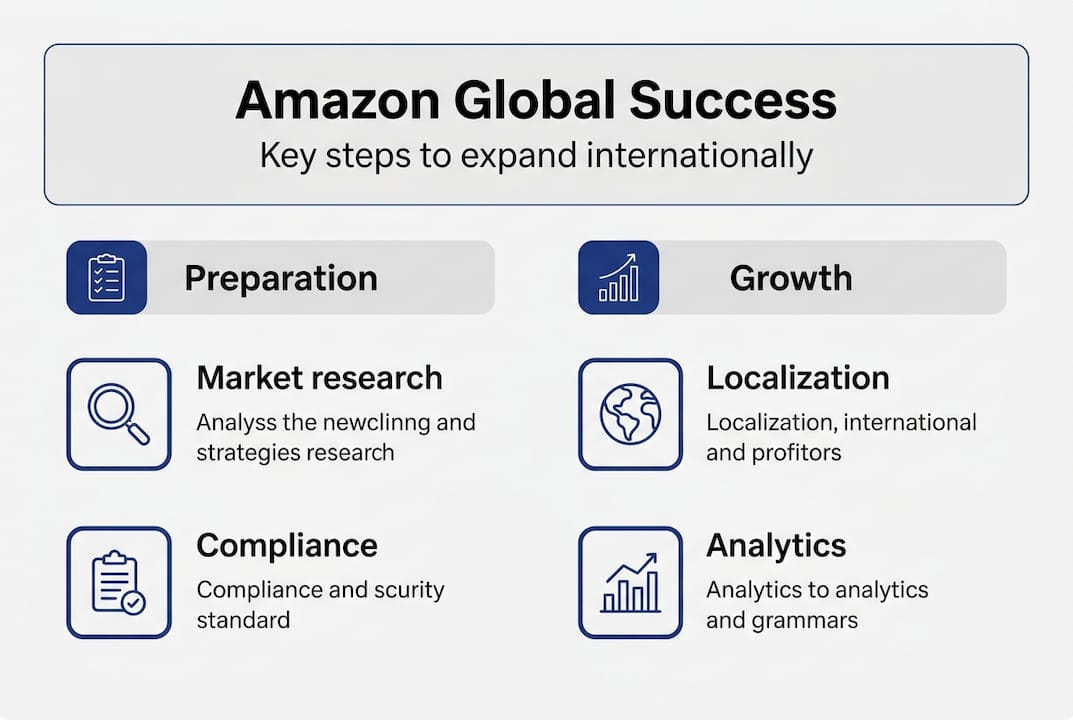
But the rewards come with real complexity. Cultural differences shape what buyers trust and what they ignore. Regulatory environments vary dramatically. Logistics and returns management get harder the further you ship. These are not reasons to stay home. They are reasons to go in prepared.
Here are the key Amazon international marketplaces worth knowing:
- Amazon.co.uk (United Kingdom): High English-language demand, strong Prime adoption
- Amazon.de (Germany): Europe’s largest marketplace, high return rates, strict consumer protections
- Amazon.fr / .es / .it (France, Spain, Italy): Growing mid-tier markets with EU-wide reach
- Amazon.co.jp (Japan): Highly localized buyer expectations, strong brand loyalty
- Amazon.ca (Canada): Close to US in culture, but distinct tax and labeling rules
- Amazon.com.au (Australia): Smaller but fast-growing, low competition in many categories
- Amazon.ae (UAE): Emerging market with rising Prime membership
“Global e-commerce is no longer a bonus channel for ambitious brands. It is quickly becoming the primary growth lever for sellers who have already maximized their home market.” — E-commerce growth analyst
A notable data point: a significant share of active Amazon sellers already draw revenue from outside their home country, and that number keeps climbing as Amazon simplifies cross-border tools. Checking out global seller success tips before you launch internationally can save you months of trial and error.
Localization: The key to international Amazon sales success
Localization is not translation. That distinction matters more than most sellers realize. Translation swaps words from one language to another. Localization adapts your entire listing to match how buyers in a specific market think, search, and decide. The difference in conversion rates between the two approaches can be dramatic.

Consider a simple example. A US listing for a kitchen knife might emphasize “razor-sharp blade” and “professional grade.” In Japan, buyers are more likely to search for specific steel types and blade angles. A direct translation of the US copy misses the actual search intent entirely. Localization of listings, keywords, and pricing is required for success because buyer behavior is market-specific, not universal.
Here is a step-by-step process for localizing any Amazon listing:
- Research local keywords first. Use market-specific tools to find how buyers in that country actually search. Do not start with your US keywords and translate them.
- Rewrite the title using local search terms. Structure matters too. German buyers often respond to technical specs in titles. UK buyers may prefer benefit-led copy.
- Adapt bullet points to local priorities. What a US buyer values (speed, convenience) may not match what a German buyer values (quality certification, durability).
- Review product images for cultural fit. Lifestyle imagery should reflect local settings, models, and contexts where relevant.
- Set pricing based on local market data. Factor in VAT, shipping costs, and local competitor pricing. Your US price point rarely translates directly.
Pro Tip: Use dedicated backend keyword tools that support non-English marketplaces. Generic US tools often miss regional search volume entirely, which means you are optimizing for terms nobody in that country actually types.
Keyword research for international listings also benefits from understanding the Amazon SEO keywords guide approach, which covers how Amazon’s A9 algorithm weighs relevance signals differently by marketplace. For sellers ready to go deeper, advanced keyword strategies can help you find low-competition, high-intent terms in new markets before your competitors do.
“The biggest keyword mistake in international selling is assuming that a translated phrase carries the same search volume and intent as the original. It almost never does.” — Amazon marketplace consultant
Navigating compliance, shipping, and customs as an international seller
Compliance is where many promising international expansions stall. The rules are not optional, and ignorance does not protect you from penalties, listing removals, or shipment seizures. Getting this right before you launch saves enormous headaches later.
Start with the basics. VAT (Value Added Tax) applies in the EU, UK, and many other markets. You are typically required to register for VAT once you exceed certain thresholds or use local fulfillment. Local labeling rules may require specific language, safety symbols, or certifications that your US packaging does not include. And HS codes are critical for customs clearance because they determine tariff rates and import eligibility for every product crossing a border.
Essential compliance checkpoints before launching in any new market:
- VAT registration: Know the threshold and register before you hit it
- Product safety certifications: CE marking for EU, PSE for Japan, and others depending on category
- Labeling requirements: Language, country of origin, and material disclosures vary by market
- Restricted or prohibited products: Some items legal in the US are restricted elsewhere
- Returns policy compliance: Germany, for example, has legally mandated return windows
Here is a quick comparison of key compliance differences across major markets:
| Market | VAT/Tax requirement | Key labeling rule | Notable challenge |
|---|---|---|---|
| EU (Germany, France) | VAT registration required | CE marking, local language | High return rates in Germany |
| United Kingdom | UK VAT post-Brexit | UKCA marking for some products | Separate from EU rules now |
| Japan | Consumption tax applies | Japanese language required | Strict product safety standards |
| Canada | GST/HST may apply | Bilingual (English/French) | Province-level tax variation |
| Australia | GST threshold applies | Australian safety standards | Smaller market, unique rules |
Germany deserves a special mention. Return rates there are among the highest of any Amazon marketplace, driven by consumer protection laws and buyer habits. Proactive sellers monitor their return rate weekly and use that data to improve listings, packaging, and product descriptions. Reviewing compliance in EU markets before you launch in Europe is time well spent.
Optimizing performance: Monitoring, analytics, and scaling up
Launching internationally is the beginning, not the finish line. Sellers who treat their international listings as “set and forget” consistently underperform compared to those who actively monitor and adjust. The data tells you what your instincts cannot.
Start with the metrics that matter most. Monitoring return rates and local market data is essential for sustaining growth because problems that are invisible at launch become obvious in the numbers within weeks. A spike in returns in one market often signals a listing issue, a packaging problem, or a product-market fit gap.
Here is a practical performance tracking table for international sellers:
| Metric | Why it matters | Review frequency |
|---|---|---|
| Revenue by marketplace | Identifies which markets are growing | Weekly |
| Return rate by country | Flags listing or product issues early | Weekly |
| Conversion rate | Measures listing effectiveness | Bi-weekly |
| Product reviews and ratings | Tracks buyer satisfaction and trust | Weekly |
| Ad spend and ACoS by market | Controls profitability of paid traffic | Weekly |
Pro Tip: Never apply the same advertising strategy across all international marketplaces. Buyer intent, competition levels, and cost-per-click vary significantly by country. What works in the US may burn budget in Japan. Build market-specific ad strategies from the start using Amazon analytics best practices.
When a market is performing well, the question becomes: when do you reinvest and when do you expand? A useful rule is to reinvest in a market until your conversion rate stabilizes above your category average, then use surplus profit to fund the next marketplace launch. Sellers who follow a structured listing optimization workflow tend to scale faster because they are not rebuilding processes from scratch with each new market.
Quick wins often come from markets with lower competition in your category. Australia and the UAE, for example, have fewer established sellers in many niches, which means well-optimized listings can rank quickly without heavy ad spend.
Why most Amazon international seller advice falls short
Here is the uncomfortable reality: most guides on Amazon international selling treat localization as a checklist and compliance as a footnote. That framing sets sellers up for mediocre results.
US success does not transfer automatically. We have seen sellers with strong domestic rankings launch internationally with copy-pasted listings and wonder why conversion rates are half what they expected. The reason is almost always buyer intent. Shoppers in different markets are not just speaking different languages. They are asking different questions and trusting different signals.
The bigger missed opportunity is microtrend tracking by country. A product category gaining momentum in France may be six months behind the trend curve in Spain. Sellers who monitor market-specific data, not just overall international performance, catch these windows early. Most advice skips this because it requires ongoing effort, not a one-time setup.
The essential sales tips that actually move the needle internationally are rooted in continuous monitoring, not launch-day optimization. The sellers who win globally are the ones who treat each market as a living, evolving business, not a copy of their US store.
Scale your Amazon global sales with expert support
Putting these strategies into practice takes more than good intentions. It takes the right tools, the right data, and a workflow built for international complexity.

At Searchoneers, we specialize in exactly this. Our listing enhancement guide gives you a proven framework for building listings that convert across multiple marketplaces. Our Amazon analytics tools help you track the metrics that actually predict international growth. And our optimization workflow ensures you are not reinventing the wheel with every new market you enter. If you are serious about scaling globally, we are ready to help you do it right.
Frequently asked questions
What is the biggest mistake new Amazon international sellers make?
Most new international sellers fail to localize their listings, relying on direct translations instead of true localization for language, pricing, and keywords. This results in poor search visibility and low conversion rates in the new market.
How do customs codes (HS codes) affect my Amazon international shipments?
Incorrect or missing HS codes can lead to customs delays, unexpected tariffs, or confiscated shipments. Always verify the correct HS code for each product before shipping internationally.
What metrics should I track when selling internationally on Amazon?
Focus on revenue by marketplace, return rates by country, product reviews, conversion rates, and advertising spend to make data-driven decisions for each market.
Is Amazon FBA available to international sellers?
Yes, Amazon FBA is available in most major international marketplaces, but fulfillment fees, storage limits, and eligibility requirements differ by country and should be reviewed before committing inventory.
Recommended
- Amazon International Sales: Unlocking EU Growth Potential – Searchoneers
- Amazon Business Blog: Driving Seller Growth Worldwide – Searchoneers
- 7 Essential Amazon Sales Tips for Global Seller Success – Searchoneers
- Amazon sales growth tips: optimize listings, boost 2026 sales – Searchoneers
- Amazon Marktplatz Expansion: Die besten Tipps für Erfolg
- Amazon International: Einstieg in neue Märkte | AMAVEN

Comments
2 responses to “Amazon international sellers: strategies to expand globally”
[…] international growth, go global on Amazon through programs like Amazon Global Selling, which connects you to marketplaces in Europe, Asia, […]
[…] you are thinking about expanding as an international seller, account type decisions become even more important. Different Amazon marketplaces have different […]