

Most Amazon sellers believe the path to growth is simple: list your products, run some ads, and watch the sales roll in. That assumption costs them thousands. The reality is that Amazon’s algorithm, fee structure, and policy landscape are far more complex than they appear on the surface. Sellers who rely on intuition instead of data consistently leave money on the table or, worse, risk account suspension. A skilled Amazon Seller Central consultant brings structured strategy, real performance data, and hands-on experience to fix what guesswork can’t. This guide breaks down exactly what consultants do, which metrics they track, how to choose the right support model, and when it’s time to bring one in.
Table of Contents
- What does an Amazon Seller Central consultant actually do?
- Key metrics consultants track for Amazon growth
- Agency vs. consultant vs. in-house: How to choose the right model
- When to hire an Amazon Seller Central consultant
- Why most sellers underuse consultants—and the hidden ROI
- Boost your Amazon results with expert guidance
- Frequently asked questions
Key Takeaways
| Point | Details |
|---|---|
| Consultants drive data-backed growth | Expert audits and ongoing metric analysis help maximize Amazon sales profitably. |
| Success is about more than ads | Listing optimization, compliance, and strategic positioning matter as much as advertising. |
| Choose the right support model | Weigh consulting, agencies, and in-house options carefully depending on business stage. |
| Act early for best results | Bring in consultants at strategic points to avoid profit loss and compliance risks. |
What does an Amazon Seller Central consultant actually do?
Let’s be clear about something: an Amazon Seller Central consultant is not just someone who tweaks your bullet points. They audit your entire operation and rebuild it around data, not assumptions. Their work spans listing optimization, pricing strategy, advertising management, account health, and fulfillment setup. That’s a wide scope, and it’s intentional.
Here’s what a qualified consultant typically handles:
- Listing SEO and conversion optimization: Rewriting titles, bullet points, descriptions, and backend keywords to align with how Amazon’s A9 algorithm ranks products. Improving Amazon listings is often the single highest-ROI activity a seller can do.
- Pricing strategy: Analyzing competitor pricing, Buy Box eligibility, and margin thresholds to set prices that win without eroding profit.
- Ad campaign management: Building and refining Sponsored Products, Sponsored Brands, and Sponsored Display campaigns with a focus on TACoS, not just ACOS.
- Account health management: Monitoring Order Defect Rate, Late Shipment Rate, and policy compliance to keep accounts in good standing.
- Fulfillment strategy: Advising on FBA vs. FBM trade-offs, inbound placement fees, and multi-channel fulfillment setups.
- Policy and compliance issues: Navigating returns abuse, listing suppression, and Amazon policy compliance violations that can get accounts suspended.
What separates a great consultant from a mediocre one is their relationship with data. As one industry source puts it, data-driven listings, positioning before ads, and handling compliance edge cases are the core focus of any serious consultant. They don’t recommend changes because something looks good. They recommend changes because the numbers support it.
“The best consultants treat your Amazon account like a business system, not a collection of individual listings.”
Pro Tip: Validate your margins before investing heavily in FBA. Amazon’s fees can consume over 50% of your revenue when you factor in referral fees, fulfillment costs, storage, and returns. A consultant will run this math before you commit inventory.
Key metrics consultants track for Amazon growth
Understanding the value of consultant expertise means knowing what they actually measure and improve. Metrics are the language of Amazon success, and consultants are fluent in it.
Here are the core metrics that matter most:
- TACoS (Total Advertising Cost of Sale): This measures your ad spend as a percentage of total revenue, not just ad-attributed revenue. A low TACoS signals organic strength. A rising TACoS often means your organic rank is slipping.
- Order Defect Rate (ODR): Amazon requires this to stay under 1%. Breaching it triggers account warnings or suspension.
- Conversion Rate (CVR): The percentage of shoppers who buy after viewing your listing. Industry benchmarks vary by category, but most healthy listings convert between 10% and 15%.
- Inventory Performance Index (IPI): Amazon’s score for how well you manage FBA inventory. A low IPI limits your storage capacity.
- Net profit per SKU: The real measure of success. Revenue means nothing if your margins are gone after fees, ads, and returns.
| Metric | Healthy benchmark | Risk threshold |
|---|---|---|
| TACoS | Under 10% | Over 20% |
| Order Defect Rate | Under 0.5% | Over 1% |
| Conversion Rate | 10% to 15% | Under 5% |
| IPI Score | 450 or above | Under 400 |
| Net margin per SKU | 20% or above | Under 10% |
Consultants don’t look at these metrics in isolation. They review them as a system. A spike in returns might explain a drop in CVR. A rising TACoS might point to weakening organic keywords. Reviewing Amazon listing benchmarks against your own data reveals the gaps that cost you the most.

Pro Tip: Don’t react to a single bad week of data. Pull 30, 60, and 90-day trends before making any major changes. Consultants use rolling averages to separate noise from real performance shifts. For more context, explore tips for increasing Amazon sales that align with these metrics.
Agency vs. consultant vs. in-house: How to choose the right model
Having seen what metrics matter, it’s essential to choose the support model that matches your growth phase. Each option has real trade-offs, and the wrong choice can slow you down or drain your budget.
| Factor | Consultant | Agency | In-house team |
|---|---|---|---|
| Cost | Mid-range, project-based | High, often 15% to 50% of ad spend | High upfront (hiring, tools) |
| Scope | Specialized, focused | End-to-end management | Full control, broad scope |
| Speed to results | Fast | Moderate | Slow (ramp-up time) |
| Customizability | Very high | Moderate | Very high |
| Knowledge transfer | Limited | Low | High |
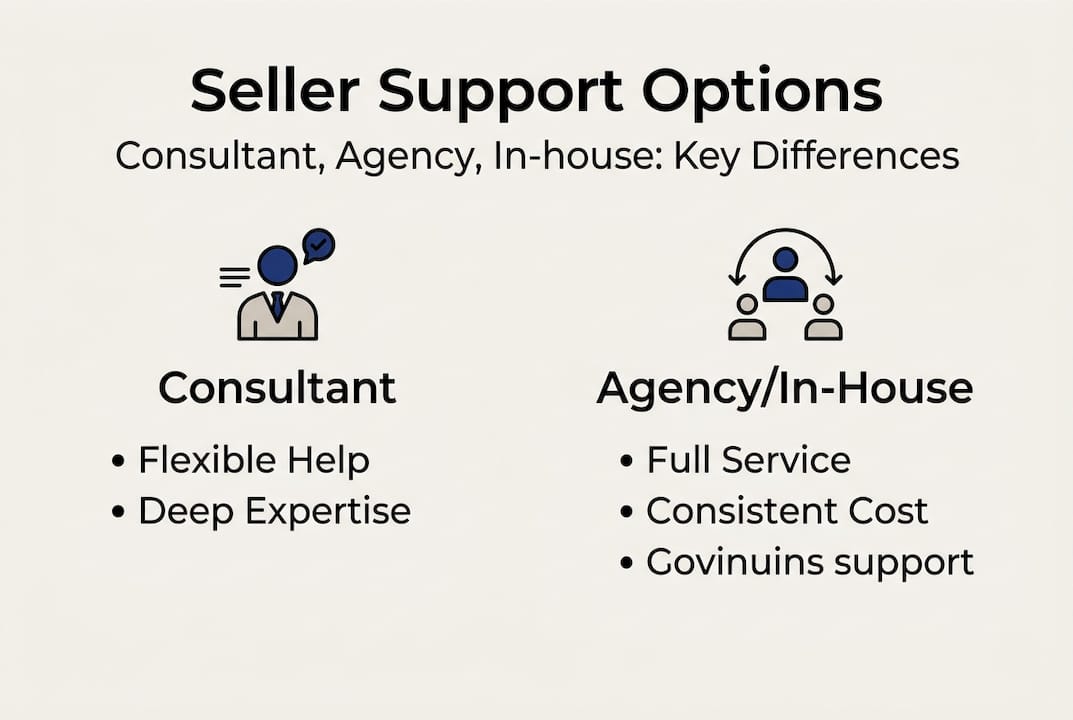
Some experts favor lean in-house teams for established brands, but warn that FBA fee increases in 2026 make margin management critical regardless of the model you choose.
Here’s how to evaluate which model fits your business:
- Assess your current revenue stage. Under $500K annually, a consultant is usually the most cost-effective option. Over $2M, an agency or in-house hybrid may make more sense.
- Identify your biggest pain point. Account health issues? Hire a consultant. Need full account management? Consider an agency. Want long-term capability? Build in-house.
- Review your internal bandwidth. If you or your team are already stretched, adding more self-managed tools won’t help.
- Calculate the true cost of inaction. Poor listings, wasted ad spend, and compliance risks have real dollar values. Compare those costs to what expert help actually costs.
- Check references and case studies. Any consultant or agency worth hiring will have verifiable results, not just testimonials.
Reviewing a solid Amazon listing optimization workflow can also help you understand what a consultant will actually work through with you before you commit.
When to hire an Amazon Seller Central consultant
Knowing the differences between support options is critical, but when do you actually need a consultant? There are specific scenarios where outside expertise isn’t just helpful, it’s necessary.
Here are the clearest signals:
- You’re launching new products without a proven margin or SEO strategy. Launching blind is one of the most expensive mistakes sellers make. A consultant validates your approach before you invest in inventory.
- Your account health is at risk. Defect rates climbing, policy warnings appearing, or a suspension notice in your inbox all demand expert attention fast.
- You’re scaling inventory and need a fulfillment strategy. Moving from 10 SKUs to 100 requires a completely different approach to FBA placement, reorder cycles, and cash flow.
- Competitors are attacking your listings. Review manipulation, unauthorized sellers, and listing hijacking require fast, strategic responses.
- You’re entering a new marketplace. Expanding to Amazon Canada, UK, or other regions involves different fee structures, tax rules, and customer behavior.
- You’re considering a hybrid FBA and FBM model. This approach can protect you from stockouts and reduce storage fees, but it requires careful setup.
Sellers facing account suspensions, returns abuse, policy headaches, or eroding profits especially benefit from bringing in an external expert who has seen these problems before and knows the fastest path to resolution.
Pro Tip: The earlier you involve a consultant, the more costly errors you avoid. Waiting until your account is suspended or your margins have collapsed means paying for both the consultant and the damage already done. Proactive investment in higher sales strategies pays dividends long before problems appear.
Why most sellers underuse consultants—and the hidden ROI
Here’s an uncomfortable truth: most small and medium-sized sellers assume Amazon Seller Central is manageable on their own. They’ve read the help docs, watched a few YouTube videos, and figured it out well enough. That mindset is costing them more than they realize.
The hidden ROI of a consultant isn’t just in the revenue they help you generate. It’s in the losses they prevent. Wasted ad spend on poorly structured campaigns, margin erosion from FBA fees that weren’t modeled correctly, and account suspensions from policy violations that were entirely avoidable. These are not rare edge cases. They are common outcomes for sellers who go it alone.
Consultants who avoid policy suspensions, reduce wasted ad spend, and protect margins deliver ROI that rarely shows up in a single line item. It shows up in the absence of problems. The best consultants don’t wait for your TACoS to spike or your ODR to breach 1%. They build systems that make those outcomes unlikely. That’s the kind of advanced strategies for Amazon sales that separates sellers who scale from those who stall.
Stop thinking of a consultant as an expense. Think of them as the person who keeps your business from making the mistakes that are hardest to recover from.
Boost your Amazon results with expert guidance
If this guide has made one thing clear, it’s that Amazon success is built on strategy, data, and the right expertise working together. The sellers who scale consistently aren’t doing it alone.

Our Amazon listing enhancement guide gives you the exact framework top consultants use to build high-converting listings. If you want to see how the full process works, our listing optimization workflow walks you through every step. And if inventory management is your current challenge, our resource on inventory optimization for higher sales covers the strategies that protect your margins while you scale. Your next growth phase starts with the right tools and the right knowledge.
Frequently asked questions
What is the difference between an Amazon Seller Central consultant and a full-service agency?
Consultants offer specialized, project-based help focused on specific problems or growth goals, while agencies provide end-to-end account management at a higher cost. As some experts warn, high agency fees can erode the margins you’re trying to protect.
Which metrics matter most for tracking Amazon growth?
Focus on TACoS, Order Defect Rate, Conversion Rate, Inventory Performance Index, and net profit per SKU for a complete picture of performance. These key seller metrics reveal both growth opportunities and hidden risks.
How soon should you bring in an Amazon Seller Central consultant?
Ideally, bring in a consultant before product launch or at major growth inflection points to avoid costly mistakes. Early involvement is especially important for margin and compliance issues that compound quickly if left unaddressed.
How do consultants help with account health or policy problems?
They use reporting data and platform experience to resolve defects, prevent suspensions, and manage returns abuse or inbound placement fee disputes. Specialized policy compliance experts can also represent sellers in formal Amazon appeals processes.
Recommended
- Boost Sales with an Amazon Optimization Consultant – Searchoneers
- Amazon Vendor Consulting
- Amazon Listing Consultant: Maximizing Product Visibility – Searchoneers
- Amazon Vendor Services: Driving Profitable Growth Online – Searchoneers
- Maximize Your Online Presence with a Cape Town SEO Consultant – LSA SEO Agency

Comments
One response to “Grow faster with Amazon Seller Central consultants”
[…] Grow faster with Amazon Seller Central consultants – Searchoneers […]