TL;DR:
- Keyword stuffing is no longer effective; Amazon’s Rufus AI now prioritizes clear, complete answers to shopper questions. A skilled copywriter balances algorithmic optimization with persuasive, benefit-driven content that builds trust and improves conversions. To succeed, listing content must answer questions explicitly, reinforce claims across all sections, and adhere to compliance standards.
Keyword stuffing used to be enough. Pack your title with search terms, load your bullets with variations, and you could rank. That era is over. Amazon’s Rufus AI now shapes what shoppers see before they ever scroll through results, and it does not reward keyword density. It rewards listings that answer real shopper questions clearly and completely. The good news? A skilled amazon copywriter knows exactly how to write for both Rufus and real humans. This article breaks down what to look for, what to expect, and how professional listing copy transforms your sales.
Table of Contents
- Key takeaways
- What an Amazon copywriter does and why it matters
- How Rufus AI changed the copywriting game
- Best practices for Amazon product listing copy
- How to find and work with the right Amazon copywriter
- Measuring the impact of your listing copy
- My take on where copywriting is headed for Amazon sellers
- Ready to upgrade your Amazon listings with Searchoneers?
- FAQ
Key takeaways
| Point | Details |
|---|---|
| Rufus AI rewards answers, not keywords | Write listings that directly answer shopper questions to get surfaced by Amazon’s AI. |
| Compliance protects your listings | Unsubstantiated claims and promotional excess can trigger suppression under 2026 policies. |
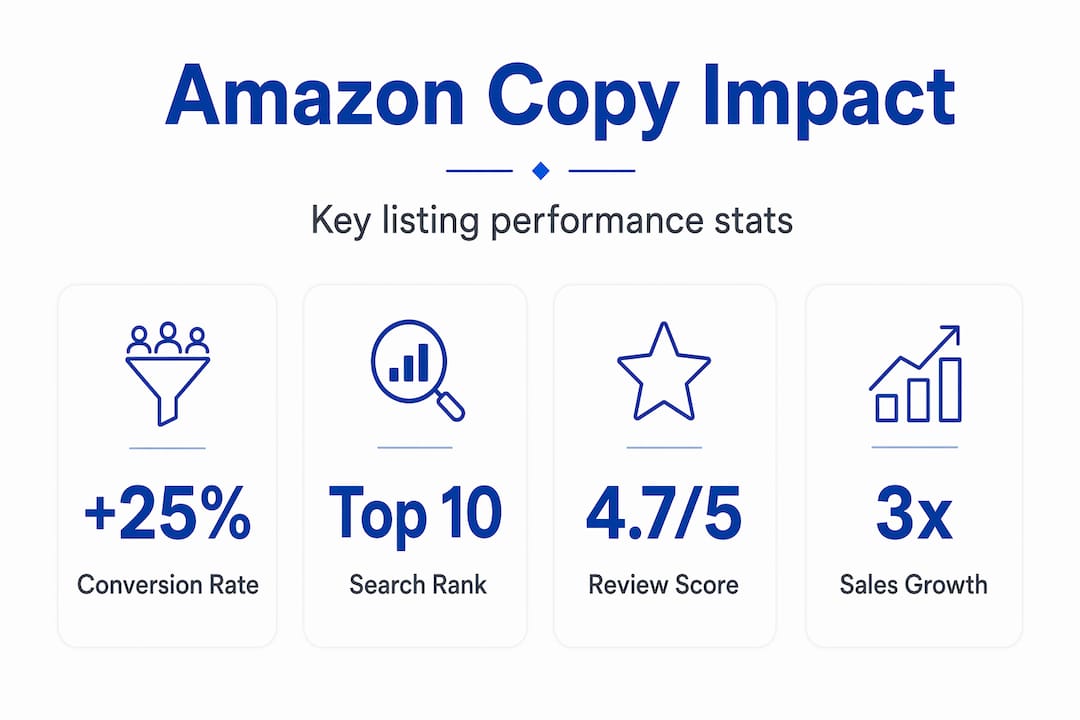
| Copywriting drives conversion lifts | Benefit-focused copy addressing buyer objections can produce 20% to 100%+ conversion lifts. |
| Q&A is indexed listing content | Every answered shopper question in bullets or A+ Content becomes searchable and AI-visible. |
| Measure copy performance with data | Track conversion rate, search ranking, and sales velocity to know when your copy needs a refresh. |
What an Amazon copywriter does and why it matters
An Amazon copywriter is not a general content writer with an extra title. The role requires a very specific mix of skills: persuasive writing, buyer psychology, Amazon policy knowledge, and an understanding of how Amazon’s search algorithm and AI tools evaluate content.
At the core, this specialist crafts every text element of your product detail page. That includes:
- Title: The first signal Amazon uses for search relevance and the first thing a shopper reads
- Bullet points: Where shoppers look to answer specific product questions before buying
- Product description: Where longer-form copy makes an emotional and logical case for purchase
- A+ Content: Enhanced brand content that combines visuals with structured copy to tell your brand story
- Backend keywords: Hidden fields that expand your discoverability without cluttering your public listing
What separates ecommerce copywriting on Amazon from general SEO writing is the dual audience. You write for the algorithm to get found, and you write for the shopper to get the sale. Those goals can conflict. A skilled Amazon product description writer knows how to balance them so your listing ranks and converts.
Professional copywriting that focuses on benefits and objection handling consistently outperforms listings that only prioritize technical optimization. Buyers want to trust what they read. They want to know if your product fits their use case before they click “Add to Cart.”
How Rufus AI changed the copywriting game
Amazon’s Rufus AI is a conversational shopping assistant built directly into the Amazon app and website. Shoppers can type questions like “What’s the best waterproof backpack for hiking in rain?” and Rufus will surface products it believes answer that question well. This is a meaningful shift in how listings compete.
Rufus evaluates listings by pulling from your title, bullet points, description, A+ Content, Q&A, and customer reviews. It synthesizes those elements to form an answer. If your listing does not contain a clear answer to the shopper’s question, Rufus moves on to a competitor that does.
Here is how that changes the approach to Amazon listing copy:
- Map common shopper questions first. Before writing a single word, identify what shoppers actually ask about your product category. What are the compatibility questions? The durability concerns? The sizing doubts?
- Write direct answers into your Tier 1 content. Title, bullets, and description must each contain clear, concrete responses. Vague claims like “premium quality” are ignored by Rufus. Specific details like “100% stainless steel, compatible with 6-qt and 8-qt models” are exactly what gets surfaced.
- Use your Q&A section as copy. Each question answered in the Q&A becomes indexed content for Rufus. Unanswered questions create gaps that Rufus will fill with a competitor’s listing.
- Reinforce key claims across multiple listing areas. Rufus assigns higher confidence to claims repeated in bullets, descriptions, and reviews. Consistency across your listing makes your product more trustworthy to the AI.
- Complete your backend structured attributes. Attribute completeness has a measurable impact on Rufus surfacing your product, sometimes exceeding the impact of the copy itself.
Pro Tip: Mine your negative reviews for unanswered questions. If customers repeatedly ask about return policy, material safety, or fit, those questions belong in your bullets and A+ Content before your next competitor answers them first.
Best practices for Amazon product listing copy
Writing great Amazon copy is part art, part science, and very much a discipline. Here are the best practices for Amazon copy that experienced Amazon SEO copywriters follow consistently.
Write titles that earn the click, not just the rank
Your title has one job: get the click. Amazon suppresses listings that use manipulative language, keyword stuffing, or excessive punctuation. Think readable, not loaded. Include your primary keyword, your most important product attribute, and a benefit where it fits naturally. That is the formula.
A bad title looks like: “Yoga Mat Non Slip Thick Extra Wide Best Premium Eco Friendly High Performance”
A strong title looks like: “BalanceForm 6mm Yoga Mat, Non-Slip Surface, 72×24 in, Eco-Friendly TPE, Ideal for Home or Studio Use”
The second version answers questions, reads naturally, and avoids suppression triggers.
Bullet points that answer before the shopper has to ask
Each bullet should address a specific shopper concern, not just describe a feature. The framework is simple: lead with the benefit, follow with the feature, close with context.
- Mention material and dimensions with exact numbers
- Address compatibility questions directly (fits X, works with Y, safe for Z)
- Answer durability concerns (lifetime warranty, commercial-grade construction, tested to X standard)
- State usage context clearly so the buyer self-selects
- Keep bullets scannable but substantive. Two lines per bullet is the sweet spot
Descriptions that create emotional momentum
Your product description is where you can breathe a little. This is the space where buyer psychology takes over. Paint a picture of the problem your product solves. Use “you” language. Tell the shopper exactly what life looks like after they buy.

Keep in mind: Amazon treats product pages as legal labels. Every claim in your description needs to be substantiated. Saying your product is “clinically proven” without documentation is not just bad copy. It is an enforcement risk.
Pro Tip: Pull phrases directly from your five-star reviews. If customers say “finally fits my cabinet door” or “survived three camping trips in the rain,” those are real-world answers to real-world shopper questions. Use that language in your bullets and description.
How to find and work with the right Amazon copywriter
Finding a qualified Amazon SEO copywriter is easier when you know what to look for. Here is where to start and what to prioritize.
Where to find experienced Amazon copywriters:
- Freelance platforms like Upwork or Fiverr (filter for sellers with strong Amazon portfolio examples and reviews from verified sellers)
- Specialized Amazon agencies that offer listing optimization as a core service
- Referrals from other sellers in your category or niche communities
- LinkedIn, where you can vet work history and clients directly
What to evaluate before hiring:
- Portfolio samples of actual Amazon listings, not just website copy
- Knowledge of Rufus AI, A10 algorithm, and 2026 Amazon listing policies
- Ability to explain their process for keyword research and question mapping
- Clear communication about revisions, timelines, and deliverables
How to set up the engagement for success:
Once you hire, the quality of your brief determines the quality of the copy. Give your freelance Amazon copywriter everything they need up front. That means your top competitor listings, your best and worst customer reviews, your unique selling points, your compliance documentation for any claims, and your target customer profile.
You should also align early on your optimization goals. Are you trying to rank for a specific keyword cluster? Improve conversion rate on existing traffic? Prepare listings for A+ Content rollout? Each goal shapes how the copy should be structured. A good copywriter will ask these questions. If they do not, prompt the conversation yourself.
After copy is delivered, use real data to evaluate it. Track changes in conversion rate and search ranking week over week after the new copy goes live. That data tells you whether the copy is working or whether it needs another pass.
Measuring the impact of your listing copy
Great copy is not a one-time event. It is an ongoing asset you should monitor and refresh. Here is a quick reference for tracking performance after your listing gets new copy:
| Metric | What it tells you | When to act |
|---|---|---|
| Conversion rate (CVR) | Whether shoppers who find you are buying | Below category average means copy or pricing needs review |
| Search ranking | How well your listing ranks for target keywords | Drops signal keyword or content gaps |
| Sales velocity | Units sold over time, reflecting overall momentum | Sudden declines warrant a copy audit |
| Click-through rate (CTR) | Whether your title and image earn the click | Low CTR means your title is not compelling enough |
| Q&A volume | How often shoppers are asking unanswered questions | High Q&A activity signals copy gaps Rufus will penalize |
Amazon’s own analytics in Seller Central (specifically Brand Analytics for brand-registered sellers) gives you search term data, click-through, and conversion metrics per listing. Pair that with a tool like Helium 10 or Jungle Scout for rank tracking. When CVR drops without a price change, that is usually a signal to revisit copy. When Q&A volume spikes, that is a signal your bullets are not answering what shoppers need.
Treating listing optimization as a content strategy rather than a one-time setup task is what separates sellers who plateau from sellers who grow.
My take on where copywriting is headed for Amazon sellers
I’ve watched a lot of sellers treat listing copy as an afterthought. Get photos done, set a competitive price, figure out PPC. Copy? They paste in the specs, throw in a few keywords, and call it done. I’ve seen this pattern destroy otherwise solid products.
What I’ve learned working inside Amazon SEO is that copy is the biggest undertapped lever most sellers have. A product with average photos and excellent copy will consistently outperform a visually stunning listing with weak, vague, or policy-violating text. Rufus made this even more true in 2026.
My honest view is this: sellers who are still writing copy around keyword density alone are fighting the last war. The shift to answering shopper questions directly is not a trend. It is a structural change in how Amazon surfaces products. And the sellers who adapt their copy to answer real questions in concrete, substantiated language will hold a real competitive advantage.
I’d also push back on the idea that any good writer can write Amazon copy. The compliance dimension alone, where listing content is treated as a legal label, changes the stakes considerably. A well-meaning claim that lacks documentation can suppress your listing. You want someone who writes for conversions and understands where the lines are.
The cost of hiring a skilled Amazon copywriter is small relative to the cost of a listing that does not convert. Prioritize it like you would your PPC budget.
— Goga
Ready to upgrade your Amazon listings with Searchoneers?
If your listings are not converting the way they should, the words might be the reason. Searchoneers specializes in Amazon listing optimization built around the exact standards Rufus and the A10 algorithm reward in 2026.

From titles and bullet points to full A+ Content builds and backend keyword strategy, the Searchoneers team crafts copy that answers shopper questions, complies with Amazon policy, and converts browsers into buyers. Whether you need a full listing audit, a copy rewrite, or an end-to-end optimization workflow, there is a solution for where you are right now. The sellers growing on Amazon are not leaving their copy to chance. You should not either.
FAQ
What does an Amazon copywriter actually do?
An Amazon copywriter crafts the title, bullet points, product description, A+ Content, and backend keywords for your product listings. Their goal is to write copy that ranks in search, satisfies Rufus AI’s answer requirements, and converts shoppers into buyers.
How is Amazon copywriting different from regular SEO writing?
Amazon copywriting must serve two audiences simultaneously: Amazon’s search algorithm and the human shopper. It also requires knowledge of Amazon’s compliance rules, since product pages are treated as legal labels and unsubstantiated claims can trigger suppression.
Can keyword stuffing hurt my Amazon listing?
Yes. Amazon actively suppresses listings that use keyword stuffing, excessive punctuation, or manipulative language in titles. Readable, natural titles that still include your primary keyword perform better in both rankings and conversions.
How do I know if my listing copy needs a rewrite?
If your conversion rate is below the category average, your search rankings have dropped without a pricing change, or your Q&A section is growing with repeated unanswered questions, your listing copy likely needs a professional audit and rewrite.
How does Rufus AI affect which listings get recommended?
Rufus AI evaluates your title, bullets, description, A+ Content, Q&A, and reviews to find direct answers to shopper queries. Listings that answer specific questions clearly and consistently across multiple listing areas get surfaced. Vague or incomplete copy gets skipped in favor of competitors who answer better.