

TL;DR:
- Effective inventory management is essential for ecommerce profitability, requiring real-time stock visibility and channel-specific safety stock. Implementing a weekly review routine, weighted forecasting, and a buffer node at a domestic 3PL helps prevent stockouts and excess inventory. Proper stock control impacts sales rankings, reduces costs, and supports sustainable business growth.
Inventory management is defined as the process of ordering, storing, tracking, and selling the right products in the right quantities to meet customer demand while minimizing costs. For Amazon sellers and ecommerce business owners, this process is the difference between profit and loss. 61% of ecommerce businesses in 2026 identify inventory management as their top operational challenge. That number has climbed from 53% just 18 months prior, which tells you the stakes are rising fast. Inventory often represents 50–80% of total assets for product-based businesses, making stock control one of the highest-leverage decisions you make.
What is inventory management and how does it work for Amazon sellers?

Inventory management, also called stock management or inventory control, covers every step from placing a purchase order to the moment a customer receives their product. For Amazon FBA sellers specifically, it also includes managing your Inventory Performance Index (IPI) score, which Amazon uses to determine your storage limits and fee structure. An IPI score below 400 triggers stricter storage limits and surcharges. That single metric can cost you shelf space during your highest-volume selling periods.
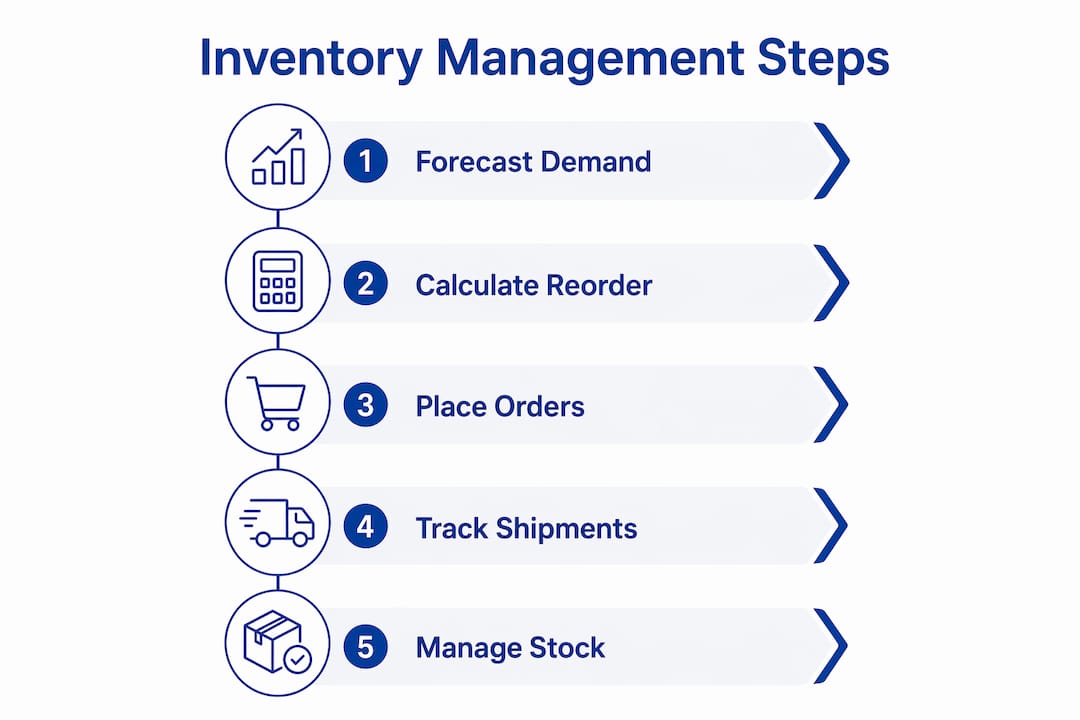
The core process breaks down into four operational steps:
- Demand forecasting: Estimate how many units you will sell over a given period using sales velocity, seasonality, and channel mix data.
- Reorder point calculation: Determine the exact stock level that triggers a new purchase order, factoring in lead time and safety stock.
- Lead time accuracy: Calculate your total landed lead time by adding production, transit, port clearance, receiving, and putaway. Southeast Asia to U.S. pipelines often total 55–75 days, not the 30 days a supplier quotes. Underestimating this single number causes more stockouts than any other mistake.
- Safety stock management: Keep a buffer of units on hand to absorb demand spikes and supply delays. For FBA sellers in 2026, the optimal safety stock window is 30–45 days to balance Amazon’s low-inventory fees against aged inventory surcharges.
Pro Tip: Build your reorder point formula as: (Average Daily Sales × Total Landed Lead Time) + Safety Stock. Plug in real numbers from your last 90 days, not supplier estimates.
What are the biggest challenges in managing inventory effectively?
The most damaging inventory mistakes fall into three categories: forecasting errors, channel misalignment, and synchronization failures. Each one quietly drains cash before you notice the problem.
- Forecasting errors: Rolling 30-day averages for demand planning often fail because they ignore seasonality, promotions, and shifts in channel mix. The result is stockouts and overstock happening at the same time across different SKUs.
- Overstocking vs. stockouts: Mismanaged inventory causes 20–30% annual value loss in holding costs and markdowns. For multichannel brands, combined stockouts and stranded stock can generate losses around $670,000 annually. That is not a rounding error. That is a business-ending number for most sellers.
- Channel misalignment: Allocating stock without accounting for each channel’s risk profile means you run out on Amazon while sitting on excess inventory in your Shopify warehouse.
- Sync latency: Real-time syncing across sales channels is the most frequent failure mode in multichannel inventory management. A sale on Amazon must immediately decrement stock in Shopify, Walmart, and TikTok Shop. Any delay creates overselling, negative reviews, and order cancellations.
- Amazon fee exposure: Aged inventory surcharges and low-inventory fees compound quickly when your IPI score drops. Understanding the full Amazon seller fee structure helps you model the true cost of holding excess stock.
The significance of inventory control becomes clear when you add up these costs. Most sellers underestimate how much poor stock management affects their margin until they run a full cost audit.
Manual spreadsheets vs. inventory management software: which is right for you?
The tools you use to manage inventory determine how fast you can react to demand changes. Here is a direct comparison of the main approaches available to ecommerce sellers in 2026.
| Approach | Best For | Key Limitation |
|---|---|---|
| Manual spreadsheets (Excel, Google Sheets) | Solo sellers with fewer than 50 SKUs | No real-time sync; human error risk is high |
| Cin7 | Multichannel sellers needing warehouse management | Higher cost; setup complexity |
| Katana | Manufacturers and sellers with production workflows | Less suited for pure resellers |
| Finale Inventory | Mid-size Amazon and Shopify sellers | Interface learning curve |
| Native Amazon tools (Restock Inventory, FBA Dashboard) | FBA-only sellers | Limited multichannel visibility |
The core requirement for any tool you choose is a real-time available-to-promise (ATP) calculation. ATP tells every sales channel exactly how many units are actually available to sell right now, after accounting for pending orders and reserved stock. Without it, you are guessing. Platforms like Cin7 and Finale integrate directly with Amazon Seller Central and Shopify, which means a sale on one channel immediately updates available stock across all others.
Channel-aware allocation takes this further by applying different reservation rules per channel. You might reserve 60% of a SKU for Amazon FBA and 40% for direct-to-consumer, based on each channel’s sales velocity and margin profile. That kind of rule-based logic is impossible to maintain in a spreadsheet at scale.
Pro Tip: Before buying any inventory management software, map your exact data flow: where does a sale trigger a stock update, and how long does that update take? If the answer is “I’m not sure,” that gap is your biggest operational risk.
How to implement inventory management strategies that actually work
Turning inventory control from a reactive scramble into a predictable system requires a fixed weekly cadence and a few non-negotiable frameworks. Weekly inventory reviews of sell-through rates and aged stock keep your operations aligned. Daily velocity data is noise. Monthly reviews are too slow to catch demand shifts before they become expensive problems.
Here is a practical implementation sequence for Amazon and ecommerce sellers:
- Set your weekly review schedule. Every week, pull your sell-through rate, days of supply, and aged inventory report from Amazon Seller Central. Flag any SKU below 30 days of supply or above 90 days of supply immediately.
- Segment safety stock by channel risk. Safety stock targets segmented by channel risk prevent blanket overstock. Amazon FBA carries higher stockout risk due to lead time and fee penalties, so it warrants a larger buffer than a 3PL fulfilling your own website.
- Build a buffer node strategy. Experienced Amazon sellers keep safety stock at a domestic 3PL as a buffer node to replenish FBA quickly without triggering aged inventory surcharges or lowering their IPI score. You send 45 days of stock to FBA and hold 30 days at the 3PL. When FBA stock drops to 20 days, you ship from the 3PL the same week.
- Apply weighted forecasting. Replace rolling 30-day averages with weighted averages that emphasize recent data and account for seasonality. If Q4 drives 40% of your annual volume, your reorder points in October need to reflect that, not your August average.
- Audit your Amazon FBA fees monthly. Review your Amazon FBA cost structure to identify which SKUs are generating disproportionate storage fees. Low-margin, slow-moving SKUs often cost more to store than they earn. Remove or liquidate them before they drag down your IPI score.
The role of inventory in business performance is not just operational. It is financial. Lean, well-managed inventory frees up cash that you can reinvest in advertising, new product development, or listing optimization. That is where the real growth happens.
Pro Tip: Create a “SKU health scorecard” that tracks days of supply, sell-through rate, and storage fee cost per unit for every active SKU. Review it every Monday morning before you check anything else.
Key takeaways
Effective inventory management is the foundation of profitable ecommerce, requiring real-time stock visibility, channel-specific safety stock, and a fixed weekly review cadence to prevent costly stockouts and overstock.
| Point | Details |
|---|---|
| Define total landed lead time | Include production, transit, and receiving in your lead time, not just the supplier quote. |
| Use the buffer node strategy | Keep safety stock at a domestic 3PL to replenish FBA fast without aged inventory penalties. |
| Segment safety stock by channel | Assign different buffer levels per channel based on stockout risk and fee exposure. |
| Switch to weighted forecasting | Replace rolling averages with seasonality-adjusted models to prevent simultaneous overstock and stockouts. |
| Run weekly inventory reviews | Daily data is noise; monthly is too slow. Weekly reviews catch problems before they cost you money. |
Why I think most sellers treat inventory as an afterthought
Most Amazon sellers I work with come to inventory management the hard way. They run out of stock during Prime Day, watch their organic rank collapse, and spend the next three months clawing it back. Or they over-order to compensate, get hit with aged inventory surcharges, and watch their IPI score drop below 400 right before Q4 storage limits kick in. Both outcomes are avoidable. Neither is rare.
The uncomfortable truth is that inventory management is not a logistics problem. It is a financial planning problem. The sellers who get it right treat their stock levels the same way a CFO treats a cash flow forecast: with a fixed weekly rhythm, clear thresholds, and a bias toward action before the numbers get bad.
What I have found actually works is the combination of a buffer node at a domestic 3PL, channel-specific safety stock targets, and weighted forecasting that accounts for your actual sales patterns. None of these are complicated. All of them require discipline to maintain consistently.
The sellers who win on Amazon in 2026 are not the ones with the best products. They are the ones whose products are always in stock, always ranked, and always converting. Inventory is the silent variable behind all three. Pair your stock control with strong listing optimization strategies and you compound the advantage. One without the other leaves money on the table.
— Goga
How Searchoneers helps you turn inventory control into sales growth

Strong inventory management keeps your products in stock. Strong listing optimization makes sure those products convert when shoppers find them. Searchoneers specializes in both sides of that equation. The team at Searchoneers builds data-backed Amazon listings with enhanced titles, bullet points, descriptions, and backend keywords that capture visibility and drive sales. If your products are in stock but not ranking, your inventory investment is not working as hard as it should. Start with the Amazon listing enhancement guide to see exactly where your listings are leaving sales behind. Pair that with the listing optimization checklist to build a repeatable process that compounds over time.
FAQ
What is inventory management in simple terms?
Inventory management is the process of tracking, ordering, and storing products so you always have the right stock available to meet customer demand without overspending on storage.
What is the inventory control definition for Amazon FBA sellers?
Inventory control for Amazon FBA sellers means maintaining stock levels that keep your IPI score above 400, avoid aged inventory surcharges, and prevent stockouts that damage organic rankings.
How do I calculate safety stock for my ecommerce business?
Safety stock equals your maximum daily sales minus your average daily sales, multiplied by your maximum lead time. For FBA sellers, target 30–45 days of supply as a baseline buffer.
What inventory management software works best for multichannel sellers?
Cin7, Katana, and Finale Inventory all integrate with Amazon and Shopify, providing real-time available-to-promise calculations that prevent overselling across channels.
Why does inventory management matter for Amazon rankings?
Stockouts cause your Amazon listing to go inactive, which drops your sales velocity and organic rank. Recovering that rank after a stockout typically takes weeks of lost revenue and advertising spend.

Comments
One response to “What Is Inventory Management for Amazon Sellers”
[…] product with strong margins at $26.00 gives you room to hold more stock without pressure. Use your inventory cost forecasts alongside calculator outputs to plan reorder quantities that match your cash […]