

TL;DR:
- SEM offers immediate, targeted visibility to high-intent buyers, complementing long-term SEO efforts.
- Combining SEM and SEO enhances product ranking, reduces dependency on paid ads, and boosts profitability.
- Active management and data analysis of campaigns improve ad performance and inform listing optimization.
Amazon SEM strategies to boost storefront visibility
Listing your products on Amazon and hoping buyers find you is like opening a store in the middle of nowhere and waiting for foot traffic. The marketplace has over 9.7 million sellers competing for the same eyeballs, and simply being present is no longer enough. Search engine marketing gives you the tools to put your products in front of buyers who are ready to purchase, right now. This guide breaks down exactly how SEM works on Amazon, when to use it, and how to combine it with SEO to build a storefront that generates consistent, profitable sales without burning through your ad budget.
Table of Contents
- Understanding search engine marketing for Amazon storefronts
- When and why to use SEM: Timing and business goals
- Integrating SEM and SEO for lasting success on Amazon
- Actionable SEM strategies and pitfalls to avoid for Amazon sellers
- Why most Amazon sellers misuse SEM (and what experience teaches us)
- Next steps: Master SEM and SEO with expert Amazon resources
- Frequently asked questions
Key Takeaways
| Point | Details |
|---|---|
| SEM delivers fast visibility | Ad campaigns can immediately drive high-intent traffic to new and seasonal Amazon products. |
| SEO ensures lasting growth | Optimized product listings steadily build organic rank and reduce long-term ad dependence. |
| Integration boosts results | Combining SEM and SEO maximizes both short-term sales velocity and sustained organic reach. |
| Data drives decisions | Regularly monitoring TACoS, ACOS, and conversion rates helps prevent wasted ad spend. |
Understanding search engine marketing for Amazon storefronts
Search engine marketing, or SEM, refers to paid advertising tactics that increase product visibility in search results. On Amazon, this primarily means Sponsored Products, Sponsored Brands, and Sponsored Display ads. These appear at the top or throughout search result pages, giving your listings prime real estate before a single organic result appears.
A lot of sellers confuse SEM with SEO and end up treating them as the same thing. They are not. SEO, or search engine optimization, is the process of improving your product listings so they rank higher in organic (unpaid) search results. It focuses on keyword placement in your title, bullet points, description, and backend search terms. SEM, by contrast, puts your listing in front of shoppers immediately by paying for placement. As Amazon notes, SEM vs SEO differ in a key way: SEM provides immediate visibility for launches and high-intent traffic but risks ad dependency if your TACoS (Total Advertising Cost of Sale) rises uncontrollably, while SEO builds sustainable organic rank through optimized listings over time.
Here is why both matter together:
- SEM captures ready-to-buy shoppers immediately after launch or during peak seasons.
- SEO compounds over time, reducing your reliance on paid ads as organic ranking improves.
- Combined, they allow you to boost product visibility at launch and maintain it without hemorrhaging ad spend long-term.
- Keyword data from SEM reveals which terms actually convert, informing smarter SEO decisions.
- Optimized listings from SEO improve your Quality Score equivalent on Amazon, often lowering your cost per click in SEM campaigns.
One of the most persistent misconceptions about Amazon SEM is that bigger budgets automatically mean better results. That is simply not true. A poorly targeted campaign with a large budget will drain money faster than a focused, well-structured campaign on a modest budget. Another misconception is that SEM is only for large brands. Small sellers running targeted Sponsored Products campaigns on niche keywords often see better returns than large sellers running broad campaigns.
“SEM is not a silver bullet. It is a lever. Pull it at the right moment, with the right setup, and it accelerates your growth. Pull it blindly and it bleeds your margins dry.”
Understanding this distinction sets the foundation for everything that follows. SEM is a precision tool, not a spray-and-pray solution.
When and why to use SEM: Timing and business goals
Knowing what SEM is matters less than knowing when to activate it. Timing your campaigns to specific business scenarios makes the difference between a profitable ad spend and a money pit.
Here are the most impactful moments to lean into SEM:
- New product launches. Organic rank takes time to build. SEM gives a brand-new listing immediate exposure on page one while your SEO efforts gain traction.
- Seasonal promotions. Prime Day, Black Friday, and back-to-school seasons see spikes in buyer intent. Ramping up SEM during these windows captures high-conversion traffic.
- Clearing slow-moving inventory. Running Sponsored Products on underperforming SKUs can generate the sales velocity needed to recover rank and move stock before storage fees mount.
- Competitive keywords. If competitors dominate organic results for your highest-value keywords, SEM lets you appear alongside them immediately.
- Testing new markets. Before committing to full SEO optimization for a new keyword cluster, run a short SEM test to validate buyer demand.
Here is a straightforward comparison of what SEM-driven and organic sales look like over time:
| Metric | SEM-driven sales | Organic sales |
|---|---|---|
| Time to first sale | Immediate (hours) | Weeks to months |
| Cost per sale | Higher (ad spend included) | Lower over time |
| Scalability | Budget-dependent | Compounds with rank |
| Risk | Ad dependency, margin squeeze | Slower start |
| Best for | Launches, promos, testing | Long-term profitability |
To evaluate whether your SEM campaigns are actually working, track these key metrics closely:
- TACoS (Total Advertising Cost of Sale): Measures ad spend relative to total revenue. A rising TACoS over time signals dangerous ad dependency.
- ACOS (Advertising Cost of Sale): Ad spend divided by ad-attributed revenue. Lower is generally better, but acceptable ACOS varies by margin.
- Click-through rate (CTR): Indicates how compelling your listing title and image are to shoppers.
- Conversion rate (CVR): Shows what percentage of clicks result in a purchase. Low CVR with high spend means the listing itself needs work.
As Amazon confirms, SEM provides immediate visibility for launches and high-intent traffic but risks ad dependency if TACoS climbs without a parallel SEO strategy. Pair SEM with a solid SEO guide for boosting sales to ensure ads are a catalyst, not a crutch.

Pro Tip: Set a TACoS target before launching any SEM campaign. If TACoS exceeds your gross margin percentage, you are paying customers to buy from you at a loss. A common target is keeping TACoS below 15% for established products.
Integrating SEM and SEO for lasting success on Amazon
Running SEM campaigns without a solid SEO foundation is like filling a leaking bucket. You pour in ad spend, see some sales, then watch the bucket empty the moment you pause the ads. Integration is the move that changes the game.
Amazon’s A10 algorithm rewards products that demonstrate strong sales velocity, good conversion rates, and relevant keyword performance. When SEM drives traffic that converts, you are feeding exactly the signals A10 looks for to improve your organic rank. This means SEM boosts sales velocity, which feeds the A10 algorithm for organic gains long after the ads stop.
Here is a practical workflow for combining both:
| Step | SEM action | SEO action |
|---|---|---|
| Launch | Run broad Sponsored Products | Optimize title and bullet points |
| Week 2-4 | Identify top-converting keywords | Add converting keywords to backend |
| Month 2 | Narrow to exact match on winners | Refine description with proven terms |
| Month 3+ | Scale winning campaigns | Build review momentum to sustain rank |
Beyond the workflow, here are the specific SEM and SEO touchpoints you should align:
- Keywords: Use SEM data to identify which keywords drive actual purchases, then embed those terms into your listing’s title, bullets, and backend fields.
- Product images: A high CTR from SEM signals strong visual appeal. Use that data to A/B test images in your listing.
- Price adjustments: If SEM conversion rates are lower than expected, a price test or a bundle offer might lift CVR across both paid and organic traffic.
- Reviews: SEM-driven early sales generate reviews faster, which boosts organic credibility and conversion rates.
- A+ Content: Enhancing your listing’s A+ Content improves conversion rates for both ad traffic and organic visitors.
Follow a proven listing optimization workflow to ensure every element of your listing is conversion-ready before you invest in SEM. Spending money on ads to drive traffic to a weak listing is one of the most expensive mistakes on Amazon.
Common integration mistakes include running ads on keywords not present anywhere in your listing, neglecting to update listings after SEM keyword data comes in, and failing to pause ads when organic rank is already strong. Also, ignoring Amazon SEO best practices during SEM campaigns means you are doubling your effort for half the results.
Pro Tip: Use a 30-day SEM sprint on a new product with a healthy daily budget. Review which keywords had the highest conversion rates, then immediately update your listing’s title and backend search terms with those proven winners. This compresses months of SEO testing into a few weeks.
Actionable SEM strategies and pitfalls to avoid for Amazon sellers
Strategy without execution is just theory. Here is exactly how to build, run, and optimize SEM campaigns on Amazon in a way that protects your margins and builds momentum.
Step-by-step campaign creation:
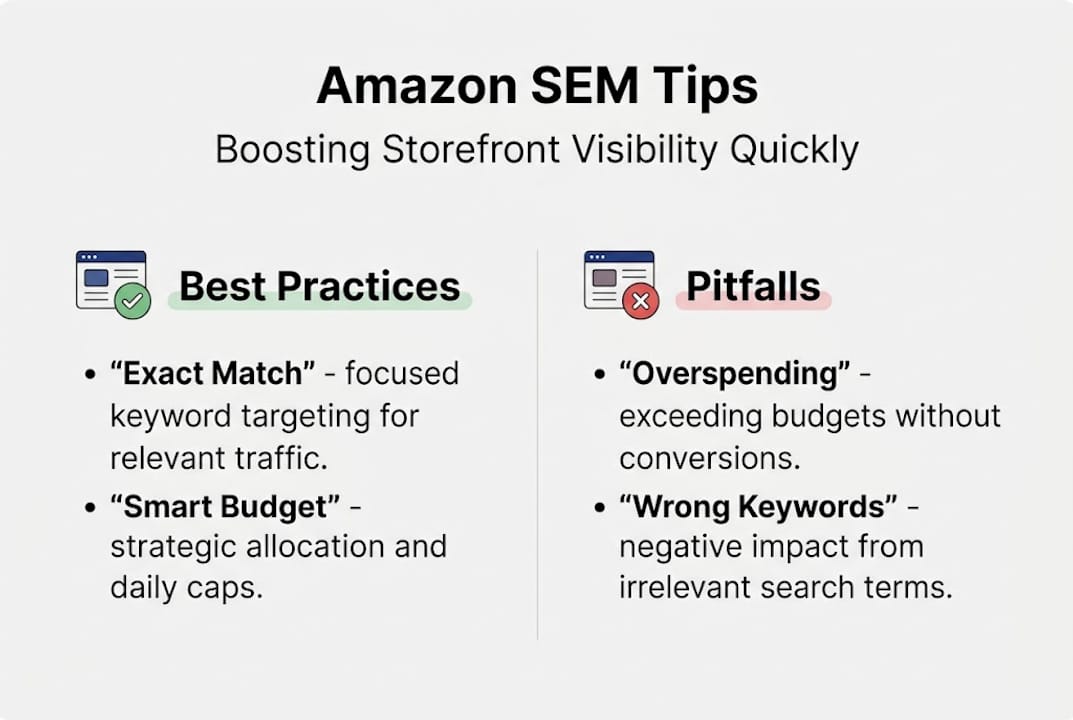
- Start with automatic campaigns. Amazon’s algorithm identifies relevant search terms for your product. Let it run for 7 to 14 days to gather data before making changes.
- Harvest converting keywords. Pull the Search Term Report from Seller Central. Identify keywords with conversions and move them into a manual campaign with exact match targeting.
- Set bids based on target ACOS. Use your product margin to calculate the maximum CPC (cost per click) you can afford. Formula: Max CPC = Conversion rate x Product price x Target ACOS.
- Segment campaigns by match type. Run separate campaigns for broad, phrase, and exact match. This lets you control spend at each funnel stage.
- Test one variable at a time. Adjust bids, budgets, or targeting one element at a time so you can measure what actually moved the needle.
Now, the pitfalls. These are the mistakes that cost Amazon sellers thousands of dollars every year:
- Overbidding on generic keywords. Broad terms like “kitchen knife” attract window shoppers, not buyers. Specific long-tail keywords like “6-inch ceramic chef’s knife” convert far better at lower cost.
- Ad dependency. If pausing your ads tanks your sales completely, your organic SEO has not done its job. Ads should supplement organic rank, not replace it.
- Ignoring the listing. As Amazon confirms, SEM risks ad dependency when it compensates for a weak listing. Use a high-converting listing guide to fix the listing before scaling ad spend.
- Set-and-forget mentality. Amazon’s ad marketplace shifts constantly. Keywords that perform in January may hemorrhage in March. Review campaigns weekly.
- Ignoring negative keywords. Without a negative keyword list, your ads show for irrelevant searches, eating budget with zero conversion potential.
Ongoing optimization checkpoints to run weekly or biweekly:
- Review TACoS and ACOS trends
- Add new negative keywords from the Search Term Report
- Pause underperforming ad groups (zero conversions after 30 days)
- Scale budgets on campaigns with ACOS below your target
- Test new creative in Sponsored Brand campaigns
For sellers aiming to refine both their campaigns and listings together, a guide focused on optimizing for higher sales covers the listing improvements that directly lift SEM performance.
Pro Tip: Allocate 70% of your SEM budget to your proven exact-match winners and only 30% to exploration (broad and automatic campaigns). This protects your core revenue while still allowing you to discover new keywords.
Why most Amazon sellers misuse SEM (and what experience teaches us)
Here is the candid truth most SEM guides will not tell you: the majority of Amazon sellers treat paid advertising like a vending machine. Insert money, receive sales. That mindset is exactly why so many storefronts bleed ad spend without building any real asset.
The sellers who get lasting results understand something fundamental. SEM is a data-collection and acceleration tool, not a perpetual revenue engine. Every dollar you spend on ads should be buying you information. Which keywords convert? At what price point does your conversion rate hold? Which images drive clicks?
The “set-and-forget” approach fails because Amazon’s marketplace is dynamic. Competitor bids change. Seasonality shifts buyer intent. New sellers enter your niche and disrupt keyword pricing. Without active management, campaigns drift toward inefficiency quietly and expensively.
There is also a hidden benefit most sellers overlook: SEM naturally filters for high-intent buyers. Someone who clicks a Sponsored Products ad after searching a specific term is far more likely to convert than a browser scrolling through recommendations. That behavioral signal, when collected and analyzed, tells you exactly which step-by-step SEO strategies to prioritize in your organic listing improvements.
The sellers who win are not the ones with the biggest budgets. They are the ones who treat every campaign as an experiment, pull data relentlessly, and use what they learn to sharpen both their ads and their listings.
Next steps: Master SEM and SEO with expert Amazon resources
You now have a clear framework for understanding, timing, integrating, and executing SEM on your Amazon storefront. The next move is applying these strategies with the right tools and guidance behind you.

Our Amazon Listing Enhancement Guide walks you through the exact listing improvements that multiply the returns from your ad spend, covering titles, bullet points, A+ Content, and backend keyword strategies built for 2026’s algorithm. If you want to build the organic foundation that makes SEM work harder, the Amazon SEO Guide gives you a full, step-by-step system to grow organic rank alongside your paid campaigns. Both resources are built specifically for sellers who are serious about sustainable storefront growth.
Frequently asked questions
What is the main difference between SEM and SEO for Amazon sellers?
SEM delivers fast, paid visibility through Sponsored Products and Brand ads, while SEO builds organic reach by optimizing your listing’s keywords, content, and structure. As Amazon states, SEM provides immediate visibility but risks ad dependency, while SEO builds sustainable organic rank. Using both together consistently yields the strongest long-term results.
How does SEM influence Amazon’s A10 algorithm for organic ranking?
SEM drives sales velocity, a key signal that Amazon’s A10 algorithm interprets as strong buyer demand. More sales in a short window signals relevance, which improves your product’s organic ranking over time even after the ads stop running.
When is it best to rely on SEM rather than SEO strategies?
SEM is the right tool during product launches, major sales events, or when you need immediate visibility in competitive search terms. As Amazon explains, SEM provides immediate high-intent traffic, while SEO is better suited for sustained, lower-cost growth once organic rank is established.
What SEM metrics should Amazon sellers monitor closely?
Track TACoS, ACOS, click-through rate, and conversion rate on every active campaign. These four metrics reveal whether your campaigns are generating profitable sales or simply moving budget into Amazon’s pockets without building long-term storefront value.
Can overusing SEM hurt long-term Amazon sales?
Yes. Heavy reliance on SEM without building organic rank creates a fragile business model where pausing ads causes sales to collapse. Balancing paid campaigns with consistent SEO improvements builds lasting momentum and reduces your cost of sale over time.

Comments
One response to “Amazon SEM strategies to boost storefront visibility”
[…] Amazon SEM strategies to boost storefront visibility – Searchoneers […]