

Keyword stuffing used to be the go-to move for Amazon sellers chasing page-one rankings. That era is over. The A10 algorithm in 2026 has shifted the playing field dramatically, prioritizing behavioral signals like conversion rate, sales velocity, and click-through rate over raw keyword density. If you’re still loading your titles with repetitive terms and wondering why your rankings stall, this guide will show you exactly what to fix and how to build a listing strategy that actually moves the needle.
Table of Contents
- How Amazon’s A10 algorithm works in 2026
- Amazon SEO fundamentals: What really matters
- Keyword strategy: From research to backend optimization
- Conversion rate and click-through rate: The secret weapon
- Driving sales velocity: PPC, external traffic, and inventory health
- Avoiding common Amazon SEO mistakes in 2026
- Maximize your Amazon SEO with expert assistance
- Frequently asked questions
Key Takeaways
| Point | Details |
|---|---|
| Behavioral metrics win | Conversion rate, click-through rate, and sales velocity are now the top Amazon ranking factors. |
| Keywords require strategy | Place researched keywords in titles and backend fields without duplication or stuffing. |
| Optimize for conversion | High-quality images, persuasive content, and review cultivation drive measurable ranking gains. |
| Drive consistent sales | Steady, keyword-targeted PPC and external traffic build lasting velocity and defend rank. |
| Avoid common pitfalls | Stockouts, compliance missteps, and over-optimization can quickly tank your visibility. |
How Amazon’s A10 algorithm works in 2026
Now that you know keywords alone aren’t enough, let’s break down what actually powers Amazon’s search results in 2026. The A10 algorithm is a significant evolution from its predecessor, A9. Where A9 leaned heavily on keyword relevance and paid ad spend, A10 rewards listings that demonstrate real buyer engagement after the click.
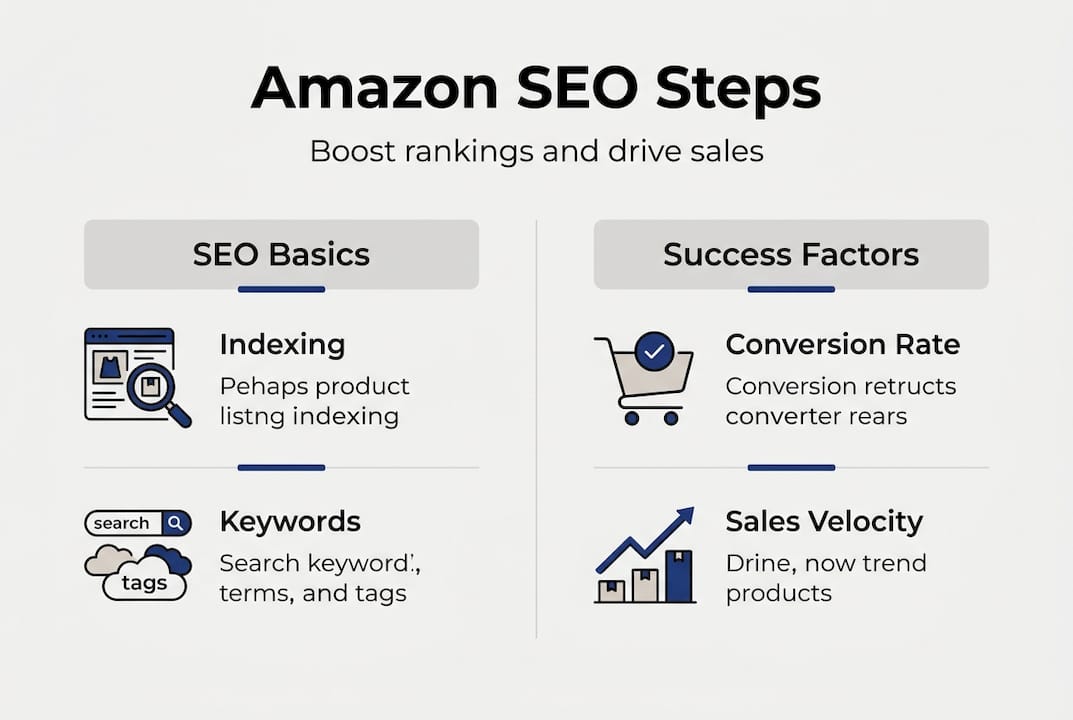
The core mechanics work in two stages. First, keywords get you indexed, meaning Amazon knows your product exists for a given search term. Your title carries the most weight here, followed by bullet points and backend search terms. But indexing is just the entry ticket. Ranking is where the real competition happens, and it’s driven by three performance signals: click-through rate (CTR), conversion rate (CR), and sales velocity.
A10 rewards listings with high conversion, where a listing converting at 12% will consistently outrank one converting at 7%, even if the lower-converting listing has more keywords. Ranking is driven by CTR from your main image, title, and price, then by conversion rate from your images and A+ content, and finally by sales velocity from organic, PPC, and external traffic combined.
Recent algorithm adjustments have also introduced compliance signals. Listings with policy violations, poor image quality, or pricing inconsistencies now face organic ranking suppression. When you’re optimizing Amazon listings, think of it as building a case for Amazon to trust your product with its customers.
| Ranking signal | A9 weight | A10 weight |
|---|---|---|
| Keyword density | High | Low |
| Conversion rate | Moderate | Very high |
| Sales velocity | Moderate | Very high |
| CTR (image/title/price) | Low | High |
| Compliance and image quality | Low | Moderate |
“Consistent keyword-specific sales velocity is the single most reliable predictor of sustained organic rank in 2026.” This is why inventory optimization strategies matter as much as listing copy.
Amazon SEO fundamentals: What really matters
Understanding A10’s priorities helps us focus on what drives visibility. Let’s see which elements matter most in 2026. The biggest mistake sellers make is treating Amazon SEO like Google SEO. On Google, content depth and backlinks drive authority. On Amazon, buyer behavior drives everything.
Here’s what actually moves rankings:
- Conversion rate: The percentage of shoppers who buy after viewing your listing. This is the single strongest signal.
- Sales velocity: How consistently you generate keyword-specific sales over time. Spikes don’t help. Steady volume does.
- Click-through rate: How often shoppers click your listing from search results. Your main image and price are the biggest levers.
- Keyword relevance: Still necessary for indexing, but not a ranking driver on its own.
- Review count and rating: Indirectly boosts CTR and CR, which then improve rank.
Behavioral signals trump indexing, and consistent velocity beats short-term spikes every time. Sellers who chase keyword rankings without fixing their conversion rate are essentially pouring water into a leaky bucket. Use our Amazon selling tips and listing optimization checklist to audit your current listings against these fundamentals.
Pro Tip: Before adding new keywords, run a quick audit of your main image and price point. If your CTR is below 0.5%, no keyword change will save your ranking.
Keyword strategy: From research to backend optimization
Having established the ranking hierarchy, let’s detail how to research and implement keywords that work for A10. Effective keyword research in 2026 starts with intent, not volume. A keyword with 50,000 monthly searches but low purchase intent will generate clicks without conversions, which actually hurts your ranking.
Follow this five-step methodology for keyword integration:
- Research by intent: Use tools like Helium 10 or Amazon’s own Brand Analytics to identify keywords by purchase intent, not just search volume.
- Optimize your title first: Front-load your primary keyword within the first 80 characters. Keep titles under 200 characters total.
- Build out bullet points: Place secondary keywords naturally within benefit-driven copy. Don’t force them.
- Write your description for A+ content: If you have Brand Registry, replace the description with A+ content and focus on feature-benefit-proof structure.
- Fill backend search terms: Use non-duplicate, non-customer-facing terms. No duplicates in backend fields, and never repeat what’s already in your title or bullets.
| Field | Compliant use | Non-compliant use |
|---|---|---|
| Title | Primary keyword, brand, key feature | Keyword repetition, competitor names |
| Bullet points | Benefits with secondary keywords | Health claims without substantiation |
| Backend keywords | Synonyms, alternate spellings | Duplicates, prohibited claims |
| Description/A+ | Feature-benefit storytelling | Pricing, promotional language |
Pro Tip: Never add competitor brand names to your backend keywords. Amazon’s algorithm deduplicates them anyway, and it risks policy violations that can suppress your listing entirely.
Building high-converting Amazon listings requires pairing smart keyword placement with strong product categorization strategies so your listing reaches the right audience from the start.
Conversion rate and click-through rate: The secret weapon
With keywords in place, it’s time to focus on the factors that truly propel rankings. Conversion rate and click-through rate are where most sellers leave the most ranking potential on the table.

Your main image is the single highest-leverage element for CTR. It’s the first thing a shopper sees in search results, before they even read your title. A professional, high-contrast image on a clean white background with clear product sizing outperforms lifestyle shots in search results every time. One image reshoot lifted CR by 5.2% in a documented case, which translated directly into a ranking jump within two weeks.
Here’s what to prioritize for CR and CTR improvements:
- Main image quality: High resolution, white background, product fills 85% of frame
- Price competitiveness: Even a $2 price difference can shift CTR significantly
- Review count: Listings with 50+ reviews convert at nearly double the rate of new listings
- A+ content: Structured feature-benefit-proof modules increase CR measurably
- Mobile optimization: Over 60% of Amazon purchases happen on mobile; check how your listing renders on a phone
Prioritize CR optimization first, specifically images over keywords, and use PPC for contextual velocity while AI-driven features like Rufus and COSMO favor intent-structured content. Review our optimized listing examples and listing strategy guide to see these principles applied in practice.
| Optimization | Avg. CTR lift | Avg. CR lift |
|---|---|---|
| Main image upgrade | 15-25% | 8-12% |
| A+ content addition | 3-5% | 10-15% |
| Price adjustment | 5-10% | 5-8% |
| Review cultivation | 8-12% | 12-18% |
“Images are your first conversion tool. Shoppers decide in under two seconds whether to click. If your image doesn’t stop the scroll, your keywords never get a chance.”
Driving sales velocity: PPC, external traffic, and inventory health
Ranking improvement relies on momentum. Let’s discuss how you can reliably drive velocity and avoid setbacks. Sales velocity is not just about total sales. It’s about keyword-specific sales, meaning Amazon tracks which search terms led to each purchase.
Here are the most effective traffic-driving methods, ranked by impact:
- Keyword-targeted Sponsored Products campaigns: The most direct way to build keyword-specific velocity. Target exact-match keywords you want to rank for organically.
- External traffic from social media and email: Drives incremental velocity that Amazon rewards with a ranking boost for off-platform demand.
- Influencer and creator partnerships: Particularly effective for new product launches where organic velocity is still building.
- Lightning Deals and promotions: Short-term velocity spikes can help establish initial rank, but they need to be followed by sustained organic sales.
- Broad PPC campaigns: Broad PPC doesn’t build keyword-specific velocity, so use them for discovery, not ranking.
Inventory health is equally critical. Stockouts suppress rankings immediately, and recovering lost rank after a stockout can take weeks. Protect your Amazon product visibility by maintaining at least 30 days of safety stock for your top-performing SKUs.
Pro Tip: Set up weekly keyword position tracking in Brand Analytics. If a keyword drops more than five positions in a week, investigate your CR and inventory levels before adjusting your PPC bids.
Avoiding common Amazon SEO mistakes in 2026
Now, let’s outline the traps even experienced sellers fall into so you can sidestep these costly mistakes. Many of these errors are invisible until the damage is already done.
Watch out for these critical mistakes:
- Keyword over-optimization: Repeating the same keyword across your title, bullets, and backend doesn’t improve ranking. It signals low-quality content and wastes character space.
- Ignoring compliance in restricted categories: Food, beverage, and health products have strict rules about claims. A single non-compliant bullet point can suppress your entire listing.
- Stockouts without a backup plan: Going out of stock erases ranking gains fast. Always have reorder triggers set before you hit your safety stock threshold.
- Neglecting mobile image stacks: Your secondary images tell the product story on mobile. Outdated or low-quality secondary images kill conversion on the majority of your traffic.
- Running PPC without checking CR first: Avoid PPC without CR optimization in place. Spending ad budget to drive traffic to a low-converting listing accelerates ranking decline, not growth.
Use a structured listing optimization workflow to audit each of these areas systematically before launching or scaling any campaign.
Maximize your Amazon SEO with expert assistance
If you want to outpace the competition and get expert support, here’s how you can take your Amazon SEO even further. Applying everything in this guide takes time, testing, and a clear system. That’s exactly what we’ve built at Searchoneers.

Our Amazon listing enhancement guide walks you through every field with real examples, while our Amazon SEO optimization resources give you the data-backed frameworks to stay ahead of algorithm changes. Whether you need a full listing audit or a step-by-step Amazon optimization workflow, our team specializes in turning underperforming listings into consistent revenue drivers. Stop guessing and start optimizing with strategies built specifically for how Amazon ranks products in 2026.
Frequently asked questions
What is the most important Amazon SEO factor in 2026?
Conversion rate and sales velocity have the strongest impact on rankings, surpassing simple keyword usage. Amazon’s algorithm rewards consistent buyer engagement over keyword density.
How should I structure backend keywords?
Use non-repetitive, customer-relevant terms and avoid duplicating keywords already present in your title or bullet points. Backend fields are for synonyms and alternate spellings only.
Can keyword stuffing improve my Amazon rankings?
No. Backend keyword stuffing is deduplicated by Amazon’s system and over-optimization now risks compliance penalties that suppress your listing.
What causes Amazon rankings to drop suddenly?
Inventory stockouts suppress rankings immediately, and compliance violations or large keyword fluctuations are the other most common causes of sudden ranking drops.
Does external traffic help boost Amazon SEO?
Yes. External traffic boosts organic rank by increasing keyword-specific sales velocity, which Amazon treats as a strong demand signal for your listing.

Comments
2 responses to “Amazon SEO guide: boost your product rankings and sales”
[…] sellers who win long-term do something different. They treat Amazon SEO strategies like a discipline, not a one-off project. They set a review cadence, pull SQP data on a fixed […]
[…] it’s below 10 percent, your ranking problem is actually a conversion problem. Fix that first. Our ranking strategies overview walks through exactly how to prioritize these levers for maximum […]