

TL;DR:
- Amazon’s proactive AI scans listings for trademark violations, making enforcement more aggressive and fast. Enrolling in Brand Registry provides essential tools to protect your brand and react swiftly to infringements. To prevent issues, sellers must ensure accurate trademarks, detailed compliance, and proper responses to infringement notices.
Understanding Amazon trademark policy is one of those things most sellers put off until it’s too late. A listing gets taken down, an account gets flagged, and suddenly what seemed like a routine product launch turns into a costly compliance crisis. Amazon’s enforcement has never been more aggressive. The platform uses predictive AI that scans product detail pages, images, and supply chain signals to catch violations before they ever go live. Whether you’re building a private label brand or reselling established products, knowing the rules before you post is the only way to stay protected.
Table of Contents
- Key takeaways
- What Amazon’s trademark policy actually covers
- Brand Registry requirements and what you get
- How Amazon detects trademark violations in 2026
- Practical compliance tips for sellers
- Responding to trademark infringement complaints
- My take on Amazon trademark policy as a seller
- Protect your brand without risking your listings
- FAQ
Key takeaways
| Point | Details |
|---|---|
| Trademark basics matter | Amazon’s rules cover word marks, design marks, titles, images, keywords, and A+ content. |
| Brand Registry requires a trademark | You need an active or pending trademark from an approved IP office to enroll and access protection tools. |
| AI enforcement is proactive | Amazon’s AI scans billions of signals daily to block infringing listings before they go live. |
| Sellers of genuine products are not exempt | Unauthorized brand use in listing content can trigger takedowns even when the product itself is authentic. |
| Use the right channels when responding | Filing trademark appeals through Amazon’s designated legal portals resolves issues in hours, not weeks. |
What Amazon’s trademark policy actually covers
At its core, Amazon trademark policy protects brand owners and customers from confusion about who makes or endorses a product. A trademark can be a word, phrase, logo, symbol, or design that distinguishes one company’s goods from another. Amazon’s rules apply to both types: word marks (like a brand name) and design marks (like a stylized logo).
Here’s where sellers often get tripped up. The policy does not only apply to counterfeit goods. Unauthorized brand use in a listing can trigger a takedown even when the product is completely genuine. If you use a competitor’s brand name in your title to suggest compatibility, or drop a well-known logo into your product images to imply endorsement, you are stepping into infringement territory.
The policy governs several areas of your listings:
- Titles and bullet points: Brand names can only appear if you are the brand owner or an authorized reseller.
- Backend keywords: Using competitor brand names as hidden search terms is a direct violation of Amazon brand guidelines.
- Images: Logos, packaging with third-party marks, and screenshots showing branded apps or products are frequently flagged.
- A+ content: Comparative claims that reference other brands without authorization invite complaints.
Pro Tip: If you are a reseller, check your authorization agreements carefully before listing. Being an authorized distributor does not automatically grant you permission to use a brand’s stylized logo in your images.
The distinction between fair use and infringement is where the gray area lives. Nominative fair use, which allows sellers to reference a brand name to describe compatibility (think “compatible with [Brand X]”), is permitted in limited circumstances. But the moment logos or stylized marks appear in your visuals, Amazon flags the listing for implying unauthorized affiliation.
Brand Registry requirements and what you get
Amazon Brand Registry is the platform’s primary mechanism for trademark enforcement. Enrollment gives brand owners access to powerful tools that can remove infringing listings quickly, and it shifts the burden of proof away from you in many disputes.
To qualify, you must meet specific requirements. Here’s a numbered breakdown of the enrollment path:
- Obtain an active registered trademark or file a pending application with an approved IP office such as the USPTO, IPO, EUIPO, or the equivalent authority in Japan, Australia, India, or several other eligible jurisdictions.
- Ensure exact name matching. The trademark text must match your brand name precisely as it appears on your packaging and Amazon storefront. Even minor punctuation or spacing differences can cause enrollment rejections.
- Provide proof of ownership. This means submitting your trademark registration number and demonstrating that the mark appears on your product or packaging.
- Have an active brand website. Amazon expects legitimate brands to have a web presence that matches the trademark application.
Once enrolled, Brand Registry unlocks a range of brand protection tools, including the “Report a Violation” feature, which allows faster and more automated enforcement than the public infringement form. It also gives access to Amazon’s Project Zero program, which lets brands self-remove infringing listings without waiting for Amazon’s review.
Here’s a quick comparison of what you get with and without Brand Registry:
| Feature | Without Brand Registry | With Brand Registry |
|---|---|---|
| Infringement reporting | Public form only, slower review | “Report a Violation” tool with automated enforcement |
| Listing control | Shared with other sellers | Enhanced ownership and control |
| A+ content access | Limited | Full access |
| Counterfeit removal speed | Days to weeks | Hours via Project Zero |
| Keyword hijacking defense | Reactive only | Proactive monitoring tools |

Amazon’s AI enforcement systems integrate directly with Brand Registry data. When you are enrolled, your trademark information feeds into the automated scanning layer, which means the platform actively defends your brand even when you are not watching.
How Amazon detects trademark violations in 2026
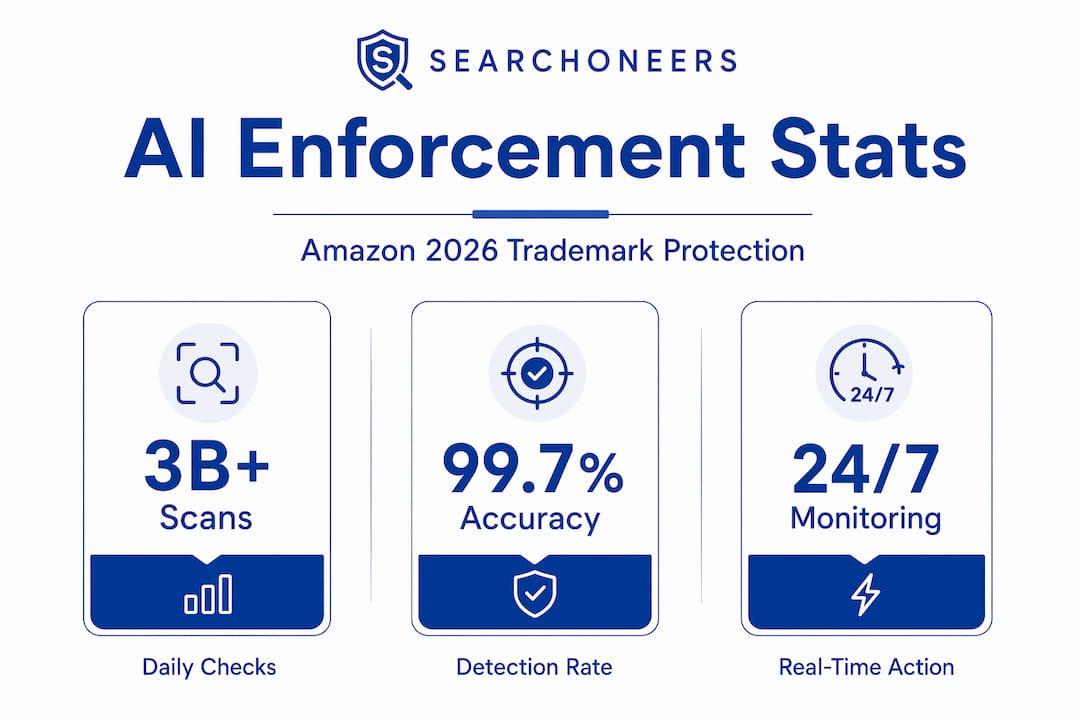
This is where Amazon’s investment in technology sets it apart from every other e-commerce marketplace. Amazon’s AI scans billions of signals including text, images, and supply chain patterns to proactively identify and block trademark infringements before listings ever go live.
To put that in perspective: Amazon scanned billions of attempted product detail changes in a single day in 2024. Most sellers never see this enforcement in action because it stops violations before they reach the marketplace. The ones who do see it are the ones who triggered it.
The detection system works across several dimensions:
| Trigger Type | What It Detects | Common Seller Mistake |
|---|---|---|
| Text analysis | Brand names in titles and keywords | Using competitor names as backend keywords |
| Image scanning | Logos, branded packaging, unauthorized marks | Adding a brand’s logo to lifestyle photos |
| Behavioral signals | Suspicious listing edits or bulk changes | Swapping titles post-launch with brand names |
| Supply chain patterns | Sourcing signals inconsistent with brand claims | Claiming brand authorization without documentation |
Amazon’s enforcement approach is system-driven and heavily favors rights owners. A single trademark claim can trigger listing suspensions or account-level actions, often without a full manual legal review. Speed is the point. Amazon prioritizes risk reduction over individual seller appeals.
Pro Tip: Before launching any new listing, run your title, backend keywords, and images through a trademark check. Search the USPTO database for existing marks that could conflict with your brand name. One seller discovered their brand contained a term already trademarked by another company, triggering automated enforcement the day their listing went live.
The role of AI in e-commerce detection is only growing. What Amazon’s systems catch today is far more sophisticated than keyword matching. Visual recognition, behavioral pattern analysis, and cross-reference with Brand Registry data all work together in real time.
Practical compliance tips for sellers
Staying compliant with Amazon trademark policy is less about memorizing rules and more about building good habits before you publish anything. Here is what that looks like in practice:
- Audit your titles first. Every brand name in your product title should either be your own registered mark or appear with documented authorization. Using phrases like “inspired by [Brand]” or “style of [Brand]” in titles creates confusion and violates policy. Proper title construction protects you and improves your search ranking at the same time.
- Clean up your backend keywords. Backend keywords are not invisible to Amazon’s systems. Competitor brand names stuffed into back-end fields are a common and costly mistake. Replace them with descriptive category terms, material types, and use-case keywords that build organic visibility without the legal risk.
- Check your images carefully. This is the most overlooked area. Lifestyle photos pulled from a manufacturer’s media kit sometimes include other brand logos in the background. Packaging images showing a third-party brand name alongside yours can be flagged. Review every image before uploading.
- Match your trademark exactly. If you are enrolled or planning to enroll in Brand Registry, the trademark name match must be exact. “BrandX” and “Brand X” are not the same. Neither are “Brand-X” and “BrandX.”
- Document your authorizations. If you resell branded products, keep authorization letters, distributor agreements, and brand approval emails in a dedicated folder. You may need them fast if a complaint comes in.
One thing sellers often miss: the compliance rules apply to sponsored ads too. Running a sponsored product ad that targets a competitor’s brand keyword is a separate category of trademark risk, governed both by Amazon’s policy and by potential legal action from the brand owner.
Responding to trademark infringement complaints
Getting a trademark infringement notice does not have to end in a suspension. How you respond in the first 48 hours matters more than most sellers realize.
- Read the notice carefully. Identify the specific ASIN, the trademark at issue, the rights owner, and the specific claim being made. Amazon’s notices often contain the trademark registration number, which you can verify in the USPTO or relevant IP office database.
- Determine whether the claim is valid. Not all infringement complaints are accurate. Check whether the reported trademark is actually registered, whether it covers your product category, and whether your use qualifies as nominative fair use (descriptive use, not implying endorsement).
- Prepare a nominative fair use defense if applicable. If you are selling a product that is genuinely compatible with a branded device and you said so accurately, document the language you used, confirm no logos appeared in your visuals, and prepare a clear written response.
- File through the right channel. Using correct Amazon channels speeds up processing dramatically. Formal trademark documents sent through general seller support can take two to four weeks. The designated Brand Registry legal portals or Amazon’s executive seller relations channels process cases in hours.
- Request a retraction from the complainant. If you have a valid defense, contact the rights owner directly and request a retraction. Amazon requires the original complainant to withdraw the claim before reinstatement, which means resolving it with them directly is often faster than appealing Amazon’s decision alone.
- Consult an IP attorney when stakes are high. For repeat complaints or account-level actions, professional legal counsel is not optional. An attorney who specializes in Amazon intellectual property issues can communicate with precision through channels that generic seller support simply cannot access.
My take on Amazon trademark policy as a seller
I’ve worked with enough Amazon brands to know that most trademark problems are entirely avoidable. And yet, I keep seeing the same pattern: sellers invest months building a product, launch it confidently, and then lose their listing within days because they did not spend two hours on trademark research before going live.
What I’ve learned is that Amazon’s enforcement doesn’t care about your intentions. It cares about signals. A logo in the wrong image, a competitor’s name in your backend keywords, a brand name that sounds too close to an existing registered mark. These are not gray areas in Amazon’s system. They are triggers.
My real concern with where this is heading in 2026 is the increasing speed of automated enforcement. The AI is faster than any appeals process. That asymmetry puts sellers at a structural disadvantage unless they get proactive. Brand Registry isn’t a nice-to-have anymore. It’s table stakes. And if you’re building a brand worth protecting, start the trademark registration process before you list, not after.
The brands I’ve seen thrive are the ones that treat their trademark as a business asset from day one. They use Brand Registry tools, monitor violations regularly, and respond through the right channels when issues arise. That’s not luck. That’s a system.
— Goga
Protect your brand without risking your listings
Building a brand on Amazon means more than just having great products. It means creating listings that are both optimized for search and fully aligned with Amazon policy compliance. That balance is exactly where Searchoneers helps sellers win.

At Searchoneers, our listing enhancement guide walks you through how to build titles, bullet points, and backend keywords that drive visibility without crossing trademark lines. If you want a repeatable process, the listing optimization workflow gives you a step-by-step system designed for compliance and conversion. Your brand deserves listings that rank, convert, and stay live.
FAQ
What is Amazon’s trademark policy?
Amazon trademark policy prohibits sellers from using trademarked brand names, logos, or designs in listings, images, or backend keywords without authorization. The policy protects brand owners and customers from confusion about product origin or endorsement.
Do I need a trademark to sell on Amazon?
You do not need a trademark to sell on Amazon, but you need an active registered trademark or a pending application to enroll in Amazon Brand Registry and access brand protection tools.
Can I use a brand name to describe compatibility?
Yes, in limited cases. Nominative fair use allows you to reference a brand name to describe compatibility (such as “compatible with Brand]”), but [using logos or stylized marks in images is not permitted and will likely trigger enforcement.
What happens when I get a trademark infringement notice?
Amazon may suspend your listing or take account-level action. You should review the claim, determine if it’s valid, and respond through Amazon’s designated legal channels rather than general seller support to speed up resolution.
How does Amazon detect trademark violations automatically?
Amazon uses predictive AI tools that analyze text, images, and supply chain data to identify and block potential trademark infringements before listings go live, often without any human review involved.

Leave a Reply