

Over 60 percent of Amazon sellers rely on detailed reports to shape their business decisions. Access to accurate sales and inventory data is critical for staying competitive in the crowded marketplace. Understanding Amazon Business Reports not only reveals where your money is going but also exposes hidden trends and opportunities for growth. In a landscape driven by data, knowing how to interpret these powerful analytics can be the difference between steady progress and missed potential.
Table of Contents
- Defining Amazon Business Reports And Core Concepts
- Essential Types Of Amazon Business Reports Explained
- Key Metrics And Features For Sellers
- How To Access And Use Business Reports
- Common Pitfalls And Mistakes To Avoid
Key Takeaways
| Point | Details |
|---|---|
| Insightful Analytics | Amazon Business Reports provide detailed insights beyond transactions, focusing on purchasing trends, inventory management, and sales performance. |
| Variety of Reports | Different report types such as Reconciliation, Returns, and Orders offer strategic perspectives that can enhance decision-making processes for sellers. |
| Critical Metrics | Key performance metrics like sales volume, conversion rates, and customer engagement are essential for evaluating market performance and driving improvements. |
| Proactive Analysis | Regular analysis of reports is crucial; sellers should avoid common pitfalls such as neglecting reconciliations and interpreting data without context to optimize strategies. |
Defining Amazon Business Reports and Core Concepts
Amazon Business Reports represent a sophisticated digital analytics platform designed to provide sellers and organizations comprehensive insights into their purchasing, sales, and operational performance. According to Up University, these reports enhance spending visibility by delivering intricate details about purchasing behaviors and organizational spending patterns.
Business Reports function as a powerful diagnostic tool that enables Amazon sellers and business account holders to track, analyze, and optimize their commercial activities. These reports go beyond simple transaction logs, offering nuanced perspectives on:
- Purchasing trends and expenditure patterns
- Inventory management metrics
- Sales performance indicators
- Organizational spending analysis
The core mechanism behind Amazon Business Reports leverages advanced data tracking technologies. As Dr. Press Research highlights, these systems utilize sophisticated barcode scanning and automated warehouse management techniques to ensure precise data collection and reporting accuracy.
Understanding these reports requires recognizing they are more than just numerical summaries. They represent strategic intelligence tools that transform raw transactional data into actionable business insights. By providing granular visibility into purchasing behaviors, inventory dynamics, and sales performance, Amazon Business Reports empower organizations to make data-driven decisions that can significantly enhance operational efficiency and financial strategy.
Essential Types of Amazon Business Reports Explained
Amazon Business provides a comprehensive suite of reporting tools designed to give sellers and organizations granular insights into their commercial activities. Up University identifies several critical report types that serve different strategic purposes, each offering unique perspectives on business performance.
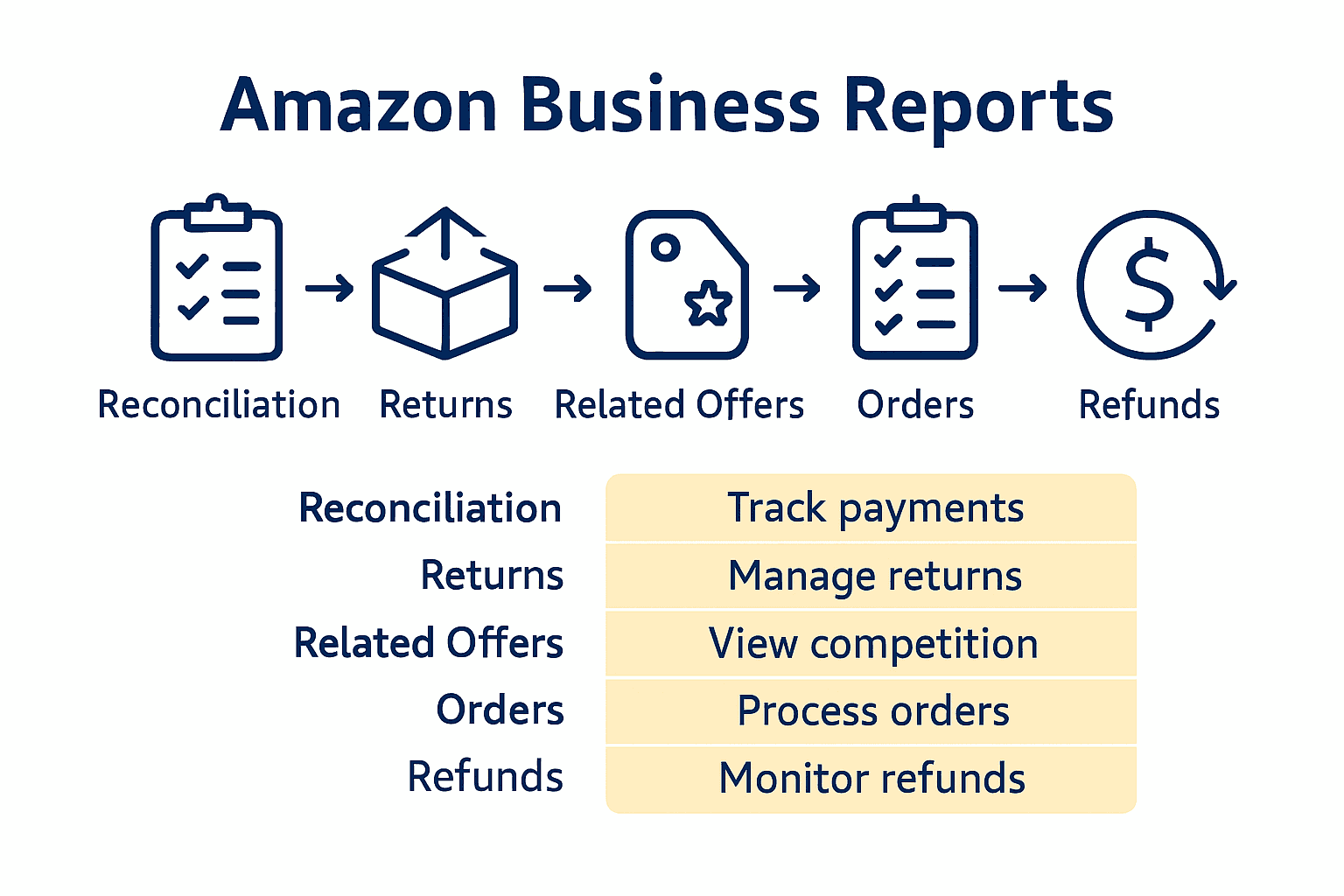
Key Amazon Business Report Categories include:
- Reconciliation Reports: Track financial transactions and ensure accurate accounting
- Returns Reports: Monitor product return patterns and customer satisfaction
- Related Offers Reports: Analyze competitive pricing and marketplace positioning
- Orders Reports: Provide detailed insights into purchasing behaviors
- Refunds Reports: Track and analyze transaction refund activities
These report types are not just static documents but dynamic analytical tools that transform raw data into strategic business intelligence. They enable sellers to make informed decisions by providing deep visibility into various aspects of their Amazon business operations.
The underlying technology powering these reports is sophisticated. As Dr. Press Research highlights, Amazon utilizes advanced barcode scanning and automated warehouse management techniques to ensure precise data collection and reporting accuracy. This technological infrastructure allows for real-time tracking, offering sellers unprecedented insights into their inventory, sales performance, and operational efficiency.
By leveraging these diverse report types, Amazon sellers can develop nuanced strategies, optimize their inventory management, understand customer behaviors, and ultimately drive more profitable business outcomes.
 Each report serves as a strategic lens, helping businesses translate complex data into actionable marketplace intelligence.
Key Metrics and Features for Sellers
Seller Central Explained: Complete Guide for Amazon Sellers reveals that Amazon Business Reports offer sellers a robust set of metrics and features designed to provide comprehensive insights into their marketplace performance. Up University highlights that these analytics enable administrators to monitor activity across multiple dimensions including group, user, and product category.
Critical Performance Metrics sellers can track include:
- Sales Volume: Total units sold and revenue generated
- Conversion Rates: Percentage of visitors who complete purchases
- Inventory Turnover: Speed and efficiency of product sales
- Customer Engagement: Views, clicks, and interaction rates
- Profitability Indicators: Gross margin and net profit per product
The technological infrastructure supporting these metrics is remarkably sophisticated. As Dr. Press Research explains, Amazon utilizes advanced barcode scanning and automated warehouse management techniques to ensure precise data tracking and reporting accuracy.
Understanding these metrics goes beyond simple number-crunching. They represent a strategic roadmap for sellers, offering granular insights that can transform raw data into actionable business intelligence. By comprehensively analyzing these metrics, Amazon sellers can make informed decisions about pricing strategies, inventory management, product positioning, and overall marketplace performance. The true power of these reports lies not just in their comprehensive data collection, but in their ability to help sellers adapt and optimize their business strategies in real-time.
How to Access and Use Business Reports
How to Optimize Amazon Listings emphasizes the critical importance of understanding reporting tools for successful Amazon selling. According to Up University, both administrators and requisitioners can access Amazon Business Analytics to create and download custom reports, offering flexible analysis capabilities.
Step-by-Step Report Access Process:
- Log into Seller Central: Navigate to your Amazon seller account
- Locate Reports Section: Find the “Reports” tab in the main dashboard
- Select Report Type: Choose specific report category (sales, inventory, etc.)
- Customize Report Parameters: Apply filters and select desired columns
- Generate and Download: Create custom report for detailed analysis
The technological backbone supporting these reports is sophisticated. As Dr. Press Research highlights, Amazon’s automated systems utilize advanced barcode scanning to ensure precise data tracking and reporting accuracy.
Maximizing the utility of these reports requires strategic thinking. Sellers should not merely download data, but actively interpret trends, identify performance gaps, and develop actionable insights. By regularly reviewing and analyzing these comprehensive reports, Amazon sellers can make informed decisions about inventory management, pricing strategies, and overall marketplace positioning.
Common Pitfalls and Mistakes to Avoid
Understanding Keyword Relevance on Amazon underscores the complexity of Amazon Business Reports, highlighting that misinterpreting data can lead to significant strategic missteps. Up University warns that users must regularly reconcile order and payment histories to prevent financial discrepancies and ensure accurate record-keeping.
Critical Mistakes Sellers Frequently Make:
- Neglecting Regular Reconciliation: Failing to compare Amazon’s records with internal financial data
- Overlooking Subtle Trend Indicators: Misinterpreting minor fluctuations in sales or performance metrics
- Ignoring Granular Data Points: Focusing only on top-level numbers while missing crucial details
- Infrequent Report Analysis: Not reviewing reports consistently or in-depth
- Misunderstanding Metric Correlations: Drawing incorrect conclusions from isolated data points
As Dr. Press Research explains, Amazon’s sophisticated tracking systems utilize advanced barcode and inventory management technologies, which means sellers must develop equally sophisticated analytical skills to truly understand their performance.
Successful Amazon sellers treat these reports as living documents, not static snapshots. They develop a nuanced approach that combines technological understanding with strategic thinking, continuously learning and adapting their interpretation methods. By avoiding these common pitfalls and approaching reports with a critical, systematic mindset, sellers can transform raw data into powerful business intelligence that drives meaningful marketplace success.
Unlock the Full Potential of Your Amazon Business Reports
Struggling to turn complex Amazon Business Reports into clear strategies that boost your sales and optimize inventory? You are not alone. Many sellers find themselves overwhelmed by the volume of data and the challenge of interpreting key metrics such as sales volume, conversion rates, and profitability indicators. This article showed how understanding those reports is crucial to avoid common pitfalls like neglecting reconciliation or missing subtle trend changes.
If you want to move beyond confusion and make data-driven decisions that truly grow your online business, explore proven approaches in our E-commerce Tips & Strategies to Grow Your Online Business section.

Take control of your Amazon performance now with expert support on Amazon listing optimization and tailored SEO & analytics strategies designed to enhance your visibility and profitability. Act today to convert report insights into real marketplace success by visiting SearchOneers and start transforming your Amazon business the smart way.
Frequently Asked Questions
What are Amazon Business Reports?
Amazon Business Reports are digital analytics tools that provide sellers and organizations with insights into their purchasing, sales, and operational performance, enhancing visibility into spending behaviors and organizational patterns.
What types of reports are available in Amazon Business Reports?
Key report types include Reconciliation Reports, Returns Reports, Related Offers Reports, Orders Reports, and Refunds Reports, each serving different strategic purposes to help sellers analyze their business performance.
How can I access and customize Amazon Business Reports?
To access Amazon Business Reports, log into Seller Central, navigate to the “Reports” section, select the desired report type, customize report parameters by applying filters, and then generate and download the report for analysis.
What are common mistakes to avoid when using Amazon Business Reports?
Common mistakes include neglecting regular reconciliation of records, overlooking subtle trend indicators, focusing solely on top-level data, infrequent report analysis, and misunderstanding the relationships between different metrics.
Recommended
- Seller Central Explained: Complete Guide for Amazon Sellers – Searchoneers
- Understanding Amazon Growth Strategies – Scale Your Business
- Amazon Inventory Ranking: What It Means & How to Improve
- What Is Amazon Best Seller Rank (BSR)?
- AI Invoice Parse – Understanding Managing Business Expenses and Its Impact

Comments
One response to “What Is Amazon Business Reports? Complete Overview”
[…] like sales volume, conversion rates, customer demographics, and product performance metrics. The business reports overview can help you understand which specific reports will provide the most actionable insights for your […]