Many sellers believe that driving more traffic to their Amazon listings automatically translates into higher sales. This common misconception overlooks a critical factor: listing quality. Without optimized content, compelling visuals, and strategic keyword placement, even the highest traffic volumes fail to convert browsers into buyers. Amazon’s algorithm rewards listings that demonstrate strong conversion rates and comprehensive product information, not just keyword density. Understanding what listing quality means and how to optimize it gives sellers a measurable competitive advantage in an increasingly crowded marketplace.
Table of Contents
- Key takeaways
- Understanding what Amazon listing quality means
- Core methodologies to optimize Amazon listing quality
- Tools and metrics for measuring and improving listing quality
- Advanced strategies and common pitfalls in listing quality optimization
- Optimize your Amazon listings for higher sales today
- Frequently asked questions
Key Takeaways
| Point | Details |
|---|---|
| Listing quality factors | Listing quality combines keywords, copy, visuals, and backend attributes to drive conversions. |
| Conversion driven ranking | Good listings drive strong conversion rates, which Amazon rewards with higher search rankings. |
| Mobile first essentials | Mobile first titles and bullets should front load the brand name, primary keyword, and key product feature within the first 80 characters. |
| Three phase workflow | A three phase workflow of keyword research, mobile first titles and bullets, and optimized visuals with quarterly audits improves CVR and CTR. |
Understanding what Amazon listing quality means
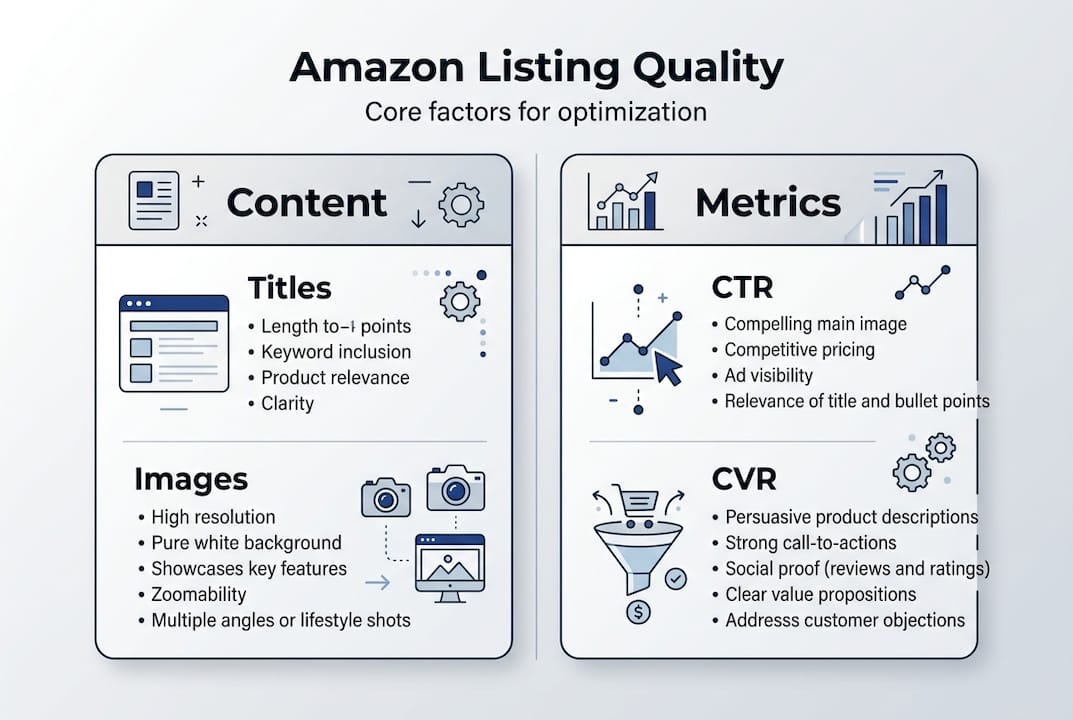
Amazon listing quality represents the combined effectiveness of your keyword optimization, copywriting, product images, and fulfillment details in driving conversions. This concept extends far beyond simply stuffing keywords into your title or description. Quality listings integrate strategic keyword placement with compelling copy that addresses customer pain points, high-resolution images that showcase product benefits, and complete backend attributes that help Amazon’s algorithm understand your product.
Good listings drive strong conversion rates, which Amazon rewards with higher search rankings. When shoppers click on your listing and make a purchase, the A10 algorithm prioritizes sales velocity and conversion rate over keyword density alone. This means a well-optimized listing with fewer keywords but better conversion performance will outrank a keyword-stuffed listing with poor sales metrics. Poor listing quality results in lower visibility despite adequate traffic because Amazon recognizes when shoppers view your listing but choose not to buy.
Several technical elements contribute to overall listing quality:
- Backend search terms that capture misspellings and alternative product names
- Mobile-first design that prioritizes readability on smartphones
- Complete attribute fields including size, color, material, and use case
- Bullet points that highlight benefits rather than just features
- A+ Content that tells your brand story and builds trust
The shift toward prioritizing conversion metrics reflects Amazon’s business model. The platform earns revenue when products sell, not when listings simply appear in search results. By focusing on high-converting product listings, you align your optimization strategy with Amazon’s core incentive structure. This alignment creates a virtuous cycle where better listings generate more sales, which leads to improved rankings, which drives additional qualified traffic.
Core methodologies to optimize Amazon listing quality
Optimizing listing quality follows a structured workflow that transforms raw product information into conversion-focused content. This systematic approach ensures you address every element that influences both customer perception and algorithmic ranking.
Step one involves comprehensive keyword research using ASIN lookup tools and Amazon’s autocomplete feature. Enter your competitor ASINs into research tools to extract their indexed keywords, then validate search volume and competition levels. Use autocomplete by typing seed keywords into Amazon’s search bar and recording the suggested phrases that appear. This combination reveals both high-volume terms and long-tail variations that capture specific customer intent.
Step two focuses on writing mobile-first titles and bullet points that combine brand name, primary keyword, and key product feature within the first 80 characters. Mobile shoppers see only the beginning of your title before it truncates, so front-load the most important information. According to Amazon’s SEO blog, a three-phase workflow of keyword research, mobile-first titles and bullets, and optimized visuals with quarterly audits improves both CVR and CTR. Your bullets should follow a consistent format that starts with a capitalized benefit phrase followed by supporting details.
Step three requires creating 7-9 high-quality images including lifestyle shots, infographics, and detail close-ups. Your main image must show the product on a pure white background, but secondary images should demonstrate use cases and highlight features through text overlays and comparison charts. Infographics that explain dimensions, compatibility, or installation steps reduce customer uncertainty and answer questions before they arise.

Pro Tip: Create a spreadsheet tracking your listing performance before and after optimization. Record CTR, CVR, sessions, and sales for 30 days pre-optimization, then monitor the same metrics for 60 days post-optimization to measure true impact.
Quarterly audits with A/B testing measure the effectiveness of your optimization efforts. Test one element at a time, such as your main image or first bullet point, and run experiments for at least two weeks to gather statistically significant data. Document your findings in a data table:
| Optimization element | Baseline CTR | Test CTR | Baseline CVR | Test CVR | Winner |
|---|---|---|---|---|---|
| Main image variation | 2.1% | 2.8% | 12.3% | 14.1% | Variation B |
| Title format | 2.8% | 2.6% | 14.1% | 13.9% | Original |
| Bullet order | 2.8% | 3.2% | 14.1% | 15.7% | Variation A |
This data-driven approach removes guesswork from optimization decisions. Following a proven listing optimization workflow ensures you systematically address every quality factor. Use an optimization checklist to verify you’ve completed all essential tasks before publishing changes. Study optimized listing examples to understand how top sellers structure their content for maximum impact.
Tools and metrics for measuring and improving listing quality
Measuring listing quality requires specialized tools that evaluate multiple factors and provide actionable scores. Different platforms offer unique scoring systems that help sellers identify weaknesses and track improvement over time.
Jungle Scout’s LQS uses a 1-10 scale while Amazon’s Internal Detail Quality (IDQ) score ranges from 0-100. These tools analyze your title length, bullet point count, image quantity, backend search terms, and attribute completion to generate an overall quality rating. A Jungle Scout LQS score below 7 indicates significant optimization opportunities, while an IDQ score below 80 suggests missing product attributes or incomplete content.
Attribute completion plays a crucial role in search ranking performance. Research shows that optimized listings with 95-100% attribute completion gain 8-12 rank positions compared to listings with incomplete data. Amazon uses these attributes to match products with specific customer searches, so leaving fields blank limits your visibility for relevant queries. Complete every available attribute field including material, size, color, pattern, and use case.
| Tool | Score range | Primary focus | Best use case |
|---|---|---|---|
| Jungle Scout LQS | 1-10 | Overall listing completeness | Quick quality assessment |
| Amazon IDQ | 0-100 | Attribute and content depth | Detailed optimization roadmap |
| Helium 10 Listing Analyzer | Letter grade | Keyword and content quality | Competitive benchmarking |
| Sellics Listing Quality Check | Percentage | Mobile optimization | Mobile-first improvements |
Conversion rate benchmarks provide context for your performance metrics. Listings achieving 15% or higher CVR typically rank in the top 10 positions for their primary keywords. Mobile conversion rates below 75% of desktop rates trigger ranking penalties ranging from 15-25% visibility reduction. Monitor your mobile versus desktop performance in Amazon’s Business Reports to identify responsive design issues.
Pro Tip: Run monthly listing quality audits using multiple tools to get a comprehensive view. Each platform evaluates different factors, so combining insights from Jungle Scout, Helium 10, and Amazon’s own metrics reveals optimization gaps that single-tool analysis might miss.
Regular audits using these tools and metrics reveal specific areas needing attention. If your LQS score is high but CVR remains low, focus on image quality and A+ Content rather than keyword optimization. If attribute completion is low, prioritize filling in product specifications before rewriting bullets. Learn how to optimize Amazon listings systematically by addressing the lowest-scoring elements first. Use Amazon analytics for sales growth to connect listing improvements with revenue outcomes.
Advanced strategies and common pitfalls in listing quality optimization
Experienced sellers employ nuanced tactics that go beyond basic optimization to achieve sustained competitive advantages. These advanced strategies require deeper understanding of Amazon’s ecosystem and customer psychology.
Target listings with low LQS scores in high-demand niches for quicker gains. Products in competitive categories with poor listing quality represent low-hanging fruit because small improvements yield disproportionate ranking boosts. Use category-specific keyword research to identify terms your competitors miss, then incorporate these gaps into your backend search terms and image alt text.
SaaS tools that analyze full listings provide contextual improvements beyond simple keyword density checks. These platforms evaluate whether your bullets address common customer questions found in competitor reviews, whether your images show scale and dimensions clearly, and whether your title structure matches top-performing listings in your category. Context-aware optimization delivers better results than generic best practices.
Continuous A/B testing and quarterly audits prevent performance stagnation. Amazon’s algorithm evolves constantly, and listing elements that performed well six months ago may no longer drive the same results. Schedule recurring optimization reviews to refresh underperforming content:
- Review competitor listings quarterly to identify new content trends
- Test seasonal keyword variations during peak shopping periods
- Update images to reflect current design standards and customer preferences
- Refresh A+ Content to highlight new use cases or customer testimonials
Avoid these common pitfalls that undermine listing quality efforts. Promotional language in titles like “Best Seller” or “#1 Rated” violates Amazon’s style guidelines and can result in suppression. Keyword stuffing that creates unreadable titles hurts credibility with shoppers even if it temporarily boosts visibility. Inconsistent information between your title, bullets, and description confuses both customers and the algorithm.
“Optimization increases visibility but requires aligned pricing, reviews, and inventory to boost revenue effectively. A perfectly optimized listing with overpriced products or frequent stockouts will underperform a moderately optimized listing with competitive pricing and reliable availability.”
Remember that pricing strategy, review management, and inventory planning must complement your listing quality improvements. A listing optimized for conversion will drive more traffic, but if your price point sits 20% above competitors without clear differentiation, that traffic won’t convert. Similarly, a listing with a 4.2-star rating will struggle against 4.7-star competitors regardless of content quality.
Monitor algorithm adjustments for 30+ days post-optimization to understand true impact. Amazon’s ranking system incorporates historical performance data, so immediate changes in position don’t reflect final outcomes. Track your keyword rankings daily using automated tools, but evaluate success based on 60-90 day trends rather than daily fluctuations. Apply Amazon selling tips that account for both short-term wins and long-term sustainability.
Optimize your Amazon listings for higher sales today
Understanding listing quality principles is just the first step toward marketplace success. Implementing these strategies consistently requires structured workflows, comprehensive checklists, and expert guidance tailored to Amazon’s evolving algorithm.

Our comprehensive guides walk you through every optimization element from keyword research to A+ Content creation. Follow proven workflows designed specifically for Amazon’s latest ranking factors and conversion best practices. Access expert resources that translate complex algorithm changes into actionable listing improvements you can implement immediately.
Whether you’re launching new products or refreshing existing catalogs, our Amazon listing enhancement guide provides step-by-step instructions for maximizing visibility and sales. Use our detailed listing optimization workflow to ensure you address every quality factor systematically. Download our optimization checklist for Amazon sellers to track your progress and verify completeness before publishing changes. Partner with Searchoneers to transform your product visibility and performance through data-backed optimization strategies.
Frequently asked questions
What is Amazon listing quality?
Amazon listing quality measures how effectively your product page combines accurate content, strategic keywords, compelling visuals, and complete product data to drive conversions. It encompasses both customer-facing elements like titles and images and backend factors like search terms and attributes. Higher quality listings earn better search rankings because they demonstrate stronger conversion rates and customer engagement.
How does listing quality affect my Amazon search ranking?
Listing quality directly influences your conversion rate, which Amazon’s A10 algorithm uses as a primary ranking signal. When shoppers click your listing and make purchases, Amazon interprets this as relevance and quality, boosting your position for related searches. Poor quality listings with low conversion rates receive lower rankings even if they contain relevant keywords, because Amazon prioritizes listings that generate sales.
Which tools should I use to measure my listing quality?
Jungle Scout’s Listing Quality Score (1-10 scale) and Amazon’s Internal Detail Quality score (0-100 scale) provide the most comprehensive quality assessments. Helium 10’s Listing Analyzer offers competitive benchmarking, while Sellics focuses on mobile optimization. Use multiple tools together for complete coverage, as each platform evaluates different quality factors and provides unique optimization recommendations.
How often should I update my Amazon listings?
Conduct quarterly audits to review performance metrics, competitor changes, and algorithm updates that might require listing adjustments. Run A/B tests monthly on individual elements like images or bullet points to continuously improve conversion rates. Make immediate updates when you identify errors, add new product variations, or notice significant ranking drops that suggest quality issues.
Does pricing affect listing quality scores?
Pricing doesn’t directly impact listing quality scores from tools like Jungle Scout LQS or Amazon IDQ, but it significantly affects the conversion rate that determines your search ranking. Overpriced listings with perfect optimization will underperform competitively priced listings with moderate quality. Treat pricing, reviews, and inventory management as complementary factors that must align with listing quality improvements to maximize sales effectiveness.
Recommended
- 7 Proven Ways to Boost Content Quality on Amazon Listings – Searchoneers
- Amazon Listing Guidelines: Unlock Higher Visibility – Searchoneers
- Listing Optimization Checklist for Amazon Sellers Success – Searchoneers
- Complete Guide to Why Amazon Listings Fail – Searchoneers
- Amazon Price Tracker Guide 2025 | PriceLix | PriceLix