TL;DR:
- Successful Amazon sellers optimize every listing element to align with the platform’s search algorithm.
- Key ranking factors include keywords, conversion rate, and sales velocity, not just price.
- Ongoing data analysis and consistent updates are crucial for maintaining and improving search visibility.
Listing a product on Amazon and actually getting found are two completely different things. Thousands of sellers upload listings every day, set a competitive price, and wait. Nothing happens. The marketplace has over 350 million products, and without a deliberate SEO strategy, your listing is invisible by default. The sellers who consistently win are not just lucky or cheaper. They understand how Amazon’s search algorithm works and they optimize every element of their listing to match it. This guide breaks down a practical, data-driven approach to Amazon SEO so you can stop guessing and start ranking.
Table of Contents
- What is Amazon SEO and why does it matter?
- Step-by-step: Building your high-ranking Amazon listing
- Keyword research: The foundation of effective Amazon SEO
- Measuring your results: Data-driven strategies for ongoing SEO success
- Our take: Why long-term data focus beats chasing short-term SEO wins
- Ready to boost your Amazon SEO? Explore expert resources
- Frequently asked questions
Key Takeaways
| Point | Details |
|---|---|
| Amazon SEO is critical | Without strategic SEO, your products are nearly invisible to buyers on Amazon. |
| Optimize listings step-by-step | Detailed attention to every element of your listing yields higher rankings and more sales. |
| Keyword research powers results | Effective keyword strategies drive targeted traffic and conversions for Amazon sellers. |
| Data guides ongoing success | Regularly monitor analytics to adapt your SEO for continuous sales growth. |
| Long-term wins beat shortcuts | Sustainable SEO comes from consistent improvement, not quick fixes or hacks. |
What is Amazon SEO and why does it matter?
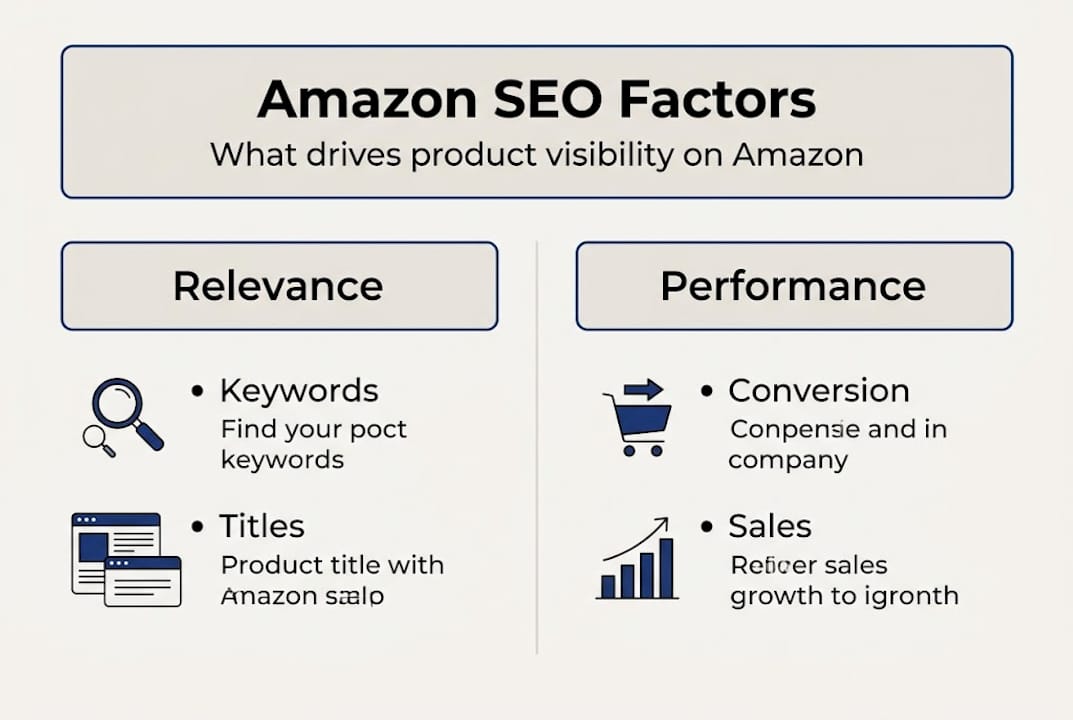
Amazon SEO refers to the strategies sellers use to improve how their products rank in Amazon’s search results. Unlike a traditional website, your Amazon listing does not need blog posts or backlinks. What it needs is relevance, performance, and proof that shoppers engage with it. Amazon’s algorithm relies on relevance, performance, and customer behavior to decide which products appear at the top.
The three core ranking factors are keywords, conversion rate, and sales velocity. Keywords tell the algorithm what your product is. Conversion rate signals that shoppers who find your listing actually buy. Sales velocity shows consistent demand over time. Reviews layer on top of all three, reinforcing trust and conversion.
One of the most persistent myths is that a low price guarantees sales. Price matters, but it cannot help you if shoppers never see your product. SEO is what gets eyes on your listing in the first place. Even a genuinely excellent product will underperform if it is buried on page five. The goal of Amazon SEO is to boost product visibility so your listing appears in front of buyers who are already ready to purchase.
Here is why investing in Amazon Webstore SEO strategies pays off across every stage of your business:
- Increased organic traffic without relying solely on paid ads
- Higher conversion rates from better-matched search intent
- Improved sales velocity, which feeds back into ranking improvements
- Stronger brand credibility through consistent visibility and reviews
- Actionable analytics that reveal what is and is not working in your catalog
“Sellers who treat SEO as a one-time setup are leaving consistent revenue on the table. The algorithm rewards activity, relevance, and results, not just presence.”
Think of your listing as a living asset. The more you refine it based on real data, the more the algorithm rewards it with exposure.
Step-by-step: Building your high-ranking Amazon listing
Every section of your product listing can be optimized for keyword relevance and conversion. That means your title, bullet points, product description, images, and backend keywords all play a role. Leaving any one of them underdeveloped is like running a race with one shoe.
Here is a proven step-by-step process you can follow using a solid listing optimization workflow:
- Conduct keyword research to identify high-volume, relevant search terms for your product category.
- Optimize your title by placing your primary keyword near the front, followed by key features and use cases.
- Write benefit-driven bullet points that address buyer pain points while weaving in secondary keywords naturally.
- Craft a product description or A+ Content that tells a story, reinforces benefits, and targets long-tail keywords.
- Fill backend search terms with additional relevant keywords that do not fit naturally in the visible listing.
- Select high-quality images including lifestyle shots, infographics, and size comparison visuals.
- Review and update regularly based on analytics, seasonal trends, and competitor activity.
Pro Tip: Do not treat your backend keywords as a one-time task. Refresh them every 60 to 90 days based on new search trend data. Small updates can unlock significant ranking improvements over time.
The difference between a weak listing and a strong one is measurable. Here is a simplified before-and-after view:
| Listing element | Before optimization | After optimization | Ranking impact |
|---|---|---|---|
| Title | Generic product name only | Keyword-rich title with key features | Significant improvement |
| Bullet points | Vague feature list | Benefit-focused with secondary keywords | Moderate improvement |
| Backend keywords | Empty or repeated | Unique, relevant, fully utilized | Notable improvement |
| Images | Single stock photo | Multiple lifestyle and infographic images | Higher conversion rate |
Using a thorough listing optimization checklist ensures you never miss a critical element during this process.
Keyword research: The foundation of effective Amazon SEO
Keyword research on Amazon works differently than it does on Google. Google users search for information. Amazon users search to buy. That shift in intent changes everything about how you choose and prioritize keywords. Relevant keywords drive targeted traffic and conversions, which is why getting this step right matters more than any other.
On Amazon, the best keywords are the ones shoppers actually type when they are ready to purchase. These tend to be specific, product-focused phrases rather than broad informational queries. Understanding essential keyword types helps you build a layered strategy that covers head terms, long-tail phrases, and competitor-adjacent searches.
Here is a comparison of the most widely used Amazon keyword research tools:
| Tool | Best for | Key feature | Price range |
|---|---|---|---|
| Helium 10 | Full-suite optimization | Cerebro reverse ASIN lookup | Paid, tiered plans |
| Jungle Scout | Beginner to mid-level sellers | Keyword Scout with search volume | Paid, tiered plans |
| Amazon Brand Analytics | Brand-registered sellers | Real search term data from Amazon | Free with brand registry |
| Merchant Words | Budget-conscious sellers | Large keyword database | Low-cost paid plan |
Avoid these common keyword research mistakes:
- Targeting only high-volume terms without considering competition level
- Ignoring long-tail keywords that convert at higher rates with less competition
- Stuffing keywords unnaturally into titles or bullets, which hurts readability and conversion
- Skipping competitor analysis to find keyword gaps you can exploit
- Neglecting seasonal shifts in search behavior that change what buyers look for
Pro Tip: Backend search terms are invisible to shoppers but fully indexed by Amazon’s algorithm. Use this space to include misspellings, regional variations, and complementary product terms. Staying current with SEO trends for Amazon will also reveal emerging keyword opportunities before your competitors catch on.
Measuring your results: Data-driven strategies for ongoing SEO success
Optimizing your listing is not a finish line. It is a starting point. Active monitoring of sales and analytics identifies which listings and keywords perform best, giving you the data you need to keep improving rather than guessing.

Amazon provides several native tools for tracking performance, including Brand Analytics, the Search Term Report, and the Business Reports dashboard. Each one surfaces different signals. Brand Analytics shows you which search terms are driving clicks and conversions. The Search Term Report reveals which keywords are triggering your ads. Business Reports track unit session percentage, which is essentially your conversion rate by listing.
Sellers who use analytics consistently grow 2 to 3 times faster than those who rely on intuition alone. That is not a coincidence. Data removes the guesswork and tells you exactly where to focus your next round of optimization.
Here is how to interpret your analytics and act on what you find:
- Check your click-through rate on key search terms. A low rate suggests your title or main image needs work.
- Review conversion rate by listing to identify which products are attracting traffic but failing to close.
- Compare keyword rankings week over week to spot gains or drops that signal algorithm shifts.
- Analyze competitor performance in Brand Analytics to see which terms they are winning on.
- Adjust your strategy quarterly based on cumulative data rather than reacting to single-week fluctuations.
Knowing why to monitor Amazon analytics is one thing. Knowing when your current strategy needs a reset is another. Watch for these warning signs:
- Ranking drops on previously stable keywords
- Declining click-through rate despite consistent ad spend
- Flat or falling conversion rate after a listing update
- Increasing returns or negative reviews pointing to a messaging mismatch
- Competitors gaining ground on terms you previously owned
A well-structured step-by-step SEO workflow gives you a repeatable system for catching these signals early and responding before they cost you ranking ground.
Our take: Why long-term data focus beats chasing short-term SEO wins
Here is something most SEO content will not tell you: the sellers who chase every new algorithm update or trending keyword trick rarely outperform the ones who simply stay consistent. It is tempting to jump on a hot strategy, especially when someone in a seller forum claims it tripled their sales overnight. But those wins are almost always temporary.
What actually compounds over time is a habit of measuring, adjusting, and improving a little each quarter. We have seen sellers with average products outrank competitors with superior items, purely because they kept refining their listings based on real data instead of assumptions. The algorithm rewards consistency and relevance above novelty.
The mindset shift that matters most is treating your listing like a business asset, not a one-time setup task. Staying current with emerging SEO trends is useful, but only when layered on top of a strong data foundation. Build that foundation first. The trends will make more sense, and your results will last longer.
Ready to boost your Amazon SEO? Explore expert resources
If you are serious about turning your listings into consistent revenue drivers, the next step is putting a proven system behind your efforts. The difference between sellers who plateau and those who scale is usually not talent. It is access to the right frameworks and the discipline to apply them.
Explore our listing enhancement guide for a deep dive into every element that affects your ranking. Use our optimization workflow to build a repeatable process that keeps your listings improving over time. And if you are just getting started, our Amazon SEO basics resource gives you a clear, structured foundation to build from. Every resource is designed specifically for sellers who want real, measurable results.
Frequently asked questions
How does Amazon SEO differ from Google SEO?
Amazon SEO focuses on product relevancy, sales data, and customer behavior, while Google emphasizes link profiles and content authority. Amazon’s algorithm prioritizes conversion-related factors over backlink profiles, making purchase intent the central signal.
What are backend keywords and why are they important?
Backend keywords are hidden search terms that boost your product’s discoverability without being seen by shoppers. Backend keywords can significantly enhance listing search visibility, making them a critical but often overlooked optimization lever.
How frequently should I update my Amazon listings for the best SEO?
Review and update your listings monthly or quarterly to adapt to keyword trends and changing customer behaviors. Ongoing optimization and monitoring yield improved visibility and sales over time.
How can I tell if my Amazon SEO strategy is working?
Monitor ranking improvements, organic traffic, and increased conversions in your analytics dashboard. Active monitoring of analytics helps sellers validate and improve their SEO strategy with real data.
Can I do effective Amazon SEO myself, or do I need a professional?
With the right resources and consistent effort, most sellers can start and refine Amazon SEO on their own. Step-by-step SEO guides empower sellers to implement proven strategies without outside help.
Recommended
- Amazon Seller Expert: Mastering SEO And Sales Growth – Searchoneers
- SEO Best Practices: Advanced Tactics for Amazon Sellers – Searchoneers
- Amazon SEO Step by Step: Boost Your Product Visibility
- How to Improve Sales in Amazon: Proven Listing Strategies – Searchoneers
- Master the Generative Search Optimization Process for Results | Artificial Intelligence