TL;DR:
- EDI is essential for automating order, shipment, and invoice processes on Amazon Vendor Central.
- Proper EDI documentation includes purchase orders, advance shipping notices, and invoices, which must comply with standards.
- Consistent EDI compliance and documentation mastery reduce errors, chargebacks, and improve supply chain efficiency.
Amazon Vendor Central promises a streamlined supply chain, but vendors who assume the platform handles everything automatically quickly run into costly delays. EDI documentation, which stands for Electronic Data Interchange, is the backbone of every order, shipment, and invoice exchange between you and Amazon. Get it wrong and you face chargebacks, delayed payments, and frustrated buyers. Get it right and your entire supply chain runs on autopilot. This article walks you through exactly what EDI documentation Vendor Central requires, how compliance works, and the practical steps that separate high-performing vendors from those stuck firefighting every week.
Table of Contents
- What is EDI and why does it matter for Amazon Vendor Central?
- Key EDI documentation types required for Vendor Central
- EDI compliance: Standards and automation advantages
- Implementing EDI: Workflow, troubleshooting, and practical tips
- A fresh perspective: Why documentation mastery is the hidden driver of Vendor Central success
- Next steps: Resources to optimize your Amazon Vendor Central workflows
- Frequently asked questions
Key Takeaways
| Point | Details |
|---|---|
| EDI automates processes | Proper EDI implementation saves time and reduces manual errors for Amazon Vendor Central sellers. |
| Documentation is essential | Accurate EDI documentation supports smoother order management and faster payments. |
| Compliance drives efficiency | Following EDI standards and auditing workflows consistently prevents costly mistakes. |
| Practical workflows matter | A step-by-step EDI implementation plan and troubleshooting routine help sellers succeed. |
What is EDI and why does it matter for Amazon Vendor Central?
EDI stands for Electronic Data Interchange, a standardized method for exchanging business documents digitally between trading partners. Instead of emailing spreadsheets or manually entering orders, EDI automates the entire conversation between your systems and Amazon’s. Think of it as a universal language that your warehouse software, accounting tools, and Amazon’s order management systems all speak fluently.
For Amazon Vendor Central explained, EDI is not optional. Amazon uses it to send Purchase Orders directly to your systems, receive your shipment confirmations, and process your invoices. If your EDI setup is broken or incomplete, Amazon cannot complete those transactions automatically, which creates backlogs and triggers financial penalties.
A common misconception among newer vendors is that EDI is only necessary for large-scale suppliers. That is not accurate. Any vendor on the platform, regardless of size, must meet Amazon’s EDI requirements to process orders efficiently. EDI integration streamlines order processing and reduces manual errors, which is why Amazon treats it as a non-negotiable part of the vendor relationship.
Here is what EDI actually does for your Vendor Central operations:
- Automates order receipt: Purchase Orders from Amazon arrive directly in your system without manual input.
- Speeds up shipment confirmation: Advance Shipping Notices are sent automatically when orders leave your warehouse.
- Accelerates invoice processing: Invoices are generated and transmitted electronically, reducing payment delays.
- Reduces human error: Automated data exchange eliminates transcription mistakes that cause chargebacks.
- Supports scalability: As order volume grows, EDI handles the load without adding headcount.
Pro Tip: Even if you currently process a small number of orders manually, setting up EDI early prevents a painful migration later when order volumes spike.
When you optimize Vendor Central listings for better visibility, the resulting sales increase will stress-test your fulfillment pipeline. A solid EDI foundation ensures that pipeline holds up under pressure.
Key EDI documentation types required for Vendor Central
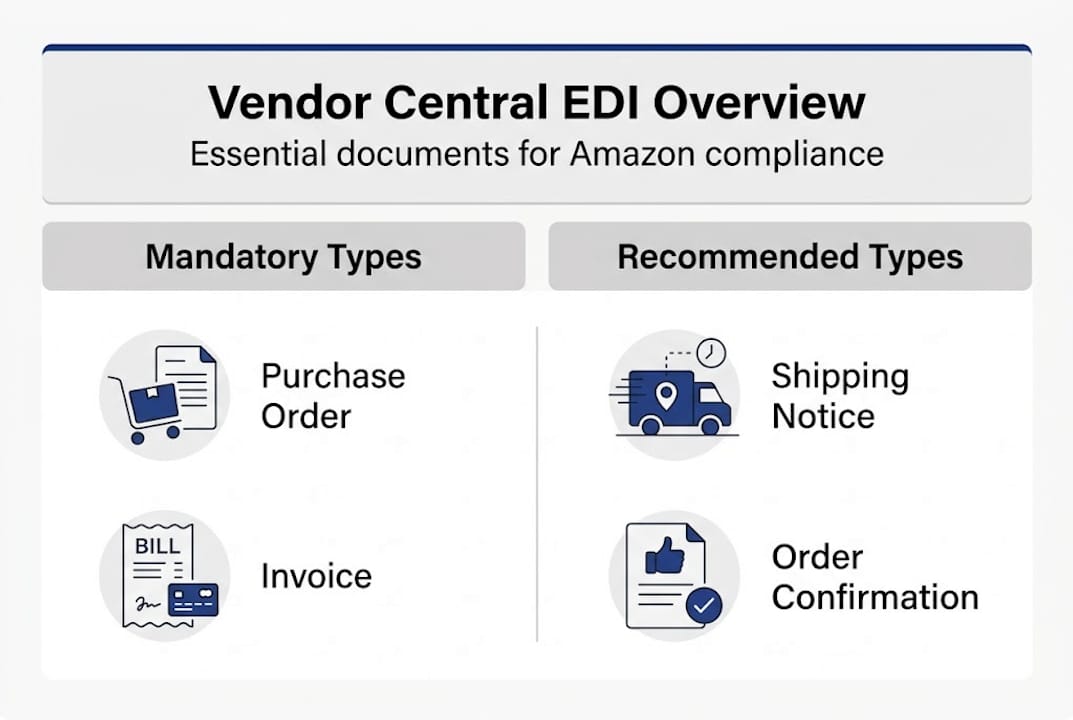
Not all EDI documents carry equal weight in Vendor Central. Some are mandatory, others are strongly recommended, and understanding the difference saves you from compliance headaches down the line.

Purchase Order (PO) or EDI 850 is the document Amazon sends to initiate an order. It contains item details, quantities, pricing, and delivery windows. Your system must receive and acknowledge this document accurately, because every downstream document traces back to it.
Advance Shipping Notice (ASN) or EDI 856 is the document you send Amazon before a shipment arrives. It tells Amazon exactly what is coming, how it is packed, and when it will arrive. Missing or late ASNs are one of the most common sources of vendor chargebacks. Amazon product compliance basics reinforces that standardized EDI documents are required for order management, and the ASN is where many vendors fall short.
Invoice or EDI 810 is your request for payment. It must match the PO and ASN data precisely. Discrepancies in quantity, price, or item detail trigger payment holds that can tie up cash flow for weeks.
Additional documents like the Order Confirmation (EDI 855) and Remittance Advice (EDI 820) round out the standard exchange. Order Confirmation acknowledges receipt of a PO, while Remittance Advice confirms payment details from Amazon.
| Document | EDI code | Function | Mandatory? | Best practice |
|---|---|---|---|---|
| Purchase Order | 850 | Initiates order from Amazon | Yes | Auto-acknowledge within 24 hours |
| Advance Shipping Notice | 856 | Confirms shipment details | Yes | Send before shipment leaves warehouse |
| Invoice | 810 | Requests payment | Yes | Match PO and ASN data exactly |
| Order Confirmation | 855 | Acknowledges PO receipt | Recommended | Automate to reduce delays |
| Remittance Advice | 820 | Confirms payment from Amazon | Optional | Useful for reconciliation |
For vendors looking to scale, exploring Vendor Services growth strategies alongside EDI mastery creates a compounding advantage across both operations and catalog performance.
EDI compliance: Standards and automation advantages
EDI does not operate in a vacuum. It runs on recognized standards that define how data is structured and transmitted. The two most relevant for Vendor Central are ANSI X12, which is the dominant standard in North America, and EDIFACT, used more broadly in international trade. Amazon primarily uses ANSI X12 for its domestic vendor relationships.
Top compliance mistakes vendors make include:
- Sending ASNs after shipment arrives instead of before, which defeats the purpose of advance notice.
- Mismatching invoice data with PO quantities or item identifiers, triggering automatic payment holds.
- Using outdated document versions that do not align with Amazon’s current EDI specifications.
- Skipping testing cycles when onboarding new EDI providers or updating systems.
- Ignoring Amazon’s EDI guidelines published in the Vendor Central portal, which are updated periodically.
Automation is where EDI compliance shifts from a burden to a competitive advantage. EDI automation improves data accuracy and supports faster order cycles, meaning you fulfill more orders with fewer resources. Automated workflows also create audit trails that make troubleshooting faster when issues arise.
Here is a compliance checklist to keep your EDI workflows clean:
- Confirm your EDI provider supports all required ANSI X12 document types.
- Map each document field to Amazon’s exact specifications in Vendor Central.
- Run a full test exchange with Amazon before going live with any new document type.
- Schedule monthly audits of your EDI transaction logs to catch recurring errors early.
- Review Amazon’s EDI specification updates at least once per quarter.
- Document every mapping rule so your team can troubleshoot without relying on one person.
“The most successful Vendor Central users always treat documentation as a living, evolving process.”
Pro Tip: Work with your Vendor consulting for EDI partner to schedule quarterly reviews of your EDI setup. Amazon’s requirements shift, and staying ahead of those changes prevents surprise chargebacks.
For sellers monitoring how their Amazon Vendor status for listing optimization affects catalog performance, strong EDI compliance directly supports better in-stock rates, which Amazon factors into vendor relationships.
Implementing EDI: Workflow, troubleshooting, and practical tips
Setting up EDI for Vendor Central follows a predictable workflow, but the details matter at every stage. Here is how the process typically unfolds.
First, you establish a connection between your systems and Amazon’s EDI network, usually through a Value Added Network (VAN) or a direct AS2 connection. Your EDI provider handles the technical handshake, but you need to supply your Amazon Vendor ID and confirm the communication protocol Amazon requires.
Next comes document mapping, where your internal data fields are matched to Amazon’s EDI specifications. This is where most errors originate. A product identifier in your system might be formatted differently than Amazon expects, and that mismatch causes rejected transactions. Retail companies must meet specific requirements to implement EDI in Vendor Central, and the mapping phase is where those requirements become concrete.
| Implementation step | Responsible party | Key output |
|---|---|---|
| Network connection setup | EDI provider | Active communication channel |
| Document mapping | Vendor and EDI provider | Validated field mapping document |
| Test transaction exchange | Both parties | Confirmed error-free test results |
| Go-live monitoring | Vendor team | Transaction log review for first 30 days |
| Ongoing maintenance | Vendor and provider | Quarterly audit reports |
Common troubleshooting issues include mismatched item numbers between PO and ASN, date format errors in shipment windows, and invoice totals that do not reconcile with PO pricing. The Seller Central guide offers useful context on how Amazon’s systems process these documents on the backend.
Practical tips for maintaining accurate documentation:
- Keep a master mapping document updated every time Amazon changes its EDI specs.
- Set automated alerts for failed transactions so issues surface within hours, not days.
- Train at least two team members on EDI troubleshooting to avoid single points of failure.
- Review customer engagement in retail practices to understand how supply chain reliability connects to buyer satisfaction.
For vendors using fulfillment programs, the Vendor Flex fulfillment guide explains how EDI integrates with specialized fulfillment arrangements.
Pro Tip: Partner with an EDI provider that has direct experience with Amazon Vendor Central. Generic EDI platforms often require significant customization to meet Amazon’s specific document requirements, which adds time and cost to your setup.
A fresh perspective: Why documentation mastery is the hidden driver of Vendor Central success
Most vendors think about EDI as a technical checkbox. Set it up, forget it, move on. That mindset is exactly why so many vendors experience recurring chargebacks and payment delays that never seem to go away.
The vendors who consistently outperform their peers treat EDI accuracy as core infrastructure, not a one-time project. They audit their transaction logs the same way they review sales data. They catch format drift before Amazon flags it. They know which document fields Amazon’s systems are most sensitive to, and they protect those fields obsessively.
The compounding benefits of strong documentation habits are real:
- Fewer chargebacks mean more cash available for inventory investment.
- Faster payment cycles improve working capital without requiring financing.
- Cleaner data makes demand forecasting more reliable.
- Strong compliance history builds trust with Amazon’s vendor management teams.
When you combine documentation discipline with efforts to optimize Vendor Central listings, you create a vendor profile that Amazon’s algorithms and human teams both favor. That is not a coincidence. It is a strategy.
Next steps: Resources to optimize your Amazon Vendor Central workflows
Mastering EDI documentation gives you a reliable operational foundation, but it is only one piece of the Vendor Central puzzle. The next layer is making sure your product listings work as hard as your supply chain does.
At Searchoneers, we help Amazon vendors connect operational efficiency with catalog performance. From our listing enhancement guide to a proven listing optimization workflow, our resources are built specifically for vendors who want measurable results. If you are navigating platform terminology and need a clear foundation, our Amazon marketplace terms guide is a practical starting point. Strong EDI documentation and optimized listings together create a Vendor Central presence that is hard to compete with.
Frequently asked questions
What is EDI in Amazon Vendor Central?
EDI (Electronic Data Interchange) is the system Amazon uses to automate the exchange of order, shipping, and invoice documents with its vendors. EDI integration streamlines order processing and reduces manual errors across the supply chain.
Which EDI documents are required for Vendor Central?
The main EDI documents include Purchase Orders (EDI 850), Advance Shipping Notices (EDI 856), Invoices (EDI 810), and Order Confirmations (EDI 855). Standardized EDI documents are required for smooth order management on the platform.
How can sellers ensure EDI compliance?
Sellers should follow ANSI X12 standards, automate workflows where possible, and conduct regular audits of transaction logs. EDI automation improves data accuracy and supports faster order cycles when properly maintained.
What are common EDI documentation errors?
Common errors include mismatched item data between PO and ASN, incorrect invoice totals, and outdated document formats. Retail companies must meet specific requirements to avoid these issues in Vendor Central.
Recommended
- Amazon Vendor Central: Optimize Your Listings and Sales – Searchoneers
- Amazon Vendor Services: Driving Profitable Growth Online – Searchoneers
- Seller Central Explained: Complete Guide for Amazon Sellers – Searchoneers
- Amazon Vendor Status: Impact on Listing Optimization – Searchoneers
- How to streamline fulfillment for mid-sized firms 2026 – BizDev Strategy