TL;DR:
- A UPC code is a unique 12-digit number managed by GS1 that identifies retail products worldwide. Proper registration ensures seamless inventory tracking, marketplace compliance, and protects against listing suppression. Each product variation requires its own UPC, and verifying code quality before printing is essential to avoid costly errors.
A UPC code, or Universal Product Code, is a standardized 12-digit numeric identifier used to uniquely identify retail products worldwide. Every barcode you scan at a grocery store, warehouse, or Amazon fulfillment center traces back to this system. GS1, the global standards organization, manages and assigns all UPC codes to guarantee uniqueness across every product and every market. Platforms like Amazon, Walmart, and Target require valid UPCs before they will list your product. If you sell physical goods, understanding the UPC code meaning is not optional. It is the foundation of your entire product identity.
What is a UPC code made of?
A UPC code is built from three components: a GS1 company prefix, an item reference number, and a check digit. The 12-digit structure works like a fingerprint. No two products in the world share the same number.

Here is how those three parts break down:
| Component | Description | Example |
|---|---|---|
| GS1 Company Prefix | Identifies the brand or manufacturer | 012345 |
| Item Reference Number | Identifies the specific product | 67890 |
| Check Digit | Validates the code mathematically | 1 |
Two formats exist under the UPC umbrella. UPC-A is the standard 12-digit version you see on most retail packaging. UPC-E is a compressed 6-digit version designed for small packages where space is limited, like lip balm or single-serve items.
One distinction matters more than most sellers realize. GTIN is the full numerical identifier, while UPC is the specific barcode format built on top of it. Think of GTIN as the category and UPC as one member of that family. EAN codes, used internationally, are 13-digit GTINs. UPC codes are 12-digit GTINs used primarily in North America. Both are valid globally, but knowing which one your retailer requires prevents costly listing errors.
A UPC code is also not the same as a UPC barcode. The code is the number. The barcode is the visual symbol that scanners read. When a cashier scans a product, the scanner reads the barcode and sends the number to the retailer’s database. The UPC acts as a digital key that retrieves product details like price, name, and inventory count. The code itself carries none of that data.
Why UPC codes matter for your business
UPC codes do more than speed up checkout. They are the connective tissue between your product and every system that touches it, from the factory floor to the customer’s door.
Here is what a properly registered UPC enables:
- Global product identification. Your product gets a unique identity recognized by retailers, distributors, and marketplaces in every country.
- Faster checkout and fewer errors. Scanning a barcode is faster and more accurate than manual entry. Retail checkout errors drop significantly when UPCs are correctly assigned.
- Inventory tracking across systems. ERP platforms like SAP and Oracle, warehouse management systems like Manhattan Associates WMS, and e-commerce platforms like Shopify all use UPCs to sync stock levels in real time.
- Marketplace compliance. Amazon, Walmart Marketplace, and Target Plus all require GS1-registered UPCs to create or maintain product listings.
- Listing protection. A mismatched or invalid UPC can trigger listing suppression on Amazon, pulling your product from search results entirely.
Pro Tip: Register your UPC with GS1 before you submit any product listing to Amazon. A GS1-registered code ties the product directly to your brand, which protects you from counterfeit sellers attaching themselves to your listing.
The product compliance requirements on Amazon are strict. A valid UPC is not just a best practice. It is a gating requirement that determines whether your product can be sold at all.
How to get a UPC code without making costly mistakes
Getting a UPC code is straightforward when you go to the right source. Cutting corners here creates problems that are expensive and time-consuming to fix.
Follow these steps to acquire a legitimate UPC:
- Go directly to GS1 US. Visit gs1us.org and choose between a single GTIN or a company prefix. This is the only source that guarantees legal brand ownership.
- Choose the right option for your business size. GS1 offers a single GTIN for $30 with no annual fee, which works for small businesses with fewer than 10 products. A company prefix starts at $250 with a $50 annual renewal fee and covers multiple products.
- Avoid third-party resellers. Sites that sell cheap UPC codes in bulk are reselling codes from old or inactive GS1 prefixes. Third-party resellers do not provide legal brand ownership required by major retailers. Amazon cross-references GS1 data, and a prefix mismatch will get your listing suppressed.
- Verify your code in the GEPIR database. GS1’s Global Electronic Party Information Registry (GEPIR) lets you confirm that your code is registered correctly and tied to your brand.
- Test print quality before mass production. Print a sample barcode and scan it with a handheld scanner or barcode verifier. A code that looks correct visually can still fail to scan if the contrast, sizing, or quiet zones are off.
- Document every code you assign. Keep a record of which UPC belongs to which product from day one. Retroactively organizing this data is painful.
Pro Tip: Many new sellers buy UPCs from resellers to save money, then discover their Amazon listings get suppressed because the GS1 company prefix does not match their brand name. The $30 single GTIN from GS1 US is the cheapest insurance you can buy.
How to use UPC codes in your business operations
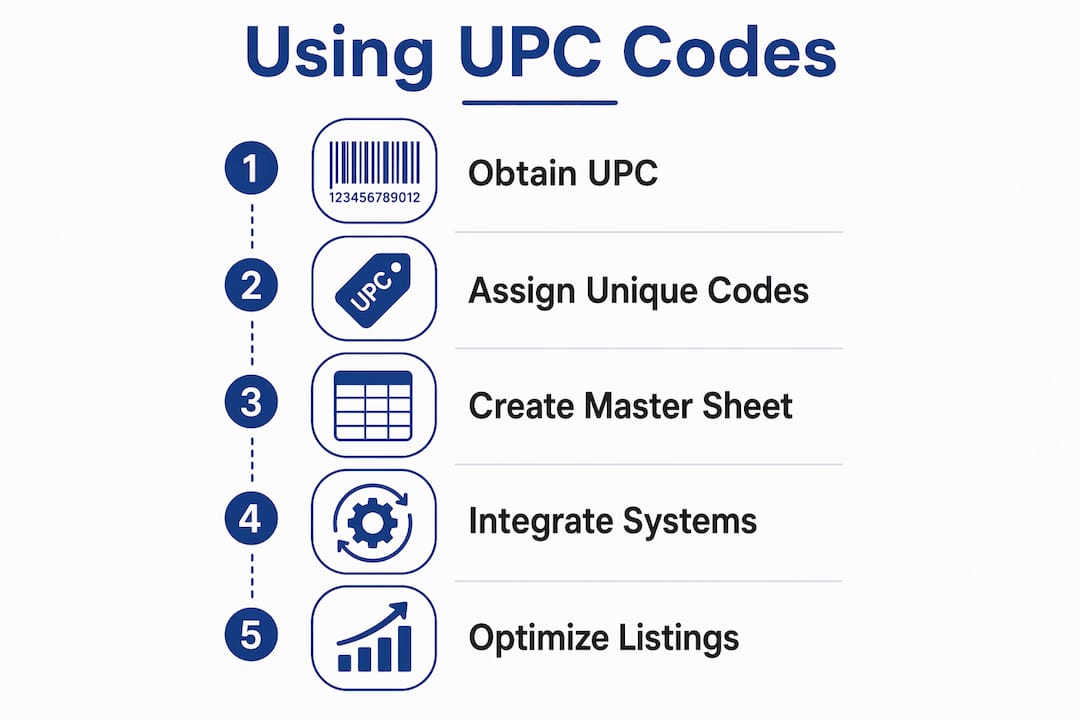
Obtaining a UPC is step one. Integrating it correctly across your operations is where the real work begins. Done right, your UPC becomes the single source of truth for every product in your catalog.
Start by assigning a unique UPC to every product variation. Each variation of size, color, or packaging requires its own code. A red T-shirt in size small and the same shirt in size medium are two different products. They need two different UPCs. This is one of the most common mistakes new sellers make when setting up their Amazon product listings.
Once your codes are assigned, build a master spreadsheet. Map each UPC to its SKU, product name, dimensions, weight, and packaging type. This spreadsheet becomes your onboarding document for every warehouse, marketplace, and retail partner you work with.
Here is a sample structure for your master product data file:
| Field | Example Value |
|---|---|
| UPC | 012345678901 |
| Internal SKU | TSHIRT-RED-SM |
| Product Name | Classic Red T-Shirt, Small |
| Dimensions (inches) | 10 x 8 x 1 |
| Weight (oz) | 6 |
| Packaging Type | Polybag |
After building your master file, push the data into your systems:
- ERP and WMS platforms like NetSuite, SAP, or ShipBob need the UPC to track receiving, picking, and shipping accurately.
- E-commerce platforms like Shopify, WooCommerce, and Amazon Seller Central use the UPC to match your product to the correct catalog entry.
- Staff training matters too. Your receiving team needs to scan UPCs at intake. Your picking team needs to verify UPCs before shipping. One wrong scan creates a chain of inventory errors.
Optimizing your Amazon inventory listings with accurate UPC data directly reduces fulfillment errors and improves your seller metrics.
UPC vs. QR code vs. EAN: which one do you need?
Sellers often confuse UPC codes with other identifiers. Each system serves a different purpose, and using the wrong one costs you time.
| Identifier | Digits | Primary Use | Standardized By |
|---|---|---|---|
| UPC-A | 12 | North American retail | GS1 |
| EAN-13 | 13 | International retail | GS1 |
| QR Code | Variable | Marketing, URLs, payments | ISO |
| Internal SKU | Variable | Internal inventory only | Retailer or brand |
UPC codes are a subset of the GTIN family, designed specifically for North American retail. EAN codes are the international equivalent. Most global retailers and marketplaces accept both, but you should confirm requirements with each partner before printing packaging.
QR codes are a completely different technology. A QR code stores data directly in the symbol and can link to a website, video, or payment page. A UPC code stores only a number and relies on an external database to return product information. QR codes are useful for marketing and consumer engagement. They do not replace UPCs for retail compliance or inventory tracking.
Internal SKUs are codes you create yourself for your own warehouse system. They are not standardized, not recognized by external partners, and cannot substitute for a UPC on a retail listing. Think of your SKU as your private nickname for a product and your UPC as its legal name.
Key takeaways
A UPC code is the universal product identifier that connects your physical product to every retail, warehouse, and marketplace system that handles it.
| Point | Details |
|---|---|
| UPC structure | A 12-digit code built from a GS1 prefix, item reference, and check digit. |
| Always buy from GS1 | Third-party resellers cause listing suppression; GS1 US guarantees legal ownership. |
| Every variation needs its own code | Size, color, and packaging differences each require a unique UPC. |
| Build a master data file | Map UPCs to SKUs, dimensions, and packaging before onboarding any partner. |
| UPC vs. QR code | UPCs are for retail compliance; QR codes are for marketing and consumer engagement. |
What i’ve learned from watching sellers get this wrong
I have seen the same mistake play out dozens of times. A seller launches on Amazon, buys 50 UPC codes from a reseller for $10, uploads their listings, and everything looks fine. Then, three months later, Amazon suppresses the listings because the GS1 company prefix on those codes belongs to a defunct electronics company from 2003. The seller has to re-register with GS1, get new codes, update every listing, and reship inventory with corrected labels. The cost in time and lost sales is always far greater than the $30 they saved.
The other pattern I see is sellers who assign one UPC to an entire product family. They list a blue widget and a red widget under the same code because “it’s basically the same product.” That works until a retailer’s system flags a data mismatch, or a customer receives the wrong color because the warehouse picked by UPC rather than by visual inspection.
My honest advice: treat your UPC setup like your business registration. Do it once, do it correctly, and document everything. The GS1 GEPIR database is free to use for verification. There is no excuse for skipping it. And before you print a single label, scan the barcode with a real scanner. Not a phone app. A proper handheld scanner or barcode verifier. Print quality failures are invisible to the eye and catastrophic at the receiving dock.
UPCs are not glamorous. They are not the part of selling that anyone gets excited about. But they are the foundation that every other system sits on. Get them right early, and scaling your catalog from 10 products to 500 becomes a process instead of a crisis.
— Goga
Ready to turn your UPC data into amazon sales?
Getting your UPC codes right is the first step. Turning that product data into a high-converting Amazon listing is where Searchoneers comes in.

Searchoneers specializes in Amazon listing optimization, using your product identifiers, attributes, and catalog data to build listings that rank and convert. From enhanced titles and bullet points to backend keyword strategy, every element is built around your actual product data, including your UPC structure. If you are ready to stop guessing and start selling, the Amazon listing enhancement guide from Searchoneers is the place to start. You can also follow the listing optimization workflow to make sure every product in your catalog is set up for maximum visibility from day one.
FAQ
What does UPC stand for?
UPC stands for Universal Product Code. It is a standardized 12-digit barcode system managed by GS1 and used to identify retail products globally.
Where do you find the UPC code on a product?
The UPC code is printed on the product’s packaging, typically on the back or bottom, displayed as a barcode with 12 digits printed beneath it.
What is the difference between a UPC and a GTIN?
GTIN (Global Trade Item Number) is the broader identifier family. A UPC is a specific 12-digit GTIN format used primarily in North America, while EAN is a 13-digit GTIN used internationally.
Can you reuse a UPC code for a different product?
No. Each UPC must be permanently assigned to one specific product. Reusing a code causes data conflicts across retail systems, inventory platforms, and marketplace catalogs.
Do you need a UPC code to sell on amazon?
Yes. Amazon requires a valid GS1-registered UPC to create most product listings. Codes purchased from third-party resellers can trigger listing suppression due to GS1 prefix mismatches.