TL;DR:
- External local SEO significantly increases Amazon sales by targeting “near me” searches through platforms like Google Business Profile. Building a verified GBP, optimizing product listings, and defining service areas create valuable traffic sources outside Amazon, strengthening long-term brand stability. Combining internal Amazon SEO with external local strategies yields measurable growth, higher rankings, and greater customer engagement.
Most Amazon sellers assume that winning on Amazon means focusing entirely on Amazon. Optimize your title, nail your bullet points, load up your back-end keywords, and you’re done. That thinking is costing you real sales. Local SEO for Amazon sellers actually lives outside Amazon entirely, working through external platforms like Google Business Profile and local citations to funnel ready-to-buy shoppers directly to your product pages. The sellers who understand this distinction are quietly capturing traffic that everyone else is leaving on the table.
Table of Contents
- Why local SEO matters for Amazon sellers
- Key tactics: Google Business Profile and local listings
- Service-area businesses: Local SEO for Amazon FBA sellers
- Local SEO outcomes: Case studies and proven metrics
- What seasoned sellers know: Hidden advantages of external local SEO
- Ready to scale your Amazon sales with expert local SEO?
- Frequently asked questions
Key Takeaways
| Point | Details |
|---|---|
| Local SEO drives external traffic | Optimizing Google Business Profile and local listings increases Amazon product visibility by targeting location-based shoppers. |
| Amazon SEO differs from local SEO | Amazon’s search algorithm rewards conversions and keywords, while external local SEO leverages platforms like Maps and GBP. |
| Tactics vary by business type | Amazon FBA sellers can use service-area GBP setups even without a physical store for local search ranking. |
| Measurable results from local SEO | Case studies document 31-87% growth in clicks and impressions for Amazon e-commerce brands using local optimization. |
| Avoid common pitfalls | Steer clear of fake reviews and PO boxes to protect your Google Business Profile and maximize local visibility. |
Why local SEO matters for Amazon sellers
Let’s clear up the biggest misconception first. Local SEO for Amazon is not something you do inside Seller Central. Amazon’s internal algorithm, known as the A9/A10 system, runs on keywords, conversion rates, and sales velocity. Location is not a ranking factor inside Amazon’s search results. The platform operates globally, and its engine rewards listings that convert buyers fast, not listings tied to a specific zip code.
So where does local SEO fit? It fits outside. No direct local SEO exists within Amazon itself; instead, local tactics like Google Business Profile optimization, citation building, and “near me” targeting are applied externally to direct traffic toward your Amazon URLs. Think of it like this: Amazon is the store, and local SEO is the road sign that gets people off the highway and through your door.
“Local SEO isn’t about changing what Amazon sees. It’s about changing who Google sends to Amazon on your behalf.”
This matters because Google processes billions of searches each day, and a significant portion of those carry local intent. Searches like “buy protein powder near me” or “where to get dog toys delivered today” represent buyers with purchasing urgency. If your brand shows up in those results and links directly to your Amazon listing, you win the sale before competitors even know the shopper exists.
Here is why this channel is worth your attention:
- Google’s local pack appears for millions of product-related “near me” searches every month
- Shoppers in the local pack convert at higher rates because their intent is immediate
- External traffic to Amazon listings signals strong demand, which can boost organic rankings for ecommerce on Amazon itself
- Building a local presence builds brand trust beyond the Amazon ecosystem
Understanding Amazon SEO step by step helps you master the internal side, but layering local SEO on top creates a traffic advantage your competitors are almost certainly missing. Combine both, and you’re operating on a different level entirely. For a broader view, check the SEO best practices for ecommerce that reinforce these combined strategies.
Key tactics: Google Business Profile and local listings
Google Business Profile (GBP) is your primary weapon for local SEO as an Amazon seller. Done right, it puts your brand and products directly in front of shoppers searching with local intent, even if you don’t have a physical storefront.
Key mechanics include consistent NAP (Name, Address, Phone), GBP product listings with accurate titles, prices, and clear calls to action (CTAs), and structured data for local inventory visibility. Each of these elements signals to Google that your business is legitimate, relevant, and worth showing in local results.
Amazon sellers can use the GBP Products feature to showcase specific items directly in Google Maps and “near me” searches, with links pointing to Amazon listings for buyers who want delivery or pickup. This is a direct pipeline between Google’s local ecosystem and your Amazon product page.
Here’s how to set this up properly:
- Claim and verify your Google Business Profile. Use your actual business name, a real address or defined service area, and a phone number you actively monitor. Consistency across every directory matters.
- Complete every GBP section. Add business categories, hours, a compelling business description with relevant keywords, and high-quality product images that match your Amazon listings.
- Use the Products tab on GBP. Add your top Amazon products with accurate titles, prices, and a CTA button that links directly to your Amazon product page URL. This drives trackable traffic with strong purchase intent.
- Build citation consistency across directories. Your NAP information must match exactly on GBP, Yelp, Bing Places, and any other local directory. Inconsistency confuses search engines and weakens your local rankings.
- Gather authentic reviews. Ask satisfied buyers to leave Google reviews. Genuine, positive reviews build credibility and improve your placement in local search results. Start with a detailed ecommerce keyword research approach to choose product titles that align with what local shoppers actually search.
| GBP Element | Why it matters | Action required |
|---|---|---|
| NAP consistency | Builds trust with Google | Match across all directories |
| Products tab | Direct links to Amazon listings | Add top products with prices |
| Business description | Keyword relevance for local search | Use product-specific terms |
| Reviews | Boosts local pack placement | Request from happy customers |
| Photos | Increases click-through rate | Upload professional product images |
Pro Tip: When writing your GBP product titles, use the same keyword-rich language from your Amazon listing titles. This creates consistency that helps Google connect your GBP presence with your Amazon brand and strengthens your overall relevance for product searches.
When you’re optimizing for Amazon search, those same keywords translate well into GBP optimization. Use the SEO checklist for Amazon listings to cross-reference keywords that work inside Amazon with the terms you’re targeting externally.
Service-area businesses: Local SEO for Amazon FBA sellers
Here’s where many FBA sellers get stuck. You don’t have a physical store. Your inventory lives in Amazon’s fulfillment centers. How can you possibly use local SEO?
The answer is the service-area business configuration in Google Business Profile. For Amazon FBA sellers without physical stores, setting up GBP as a service-area business and defining your delivery zones lets you rank in local results without needing a storefront address. You simply tell Google which geographic areas you serve and your profile becomes eligible for local pack visibility within those zones.
Online-only Amazon sellers can rank in Google Maps through this service-area setup combined with product feeds. The critical rules to follow: never use a PO box as your business address, and never solicit fake reviews. Both actions violate Google’s guidelines and can result in your GBP listing being suspended, which wipes out all the visibility you’ve worked to build.
Common mistakes FBA sellers make when setting up local SEO:
- Using a personal home address without hiding it (service-area businesses should hide the physical address)
- Defining a service area that’s too broad to be relevant for local searches
- Leaving the Products tab empty after creating the GBP profile
- Ignoring citation building because “it’s not Amazon”
- Setting up GBP once and never updating it with new products or seasonal promotions
| Setup type | Physical store required | Address displayed | Service area defined |
|---|---|---|---|
| Traditional local business | Yes | Yes | Optional |
| Service-area business (FBA) | No | Hidden | Yes, required |
| Hybrid (warehouse + online) | Yes | Optional | Yes |
The multichannel SEO strategies available to FBA sellers are more powerful than most realize. When you combine a correctly configured GBP with product feeds and strong citation signals, you’re essentially running a parallel traffic channel that feeds Amazon sales without touching your internal Amazon ranking mechanics. That’s leverage. For a deeper look at applying this effectively, explore advanced Amazon SEO tactics that layer external signals on top of strong internal listing optimization.
Local SEO outcomes: Case studies and proven metrics
Numbers make the argument better than anything else. Let’s talk results.
Local ecommerce SEO delivered 31% more clicks, 137% more impressions, and 42% more organic keywords in just five months for a brand generating $350,000 per month in revenue. That’s not a small brand testing a side project. That’s a high-volume seller using local SEO as a serious growth lever.
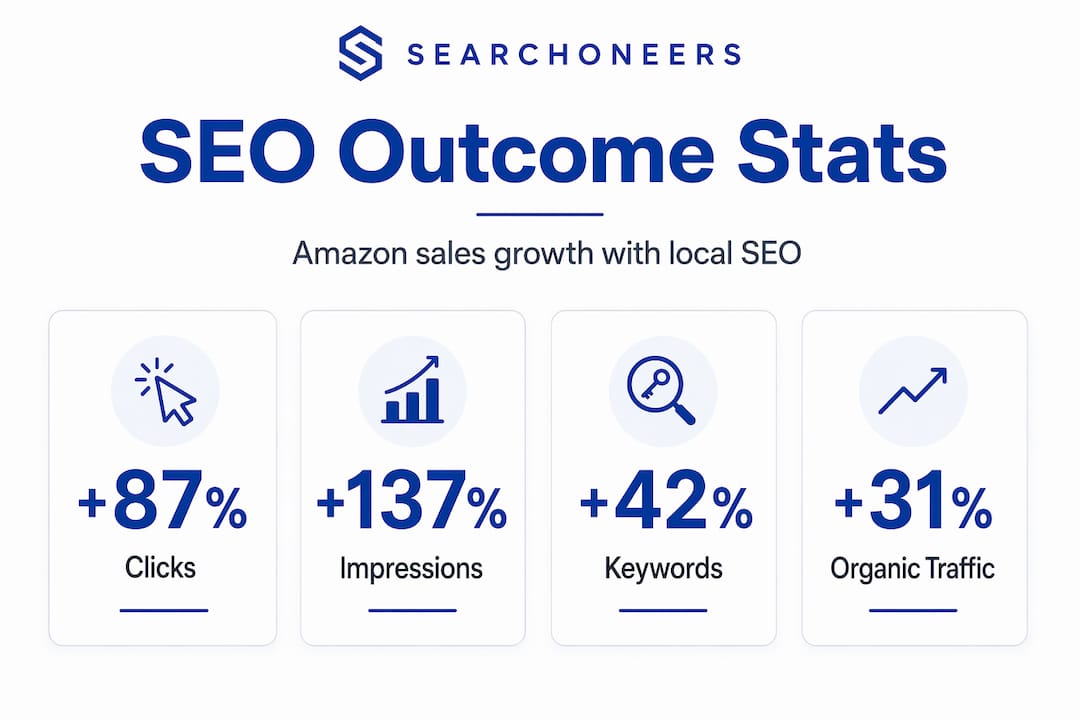
The Amazon agency case study results are even more striking: local SEO drove an 87% increase in clicks, jumping from 17,400 to 32,600 monthly clicks, plus an 89.6% increase in impressions, with rankings reaching the top 3 positions in both national and local city searches.
| Metric | Before local SEO | After local SEO | Change |
|---|---|---|---|
| Monthly clicks | 17,400 | 32,600 | +87% |
| Impressions | Baseline | Measured lift | +89.6% |
| Organic keywords | Baseline | Measured lift | +42% |
| Clicks (5-month case) | Baseline | Measured lift | +31% |
These aren’t vanity metrics. More clicks mean more product page visits. More impressions mean more brand awareness. Both feed into Amazon’s traffic signals, which in turn support stronger organic rankings inside Amazon’s own algorithm.
Integrating GBP with Google Merchant Center for Surfaces Across Google coverage is a critical advanced step. This combination lets your products appear across Google Search, Maps, Shopping, and Images simultaneously, multiplying visibility touch points without multiplying your workload. Geo-relevance signals need to come from quality content and citation depth, not from creating thin location pages that add no real value for the shopper.
Pro Tip: Connect your Google Business Profile to Google Merchant Center by linking them through your Google account. This unlocks “See what’s in store” features and local inventory ads, which push product visibility even further for buyers searching in your service zones.
Use data-driven Amazon listing optimization to track which external traffic sources drive the strongest conversion rates, then double down on those channels. The Amazon listing optimization workflow helps structure these efforts so nothing gets missed, and pairing it with best SEO tools for ecommerce gives you the data layer to measure exactly where your gains are coming from.
What seasoned sellers know: Hidden advantages of external local SEO
Here’s the honest take most guides skip. Sellers who rely solely on Amazon’s internal SEO are building on rented land. Amazon’s A10 algorithm changes without notice. Keyword rankings shift. Competitors undercut prices. But when you build a presence on Google through local SEO, you’re creating an asset that you own and control.
Pure Amazon SEO prioritizes conversion rates and sales velocity above everything else. Location is irrelevant to Amazon’s internal ranking engine. That’s actually an opportunity, not a limitation. It means that while your competitors are fighting each other inside Amazon, you can be capturing buyers from Google’s local results before they even open the Amazon app.
The sellers who win long-term understand something deeper. Local SEO builds brand recognition outside Amazon. A shopper who discovers your brand through a Google Maps result and clicks through to your Amazon listing is more likely to search directly for your brand next time. That repeat buyer behavior is invisible gold for your long-term revenue, and it compounds over time.
Blending local and Amazon SEO also creates brand stability. If Amazon ever restricts your account, suspends a listing, or changes its algorithm, you still have external traffic flowing. That’s not paranoia. That’s smart business architecture. Most sellers ignore this advantage until they desperately need it.
The path forward is clear: master your internal Amazon SEO with advanced SEO for Amazon sellers strategies, and build a parallel local SEO engine on Google. Both systems feed each other. External traffic to Amazon strengthens your sales velocity signals. Higher rankings inside Amazon bring more organic buyers. It’s a flywheel, and local SEO is the push that gets it spinning.
Ready to scale your Amazon sales with expert local SEO?
Knowing the strategy is one thing. Executing it at a level that actually moves the needle is another. Building a GBP that drives real traffic to Amazon, creating a citation network that holds, and layering that on top of a fully optimized listing takes time, expertise, and consistency.

That’s exactly where we come in. At Searchoneers, we specialize in optimizing Amazon inventory and listings from the inside out, and now you can pair that with external local SEO to capture every possible traffic source. Start with our Amazon listing checklist to tighten your on-platform foundation, then use our full Amazon SEO guide to build the complete strategy. Your competitors are not doing this yet. Now’s your time to move.
Frequently asked questions
Can Amazon sellers rank in local search results without a brick-and-mortar store?
Yes. Amazon FBA sellers can set up GBP as a service-area business and define delivery zones to appear in Maps and “near me” searches without a physical storefront.
How does Google Business Profile help Amazon listings get more traffic?
GBP’s Products feature lets sellers link directly to Amazon listings in local Maps and “near me” results, driving high-intent clicks from shoppers ready to buy.
What is the difference between Amazon internal SEO and local SEO?
Amazon’s internal SEO uses the A9/A10 algorithm, rewarding keywords and conversion performance, while local SEO uses external platforms like GBP to capture location-based search traffic and send it to your listings.
Are there risks in misconfiguring local SEO for Amazon businesses?
Yes. Using PO boxes or soliciting fake reviews violates Google’s policies and can result in GBP listing suspension, eliminating all your local visibility.
What ROI can Amazon sellers expect from investing in local SEO?
Case studies show local SEO driving 87% more clicks and nearly 90% more impressions within months, with additional data showing a 31% click increase and 137% impression lift for high-revenue brands.