TL;DR:
- Amazon enforces strict, automated photography requirements, including pure white backgrounds, minimum resolution, and product fill ratio, to maintain listing quality and visibility. A comprehensive image package with main images, angles, lifestyle shots, and infographics enhances sales and conversion rates beyond mere compliance. Carefully select and collaborate with professional studios that guarantee technical standards, provide relevant image types, and understand category-specific rules to optimize listing performance.
Your Amazon listing has roughly two seconds to grab a shopper’s attention before they scroll past. Most sellers know images matter, but fewer realize that pure white background requirements, minimum pixel counts, and exact product framing rules are enforced automatically, and violations can suppress your listing entirely. This guide breaks down everything you need to know about amazon photography services, from technical compliance to choosing the right studio, so your products look great and stay live.
Table of Contents
- Understanding Amazon’s strict photography requirements
- Types of Amazon photography services and what they include
- Key considerations when choosing an Amazon photography service
- Common pitfalls and expert tips for Amazon product photography
- How to work with a professional Amazon photography studio
- Why savvy Amazon sellers focus on photography quality beyond just compliance
- Enhance your Amazon listings with expert photography & optimization
- Frequently asked questions
Key Takeaways
| Point | Details |
|---|---|
| Strict image compliance | Amazon requires pure white backgrounds, minimum resolution, and no text on main images to prevent listing suppression. |
| Multiple image types | Use main product shots, lifestyle images, and infographics to create complete, converting Amazon listings. |
| Choose suitable services | Evaluate photography services based on compliance expertise, turnaround time, cost, and included assets. |
| Avoid common pitfalls | Off-white backgrounds, watermarks, and low resolution cause listing issues and lost sales. |
| Professional quality matters | High-quality, compliant images boost conversions, reduce returns, and strengthen brand trust. |
Understanding Amazon’s strict photography requirements
Amazon’s image rules are not suggestions. They are enforced by automated systems that scan every listing, and a single violation can pull your product from search results without warning. If your listing suddenly stops generating traffic, non-compliant images are often the first place to investigate.
Here is what Amazon mandates for every main product image:
- Pure white background with exact RGB 255,255,255 values; off-white shades like RGB 250,250,250 will fail the scan
- Minimum 1000 pixels on the longest side, with 2000+ pixels strongly recommended to activate the zoom function that shoppers rely on
- Product fills at least 85% of the frame, ensuring buyers can actually see what they are purchasing
- JPEG format using the sRGB color profile for consistent rendering across devices
- No text, logos, watermarks, or props that are not sold with the product
That zoom feature is worth calling out specifically. When a shopper hovers over your image and nothing happens, it signals low quality instantly. Going above 1000px resolution ensures zoom activates, which builds buyer confidence and reduces bounce rates.
Pro Tip: Ask your photographer to deliver a color profile certificate or confirmation that all files are saved in sRGB. Some studios default to Adobe RGB, which can cause color shifts when Amazon renders the image.
When you are optimizing Amazon images, compliance is the floor, not the ceiling. Use the Amazon listing checklist to verify every image slot before uploading a new batch.
Types of Amazon photography services and what they include
Now that you know Amazon’s requirements, let’s explore the actual types of photography services available and what you can expect from each.
Professional amazon product photography is not a single deliverable. It is a package of image types, each serving a distinct purpose in your listing. Professional Amazon photography covers the full spectrum from compliance-ready main images to conversion-driving secondary shots.
Here is what a complete image package typically includes:
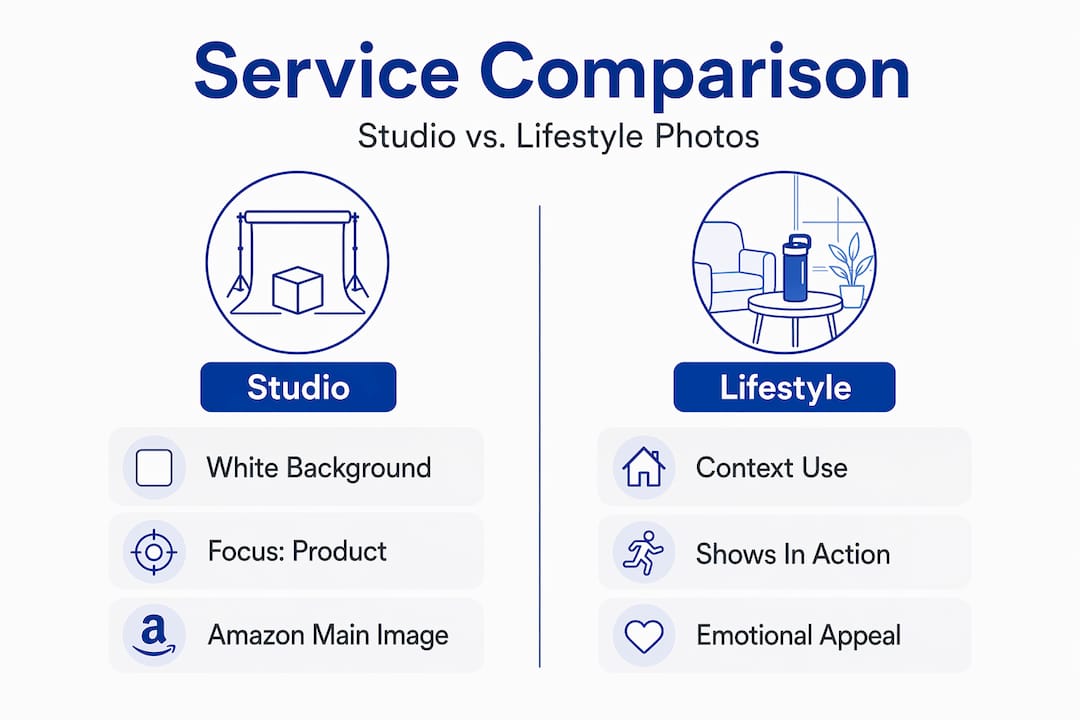
- Main white-background image: Strict compliance shot with product centered on pure white. This is your make-or-break first impression.
- Multi-angle shots: Show the product from top, side, back, and detail angles. Buyers cannot touch the product, so more angles reduce hesitation.
- Lifestyle images: Product shown in a real-world context, for example, a kitchen gadget being used by someone cooking. These build emotional connection.
- Infographic images: Feature callouts, dimensions, and specifications overlaid on product photos. These answer buyer questions before they even scroll to the bullets.
- 360-degree photos and video: Interactive assets that let shoppers rotate and inspect the product. Available in the A+ content section and increasingly valued in competitive categories.
| Image type | Primary purpose | Allowed as main image? |
|---|---|---|
| White background | Compliance and clarity | Yes |
| Multi-angle shots | Reduce buyer uncertainty | No |
| Lifestyle images | Emotional connection | No |
| Infographics | Feature communication | No |
| 360° / video | Interactive engagement | No |
Using a mix of these listing image types transforms a flat, basic listing into something that actually sells. Sellers who build high-converting listing images around a visual story consistently outperform those who upload a single white-background shot and call it done.
Pro Tip: Use your infographic slot to address the single most common question in your product’s one-star reviews. If buyers complain about size confusion, make the dimensions impossible to miss visually.
A professional photography service will typically offer bundled packages that include several of these image types at a fixed price per product. Always confirm what is included before booking.
Key considerations when choosing an Amazon photography service
Understanding the service options, now learn how to pick the one that fits your product catalog, budget, and timeline best.
Not every studio is the same. Some specialize in electronics with complex setups; others focus on apparel or food. Choosing the wrong one wastes time, money, and inventory. Here is how to evaluate your options:
Verify Amazon compliance guarantees. Ask directly whether the studio guarantees pure white backgrounds at RGB 255,255,255. Some photographers produce “near white” backgrounds that require you to pay extra for digital correction later.
Check turnaround times against your launch schedule. Standard 48-hour delivery works well for most product types, but complex orders can take 3 to 5 business days. If you are running a time-sensitive launch or a Prime Day restock, confirm rush availability upfront.
Understand the pricing structure. Professional product photography ranges from $50 to $500+ per product depending on complexity. Studios that charge per image tend to cost more for full packages, while per-product pricing is often more predictable.
Confirm the full deliverable package. Does the price include lifestyle images and infographics, or just a white-background shot? A service that only delivers one image type is rarely worth the cost for competitive categories.
Ask about revisions. Reputable studios offer at least one round of free edits. If a studio does not mention revisions at all, that is a red flag.
Pro Tip: Request sample images from the studio that were shot for products in your category specifically. A studio that excels at jewelry may struggle with large outdoor equipment. Category experience matters more than a generic portfolio.
When choosing photography services, also factor in Amazon compliance tips to make sure the images you receive match not just technical specs but also category-specific rules for your niche.
Common pitfalls and expert tips for Amazon product photography
To wrap up your service selection, let’s review common errors and practical tips for ensuring your images comply and convert well.
These mistakes show up constantly, even among experienced sellers working with paid studios:
- Off-white backgrounds that look white to the human eye but fail Amazon’s automated scan. RGB 250,250,250 looks nearly identical on screen but is enough to trigger suppression.
- Watermarks on the main image are an automatic violation. Even subtle branding elements in the corner of your main shot can get a listing pulled.
- Low-resolution files that prevent zoom from activating. If your studio delivers images under 1000 pixels, request a reshoot immediately.
- Showing excluded accessories. If the charging cable is not included with the product, it cannot appear in the main image. This violates Amazon’s “product only” rule.
- Wrong color profile. Files saved in Adobe RGB instead of sRGB often render differently on Amazon, causing color shifts that make products look inaccurate.
“Listings are frequently suppressed due to non-pure-white backgrounds, watermarks on main images, or insufficient resolution preventing the zoom feature from activating.”
The fix for most of these issues starts before you hire anyone. Define your requirements clearly in writing, confirm file specs in advance, and review every image against a quality checklist before uploading.
Reviewing image optimization mistakes before your next shoot can save hours of back-and-forth with a studio. The common photo pitfall guide is also a practical reference to keep open while reviewing delivered files.
How to work with a professional Amazon photography studio
Now that you feel confident selecting a service, learn how to collaborate with a professional studio to get the best results.
The process is more straightforward than most sellers expect. Here is a step-by-step breakdown:
Prepare and package your products. Most studios accept shipped inventory and many provide prepaid shipping labels. Wrap products securely to prevent damage in transit.
Book a consultation. Discuss your compliance requirements, branding goals, and which image types you need. This is the moment to share your competitor benchmarks and any specific angles that matter for your product.
Confirm the shot list in writing. Document every required image type, quantity, and spec before the shoot begins. Verbal agreements get lost.
The studio shoots and retouches. Most studios deliver standard orders within 48 hours. Complex multi-product shoots may take longer, so confirm the timeline at booking.
Review delivered images thoroughly. Check backgrounds against RGB 255,255,255, verify resolution, confirm correct color profile, and review each shot for accuracy and visual quality.
Request edits if needed. A professional studio will accommodate reasonable revision requests. Document what needs fixing clearly with annotated screenshots if possible.
Upload and update your listing. Once images are approved, replace your existing photos and monitor CTR (click-through rate) and CVR (conversion rate) over the following 2 to 4 weeks to measure impact.
Following this listing enhancement process from start to finish gives you the best shot at images that are both compliant and genuinely compelling.
Why savvy Amazon sellers focus on photography quality beyond just compliance
Here is the uncomfortable truth: compliance gets you in the game. It does not win it.
Amazon’s rules set the baseline. Every serious competitor in your category is already meeting them. The sellers who actually grow their market share invest in imagery that does a job beyond passing automated checks. They treat every image slot as sales real estate.
High-quality, compliant images convert at 2 to 3x the rate of mediocre visuals. Sellers who fill all image slots with diverse, complementary shots consistently drive stronger buyer confidence. That is not just a photography win; it is a ranking win. Amazon’s A10 algorithm rewards listings with strong CVR, meaning better images feed better organic rankings over time.
There is also a return rate angle that most sellers underestimate. Accurate, detailed photography sets realistic expectations. When buyers receive exactly what they saw in the images, return rates drop. Returns hurt your seller metrics and your profitability simultaneously.
One more thing worth saying: over-styled or heavily edited images can backfire. If your product looks dramatically different in real life, buyers feel deceived. Authenticity in photography is not just an aesthetic choice; it is a trust decision. The best ecommerce photography solutions balance polish with accuracy.
Every image slot you leave empty is a question your buyer walks away with unanswered. Fill them with purpose.
Enhance your Amazon listings with expert photography & optimization
Great photography is only half the equation. The other half is making sure your listing copy, keywords, and structure work together to convert that visual interest into actual sales.

At Searchoneers, we combine proven Amazon listing enhancement strategies with a deep understanding of what makes images and copy work together. Whether you need help structuring a full multi-image package, aligning your visuals with backend keywords, or rebuilding a suppressed listing from scratch, our listing optimization workflow covers every step. We also bring Amazon SEO fundamentals into every project so your images and text reinforce each other for maximum visibility and sales performance.
Frequently asked questions
What are the Amazon requirements for main product images?
Main images must have a pure white background (RGB 255,255,255), be at least 1000 pixels on the longest side, show the product filling at least 85% of the frame, and be saved as a JPEG file with no text, watermarks, or logos.
How many images should I upload for an Amazon listing?
Amazon allows up to 9 images per listing, and sellers filling every slot consistently outperform those with fewer images; aim for 7 to 8 images including main, angles, lifestyle, and infographic shots.
How long does it take to get professional Amazon product photos?
Most professional studios deliver optimized images within 48 hours for standard product orders, while larger or more complex projects typically take 3 to 5 business days.
Can I use lifestyle images as my main Amazon product image?
No. Amazon-compliant main images must show the product only on a pure white background; lifestyle shots are permitted exclusively in secondary image slots.
Are AI-generated images allowed for Amazon product listings?
Yes. Amazon allows AI-generated images as long as they accurately represent the product and meet all standard compliance requirements, including pure white backgrounds and correct product depiction.